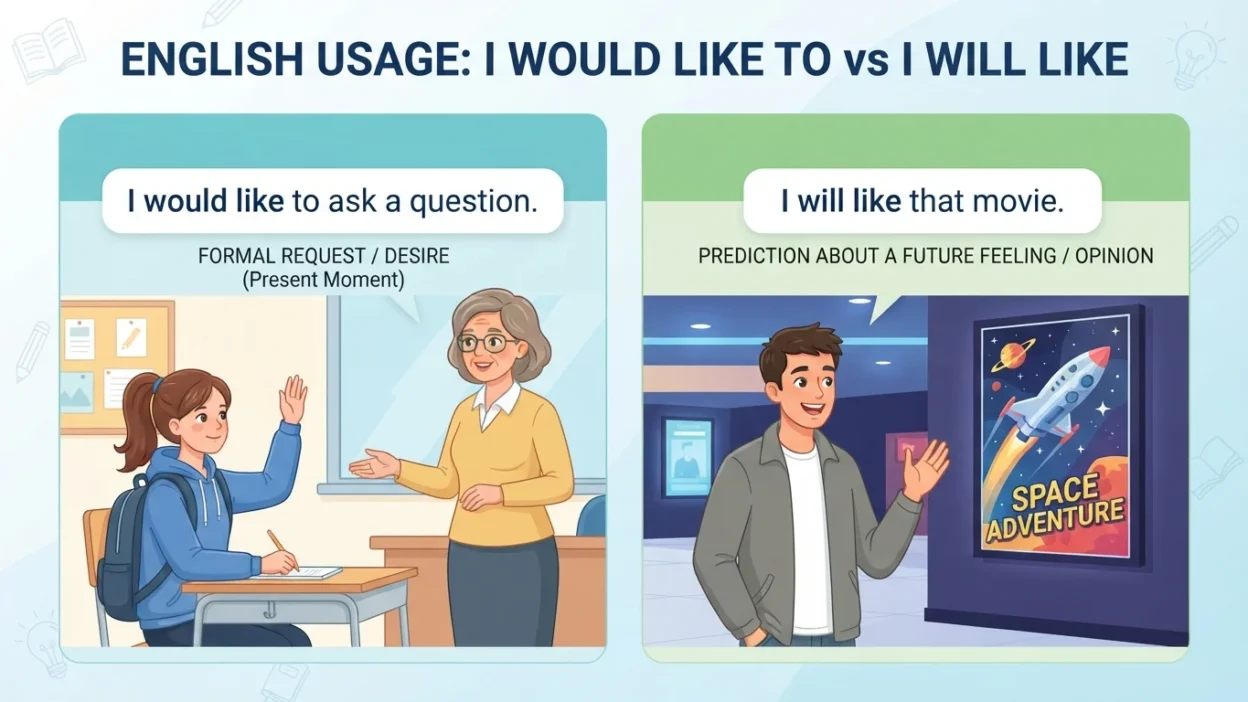
“I would like to” and “I will like to” are both grammatically possible, but they do not normally mean the same thing. Use “I would like to” to express a present or future wish, desire, request, or preference in a polite way: “I would like to speak with the manager.” Use “I will like to” when you are talking about something you expect to like in the future, although this form is much less common in everyday English.
For most situations where you want to say “I want to” politely, “I would like to” is the natural choice. For example, at a restaurant, you would say “I would like to order a coffee,” not “I will like to order a coffee.”
The key difference is that would like expresses a desire or polite intention, while will like describes a future feeling or reaction. Understanding this distinction will help you sound more natural and confident in everyday English.
Quick Answer
Use “I would like to” when you want to express a wish, preference, intention, or polite request: “I would like to ask a question.” Use “I will like” when you mean that you expect to enjoy or approve of something in the future: “I think I will like this book.” For polite requests, use would like.
Why Do People Confuse “I Would Like To” and “I Will Like To”?
The confusion comes from the fact that would and will are both modal verbs associated with the future.
However, they perform different functions here.
Compare:
I would like to speak with you.
This means:
I want to speak with you.
It is polite and natural.
Now compare:
I will like the new restaurant.
This means:
I expect that I will enjoy the new restaurant.
The second sentence is about a future feeling, not a polite request.
There is also an important grammar point: “I will like to” is possible in some contexts, but it is generally not the normal way to make a polite request.
First Expression: “I Would Like To”
“I would like to” is a polite way to express what you want or wish to do.
It is similar to:
I want to…
but sounds more polite and less direct.
For example:
I would like to speak with the manager.
This means:
I want to speak with the manager.
But it sounds more courteous.
Common Uses of “I Would Like To”
You can use it to:
- make a polite request
- express a desire
- state a preference
- express an intention
- say what you want to do
Examples:
I would like to order dinner.
I would like to ask a question.
I would like to visit Japan.
I would like to learn Spanish.
I would like to apply for the position.
Second Expression: “I Will Like To”
“I will like” normally means that you expect to enjoy, appreciate, or approve of something in the future.
For example:
I think I will like this movie.
This means:
I think I will enjoy this movie.
Here, like is an ordinary verb meaning “enjoy.”
Notice that the natural structure is usually:
I will like + noun
or:
I will like + something
For example:
I will like the new house.
I think I will like your idea.
I’m sure you will like this restaurant.
The expression “I will like to” is much less common when expressing a desire.
“I Would Like To” vs “I Will Like To”
| Expression | Main Meaning | Natural Use | Example |
|---|---|---|---|
| I would like to | I want to / I wish to | Polite request or desire | I would like to speak with you. |
| I will like | I will probably enjoy | Future feeling | I think I will like this book. |
| I will like to | Future desire in limited contexts | Less common | I will like to think about it. |
| I would like | Polite preference or desire | Very common | I would like some coffee. |
The most important distinction is:
would like = want
will like = will enjoy
When Should You Use “I Would Like To”?
Use “I would like to” when you want to say what you want to do politely.
Making a request
I would like to speak with the manager.
Asking for something
I would like to have a glass of water.
Expressing a desire
I would like to travel around Europe.
Expressing an intention
I would like to start my own business.
In professional situations
I would like to discuss this matter with you.
This structure is especially useful in polite conversations, customer service, emails, interviews, and professional communication.
When Should You Use “I Will Like”?
Use “I will like” when you are talking about a future reaction, opinion, or feeling.
For example:
I think I will like this restaurant.
You are predicting that you will enjoy the restaurant.
Other examples:
I think I will like this book.
I’m sure I will like your new house.
I believe I will like the new teacher.
I know I will like this movie.
Here, like means enjoy or have a positive opinion of.
15 Examples of “I Would Like To”
- I would like to ask a question.
- I would like to speak with the manager.
- I would like to order some coffee.
- I would like to visit Italy.
- I would like to learn French.
- I would like to apply for this job.
- I would like to make an appointment.
- I would like to thank you for your help.
- I would like to discuss this issue.
- I would like to reserve a table.
- I would like to know more about the program.
- I would like to make a suggestion.
- I would like to improve my English.
- I would like to meet your team.
- I would like to buy this book.
15 Examples of “I Will Like”
- I think I will like this movie.
- I’m sure I will like your new house.
- I believe I will like the new restaurant.
- I think I will like this book.
- I’m sure I will like the new job.
- I think I will like living in the city.
- I believe I will like your idea.
- I know I will like the food.
- I’m sure I will like your friends.
- I think I will like this neighborhood.
- I believe I will like my new teacher.
- I’m confident I will like the course.
- I think I will like working with your team.
- I suspect I will like the new design.
- I’m sure I will like the experience.
“I Would Like To” vs “I Want To”
These expressions are closely related.
I want to speak with you.
I would like to speak with you.
Both express a desire, but would like to is more polite and softer.
Compare:
I want a cup of coffee.
This is direct.
I would like a cup of coffee.
This is more polite.
For customer service, formal conversations, and polite requests, would like is often the better choice.
“I Would Like To” vs “I Will”
Do not automatically replace would with will.
I would like to ask a question. ✅
This is a polite request.
I will ask a question. ✅
This means you intend or promise to ask a question.
But:
I will like to ask a question. ⚠️
This is generally unnatural if you mean “I want to ask a question.”
The natural sentence is:
I would like to ask a question.
Can “I Will Like To” Ever Be Correct?
Yes, but it is much less common and often has a special context.
For example:
If you give me more time, I will like to reconsider the decision.
However, in modern standard English, “I would like to reconsider the decision” is usually more natural if you are expressing a desire.
Another possibility occurs when will is part of a future statement and like is being used in its ordinary sense:
When I try the new restaurant, I will like to know what you think.
But this sentence would usually be rewritten for clarity:
When I try the new restaurant, I would like to know what you think.
The important point is that “I will like to” is not the normal replacement for “I would like to.”
Comparison Table: Common Situations
| Situation | Best Choice | Example |
|---|---|---|
| Polite request | I would like to | I would like to ask something. |
| Expressing a desire | I would like to | I would like to travel. |
| Ordering food | I would like to | I would like to order soup. |
| Professional communication | I would like to | I would like to discuss this. |
| Predicting enjoyment | I will like | I think I will like it. |
| Predicting an opinion | I will like | I think I will like the idea. |
| Direct future action | I will | I will call you tomorrow. |
Common Mistakes
1. Saying “I will like to” when you mean “I want to”
Incorrect or unnatural in most ordinary contexts:
I will like to speak with you.
Better:
I would like to speak with you.
2. Confusing “would like” with “will like”
I would like this book.
This means you want the book or would be pleased to have it.
I will like this book.
This means you expect to enjoy the book.
3. Using “I will like” for a request
If you are ordering something:
I would like a coffee. ✅
Not:
I will like a coffee. ❌
4. Thinking “would” always means the past
In “I would like to,” would does not simply indicate past time.
It creates a polite and less direct expression of desire.
Memory Trick
Remember this simple rule:
WOULD LIKE = WANT
WILL LIKE = WILL ENJOY
For example:
I would like to see the movie.
= I want to see the movie.
But:
I think I will like the movie.
= I think I will enjoy the movie.
This trick will help you choose the correct expression quickly.
American vs British English
The distinction between “I would like to” and “I will like” is essentially the same in American and British English.
Both varieties commonly use:
I would like to speak with you.
I think I will like this book.
Would like is widely used as a polite expression of desire in both varieties.
Similar Expressions
I want to
A direct way to express desire.
I want to leave early.
I’d like to
The contracted form of I would like to.
I’d like to ask a question.
I wish to
A more formal expression of desire or intention.
I wish to discuss the matter.
I hope to
Expresses a desire or expectation about the future.
I hope to visit Spain next year.
I plan to
Expresses an intention or plan.
I plan to start tomorrow.
I intend to
Expresses a firm intention.
I intend to finish the project soon.
Final Verdict
When you mean “I want to” or “I wish to”, use:
I would like to
For example:
I would like to speak with you.
When you mean “I expect to enjoy”, use:
I will like
For example:
I think I will like this movie.
The phrase “I will like to” is possible in limited contexts, but it is not the normal way to make a polite request or express a present desire.
The easiest rule is:
I would like to = I want to
I will like = I will enjoy
Frequently Asked Questions
Is “I would like to” correct?
Yes. “I would like to” is completely correct and is a very common polite way to express a desire, request, or intention.
Is “I will like to” grammatically correct?
It can occur in certain contexts, but it is not normally used to mean “I want to.” In most situations, “I would like to” is the natural choice.
What is the difference between “I would like to” and “I will like”?
I would like to usually means “I want to”, while I will like usually means “I will enjoy” or “I will have a positive opinion of.”
Should I say “I would like to order” or “I will like to order”?
Say:
I would like to order.
This is the natural and polite expression when ordering food or drinks.
Is “I would like to” more polite than “I want to”?
Yes. “I would like to” is generally softer and more polite than “I want to.”
Can “I would like to” refer to the future?
Yes. It can express a future wish or intention.
I would like to travel next year.
Can “will like” describe a future feeling?
Yes.
I think you will like this restaurant.
Here, will like means will enjoy.
What is the easiest way to remember the difference?
Remember:
Would like = want
Will like = will enjoy
Remember This
Use “I would like to” for a desire or polite request:
I would like to ask a question.
Use “I will like” for a future feeling or opinion:
I think I will like this book.
Do not normally use “I will like to” when you mean “I want to.”
The safest rule is:
Would like = want
Will like = enjoy
Conclusion
“I would like to” and “I will like” have different meanings, even though they look similar. I would like to is a polite way to express a desire, request, preference, or intention. It is similar to “I want to” but sounds softer and more courteous. For example, “I would like to speak with the manager” is a natural way to make a polite request.
I will like, on the other hand, normally describes a future feeling or opinion. For example, “I think I will like this movie” means that you expect to enjoy the movie. The phrase “I will like to” is possible in limited contexts, but it is not normally the natural choice when expressing a desire. For everyday English, remember the simple rule: would like = want, while will like = will enjoy.

Adam Aaron is a language enthusiast and content writer at SimileHive, creating clear, engaging guides on similes, idioms, metaphors, and figurative language to help readers improve English confidently every day.