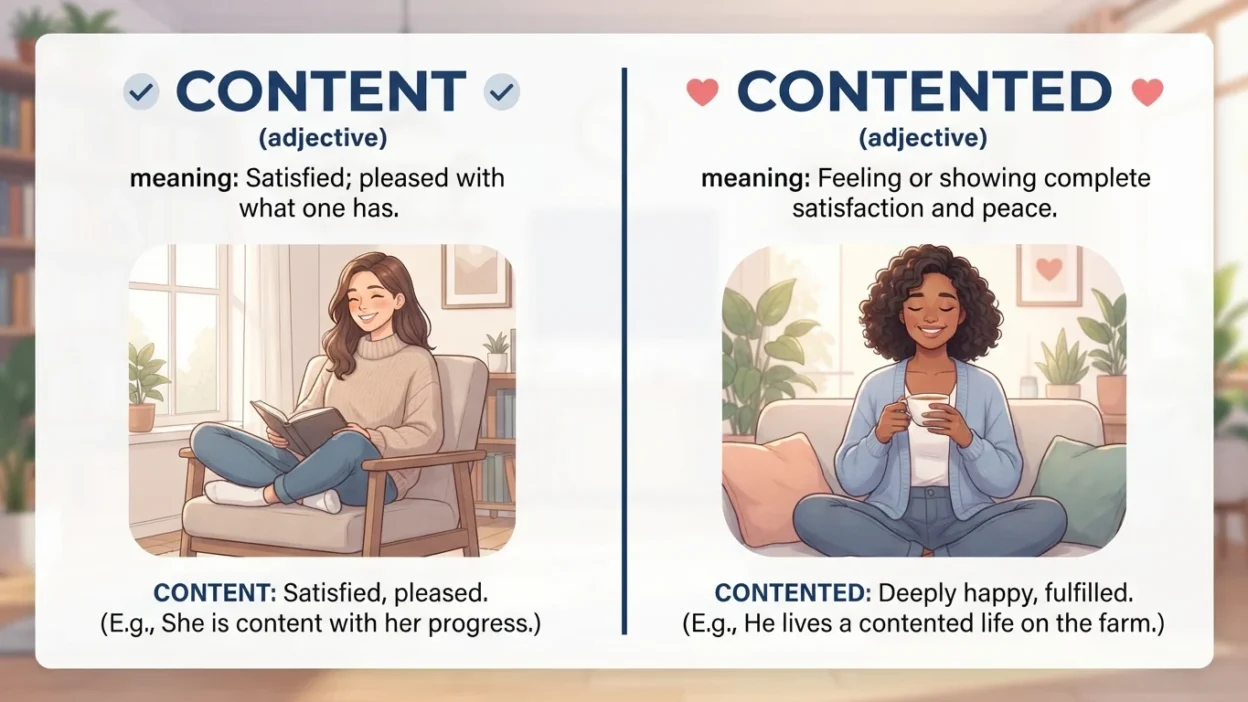
“Content” and “contented” can both describe someone who is satisfied, peaceful, and happy with what they have, but they are used differently. In this meaning, content is usually an adjective meaning satisfied or happy with a situation. Contented is also an adjective and means feeling or showing satisfaction and happiness. For example, you can say, “She is content with her life” or “She looked contented after the meal.”
The main difference is that content is much more common and flexible. It can describe a person’s state of mind, while contented often emphasizes a visible or lasting feeling of satisfaction. In everyday English, content is generally the safer and more natural choice.
However, contented is perfectly correct and can sound warm, peaceful, or slightly literary. It is also important to remember that content has another completely different meaning as a noun, referring to the information or material contained in something, such as a book, website, or video.
Quick Answer
Content and contented can both mean satisfied and happy, but content is more common and flexible. Contented emphasizes a feeling or appearance of satisfaction and can sound slightly more literary. For example, “He is content with his life” and “The baby looked contented” are both correct.
Why Do People Confuse “Content” and “Contented”?
People often confuse these words because they are closely related and can both describe satisfaction.
Compare:
She is content with her life.
She is contented with her life.
Both sentences can mean that she is satisfied with her life.
However, content is much more common in everyday English.
Contented is often used when describing someone’s peaceful or satisfied appearance or state.
There is also another important difference: content has several meanings, while contented only describes a feeling of satisfaction.
First Word: Content
As an adjective, content means satisfied, peaceful, or happy with a situation.
For example:
He is content with his simple life.
This means he is satisfied with his life and does not feel that he needs something more.
You will often see content followed by with:
She is content with her decision.
They are content with what they have.
I am content with the results.
Content as a Noun
Content also has a completely different meaning as a noun.
It can mean the information, material, or ideas contained in something.
For example:
The content of the book is interesting.
We need more educational content on the website.
The video contains useful content.
So, context is important.
Content as a Verb
The verb content means to satisfy someone, although this use is less common.
For example:
The small meal contented him.
However, in modern everyday English, people are more likely to use satisfy.
Second Word: Contented
Contented is an adjective meaning satisfied, peaceful, and happy with what you have or with your situation.
For example:
The child looked contented after eating.
The word often describes a visible feeling of calm satisfaction.
You might say:
She had a contented smile.
This suggests that her expression showed peaceful happiness.
Another example:
He lived a quiet and contented life.
Here, contented emphasizes a sense of lasting satisfaction.
Content vs Contented: The Main Difference
| Word | Meaning | Common Use | Example |
|---|---|---|---|
| Content | Satisfied or happy with a situation | Very common | She is content with her life. |
| Contented | Feeling or showing peaceful satisfaction | Less common, sometimes literary | She looked contented. |
| Content | Information or material in something | Noun | The website has useful content. |
The key difference is:
Content = satisfied
Contented = satisfied and peaceful
The meanings overlap considerably, so the difference is often one of usage and emphasis rather than completely different meaning.
When Should You Use “Content”?
Use content when you simply want to say that someone is satisfied with their circumstances.
It is especially natural with:
content with
Examples:
I am content with my decision.
She is content with her current job.
They are content with what they have.
He seems content with his life.
Content is usually the best choice for ordinary modern English.
When Should You Use “Contented”?
Use contented when you want to emphasize a feeling or appearance of peaceful satisfaction.
For example:
The baby looked contented.
She wore a contented smile.
He lived a quiet, contented life.
It can sound warmer or more descriptive than content.
15 Examples of “Content”
- She is content with her simple lifestyle.
- He seems content with his new job.
- I am content with the results.
- They are content with what they have.
- The old man was content to live quietly.
- She felt content after spending time with her family.
- He is perfectly content with his current situation.
- We are content to wait a little longer.
- The children were content to play outside.
- She appears content with her decision.
- He was content with a quiet evening at home.
- I am content with the way things are.
- She seems content despite the difficulties.
- He is content living in the countryside.
- They were content with the arrangement.
15 Examples of “Contented”
- The baby looked contented after feeding.
- She had a contented smile on her face.
- He lived a quiet and contented life.
- The cat looked warm and contented.
- They seemed contented with their peaceful lifestyle.
- She felt calm and contented after the vacation.
- The old couple appeared happy and contented.
- He sat by the fireplace with a contented expression.
- The children looked tired but contented after playing.
- She was relaxed and contented after finishing her work.
- The dog curled up in its bed, looking contented.
- He enjoyed a simple but contented existence.
- She gave a contented sigh.
- The farmer led a peaceful and contented life.
- Everyone looked contented after the meal.
Content vs Contented in Sentences
Consider these examples:
She is content with her life.
This simply tells us that she is satisfied.
Now compare:
She looked contented after dinner.
This emphasizes her visible state of peaceful satisfaction.
Another pair:
He is content with his job.
He had a contented smile after receiving the good news.
The first focuses on his state of satisfaction. The second describes how that satisfaction appears.
Comparison Table: Content vs Contented
| Feature | Content | Contented |
|---|---|---|
| Part of speech in this meaning | Adjective | Adjective |
| Basic meaning | Satisfied | Satisfied and peaceful |
| Frequency | More common | Less common |
| Common pattern | Content with | Contented smile, life, expression |
| Tone | Neutral | Warm, descriptive, sometimes literary |
| Example | I am content with my life. | She looked contented. |
Is “Content” More Common Than “Contented”?
Yes. Content is generally much more common when describing someone’s satisfaction.
For example:
I am content with my life.
sounds very natural.
Contented is also correct:
I am contented with my life.
But this can sound more formal, literary, or less natural in everyday conversation.
If you are unsure which one to use, content is usually the better choice.
Can You Say “Contented With”?
Yes, contented with is grammatically possible.
For example:
She was contented with her quiet life.
However, content with is much more common:
She was content with her quiet life.
Therefore, when talking about someone’s satisfaction with something, content with is usually the more natural construction.
Content vs Happy
These words are related but not identical.
Happy often describes a stronger or more general positive emotion.
I am happy about the news.
Content usually describes a calmer feeling of satisfaction.
I am content with my life.
Someone can be content without being extremely excited or joyful.
Think of it this way:
Happy = feeling pleasure or joy
Content = feeling satisfied and at peace
Content vs Satisfied
Content and satisfied are very close in meaning.
She is content with her life.
She is satisfied with her life.
Both mean that she feels that things are good enough.
However, content often suggests a calm sense of acceptance and peace.
Satisfied can also mean that a particular need, requirement, or expectation has been met.
For example:
The customer was satisfied with the service.
This is natural.
The customer was content with the service.
This is possible, but it emphasizes the customer’s feeling of being content rather than simply judging the service.
Common Mistakes
1. Assuming “contented” is always better
It is not.
Content is usually more natural in everyday English.
2. Forgetting the other meaning of “content”
Content can mean information or material.
For example:
The website contains educational content.
This has nothing to do with happiness or satisfaction.
3. Using “content” when you mean “happy” in every situation
Although the meanings overlap, content often suggests calm satisfaction rather than excitement.
She was content with her quiet life.
This does not necessarily mean she was extremely excited.
4. Overusing “contented”
Contented is correct, but it can sound somewhat literary in ordinary conversation.
He looked contented.
is more descriptive than:
He looked content.
5. Confusing “content” with “contentment”
Contentment is the noun form referring to a state of satisfaction.
She felt a deep sense of contentment.
Memory Trick
Remember:
Content = satisfied
Contented = satisfied and peaceful
A simple trick is:
Contented has the extra -ed, which can remind you of a person’s felt state.
For example:
The baby looked contented.
But when simply stating someone’s condition:
The baby is content.
American vs British English
Content and contented are used in both American and British English.
There is no major difference in meaning between the two varieties.
In both forms of English, content is more common in ordinary usage, while contented can sound more descriptive or literary.
The noun content meaning information or material is also common in both American and British English.
Similar Words
Satisfied
Means that something has met your needs or expectations.
She was satisfied with the results.
Happy
Means feeling pleasure or joy.
He was happy with his new job.
Pleased
Means feeling happy or satisfied about something.
She was pleased with the decision.
Peaceful
Means calm and free from disturbance.
He enjoyed a peaceful evening.
Contentment
Means a state of calm satisfaction.
She felt a deep sense of contentment.
Fulfilled
Means feeling that your life or efforts have purpose and satisfaction.
He felt fulfilled by his work.
Final Verdict
Content and contented can both mean satisfied and happy, but content is more common and flexible. It is especially natural in the structure “content with.”
Contented emphasizes a peaceful or visible feeling of satisfaction and is often used with words such as smile, expression, life, and looked.
For everyday English, choose:
I am content with my life.
For a more descriptive sentence, you might choose:
She had a contented smile.
Also remember that content has another major meaning: the information or material contained in something.
Frequently Asked Questions
What is the difference between “content” and “contented”?
Both can mean satisfied and happy, but content is more common. Contented often emphasizes a peaceful or visible state of satisfaction and can sound more literary.
Is “content” or “contented” more common?
Content is generally more common, especially in everyday English.
Can “content” mean happy?
Yes. As an adjective, content means satisfied, peaceful, or happy with a situation.
She is content with her life.
Is “contented” a correct word?
Yes. Contented is a correct adjective meaning satisfied, peaceful, or happy.
The baby looked contented.
Can I say “contented with”?
Yes, but content with is much more common and natural.
She is content with her decision.
Is “content” formal or informal?
The adjective content is neutral and works in both everyday and formal English.
What is the noun form of “contented”?
The noun is contentment, meaning a state of satisfaction or peaceful happiness.
He felt a sense of contentment.
Does “content” have another meaning?
Yes. As a noun, content means the information or material contained in something.
The article contains useful content.
Remember This
Content = satisfied and at peace.
I am content with my life.
Contented = feeling or showing peaceful satisfaction.
She had a contented smile.
And remember the other meaning of content:
The website has useful content.
So the easiest rule is:
Content → common way to say satisfied
Contented → descriptive way to show satisfaction
Conclusion
Content and contented are closely related adjectives that describe satisfaction and happiness. Content is the more common and flexible word, especially when followed by with. For example, “She is content with her life” means that she is satisfied with her circumstances. Contented has a similar meaning but often creates a stronger image of peaceful or visible satisfaction, as in “She had a contented smile.”
Choosing between these words usually depends on style rather than grammar. In everyday English, content is normally the best choice. Use contented when you want to describe someone’s peaceful appearance, feeling, or way of life in a more expressive way. Finally, do not forget that content can also mean the information or material inside a book, website, video, or other source, making context especially important.

Lucas Luke is a passionate language writer and content creator at SimileHive, specializing in similes, idioms, metaphors, and figurative language. He enjoys making complex English expressions simple, engaging, and easy to understand for students, writers, and language enthusiasts through well-researched, practical content.