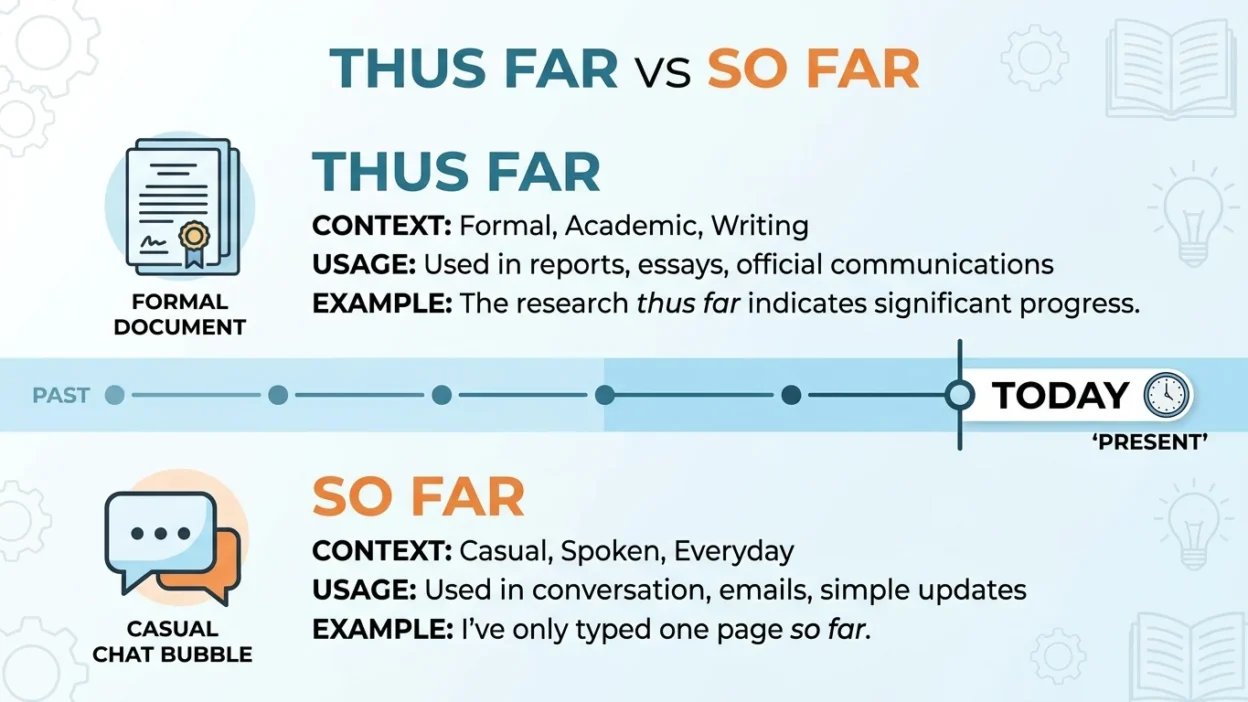
“Thus far” and “so far” have essentially the same basic meaning: up to this point or until now. For example, “The project has gone well so far” and “The project has gone well thus far” communicate the same idea. The main difference is tone and style. So far is much more common in everyday conversation and informal writing, while thus far sounds more formal, literary, or deliberate.
Both expressions are grammatically correct, and neither is inherently better than the other. Your choice depends mainly on the situation and the tone you want. If you are talking with friends, writing a casual email, or having an ordinary conversation, so far is usually the most natural choice.
In formal reports, academic writing, legal language, or polished professional writing, thus far may sound more appropriate. Understanding this small difference can help you choose the expression that fits your audience and purpose.
Quick Answer
“Thus far” and “so far” mean essentially the same thing: “up to now” or “until this point.” The main difference is style. So far is common and natural in everyday English, while thus far is more formal or literary. For most casual situations, use so far. For formal writing, thus far may be a better stylistic choice.
Why Do People Confuse “Thus Far” and “So Far”?
People confuse these expressions because they can usually be substituted for each other without changing the basic meaning.
Compare:
We have received ten applications so far.
and:
We have received ten applications thus far.
Both mean:
We have received ten applications up to now.
The important difference is not usually meaning but register.
So far sounds natural and conversational.
Thus far sounds more formal.
This makes the choice depend largely on context.
First Expression: Thus Far
Thus far means up to this point or until now.
The word thus has several meanings in English, but in this expression it has the sense of in this way or to this extent, leading to the meaning “up to this point.”
Examples:
Thus far, the experiment has been successful.
No problems have occurred thus far.
The company has performed well thus far.
The expression is grammatically correct but tends to sound more formal than so far.
Second Expression: So Far
So far also means up to this point or until now.
It is extremely common in everyday English.
Examples:
So far, everything is going well.
I have read three chapters so far.
We haven’t had any problems so far.
Because it is natural and familiar, so far is usually the better choice in ordinary conversation.
Thus Far vs So Far: The Main Difference
| Expression | Meaning | Style | Example |
|---|---|---|---|
| So far | Up to now | Common, conversational | Everything is going well so far. |
| Thus far | Up to now | Formal, literary | Everything is going well thus far. |
| Up to now | Until now | Neutral | Everything has been fine up to now. |
| Until now | Before this point | Neutral | Until now, we had no problems. |
The key point is:
Meaning: almost the same
Style: different
When Should You Use “So Far”?
Use so far when you want natural, everyday English.
It works well in:
- conversations
- text messages
- emails
- casual writing
- everyday reports
- informal discussions
For example:
How is your new job going so far?
I’ve enjoyed the course so far.
We haven’t received any complaints so far.
These sentences sound natural and conversational.
When Should You Use “Thus Far”?
Use thus far when you want a more formal or polished tone.
It can work well in:
- academic writing
- formal reports
- professional documents
- legal writing
- formal presentations
- literary writing
For example:
The research conducted thus far supports the proposed theory.
No significant changes have been observed thus far.
The phrase gives the sentence a more formal tone.
15 Examples of “So Far”
- Everything is going well so far.
- I have read five chapters so far.
- We haven’t received any complaints so far.
- How is your new job going so far?
- She has completed three assignments so far.
- The project has been successful so far.
- I haven’t seen him so far today.
- We have sold fifty tickets so far.
- The weather has been pleasant so far.
- He has scored two goals so far.
- I like the book so far.
- Nothing unusual has happened so far.
- We have visited three cities so far.
- The treatment appears to be working so far.
- The meeting has been productive so far.
15 Examples of “Thus Far”
- The project has been successful thus far.
- No problems have been reported thus far.
- The evidence gathered thus far supports the theory.
- The company has performed well thus far.
- We have received no response thus far.
- The results obtained thus far are encouraging.
- The investigation has revealed little thus far.
- The team has completed five stages thus far.
- The policy has produced positive results thus far.
- No significant changes have occurred thus far.
- The research conducted thus far is promising.
- The negotiations have proceeded smoothly thus far.
- The evidence available thus far is limited.
- The experiment has produced consistent results thus far.
- The plan has worked effectively thus far.
Can “Thus Far” and “So Far” Be Interchanged?
In many sentences, yes.
For example:
The project has gone well so far.
The project has gone well thus far.
The basic meaning is the same.
However, replacing one with the other can change the tone.
The first sounds ordinary and conversational.
The second sounds more formal.
So although the expressions are often interchangeable in meaning, they are not always equally natural in every context.
Comparison Table: Tone and Usage
| Situation | Better Choice | Example |
|---|---|---|
| Casual conversation | So far | How is the course going so far? |
| Text message | So far | Everything’s good so far. |
| Casual email | So far | The plan is working well so far. |
| Professional report | Thus far | The results obtained thus far are positive. |
| Academic writing | Thus far | Research conducted thus far is limited. |
| Legal or formal writing | Thus far | No evidence has emerged thus far. |
| General everyday writing | So far | We haven’t had any problems so far. |
“Thus Far” vs “So Far” in Formal Writing
Both expressions are grammatically correct in formal writing.
However, thus far often fits a formal register better.
For example:
The study has produced encouraging results thus far.
This sounds polished and formal.
You could also write:
The study has produced encouraging results so far.
This is also correct, but it sounds slightly more conversational.
Do not assume that formal writing always requires thus far. So far is not incorrect or unprofessional simply because it is common.
“Thus Far” vs “So Far” in Conversation
In everyday speech, so far is much more natural.
For example:
How’s your vacation going so far?
This sounds completely natural.
Using:
How’s your vacation going thus far?
is grammatically possible, but it sounds unusually formal or even playful in ordinary conversation.
Therefore:
Conversation → so far
is a useful general rule.
“So Far” at the Beginning or End of a Sentence
So far can appear at the beginning or end of a sentence.
At the beginning:
So far, everything is going well.
At the end:
Everything is going well so far.
Both are correct.
The same is true of thus far:
Thus far, everything is going well.
Everything is going well thus far.
Common Mistakes
1. Thinking “thus far” is more correct
It is not.
Both thus far and so far are correct.
The difference is mainly one of style and register.
2. Thinking “so far” is too informal for all formal writing
Not necessarily.
So far can be perfectly acceptable in professional and formal contexts. Choose thus far when you specifically want a more formal tone.
3. Using “thus far” in casual conversation
It is grammatically correct, but it may sound overly formal.
Instead of:
How is your day going thus far?
most speakers would naturally say:
How is your day going so far?
4. Thinking “thus far” means something different
In most modern uses of this expression, thus far simply means up to this point.
5. Confusing “so far” with “so long”
These are different expressions.
So far = up to now
So long = goodbye, or for a long time in some contexts
“So Far” vs “Up to Now”
These expressions are very similar.
We haven’t received a response so far.
We haven’t received a response up to now.
Both mean that there has been no response before the present point.
However, so far is usually shorter and more natural.
“Thus Far” vs “Until Now”
These can also be similar.
No problems have occurred thus far.
No problems have occurred until now.
But until now can sometimes emphasize a change that has just occurred:
Everything was fine until now.
This sentence may suggest that something has changed.
Thus far does not necessarily carry that same implication.
Can “So Far” Mean Distance?
Yes, depending on context.
So far can mean to such a great distance.
For example:
We walked so far that we became tired.
Here, so far refers to physical distance rather than time.
But in:
I haven’t received an answer so far.
it means up to now.
The context determines the meaning.
Memory Trick
Remember:
SO FAR = everyday
THUS FAR = formal
Both mean:
UP TO NOW
A simple memory sentence is:
So far is what you usually say; thus far is what you might write when you want a more formal tone.
American vs British English
So far and thus far are used in both American and British English.
There is no major difference in meaning between the two varieties.
However, so far is common in everyday speech in both forms of English, while thus far tends to have a more formal or literary tone.
The choice is therefore mainly about register, not American versus British grammar.
Similar Words and Expressions
Up to now
Means until the present moment.
Up to now, everything has been fine.
Until now
Means before the present point.
Until now, we had not noticed the problem.
To date
Means up to the present time.
To date, the company has hired 100 employees.
So far
The common everyday expression meaning up to now.
So far, everything is working.
Thus far
A more formal expression meaning up to now.
Thus far, the evidence is encouraging.
To this point
Means up to the current stage.
To this point, the project has been successful.
Final Verdict
“Thus far” and “so far” have essentially the same meaning: “up to now” or “until this point.” The main difference is tone.
Use so far for everyday conversation and natural, general writing:
Everything is going well so far.
Use thus far when you want a more formal, literary, or polished tone:
The results have been encouraging thus far.
Neither expression is more grammatically correct than the other. If you are unsure, so far is usually the safest and most natural choice.
Frequently Asked Questions
What is the difference between “thus far” and “so far”?
Both mean “up to now” or “until this point.” The main difference is style. So far is more common and conversational, while thus far sounds more formal or literary.
Is “thus far” more formal than “so far”?
Yes. Thus far generally has a more formal or literary tone. So far is the usual choice in everyday conversation.
Is “so far” grammatically correct?
Yes. So far is completely correct and very common in standard English.
Can I use “thus far” in conversation?
Yes, but it may sound unusually formal. In most everyday conversations, so far sounds more natural.
Can “thus far” and “so far” be used interchangeably?
Often, yes. When they mean “up to now,” they can usually replace each other without changing the basic meaning. The tone may change.
Which is better for academic writing: “thus far” or “so far”?
Both can be correct. Thus far may fit a formal academic style more naturally, but so far is not grammatically wrong or automatically too informal.
Does “so far” always refer to time?
No. So far can also refer to physical distance.
We walked so far that we became tired.
When it means “up to now,” however, it refers to time or progress.
What is another word for “thus far”?
Depending on the sentence, alternatives include so far, up to now, until now, to date, and to this point.
Remember This
So far = up to now
The project is going well so far.
Thus far = up to now
The project is going well thus far.
The difference is mainly tone:
So far → common and conversational
Thus far → formal and literary
When in doubt, choose so far. It is natural, clear, and correct in most situations.
Conclusion
Thus far and so far are two expressions that generally communicate the same idea: up to now or up to this point. The most important difference is not meaning but style. So far is the more common expression and sounds natural in everyday speech, casual writing, emails, and ordinary conversations. Thus far carries a more formal, polished, or literary tone.
Both expressions are correct, so there is no need to worry that choosing so far makes your English grammatically weaker. In most everyday situations, it is actually the more natural choice. When writing a formal report, academic paper, or polished professional document, thus far can be useful if you want a more formal tone. The easiest rule is simple: use “so far” for everyday English and “thus far” when you want a more formal style.

Charles Kevin is a passionate language writer and researcher at SimileHive, creating clear, engaging content about similes, idioms, metaphors, and figurative language to help readers improve English communication confidently every day.