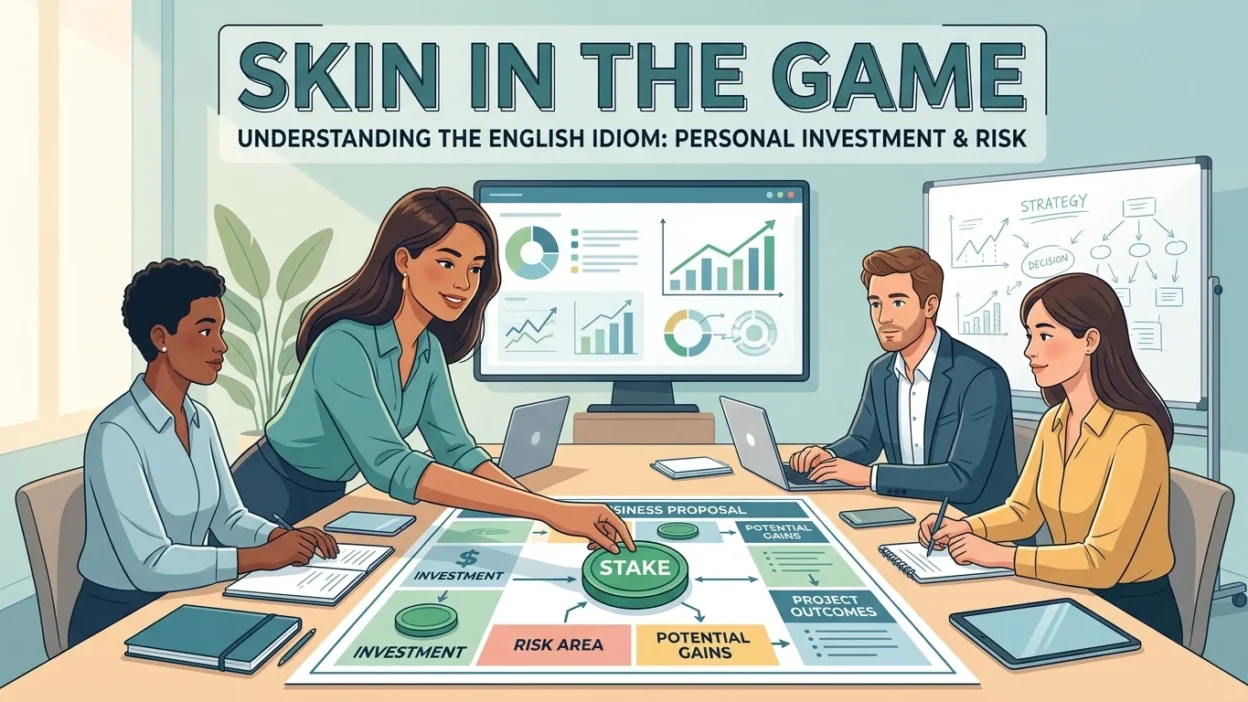
“Skin in the game” means having a personal stake, risk, or something valuable to lose in a situation. When someone has skin in the game, they are personally involved and will experience consequences if things go badly.
For example, if a business owner invests their own money in a new project, they have skin in the game because their own money is at risk. The expression is often used when talking about business, investments, decisions, leadership, and responsibility.
The phrase can also suggest that a person is more likely to take a situation seriously when they have something personally at stake. Someone who gives advice without facing any consequences may be less committed than someone who shares the same risks as everyone else.
For this reason, “skin in the game” is commonly used to describe personal responsibility, commitment, and shared risk. It is usually informal but is widely understood in modern English.
Quick Answer
“Skin in the game” means having a personal stake or something valuable to lose in a situation. If someone has skin in the game, they are personally affected by the outcome and therefore have a reason to care about the result. The phrase is common in business, finance, decision making, politics, and everyday conversation.
Why Do People Say “Skin in the Game”?
The expression is based on the idea that someone who has something at risk is more personally invested in an outcome.
For example:
The manager is investing her own money, so she has skin in the game.
If the project succeeds, she benefits.
If it fails, she loses something.
Therefore, she has a personal stake in the result.
The phrase is often used when people want to distinguish between someone who is merely giving advice and someone who is actually taking a risk.
First Word: Skin
The word skin literally means the outer covering of the human body.
For example:
My skin is sensitive to sunlight.
But in “skin in the game,” the word is being used figuratively.
The expression does not literally mean that someone’s skin is inside a game.
Instead, skin represents something personal that is at risk.
In other words:
Skin = something personal that you could lose.
Second Word: Game
The word game literally refers to an activity or competition with rules.
For example:
They played a football game.
In “skin in the game,” however, game refers more broadly to a situation, activity, business venture, decision, or competition.
So:
Skin in the game = a personal stake in a situation.
What Does “Skin in the Game” Really Mean?
When someone has skin in the game, they have something personally at risk.
That could be:
- money
- reputation
- time
- career
- relationships
- status
- personal success
- another valuable interest
For example:
The investors have skin in the game.
This means the investors have their own money or interests at risk.
Another example:
She should have some skin in the game before giving advice.
This suggests that she should share some of the risks or consequences of the decision.
When Should You Use “Skin in the Game”?
Use “skin in the game” when you want to say that someone has a personal stake or personal risk in a situation.
It is especially common when discussing:
- business
- investments
- leadership
- entrepreneurship
- negotiations
- decision making
- responsibility
- competition
- personal commitments
For example:
The founders have a lot of skin in the game.
This means the founders have a lot personally at stake.
15 Examples of “Skin in the Game”
- The company owners have skin in the game because they invested their own money.
- If you want to make the decision, you should have some skin in the game.
- The investors have plenty of skin in the game.
- She has skin in the game because her career depends on the project’s success.
- The manager needs to have some skin in the game before criticizing the team.
- Everyone involved should have some skin in the game.
- He has no skin in the game, so he does not care which option we choose.
- The founders put their savings into the company, so they definitely have skin in the game.
- You cannot expect people to take the project seriously if they have no skin in the game.
- The new investors now have significant skin in the game.
- She has a lot of skin in the game because she owns part of the business.
- The coach has skin in the game because his job depends on the team’s performance.
- Everyone should have some skin in the game if the decision affects the whole group.
- He offered advice but had no skin in the game.
- The partners have too much skin in the game to walk away easily.
“Have Skin in the Game” Meaning
The most common construction is:
have skin in the game
It means:
to have a personal stake or risk in a situation
For example:
The CEO has skin in the game.
This means the CEO has something personally at stake.
You can also say:
put skin in the game
This means to personally commit something valuable or take a personal risk.
For example:
If you believe in the business, put some skin in the game.
This means:
Take a personal risk or make a personal investment.
“No Skin in the Game” Meaning
The opposite idea is:
have no skin in the game
This means that someone has nothing personally at risk.
For example:
He has no skin in the game, so he can leave whenever he wants.
The person does not have much to lose.
Another example:
It’s easy to criticize when you have no skin in the game.
This means that someone may be giving opinions without personally experiencing the consequences.
“Put Skin in the Game” Meaning
“Put skin in the game” means to personally commit something valuable or accept some risk.
For example:
If you want to lead the project, you need to put some skin in the game.
This means the person should personally commit time, money, effort, or responsibility.
Another example:
The investors put their own money into the company, so they have skin in the game.
Skin in the Game vs Personal Stake
These expressions are closely related.
Personal stake is a more neutral and formal expression.
She has a personal stake in the decision.
Skin in the game is more informal and often emphasizes risk or consequences.
She has skin in the game.
Both mean that the person is personally connected to the outcome.
Comparison Table: Related Expressions
| Expression | Meaning | Example |
|---|---|---|
| Skin in the game | Personal risk or stake | He has skin in the game. |
| Personal stake | Personal interest in an outcome | She has a personal stake in the project. |
| Something at stake | Something valuable that could be gained or lost | We have a lot at stake. |
| Take a risk | Accept the possibility of loss | They decided to take a risk. |
| Put something on the line | Risk something valuable | He put his reputation on the line. |
| Have a vested interest | Have a strong personal interest | She has a vested interest in the outcome. |
Common Mistakes
1. Taking the phrase literally
“Skin in the game” is figurative.
It does not mean that someone’s skin is physically involved in a game.
It means:
something personally valuable is at risk.
2. Thinking it only means money
Money is a common example, but it is not the only type of stake.
Someone can have skin in the game because they risk:
- their career
- reputation
- time
- relationships
- business
- personal success
3. Using it in highly formal writing
The expression is widely understood, but it is still relatively informal.
In formal writing, alternatives such as personal stake, personal interest, or financial interest may be more appropriate.
4. Confusing “skin in the game” with “stake in the game”
Both ideas involve personal involvement, but “skin in the game” emphasizes that the person has something to lose or risk.
5. Assuming having skin in the game guarantees good decisions
It does not.
Having something at stake may increase someone’s motivation, but it does not automatically make their judgment correct or unbiased.
Origin of “Skin in the Game”
The expression became widely known through modern business, finance, and decision making, although the underlying idea of having something personally at risk is much older.
The phrase is strongly associated with personal investment and accountability. It became especially prominent in discussions about financial incentives and risk.
The expression was also popularized in modern intellectual and financial writing, particularly through discussions of whether people who make decisions should personally bear some of the consequences of those decisions.
Today, it is a common idiom in business and everyday English.
Is “Skin in the Game” an Idiom?
Yes. “Skin in the game” is a widely used English idiom.
Its meaning is not literal.
Literal: skin is part of a game.
Figurative: someone has something personally at risk.
The figurative meaning is the one normally intended.
Skin in the Game in Business
The expression is especially common in business.
Suppose a company’s manager recommends an expensive project.
If the manager’s own money, career, or reputation is connected to the outcome, you might say:
The manager has skin in the game.
This suggests personal accountability.
For example:
The founders invested their own savings, so they have serious skin in the game.
Skin in the Game in Investing
The phrase is also common in finance and investing.
An investor who puts their own money into a company has a personal financial stake.
For example:
The founders still own a large share of the company, so they have plenty of skin in the game.
Here, the phrase emphasizes that the founders can personally benefit or suffer depending on the company’s performance.
Skin in the Game in Everyday English
You do not need to be discussing business to use the expression.
For example:
You keep telling me to join the competition, but you have no skin in the game.
This means the other person does not face the same consequences.
Another example:
I have a lot of skin in the game because my friends are involved.
Here, the speaker has a personal interest in the outcome.
Memory Trick
Think:
Skin = something personal
Game = the situation
Therefore:
Skin in the game = something personal at risk in the situation.
A simple memory sentence is:
If you can win or lose something personally, you have skin in the game.
American vs British English
“Skin in the game” is widely understood in both American and British English.
It is especially common in business, finance, management, and informal discussion.
The expression is not limited to one national variety of English.
However, in formal British or American writing, a more neutral phrase such as personal stake may sometimes be preferred.
Similar Expressions
Personal stake
Means a personal interest or something personally at risk.
She has a personal stake in the decision.
Something at stake
Means something valuable that could be gained or lost.
We have a lot at stake.
Put something on the line
Means to risk something valuable.
He put his reputation on the line.
Vested interest
Means a strong personal interest in a particular outcome.
She has a vested interest in the company’s success.
Take a risk
Means to accept the possibility of loss or failure.
They decided to take a risk.
Personal investment
Means something valuable that someone has personally committed to a situation.
He has a personal investment in the project’s success.
Final Verdict
“Skin in the game” means having a personal stake or something valuable at risk in a situation. It suggests that a person is personally involved and will experience some benefit or consequence depending on the outcome.
You can have skin in the game, put skin in the game, or have no skin in the game. The phrase is particularly common in business, finance, leadership, and decision making, but it also works naturally in everyday conversation.
The easiest way to remember it is:
Skin in the game = something personal to gain or lose.
Frequently Asked Questions
What does “skin in the game” mean?
“Skin in the game” means having a personal stake, risk, or something valuable to lose in a situation.
What does “have skin in the game” mean?
It means that you are personally involved and have something at risk depending on the outcome.
What does “put skin in the game” mean?
“Put skin in the game” means to personally commit something valuable, such as money, time, effort, reputation, or responsibility.
What does “no skin in the game” mean?
It means that someone has little or nothing personally at risk in a situation.
Is “skin in the game” an idiom?
Yes. It is an English idiom meaning personal involvement, personal risk, or a personal stake in an outcome.
Is “skin in the game” formal or informal?
It is generally informal to neutral. It is common in business and everyday conversation, but more formal alternatives include personal stake, personal interest, and financial interest.
Can “skin in the game” mean something other than money?
Yes. A person’s career, reputation, time, relationships, effort, or responsibilities can also be at risk.
What is the opposite of having skin in the game?
A person who has no skin in the game has little or nothing personally at risk. They may therefore be less affected by the outcome.
Remember This
Skin in the game = personal stake or personal risk.
If someone has something valuable to gain or lose, they have skin in the game.
The founders invested their own money, so they have skin in the game.
He has no skin in the game, so the decision does not affect him personally.
If you want to lead the project, you need to put some skin in the game.
The simplest definition to remember is:
“Skin in the game” means having something personally at stake.
Conclusion
The phrase “skin in the game” is a useful English idiom for describing personal involvement and risk. When someone has skin in the game, they have something personally valuable at stake, such as money, time, reputation, career opportunities, or responsibility. Because they can personally benefit or suffer from the result, they have a strong reason to care about what happens.
The expression is especially common in business, finance, investing, leadership, and decision making, but it is also natural in everyday conversation.
Remember that “have skin in the game” means having a personal stake, “put skin in the game” means accepting or making a personal commitment, and “have no skin in the game” means having little or nothing personally at risk.

Adam Aaron is a language enthusiast and content writer at SimileHive, creating clear, engaging guides on similes, idioms, metaphors, and figurative language to help readers improve English confidently every day.