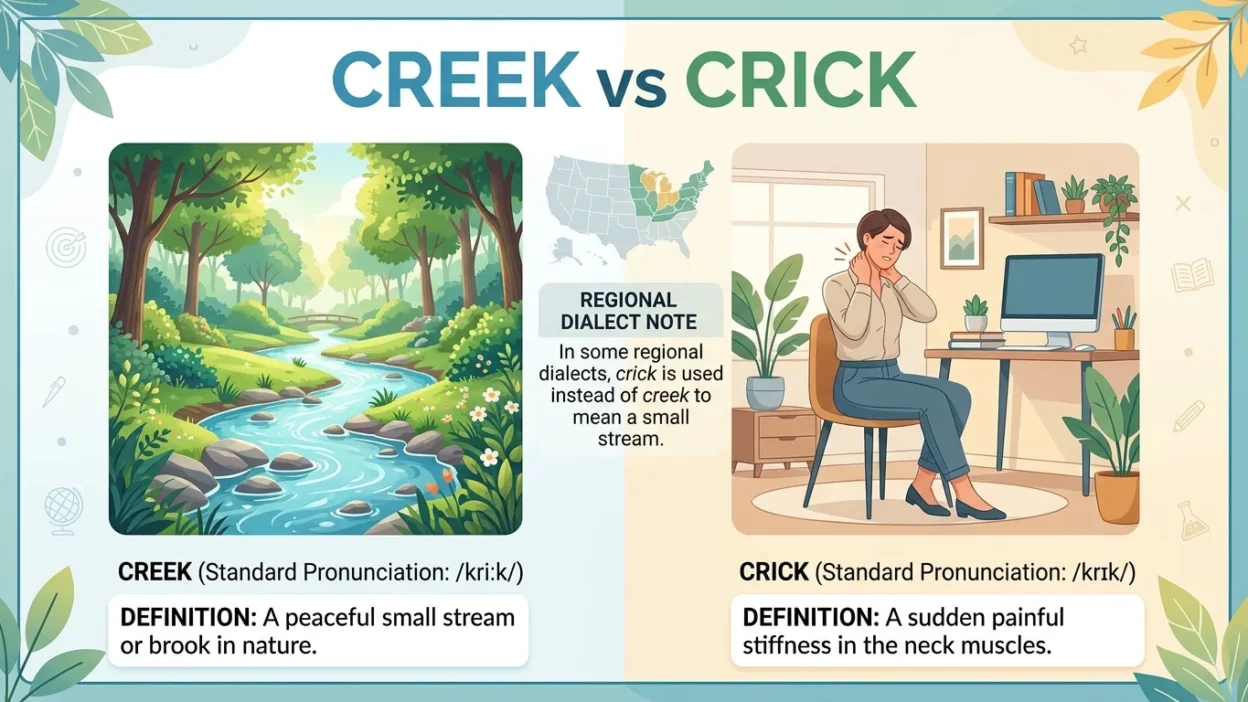
Creek and crick can be confusing because they are sometimes pronounced similarly, but they have different meanings and uses. Creek is a standard English word for a small stream or, in some varieties of English, a narrow inlet or channel of water. Crick is usually an informal word meaning a sudden pain or stiffness in the neck or another part of the body. For example, “We walked beside the creek” refers to a small stream, while “I have a crick in my neck” describes discomfort or stiffness.
The two words are therefore not normally interchangeable. Creek is mainly associated with water, while crick is commonly associated with physical stiffness or pain. However, there is an important regional detail: in some parts of the United States, crick is also used as a regional pronunciation or spelling for creek. Understanding this regional usage can help you recognize both words without confusing their standard meanings.
Quick Answer
Creek usually means a small stream or waterway. Crick commonly means a sudden pain, stiffness, or uncomfortable sensation, especially in the neck. For example, “The children played near the creek” refers to a stream, while “I woke up with a crick in my neck” means the speaker has neck stiffness. In some U.S. regions, crick also means creek.
Why Do People Confuse “Creek” and “Crick”?
The main reason is pronunciation.
In some English-speaking regions, especially parts of the United States, creek may be pronounced like “crick.” In these areas, people may also use crick as a regional spelling for a small stream.
However, in standard written English, creek is the normal spelling when you mean a small stream.
The word crick has a separate common meaning:
a crick in the neck
This means a painful or stiff feeling in the neck.
So context is important.
We walked along the creek.
Here, the word is about water.
I have a crick in my neck.
Here, the word is about physical discomfort.
First Word: Creek
Creek is a noun that usually means a small stream or narrow body of flowing water.
For example:
A small creek runs through the forest.
We crossed the creek using a wooden bridge.
The exact size of a creek can vary. In everyday English, the word generally describes a smaller waterway than a river.
In some regions, particularly in Australia and certain other varieties of English, creek can also refer to a narrow inlet, channel, or watercourse, depending on the local geography.
Second Word: Crick
Crick is commonly used to describe a sudden stiffness or pain in the neck or another part of the body.
The most familiar expression is:
a crick in the neck
For example:
I slept badly and woke up with a crick in my neck.
This means the person’s neck feels stiff or painful.
Crick in this sense is informal.
It is not normally the word you would use for a medical diagnosis. It is an everyday way of describing minor stiffness or discomfort.
Creek vs Crick: The Main Difference
| Word | Main Meaning | Example |
|---|---|---|
| Creek | A small stream or waterway | We walked beside the creek. |
| Crick | Stiffness or pain, especially in the neck | I have a crick in my neck. |
| Crick | Regional form of “creek” in some U.S. areas | They live near a crick. |
The easiest distinction is:
Creek = water
Crick = stiffness or pain
But remember that crick can also be a regional term for creek in some American English varieties.
When Should You Use “Creek”?
Use creek when you are talking about a small stream, waterway, or similar body of water.
Examples:
The children played beside the creek.
A creek flows behind the house.
We crossed the creek on foot.
The trail follows the creek for several miles.
If you are writing for a general audience, creek is the safest spelling when you mean a small stream.
When Should You Use “Crick”?
Use crick when you mean a minor stiffness or pain, especially in the neck.
For example:
I have a crick in my neck.
She woke up with a crick in her neck.
Sitting at the computer all day gave me a crick in my neck.
You may also encounter crick meaning creek in regional American speech and writing. In that context, the intended meaning should be clear from the surrounding words.
15 Examples of “Creek”
- We walked beside the creek.
- The children were playing near the creek.
- A small creek runs through the village.
- We crossed the creek using a bridge.
- The trail follows the creek.
- Fish swim in the creek.
- The rain caused the creek to rise.
- We sat beside the creek and had lunch.
- A wooden bridge crosses the creek.
- The cabin is located near a quiet creek.
- The creek flows into the river.
- We could hear the sound of the creek.
- The hikers stopped at the creek for water.
- Leaves covered the surface of the creek.
- The farmer built a small bridge over the creek.
15 Examples of “Crick”
- I woke up with a crick in my neck.
- I have a crick in my neck from sleeping awkwardly.
- She got a crick in her neck after working at her desk.
- He complained about a crick in his neck.
- Stretching helped relieve the crick in my neck.
- I think I slept in a strange position and got a crick.
- She turned her head and felt a crick in her neck.
- My neck has had a crick in it all morning.
- I need to stretch because I have a crick in my neck.
- He woke up with a painful crick in his neck.
- The long car ride gave me a crick in my neck.
- She used a warm towel to ease the crick.
- I got a crick in my neck from looking down at my phone.
- He said the crick was making it difficult to turn his head.
- After sleeping on the couch, I had a crick in my neck.
“A Crick in the Neck” Meaning
The expression a crick in the neck means a minor stiffness or pain in the neck, often caused by sleeping in an uncomfortable position, sitting awkwardly, or holding your head in one position for too long.
For example:
I woke up with a crick in my neck.
This means:
My neck feels stiff or painful.
It is an informal everyday expression.
Is “Crick” a Variant of “Creek”?
Yes, in some regional varieties of American English, crick is used to refer to a small stream.
For example, you may hear someone say:
We went fishing in the crick.
Here, crick means creek, not neck pain.
This usage is regional and is especially associated with certain parts of the United States.
For general writing, however, creek is the safer choice when referring to a stream.
Creek vs Crick Pronunciation
The pronunciation of creek varies among English speakers.
Many speakers pronounce it approximately like:
kreek
In some regional American varieties, creek may be pronounced more like:
crick
This pronunciation difference helps explain why the spelling crick is sometimes used for a stream.
However, when you are writing standard English and mean a small stream, creek is generally the preferred spelling.
Common Mistakes
1. Using “crick” for a stream in formal writing
If you mean a small stream, use:
creek
For example:
The house is beside a creek.
Crick may reflect regional speech, but creek is the standard general spelling.
2. Thinking “creek” means neck pain
It does not.
I have a crick in my neck.
Here, crick refers to stiffness or pain.
3. Forgetting the phrase “a crick in the neck”
The most common use of crick is in:
a crick in the neck
This is a natural informal expression for minor neck stiffness.
4. Assuming “crick” always means pain
Not necessarily.
In some regional American English, crick means a small stream.
The context tells you which meaning is intended.
Comparison Table: Creek, Crick, and Similar Words
| Word | Meaning | Example |
|---|---|---|
| Creek | Small stream | We walked beside the creek. |
| Crick | Neck stiffness or pain | I have a crick in my neck. |
| Crick | Regional word for creek | They went fishing in the crick. |
| Stream | A small or moderate flowing body of water | A stream runs through the valley. |
| River | A larger natural flowing waterway | The river flows to the sea. |
| Inlet | A narrow body of water extending into land | The boat entered the inlet. |
Creek vs Stream
Creek and stream are closely related.
A stream is a general term for a body of flowing water.
A creek is commonly used for a smaller stream, although the exact distinction can vary by region.
For example:
A small stream runs through the forest.
A small creek runs through the forest.
Both can be correct.
Creek vs River
A river is generally larger than a creek.
For example:
We crossed the creek using a small bridge.
The river required a large bridge.
However, there is no universal size rule that applies to every body of water. Local naming conventions can affect whether a waterway is called a creek, stream, river, or another term.
Memory Trick
Use this simple trick:
CREek = CREEK has WATER
Think:
Creek = waterway
CRick = CRick in your neck
Think:
Crick = stiffness
So remember:
Creek → water
Crick → neck pain
And if you hear crick meaning a stream, remember that it is a regional American usage.
American vs British English
Creek is widely used in American and British English for a small stream or waterway, although the precise meaning can vary by region.
Crick meaning a stiffness or pain in the neck is informal and familiar in English.
The use of crick to mean creek is particularly associated with regional American English.
Therefore, if you are writing for an international audience and mean a small stream, creek is the clearest choice.
Similar Words
Stream
A body of flowing water, usually smaller than a river.
A stream flows through the forest.
Brook
A small stream, especially in British English.
A narrow brook runs through the meadow.
River
A large natural flow of water.
The river passes through the city.
Rivulet
A very small stream.
A tiny rivulet flowed down the hillside.
Inlet
A narrow body of water extending into land.
The boat entered the inlet.
Stiffness
A feeling of difficulty or discomfort when moving a body part.
I woke up with neck stiffness.
Spasm
A sudden involuntary contraction of a muscle.
He experienced a muscle spasm.
Final Verdict
Creek and crick usually have different meanings.
Use creek when you mean a small stream or waterway:
We walked along the creek.
Use crick when you mean minor stiffness or pain, especially in the neck:
I have a crick in my neck.
However, remember that crick is also used as a regional term for creek in some parts of the United States.
For general or formal writing, creek is the safest choice when referring to a stream.
Frequently Asked Questions
What is the difference between creek and crick?
Creek usually means a small stream or waterway. Crick commonly means a stiffness or pain in the neck. In some regional American English, however, crick is also used to mean a creek.
Is “crick” a real word?
Yes. Crick is a standard English word meaning a minor stiffness or pain, especially in the neck. It is also used regionally to mean creek.
Is it “creek” or “crick”?
If you mean a small stream, creek is the standard general spelling. If you mean neck stiffness, use crick, as in a crick in my neck.
What does “a crick in the neck” mean?
A crick in the neck means minor stiffness or pain in the neck, often caused by sleeping or sitting in an uncomfortable position.
Is “crick” a regional word for creek?
Yes. In some parts of the United States, crick is used as a regional pronunciation or spelling for creek.
Are creek and stream the same thing?
They are similar. A creek is generally a smaller flowing waterway, while stream is a broader term. The exact distinction varies by region.
Is creek British or American English?
Creek is used in both American and British English, although its precise geographical meaning can vary by region.
Is “crick in my neck” formal?
No. A crick in my neck is an informal everyday expression. In more formal or medical contexts, neck stiffness or another specific description may be more appropriate.
Remember This
Creek = a small stream.
We sat beside the creek.
Crick = stiffness or pain.
I have a crick in my neck.
But:
Crick can also mean creek in some regional American English.
For general writing, remember:
Water → creek
Neck stiffness → crick
Conclusion
The words creek and crick look and sound similar, but their standard meanings are different. Creek is primarily a word for a small stream or waterway, while crick commonly describes a minor stiffness or pain, especially in the neck. The phrase “a crick in the neck” is one of the most familiar uses of the word.
There is one important regional exception: in parts of the United States, crick is also used for a small stream and may reflect a local pronunciation of creek. Even so, creek is the safest choice for general writing when you mean a waterway. Remembering “creek = water” and “crick = stiffness” will help you distinguish the two in most situations.

Lucas Luke is a passionate language writer and content creator at SimileHive, specializing in similes, idioms, metaphors, and figurative language. He enjoys making complex English expressions simple, engaging, and easy to understand for students, writers, and language enthusiasts through well-researched, practical content.