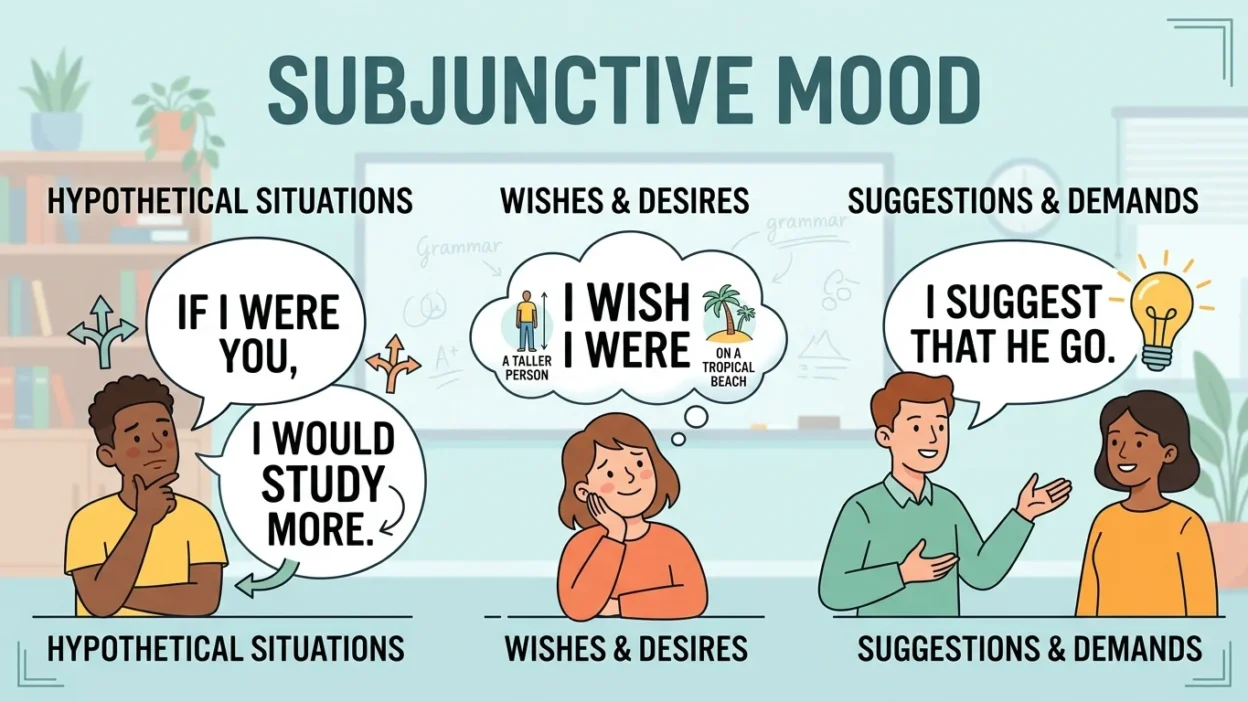
The subjunctive mood is a grammatical form used to talk about situations that are imagined, hypothetical, wished for, demanded, recommended, or contrary to fact. Unlike the indicative mood, which is normally used to state facts or ask ordinary questions, the subjunctive helps express ideas that are not being presented as straightforward facts. For example, “If I were you, I would apologize” uses the subjunctive because the speaker is imagining being another person.
The subjunctive mood can seem complicated because modern English does not always mark it with a special verb form. In many cases, it looks exactly like ordinary English. However, a few patterns are especially important, such as “If I were”, “I suggest that he go”, and “It is important that she be on time.” Learning these common structures makes the subjunctive much easier to recognize and use correctly.
Quick Answer
The subjunctive mood is used to express wishes, suggestions, demands, recommendations, hypothetical situations, and conditions that are not presented as ordinary facts. Common examples include “If I were you,” “I wish I were taller,” and “The teacher suggested that he study more.” English has several common subjunctive patterns.
Why Do People Find the Subjunctive Mood Confusing?
The subjunctive mood is confusing because English does not have one single verb ending that always identifies it.
For example:
She is here.
This is an ordinary statement of fact.
But:
I suggest that she be here by noon.
Here, be is part of a subjunctive construction.
In other cases, the subjunctive looks exactly like the ordinary base form:
They suggested that he leave.
The form leave does not look unusual, but it is being used in a subjunctive structure.
The subjunctive is therefore easier to understand as a function or grammatical mood rather than as one special verb form.
What Is the Subjunctive Mood?
A mood in grammar shows the speaker’s attitude toward an action or situation.
English has several grammatical moods, including:
- Indicative for statements and ordinary questions
- Imperative for commands and instructions
- Subjunctive for certain hypothetical, desired, recommended, or demanded situations
For example:
She is at home.
This is indicative.
Go home.
This is imperative.
I wish she were at home.
This uses the subjunctive.
The subjunctive allows speakers to move beyond simple statements of fact.
First Use: Hypothetical Situations
One of the most recognizable uses of the subjunctive is in hypothetical situations.
Consider:
If I were rich, I would travel the world.
The speaker is not saying that they are rich. They are imagining a situation.
The traditional subjunctive form is:
If I were…
rather than:
If I was…
For example:
If I were you, I would wait.
If he were here, he could help us.
If she were older, she could drive.
Second Use: Wishes
The subjunctive is also used after wish when talking about a situation that is contrary to reality or not true at the present time.
Examples:
I wish I were taller.
I wish she were here.
He wishes he were more confident.
The speaker is describing something they want to be different from reality.
Compare:
I am not taller.
I wish I were taller.
The second sentence expresses a wish rather than a fact.
Subjunctive “Were” vs “Was”
This is one of the most important points to learn.
In hypothetical or contrary-to-fact situations, traditional standard English uses were with all subjects:
If I were you…
If he were here…
If she were available…
If it were possible…
This is sometimes called the irrealis were or subjunctive were.
Comparison
| Situation | Example |
|---|---|
| Ordinary past statement | I was tired yesterday. |
| Hypothetical situation | If I were you, I would apologize. |
| Ordinary past statement | She was at home. |
| Hypothetical situation | I wish she were here. |
In informal speech, especially in some varieties of English, was may also be heard in hypothetical sentences:
If I was you…
However, If I were you remains the traditional and widely recommended form in careful English.
Third Use: Suggestions and Recommendations
The subjunctive can follow verbs and expressions that communicate suggestions, recommendations, requests, or demands.
For example:
I suggest that he leave early.
She recommended that we take a taxi.
They insisted that he be present.
The doctor recommended that she rest.
Notice that the verb after that uses the base form.
We do not say:
❌ I suggest that he leaves early.
In the subjunctive construction, standard American English generally uses:
I suggest that he leave early.
The Formula for the Mandative Subjunctive
A useful pattern is:
suggest/recommend/insist/request + that + subject + base verb
Examples:
They suggested that she wait.
I recommend that he apply.
The manager insisted that everyone be present.
The doctor advised that he get more rest.
The base verb stays the same even when the subject is he, she, or it.
Subjunctive “Be”
The verb be is especially noticeable in subjunctive constructions because it remains be rather than changing to is or are.
For example:
It is important that he be on time.
They demanded that she be informed.
The teacher insisted that everyone be quiet.
We recommend that the equipment be tested.
Compare:
He is on time.
with:
It is important that he be on time.
The second sentence expresses a requirement or recommendation.
Subjunctive Mood in Formal Expressions
Some fixed expressions commonly use the subjunctive.
Examples include:
Long live the king!
God bless you.
Heaven forbid!
So be it.
Be that as it may.
These expressions may sound formal, traditional, or literary, but they are useful examples of how the subjunctive survives in English.
15 Examples of the Subjunctive Mood
- If I were you, I would accept the offer.
- I wish I were more confident.
- If she were here, she could help us.
- He suggested that we leave early.
- The doctor recommended that she rest.
- They insisted that he be present.
- It is important that everyone be ready.
- I suggest that he take a break.
- She requested that the report be completed today.
- If it were possible, I would stay longer.
- I wish he were here.
- The manager demanded that the employee apologize.
- They recommended that we wait.
- It is essential that she follow the instructions.
- If I were in your position, I would think carefully.
Subjunctive Mood vs Indicative Mood
The indicative mood is normally used to state facts or ask ordinary questions.
She is at home.
The subjunctive mood can express a hypothetical or desired situation:
I wish she were at home.
The first sentence presents information as fact.
The second sentence expresses a wish.
| Mood | Purpose | Example |
|---|---|---|
| Indicative | Facts and ordinary questions | She is at home. |
| Imperative | Commands and instructions | Go home. |
| Subjunctive | Wishes, hypotheticals, recommendations, demands | I wish she were home. |
Subjunctive Mood vs Conditional Sentences
The subjunctive and conditional are closely related, but they are not exactly the same thing.
Consider:
If I were rich, I would travel.
Were expresses the hypothetical condition.
Would travel expresses the result.
The two forms work together to create a conditional sentence.
Another example:
If he were here, he would know what to do.
The were form is subjunctive, while would know expresses the conditional result.
Common Mistakes
1. Saying “If I was you”
You may hear:
If I was you…
in informal speech, but the traditional standard form is:
If I were you…
This is especially important in formal writing and careful English.
2. Adding “-s” after “suggest that”
A common mistake is:
❌ I suggest that he goes.
The traditional subjunctive construction is:
I suggest that he go.
3. Using “is” instead of “be”
For example:
❌ It is important that he is here.
In a mandative subjunctive construction, use:
It is important that he be here.
4. Thinking the subjunctive is only about “were”
Were is an important example, but it is not the whole subjunctive.
The subjunctive also appears in sentences such as:
I suggest that he leave.
It is essential that she be informed.
5. Thinking every “if” sentence uses the subjunctive
Not every conditional sentence requires the subjunctive.
For example:
If it rains, we will stay home.
This is a normal first conditional and uses the ordinary present form.
Compare:
If I were you, I would stay home.
This expresses a hypothetical situation and uses the subjunctive were.
Comparison Table: Common Subjunctive Patterns
| Pattern | Example | Purpose |
|---|---|---|
| If + were | If I were you… | Hypothetical situation |
| wish + were | I wish I were taller. | Present unreal wish |
| suggest + that + base verb | I suggest that he leave. | Suggestion |
| recommend + that + base verb | She recommended that we wait. | Recommendation |
| insist + that + base verb | They insisted that he be there. | Demand |
| important + that + base verb | It is important that she be ready. | Requirement |
| essential + that + base verb | It is essential that he follow the rules. | Necessity |
How to Recognize the Subjunctive Mood
Ask yourself these questions:
- Is the sentence describing something hypothetical?
- Is someone expressing a wish?
- Is someone making a recommendation or suggestion?
- Is there a demand, request, or requirement?
- Does were appear where was might normally be expected?
- Does a base verb appear after that following a suggestion or demand?
If the answer is yes, you may be looking at a subjunctive construction.
Memory Trick
Remember the three big ideas:
WISH → WERE
I wish I were taller.
IF → WERE
If I were you, I would wait.
SUGGEST → BASE VERB
I suggest that he go.
A simple memory sentence is:
Wish and hypothetical “if” often use WERE; suggestions and demands often use the BASE VERB.
American vs British English
The subjunctive exists in both American and British English, but there are some differences in frequency and style.
The mandative subjunctive, using the base verb after that, is especially common in American English:
I suggest that he go.
British English also uses this construction, particularly in formal writing, but British English may more often use an alternative construction with should:
I suggest that he should go.
Both forms are standard.
The hypothetical were is also used in both varieties:
If I were you, I would wait.
Similar Grammatical Terms
Indicative Mood
Used mainly for statements of fact and ordinary questions.
She is happy.
Imperative Mood
Used for commands and instructions.
Be quiet.
Conditional
Used to discuss possible or hypothetical results.
I would go if I had time.
Infinitive
The basic form of a verb often introduced by to.
to go
Base Form
The basic form of a verb without tense or subject endings.
go, take, leave, be
The subjunctive often uses the base form after certain expressions.
When Is the Subjunctive Mood Necessary?
The subjunctive is especially useful when you want to express:
- hypothetical situations
- wishes
- recommendations
- suggestions
- demands
- requirements
- urgency
- imagined conditions
- situations contrary to fact
For example:
If I were you, I would reconsider.
I wish she were here.
I recommend that he apply.
It is essential that everyone be ready.
Final Verdict
The subjunctive mood is used to express situations that are not presented as ordinary facts, including hypotheticals, wishes, suggestions, recommendations, demands, and requirements.
The two most useful patterns to remember are:
If I were you…
and:
I suggest that he go…
The subjunctive may look unusual because English often uses the base form of a verb instead of a special ending. Once you recognize these patterns, the mood becomes much easier to understand and use.
Frequently Asked Questions
What is the subjunctive mood in simple terms?
The subjunctive mood is a grammatical form used for things such as wishes, hypothetical situations, recommendations, demands, and situations that are not presented as ordinary facts.
What is an example of the subjunctive mood?
A common example is:
If I were you, I would apologize.
The form were expresses a hypothetical situation.
Is “If I were you” subjunctive?
Yes. If I were you is one of the most familiar examples of the English subjunctive mood.
Why do we say “If I were” instead of “If I was”?
In traditional standard English, were is used for hypothetical or contrary-to-fact situations:
If I were you…
The ordinary past form was is used for factual past situations:
I was tired yesterday.
What is the subjunctive after “suggest”?
After suggest that, standard English can use the base form of the verb:
I suggest that he leave.
She suggests that we wait.
This is called the mandative subjunctive.
Is “I suggest that he goes” wrong?
It depends on the variety and construction, but if you are deliberately using the subjunctive, the standard form is:
I suggest that he go.
Other grammatical constructions are possible, but go is the subjunctive form in this pattern.
Does British English use the subjunctive?
Yes. British English uses the subjunctive, although some constructions may be less frequent than in American English. British English also commonly uses should in some recommendation structures.
What are the most common examples of the subjunctive?
Common examples include:
If I were you…
I wish I were taller.
I suggest that he leave.
It is important that she be present.
They demanded that he apologize.
Remember This
The subjunctive mood is mainly about what is imagined, wished for, recommended, required, or contrary to ordinary fact.
Remember these four patterns:
Hypothetical:
If I were you…
Wish:
I wish I were taller.
Suggestion:
I suggest that he go.
Requirement:
It is important that she be ready.
If you understand these patterns, you already understand some of the most important uses of the English subjunctive.
Conclusion
The subjunctive mood may sound like a difficult grammar topic, but its most common uses are quite practical. It helps English speakers talk about imaginary situations, wishes, recommendations, demands, and requirements. The most recognizable example is “If I were you,” where were shows that the speaker is imagining a situation that is not literally true.
The subjunctive also appears after words such as suggest, recommend, insist, demand, and expressions such as “it is important that.” In these structures, English often uses the base form of the verb: “I suggest that he go” and “It is important that she be ready.” Learning these common patterns is much more useful than trying to memorize the subjunctive as one complicated rule.

Lucas Luke is a passionate language writer and content creator at SimileHive, specializing in similes, idioms, metaphors, and figurative language. He enjoys making complex English expressions simple, engaging, and easy to understand for students, writers, and language enthusiasts through well-researched, practical content.