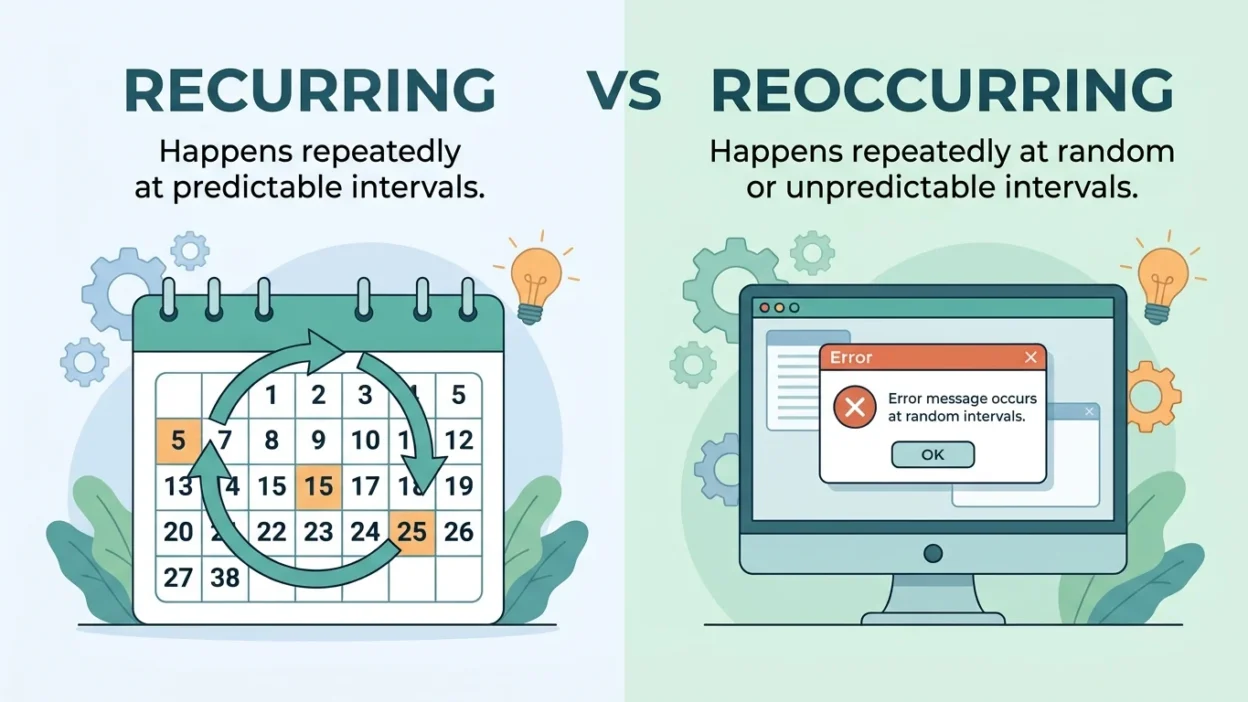
Recurring and reoccurring are both correct English words, but they are not always used in exactly the same way. Recurring usually describes something that happens repeatedly, especially when it happens regularly or follows a pattern.
Reoccurring means something that happens again after happening before, without necessarily suggesting a regular pattern. For example, a monthly meeting is a recurring meeting, while a problem that disappeared and then happened again may be described as a reoccurring problem.
The difference is subtle, and the two words can overlap in everyday English. The main distinction is that recurring often suggests repetition as a continuing or regular pattern, while reoccurring simply emphasizes that something has happened again. Choosing between them depends on what you want to emphasize: repeated regularity or happening again.
Quick Answer
Recurring means happening repeatedly, often regularly or according to a pattern. Reoccurring means happening again, especially after something has happened before. For example, “a recurring payment” happens regularly, while “a reoccurring problem” happens again after occurring previously. The words overlap, but recurring usually emphasizes repetition or regularity.
Why Do People Confuse “Recurring” and “Reoccurring”?
The confusion is understandable because both words are formed from the verb occur, meaning to happen.
They also both describe something that happens more than once.
The key difference is the emphasis:
- Recurring → happening repeatedly, often regularly
- Reoccurring → happening again
For example:
I have a recurring appointment every Monday.
The appointment happens according to a regular schedule.
Compare:
The problem reoccurred after we fixed it.
The problem happened again.
The distinction is not absolute. In many situations, either word may be understood correctly, and dictionaries acknowledge overlap between their meanings.
First Word: Recurring
Recurring means happening repeatedly or regularly.
It comes from recur, which means to happen again, especially repeatedly.
Examples include:
a recurring payment
a recurring meeting
a recurring problem
a recurring theme
a recurring event
The word often suggests that something is part of a repeated pattern.
For example:
We have a recurring meeting every Friday.
The meeting happens repeatedly on a regular schedule.
Second Word: Reoccurring
Reoccurring means happening again.
It comes from reoccur, which combines re-, meaning “again,” with occur, meaning “happen.”
For example:
The same error is reoccurring.
This means the error is happening again.
The word does not necessarily tell us that the event follows a predictable schedule.
For example:
The problem disappeared for several months but is now reoccurring.
The focus is on the problem happening again.
Recurring vs Reoccurring: The Main Difference
| Word | Main Meaning | Main Emphasis | Example |
|---|---|---|---|
| Recurring | Happening repeatedly | Repetition or regular pattern | We have a recurring meeting every Monday. |
| Reoccurring | Happening again | Return of a previous event | The problem is reoccurring. |
A useful shortcut is:
Recurring = repeated pattern
Reoccurring = happening again
However, this is a guideline rather than an absolute grammatical rule.
When Should You Use “Recurring”?
Use recurring when something happens repeatedly, especially when there is a pattern, cycle, or regular schedule.
It is especially common with:
- recurring payments
- recurring meetings
- recurring events
- recurring themes
- recurring symptoms
- recurring problems
- recurring dreams
- recurring costs
- recurring tasks
- recurring issues
For example:
The company charges a recurring fee every month.
We need to discuss this recurring issue.
The novel has a recurring theme of friendship.
When Should You Use “Reoccurring”?
Use reoccurring when you want to emphasize that something has happened again after occurring previously.
For example:
The software problem is reoccurring.
This emphasizes that the problem has returned.
Another example:
The error disappeared after the update but is now reoccurring.
The focus is on the error happening again.
Reoccurring is less common than recurring, but it is a legitimate word.
Recurring Problem vs Reoccurring Problem
Both phrases can be correct, but the emphasis can differ.
Recurring problem
We need to solve this recurring problem.
This suggests a problem that repeatedly occurs, perhaps as part of an ongoing pattern.
Reoccurring problem
The problem stopped for a few months but is now reoccurring.
This emphasizes that the problem has returned.
In everyday communication, people may use the two expressions interchangeably.
Recurring Payment vs Reoccurring Payment
Recurring payment is the standard and much more natural phrase when a payment is automatically made on a regular schedule.
For example:
I canceled my recurring payment.
This is a recurring monthly payment.
A recurring payment is normally associated with a predictable schedule, such as weekly, monthly, or annually.
Reoccurring payment is possible in a literal sense, but it is generally not the preferred expression for a scheduled payment.
Recurring Event vs Reoccurring Event
A recurring event is an event that happens repeatedly, often according to a schedule.
The conference is a recurring event held every year.
If you are simply emphasizing that an event happened again, reoccurring may be possible:
The same issue was reoccurring during this year’s event.
The first sentence describes a repeated event or tradition. The second describes something happening again.
Recurring vs Reoccurring: 15 Examples
- The company has a recurring meeting every Monday.
- I forgot to cancel my recurring subscription.
- The report identifies several recurring problems.
- The novel contains a recurring theme of loss.
- We need to reduce our recurring expenses.
- She has a recurring appointment every month.
- The same error is reoccurring after the update.
- The issue disappeared but is now reoccurring.
- The problem is recurring despite several attempts to fix it.
- We noticed a recurring pattern in the data.
- The annual festival is a recurring event.
- His computer problem keeps reoccurring.
- The company has several recurring costs.
- The same complaint is reoccurring among customers.
- The story contains several recurring characters.
Recurring vs Reoccurring in a Sentence
The choice depends on what you want to communicate.
Use recurring for a pattern
The company has recurring expenses.
This means the expenses happen repeatedly, usually on a regular basis.
Use reoccurring for something happening again
The technical problem is reoccurring.
This emphasizes that the problem has happened again.
Use recurring when both meanings are possible
We are experiencing a recurring problem.
This is natural and commonly used.
Common Mistakes
1. Thinking “reoccurring” is incorrect
Reoccurring is a real English word.
It is less common than recurring, but it is not automatically wrong.
2. Thinking the words are always interchangeable
They can overlap, but recurring often suggests repeated or regular occurrence, while reoccurring emphasizes something happening again.
3. Using “reoccurring” for scheduled payments
For regular automatic charges, recurring payment is the standard choice.
I canceled my recurring payment.
4. Assuming “recurring” always means perfectly regular
Recurring does not necessarily mean something happens at exactly fixed intervals.
For example:
She has recurring headaches.
The headaches happen repeatedly, but they may not occur on a precise schedule.
5. Confusing “reoccur” with “recur”
Both verbs describe something happening again, but recur often carries the idea of repeated occurrence or a pattern.
The problem recurred several times.
The problem reoccurred after we thought it had been solved.
Comparison Table: Related Forms
| Word | Meaning | Example |
|---|---|---|
| Recur | Happen repeatedly or return | The problem may recur. |
| Recurred | Happened repeatedly or returned | The issue recurred last year. |
| Recurring | Happening repeatedly | A recurring problem |
| Reoccur | Happen again | The error may reoccur. |
| Reoccurred | Happened again | The error reoccurred. |
| Reoccurring | Happening again | A reoccurring error |
Recurring vs Reoccurring in Formal Writing
Both words can be used in formal writing, but recurring is usually the more natural and established choice when describing repeated patterns.
For example:
The study identified several recurring patterns.
This sounds natural in academic and professional writing.
If you specifically want to emphasize that something has returned after occurring previously, reoccurring can be useful:
The researchers observed a reoccurring error after the procedure was repeated.
When you are unsure, recurring is often the safer and more concise choice.
Memory Trick
Remember:
RECURRING = REPEATED
Think of something that keeps coming back as part of a pattern.
recurring meetings
recurring payments
recurring themes
REOCCURRING = OCCURRING AGAIN
Think:
It happened before, and now it has happened again.
A simple memory sentence is:
Recurring repeats; reoccurring returns.
American vs British English
Recurring and reoccurring are used in both American and British English.
There is no major difference in their basic meanings between the two varieties.
However, recurring is generally more common and more widely established in everyday, business, academic, and professional writing.
For example, both American and British speakers commonly use:
recurring payment
recurring problem
recurring theme
recurring event
Similar Words
Repeated
Something that happens more than once.
This is a repeated problem.
Regular
Something that happens according to a consistent pattern or schedule.
We have regular meetings.
Periodic
Something that happens at intervals.
The system requires periodic maintenance.
Recurrent
Something that happens repeatedly or returns.
He experienced recurrent problems.
Frequent
Something that happens often.
Frequent errors slowed the process.
Ongoing
Something that continues to happen or develop.
The investigation is ongoing.
Repeatedly
Something happening again and again.
The system failed repeatedly.
Recurring vs Recurrent
Recurring and recurrent are very similar.
Both can mean happening repeatedly or returning.
For example:
recurring problems
recurrent problems
Both are possible.
However, recurrent is often more formal or technical, particularly in fields such as medicine, science, and academic writing.
Recurring is more common in everyday language.
Final Verdict
Recurring and reoccurring are both correct words, but recurring is usually the better choice when you mean something that happens repeatedly, especially as part of a pattern or regular cycle.
Use reoccurring when you specifically want to emphasize that something has happened again after happening previously.
For example:
We have a recurring meeting every Friday.
The technical problem is reoccurring after the update.
When in doubt, recurring is generally the more natural and widely used option.
Frequently Asked Questions
What is the difference between recurring and reoccurring?
Recurring usually means happening repeatedly, often as part of a pattern. Reoccurring means happening again after occurring previously. The meanings overlap, but the emphasis can differ.
Is reoccurring a real word?
Yes. Reoccurring is a legitimate English word meaning happening again. It is less common than recurring.
Which is correct, recurring or reoccurring?
Both are correct, depending on the intended meaning. Recurring is generally preferred for repeated or regular events, while reoccurring can emphasize something happening again.
Is it recurring payment or reoccurring payment?
Recurring payment is the standard and more natural expression for a payment that occurs regularly, such as a monthly subscription charge.
Is recurring the same as repeated?
They are very similar. Recurring often suggests that something repeatedly happens or returns, while repeated simply means something happened more than once.
Can recurring mean happening again?
Yes. Recurring can mean happening again and again or returning. It often suggests repetition rather than a single second occurrence.
Is recurring more common than reoccurring?
Yes. Recurring is considerably more common in general English and is especially common in phrases such as recurring payment, recurring problem, recurring theme, and recurring event.
What is the difference between recurrent and recurring?
Both generally mean happening repeatedly or returning. Recurrent is often more formal or technical, while recurring is more common in everyday English.
Remember This
Recurring = happening repeatedly, often in a pattern.
a recurring payment
a recurring meeting
a recurring problem
Reoccurring = happening again.
The error is reoccurring.
The easiest rule is:
Recurring repeats. Reoccurring happens again.
When describing regular payments, meetings, events, or patterns, recurring is usually the best choice.
Conclusion
Recurring and reoccurring are closely related words, which is why they are often confused. Both describe something happening more than once, but recurring usually emphasizes repetition, continuation, or a pattern. Reoccurring puts more emphasis on something happening again after it occurred before.
In everyday and professional English, recurring is generally the more common and natural choice. It works especially well for expressions such as recurring payments, recurring meetings, recurring expenses, recurring problems, and recurring themes.
Use reoccurring when you specifically want to highlight the return of something that happened previously. Although the distinction is subtle and the words sometimes overlap, understanding the difference can help you choose the most precise expression.

Charles Kevin is a passionate language writer and researcher at SimileHive, creating clear, engaging content about similes, idioms, metaphors, and figurative language to help readers improve English communication confidently every day.