Jibe and jive are two English words that are often confused because they sound similar and, in some contexts, can appear to have similar meanings. However, they have different traditional meanings and uses.
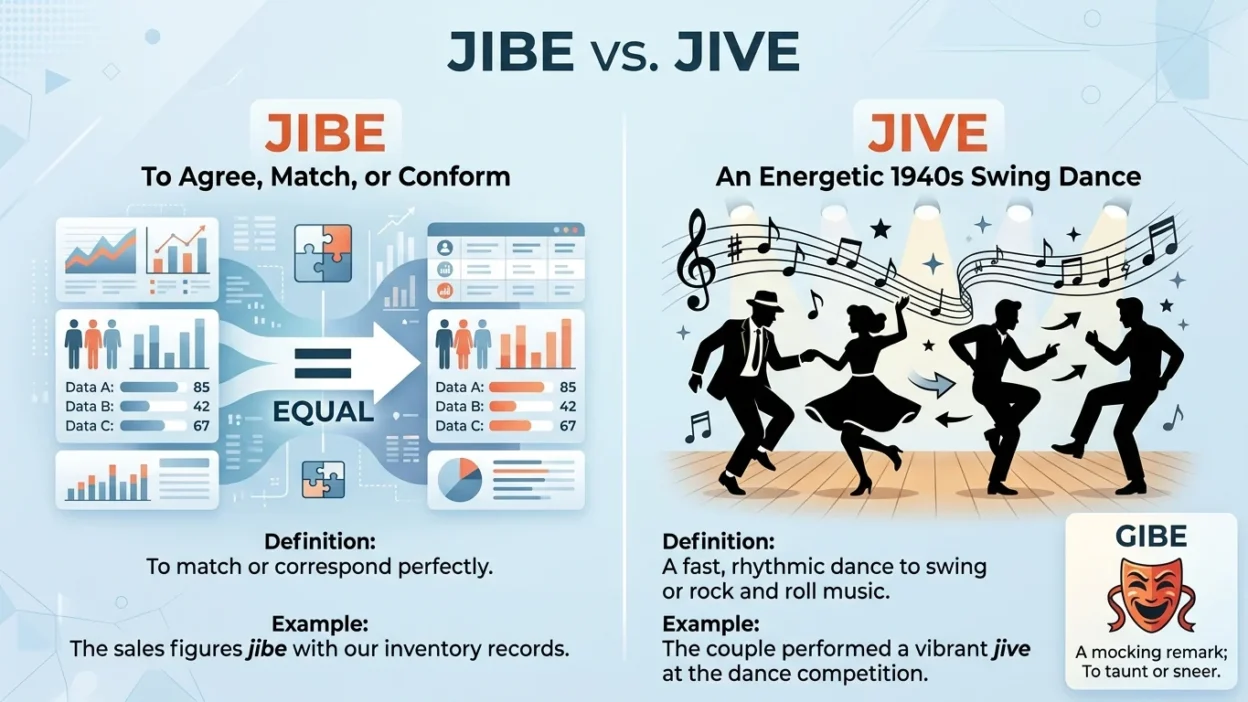
Jibe can mean to agree, correspond, or fit with something, while jive can refer to a lively style of music and dance or, informally, to misleading or insincere talk. For example, “His explanation doesn’t jibe with the evidence” means his explanation does not agree with the evidence.
The confusion becomes greater because jive is sometimes used informally in American English in the sense of “agree” or “correspond,” a use traditionally associated with jibe. This overlap means you may encounter both forms in real world writing.
Still, if you want to make the clearest traditional distinction, use jibe for agreement or correspondence and jive for music, dancing, or certain kinds of insincere talk.
Quick Answer
Jibe and jive have different traditional meanings. Jibe means to agree, correspond, or be consistent with something, as in “Her story doesn’t jibe with the facts.” Jive refers to a style of music and dance and can also mean misleading or insincere talk. In careful usage, choose the word according to its meaning.
Why Do People Confuse “Jibe” and “Jive”?
The main reason is pronunciation.
In many varieties of English, jibe and jive are pronounced similarly enough to cause confusion in speech. Their spellings are also only one letter apart.
There is another reason: jive has sometimes been used informally to mean “agree” or “correspond,” overlapping with the traditional meaning of jibe.
For example:
The results jibe with the earlier research.
Here, jibe means agree or correspond.
You may also encounter:
The results jive with the earlier research.
This usage exists, but jibe is the more traditional choice for this meaning.
First Word: Jibe
Jibe has several meanings, but one of the most important is to agree, correspond, or be consistent with something.
For example:
His explanation doesn’t jibe with the evidence.
This means:
His explanation does not agree with the evidence.
Jibe can also be a sailing term referring to a maneuver in which a sailing vessel turns so that the stern passes through the wind.
There is also the word gibe, which means a mocking or sarcastic remark. This is a different word from jibe.
Second Word: Jive
Jive has several meanings.
It can refer to:
- a lively style of music
- a style of dance associated with that music
- informal or misleading talk
- something considered insincere or deceptive in certain expressions
For example:
They danced the jive all night.
Here, jive refers to the dance.
It can also appear in the expression:
Don’t give me that jive.
Here, jive refers to insincere, misleading, or nonsensical talk.
Jibe vs Jive: The Main Difference
| Word | Main Meaning | Example |
|---|---|---|
| Jibe | Agree, correspond, or be consistent | His story doesn’t jibe with the facts. |
| Jive | A style of music or dance | They learned how to jive. |
| Jive | Insincere or misleading talk | I don’t believe that jive. |
| Jibe | A sailing maneuver | The boat jibed in the strong wind. |
The easiest distinction is:
Jibe = agree or correspond
Jive = dance, music, or certain informal talk
When Should You Use “Jibe”?
Use jibe when you mean agree, correspond, match, or be consistent.
It is often followed by with.
Examples
His account doesn’t jibe with the evidence.
The numbers jibe with our expectations.
Her explanation doesn’t jibe with what we were told.
The witness’s statement jibes with the police report.
In these examples, jibe means that two pieces of information are compatible or consistent.
When Should You Use “Jive”?
Use jive when you are talking about the music or dance.
For example:
She learned to jive at dance school.
They played some classic jive music.
The couple performed a lively jive.
You can also use jive as an informal noun referring to deceptive, insincere, or meaningless talk:
I don’t believe that jive.
This use is informal and can sound dated depending on the context.
15 Examples of “Jibe”
- His story doesn’t jibe with the evidence.
- Her explanation doesn’t jibe with the facts.
- The results jibe with our earlier findings.
- His statement jibes with what the witness said.
- The numbers don’t jibe with the report.
- Their accounts jibe with each other.
- The evidence jibes with the original theory.
- Her description doesn’t jibe with the photograph.
- The information jibes with what we already know.
- His version of events doesn’t jibe with the timeline.
- The new data jibe with our expectations.
- Their stories don’t jibe with each other.
- The explanation jibes with the available evidence.
- The figures don’t jibe with the official records.
- Everything he said jibed with the facts.
15 Examples of “Jive”
- They learned how to jive at the dance class.
- The dancers performed a lively jive.
- She loves jive music.
- The couple danced the jive beautifully.
- He took lessons in jive dancing.
- The band played a fast jive tune.
- They spent the evening dancing the jive.
- She is an excellent jive dancer.
- The competition included a jive routine.
- The dancers performed an energetic jive.
- He doesn’t believe all that jive.
- Stop giving me that jive.
- I don’t have time for that kind of jive.
- The speech sounded like political jive to him.
- She could tell that the salesman’s story was just jive.
Does “Jive” Also Mean “Agree”?
You may see jive used to mean agree, correspond, or be consistent, especially in informal American English.
For example:
His story doesn’t jive with the evidence.
This usage is found in actual English usage, but jibe is traditionally preferred when the intended meaning is “agree or correspond.”
Therefore, if you are writing carefully and want to avoid criticism, the safest choice is:
The facts don’t jibe with his story.
rather than:
The facts don’t jive with his story.
This distinction is particularly useful in formal or academic writing.
Jibe vs Jive vs Gibe
There is a third word that causes even more confusion: gibe.
These three words have different traditional meanings.
| Word | Meaning | Example |
|---|---|---|
| Jibe | Agree or correspond | His story doesn’t jibe with the evidence. |
| Jive | Music, dance, or insincere talk | They danced the jive. |
| Gibe | A mocking or sarcastic remark | He made a gibe about her mistake. |
Remember:
Jibe = agree
Jive = dance/music
Gibe = mock
“Jibe With” or “Jibe to”?
The standard construction for the meaning agree or correspond is:
jibe with
For example:
His explanation doesn’t jibe with the facts.
The evidence jibes with the theory.
Jibe with is the natural expression when comparing two things for consistency.
Common Mistakes
1. Using “jive” when you mean “agree”
If you mean agree or correspond, the traditional choice is:
The facts jibe with his explanation.
Not:
The facts jive with his explanation.
Although the latter can be found in informal usage, jibe is the safer choice in careful writing.
2. Using “jibe” for dancing
When talking about the dance, use:
They danced the jive.
Not:
❌ They danced the jibe.
3. Confusing “jibe” with “gibe”
A gibe is a mocking or sarcastic remark.
He made a gibe about my mistake.
A jibe can mean agreement or correspondence.
His story doesn’t jibe with the evidence.
4. Forgetting “with”
When jibe means agree or correspond, it is commonly used with with.
The facts jibe with his explanation.
Comparison Table: Jibe, Jive, and Gibe
| Word | Meaning | Common Use |
|---|---|---|
| Jibe | Agree or correspond | The story jibes with the evidence. |
| Jive | Dance or music style | They danced the jive. |
| Jive | Insincere or misleading talk | That’s just jive. |
| Gibe | Mocking or sarcastic remark | He made a gibe. |
Memory Trick
Use this simple trick:
JIBE = JOIN IN AGREEMENT
Think:
Jibe = things fit together.
JIVE = JAZZ, MUSIC, AND DANCE
Think:
Jive = dancing and lively music.
GIBE = GRINNING MOCKERY
Think:
Gibe = a mocking comment.
The most important pair to remember is:
Jibe = agree
Jive = dance
American vs British English
The traditional meanings of jibe and jive are generally recognized in both American and British English.
However, the informal use of jive meaning “agree” or “correspond” is particularly associated with American usage and is well established enough to appear in dictionaries and edited sources.
If you want the clearest and least controversial choice when writing about agreement or consistency, use:
jibe with
For the dance or music style, use:
jive
Similar Words
Agree
To have the same opinion or accept that something is true.
I agree with your explanation.
Correspond
To be similar, compatible, or consistent.
The results correspond with the earlier findings.
Match
To be the same or compatible.
The evidence matches his story.
Fit
To be consistent or suitable.
That explanation doesn’t fit the facts.
Gibe
A mocking or sarcastic remark.
His comment was a gibe.
Dance
To move rhythmically, often to music.
They danced all night.
Jibe vs Jive: Which One Should You Use?
If you mean “agree,” “match,” or “be consistent with,” use jibe:
The facts jibe with the evidence.
If you mean the dance or music style, use jive:
They performed a lively jive.
If you mean a mocking remark, use gibe:
He made a sarcastic gibe.
This three-word distinction will prevent most common mistakes.
Final Verdict
Jibe and jive are not normally interchangeable.
Use jibe when you mean agree, correspond, or be consistent, especially in the common phrase jibe with.
Use jive when you mean a style of music or dance, or when referring informally to insincere or misleading talk.
Although jive is sometimes used to mean agree or correspond, jibe remains the clearest traditional choice for that meaning.
And remember the third word, gibe, which means a mocking or sarcastic remark.
Frequently Asked Questions
What is the difference between jibe and jive?
Jibe traditionally means agree, correspond, or be consistent, while jive refers to a style of music or dance and can also mean insincere or misleading talk.
Is it “jibe with” or “jive with”?
For the meaning agree or correspond, jibe with is the traditional and safest choice.
The facts jibe with the evidence.
Does jive mean agree?
Jive is sometimes used informally to mean agree or correspond, particularly in American English. However, jibe is traditionally preferred for this meaning.
Is “jive” a dance?
Yes. Jive is a lively style of dance and also refers to the associated style of music.
What does “jibe with” mean?
Jibe with means agree with, correspond to, or be consistent with something.
His story doesn’t jibe with the evidence.
What is the difference between jibe and gibe?
Jibe can mean agree or correspond. Gibe means a mocking or sarcastic remark.
Is jibe formal or informal?
The use of jibe meaning agree or correspond is standard and can be used in formal writing. The sailing meaning is also standard.
Is “jive with” wrong?
It is found in actual English usage, particularly informally, with the meaning agree or correspond. However, jibe with is the traditional choice and is preferable when you want the clearest standard usage.
Remember This
Jibe = agree or correspond
The facts jibe with the evidence.
Jive = dance or music
They danced the jive.
Gibe = mocking remark
He made a gibe about my mistake.
If you remember these three meanings, you can easily distinguish the words.
Conclusion
Jibe and jive are commonly confused because they sound similar and have overlapping usage in some contexts. Traditionally, however, jibe means to agree, correspond, or be consistent, while jive refers primarily to a lively style of music and dance. Jive can also refer to insincere or misleading talk in informal usage.
The safest choice is simple: use jibe with when you mean that two things agree or correspond, and use jive when talking about the dance or music. Also remember gibe, which means a mocking or sarcastic remark. Keeping these three meanings separate will make your writing clearer and more precise.

Lucas Luke is a passionate language writer and content creator at SimileHive, specializing in similes, idioms, metaphors, and figurative language. He enjoys making complex English expressions simple, engaging, and easy to understand for students, writers, and language enthusiasts through well-researched, practical content.