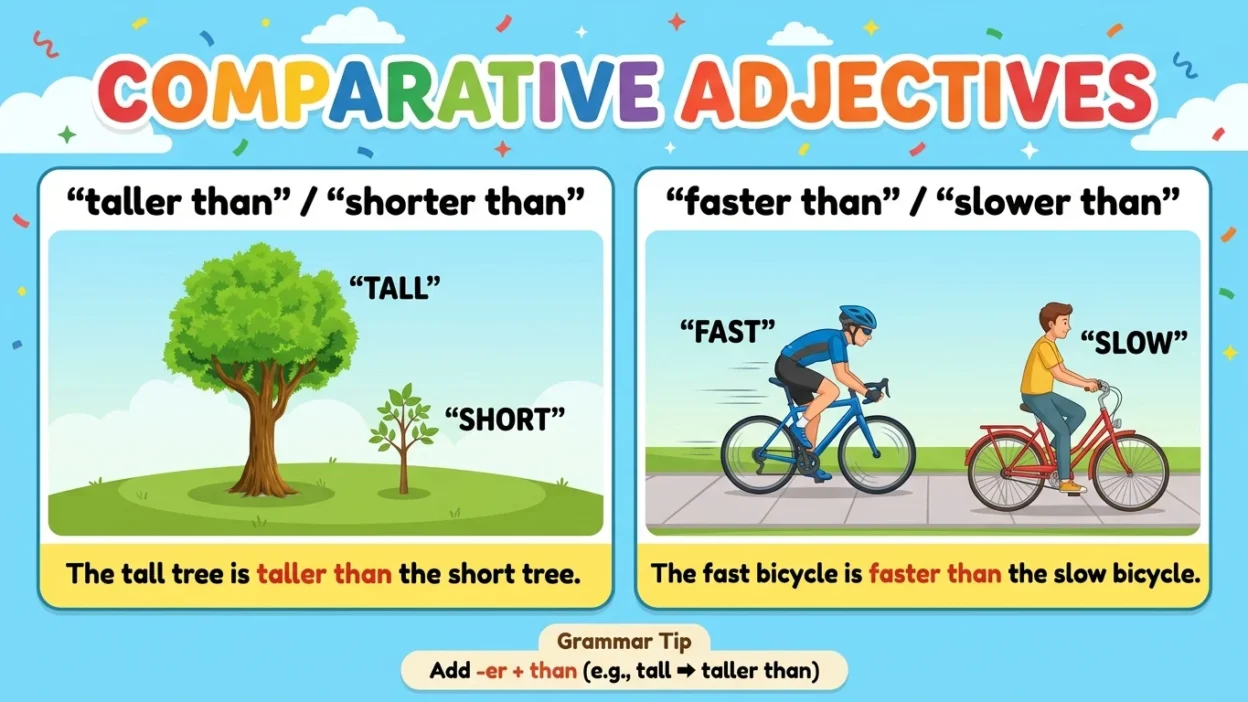
Comparative adjectives are an essential part of English grammar because they help us compare two people, places, things, or situations. Words such as taller, smaller, better, and more interesting allow us to explain how one thing differs from another. If you are writing an essay, having a conversation, or learning English as a second language, understanding comparative adjectives will help you communicate more clearly.
A comparative adjective describes a difference between two people or things in terms of qualities such as size, age, height, speed, beauty, or importance. For example, “Ali is taller than Ahmed” compares the height of two people, while “This book is more interesting than that one” compares two books.
Comparative adjectives follow several spelling and grammar rules, including adding -er to many short adjectives and using more with many longer adjectives. This guide explains these rules, provides practical examples, and shows you how to avoid common mistakes.
Quick Answer: What Is a Comparative Adjective?
A comparative adjective is a word or phrase used to compare the qualities of two people, places, things, or situations. Examples include taller, faster, smaller, better, and more expensive. Comparative adjectives often appear with the word than, as in “My car is faster than yours.” Their form depends on the adjective, so some take -er, while others use more or have irregular forms.
Why Are Comparative Adjectives Important?
Comparative adjectives help us express differences and similarities more precisely. Without them, it would be difficult to explain whether one thing is bigger, cheaper, faster, or more useful than another.
Consider these examples:
- Positive adjective: Sara is tall.
- Comparative adjective: Sara is taller than Mina.
- Positive adjective: This phone is expensive.
- Comparative adjective: This phone is more expensive than that one.
The first sentence in each pair describes a quality. The second compares two people or things.
Comparative adjectives are commonly used in conversations, school assignments, product reviews, business writing, and everyday decisions.
1. What Is a Comparative Adjective?
A comparative adjective is a form of an adjective that expresses a difference in a quality between two people, things, places, or situations.
For example:
- My brother is older than me.
- This road is wider than the other road.
- English is easier for her than mathematics.
- This laptop is more powerful than my old one.
The bold words are comparative adjectives because they compare qualities.
Comparative Adjectives vs. Positive Adjectives
A positive adjective describes a quality without making a comparison.
Examples:
- The room is small.
- The water is cold.
- The story is interesting.
A comparative adjective compares that quality with another.
Examples:
- This room is smaller than the other room.
- The water is colder than yesterday.
- This story is more interesting than the previous one.
The positive form is the basic adjective, while the comparative form indicates a difference.
2. How to Form Comparative Adjectives
The form of a comparative adjective depends on the adjective’s spelling and length. The following rules cover the most common patterns.
Rule 1: Add -er to Many Short Adjectives
For many one-syllable adjectives, add -er to form the comparative.
| Positive adjective | Comparative adjective |
|---|---|
| Tall | Taller |
| Short | Shorter |
| Fast | Faster |
| Small | Smaller |
| Long | Longer |
| Cold | Colder |
| Young | Younger |
| Cheap | Cheaper |
Examples:
- A cheetah is faster than a horse.
- My younger sister is taller than she was last year.
- This bag is cheaper than that one.
Rule 2: Add -r to Adjectives Ending in Silent e
If an adjective ends in a silent e, add -r rather than another -er.
| Positive adjective | Comparative adjective |
|---|---|
| Nice | Nicer |
| Large | Larger |
| Wide | Wider |
| Safe | Safer |
| Fine | Finer |
| Cute | Cuter |
Examples:
- This park is larger than the other park.
- The new road is wider than the old road.
- This route is safer than the alternative.
Rule 3: Double the Final Consonant in Some Short Adjectives
For certain short adjectives ending in a consonant preceded by a single vowel, double the final consonant before adding -er.
| Positive adjective | Comparative adjective |
|---|---|
| Big | Bigger |
| Hot | Hotter |
| Thin | Thinner |
| Fat | Fatter |
| Sad | Sadder |
| Wet | Wetter |
Examples:
- Today is hotter than yesterday.
- This box is bigger than that one.
- The blue line is thinner than the red line.
This rule does not apply to every adjective. Spelling patterns and pronunciation matter.
Rule 4: Change y to i and Add -er
When an adjective ends in a consonant followed by y, change the y to i before adding -er.
| Positive adjective | Comparative adjective |
|---|---|
| Happy | Happier |
| Easy | Easier |
| Busy | Busier |
| Heavy | Heavier |
| Early | Earlier |
| Friendly | Friendlier |
Examples:
- She looks happier today.
- This exercise is easier than the previous one.
- The traffic is heavier in the morning.
If a vowel comes before the y, the spelling usually stays the same, as in gray → grayer.
Rule 5: Use More with Many Longer Adjectives
For many adjectives with two or more syllables, use more before the adjective instead of adding -er.
| Positive adjective | Comparative adjective |
|---|---|
| Beautiful | More beautiful |
| Expensive | More expensive |
| Interesting | More interesting |
| Difficult | More difficult |
| Comfortable | More comfortable |
| Important | More important |
| Reliable | More reliable |
Examples:
- This painting is more beautiful than that one.
- The new computer is more expensive than the old one.
- This lesson is more difficult than yesterday’s lesson.
Some two-syllable adjectives allow either form, such as cleverer and more clever. The most natural form can depend on the adjective and the variety of English.
Rule 6: Use Irregular Comparative Forms
Some common adjectives do not follow the usual spelling rules. Their comparative forms must be learned individually.
| Positive adjective | Comparative adjective |
|---|---|
| Good | Better |
| Bad | Worse |
| Far | Farther or further |
| Little | Less |
| Much | More |
| Many | More |
Examples:
- This solution is better than the previous one.
- The weather is worse than it was yesterday.
- We need less time than we expected.
- She has more experience than I do.
For distance, farther often refers to physical distance, while further can refer to additional distance or figurative advancement. Both are used for physical distance in modern English.
Comparative Adjectives: Rules at a Glance
| Adjective pattern | Rule | Example |
|---|---|---|
| Many short adjectives | Add -er | Fast → faster |
| Ends in silent e | Add -r | Nice → nicer |
| Short vowel plus final consonant | Often double the consonant and add -er | Big → bigger |
| Consonant plus y | Change y to i and add -er | Happy → happier |
| Many longer adjectives | Use more | Careful → more careful |
| Irregular adjective | Use its special form | Good → better |
3. How to Use Comparative Adjectives in Sentences
Comparative adjectives often appear in sentences that compare two people or things. The word than commonly introduces the second part of the comparison.
Comparative Adjective + Than
Examples:
- My house is bigger than yours.
- A train is usually faster than a bicycle.
- This exercise is easier than the last one.
- Her explanation is clearer than mine.
- The new model is more efficient than the older model.
The general pattern is:
Subject + verb + comparative adjective + than + comparison.
For example: “This road is wider than that road.”
Comparisons Without Than
The word than is common, but it is not always necessary. The second person or thing may be understood from the context.
Examples:
- Which is better?
- I feel much happier now.
- The weather is getting colder.
- This version is more reliable.
These sentences still use comparative adjectives even though they do not explicitly name the second item.
Using Comparative Adjectives with Intensifiers
Words such as much, far, a little, slightly, and considerably can modify comparative adjectives.
Examples:
- This bag is much heavier than mine.
- Her new job is far better than her previous one.
- The second question is slightly easier.
- This route is considerably shorter.
- My room is a little warmer today.
These words explain how large or small the difference is.
4. Comparative Adjectives vs. Superlative Adjectives
Comparative and superlative adjectives are related, but they serve different purposes.
A comparative adjective generally compares two people or things. A superlative adjective identifies the person or thing with the highest or lowest degree of a quality within a group.
| Positive | Comparative | Superlative |
|---|---|---|
| Tall | Taller | Tallest |
| Small | Smaller | Smallest |
| Fast | Faster | Fastest |
| Happy | Happier | Happiest |
| Beautiful | More beautiful | Most beautiful |
| Expensive | More expensive | Most expensive |
| Good | Better | Best |
| Bad | Worse | Worst |
Examples:
- Comparative: Ahmed is taller than Bilal.
- Superlative: Ahmed is the tallest student in the class.
The comparative compares Ahmed with Bilal. The superlative identifies Ahmed as the tallest within the class.
5. Comparative Adjectives vs. Comparative Adverbs
Comparative adjectives describe nouns, while comparative adverbs describe verbs or explain how an action happens.
Examples:
- Comparative adjective: She is faster than her brother.
- Comparative adverb: She runs faster than her brother.
In the first sentence, faster describes the person. In the second, it describes how she runs.
More examples:
- Adjective: This explanation is clearer than the previous one.
- Adverb: He explained the topic more clearly than I did.
Recognizing the difference helps you choose the right word form for your sentence.
6. Common Mistakes with Comparative Adjectives
Mistake 1: Using More and -er Together
Incorrect: This book is more easier than that one.
Correct: This book is easier than that one.
Do not normally use more and the -er form together for the same adjective.
Mistake 2: Using the Wrong Irregular Form
Incorrect: This result is gooder than the last one.
Correct: This result is better than the last one.
The comparative form of good is better, not gooder.
Mistake 3: Forgetting the Spelling Change
Incorrect: She is happyer now.
Correct: She is happier now.
When an adjective ends in a consonant plus y, change y to i before adding -er.
Mistake 4: Confusing Comparative and Superlative Forms
Incorrect: She is the taller student in the class.
Correct: She is the tallest student in the class.
When identifying the highest degree of a quality in a group of three or more, use the superlative form when appropriate.
Mistake 5: Using Than Incorrectly
Incorrect: My car is faster then yours.
Correct: My car is faster than yours.
Use than for comparisons. Then usually refers to time, sequence, or what happens next.
Mistake 6: Assuming Every Long Adjective Uses More
Many longer adjectives use more, but some two-syllable adjectives form comparatives with -er, such as happy → happier and narrow → narrower. Learn the common patterns and check unfamiliar words when needed.
7. Ten Examples of Comparative Adjectives
Here are ten practical examples of comparative adjectives in everyday English.
- My brother is taller than I am.
- This road is wider than the old one.
- Today is colder than yesterday.
- Her new phone is more expensive than mine.
- This question is easier than the previous question.
- The blue bag is heavier than the red bag.
- Your explanation is clearer than mine.
- This restaurant is better than the one we visited last week.
- The second movie was more interesting than the first.
- Our new office is more comfortable than the old one.
Each sentence compares two people, objects, experiences, or situations.
8. How to Teach Comparative Adjectives to Beginners
Comparative adjectives are easier to learn when students compare familiar objects and experiences.
Use Real Objects
Show students two objects that differ in size, weight, or length.
Examples:
- This pencil is longer than that pencil.
- This bag is heavier than that bag.
- This box is bigger than that box.
Compare Pictures
Use pictures of animals, buildings, or vehicles to practise comparisons.
Examples:
- An elephant is bigger than a goat.
- A bicycle is slower than a car.
- A skyscraper is taller than a house.
Encourage Students to Make Their Own Sentences
Ask students to compare two familiar things.
Prompts could include:
- Compare two friends’ heights.
- Compare two school subjects.
- Compare two mobile phones.
- Compare summer and winter.
This approach helps students understand the meaning of comparative adjectives instead of simply memorizing their forms.
Memory Trick: How to Remember Comparative Adjectives
Use this simple rule:
Short adjective: often add -er. Longer adjective: often use more.
Examples:
- Tall → taller
- Fast → faster
- Happy → happier
- Beautiful → more beautiful
- Expensive → more expensive
Remember the irregular forms separately:
- Good → better
- Bad → worse
- Much or many → more
- Little → less
When comparing two people or things, than is often the word that connects the comparison.
Example: “My new laptop is faster than my old one.”
American vs. British English
Comparative adjective rules are largely the same in American and British English. Both varieties use forms such as taller, happier, better, and more expensive.
Some spelling and usage preferences may vary. For example, cleverer and more clever are both possible, and writers may differ in which form sounds most natural. The use of farther and further can also vary, especially when discussing physical distance.
| Example | American English | British English |
|---|---|---|
| Tall | Taller | Taller |
| Happy | Happier | Happier |
| Good | Better | Better |
| Expensive | More expensive | More expensive |
| Clever | Cleverer or more clever | Cleverer or more clever |
The fundamental grammar rules remain consistent across both varieties.
Similar Grammar Terms
Comparative adjectives are related to several other grammar concepts.
| Grammar term | Meaning | Example |
|---|---|---|
| Positive adjective | Describes a quality without comparison | Tall |
| Comparative adjective | Compares qualities | Taller |
| Superlative adjective | Expresses the highest or lowest degree within a group | Tallest |
| Comparative adverb | Compares how actions are performed | More quickly |
| Equality comparison | Shows that two things have the same degree of a quality | As tall as |
Understanding these related forms helps you choose the correct structure for different kinds of comparisons.
Final Verdict: What Is a Comparative Adjective?
A comparative adjective is used to compare the qualities of two people, places, things, or situations. Common examples include taller, faster, happier, better, and more interesting.
Many short adjectives form the comparative by adding -er, while many longer adjectives use more. Some adjectives, including good and bad, have irregular comparative forms. Comparative adjectives often appear with than, as in “This road is wider than that one.”
By learning the spelling patterns, irregular forms, and sentence structures, you can use comparative adjectives confidently in everyday conversation, academic writing, and professional communication.
Frequently Asked Questions
1. What is a comparative adjective?
A comparative adjective is an adjective used to compare the qualities of two people, things, places, or situations. Examples include taller, faster, better, and more interesting.
2. What are five examples of comparative adjectives?
Five examples are taller, smaller, faster, happier, and more expensive. They compare qualities such as height, size, speed, happiness, and cost.
3. How do you form a comparative adjective?
Many short adjectives take -er, such as tall → taller. Adjectives ending in consonant plus y usually change y to i and add -er, as in happy → happier. Many longer adjectives use more, as in more beautiful.
4. What is the difference between comparative and superlative adjectives?
Comparative adjectives generally compare two people or things, while superlative adjectives identify the highest or lowest degree within a group. For example, taller is comparative, while tallest is superlative.
5. Do comparative adjectives always use than?
No. Comparative adjectives often use than, as in “She is taller than me,” but than is not required when the comparison is clear from context. For example, “Which is better?” is a complete question.
6. Can you use more and -er together?
Usually, no. Avoid forms such as more taller and more easier. Use taller and easier instead. The standard comparative of beautiful is more beautiful, not beautifuler.
7. What are irregular comparative adjectives?
Irregular comparative adjectives do not follow the usual spelling patterns. Examples include good → better, bad → worse, much → more, and little → less.
8. Is faster an adjective or an adverb?
It can be either, depending on its role in the sentence. In “This car is faster,” it describes the car and functions as an adjective. In “This car moves faster,” it describes how the car moves and functions as an adverb.
Remember This
- Comparative adjectives compare qualities between two people or things.
- Many short adjectives take -er.
- Many longer adjectives use more.
- Adjectives ending in consonant plus y usually change y to i before adding -er.
- Irregular forms include better, worse, more, and less.
- Use than to introduce a comparison when needed.
- Do not combine more and -er for the same adjective in standard comparative forms.
Conclusion
Comparative adjectives make English more precise by helping us describe differences between people, objects, places, and situations. If you are saying that one person is taller, one product is cheaper, or one explanation is more useful, comparative adjectives allow you to communicate the comparison clearly.
To use them correctly, learn the common spelling rules, remember irregular forms, and practise using than in comparisons. With regular practice, you will become more confident using comparative adjectives in conversations, essays, classroom activities, and professional writing.

Lucas Luke is a passionate language writer and content creator at SimileHive, specializing in similes, idioms, metaphors, and figurative language. He enjoys making complex English expressions simple, engaging, and easy to understand for students, writers, and language enthusiasts through well-researched, practical content.