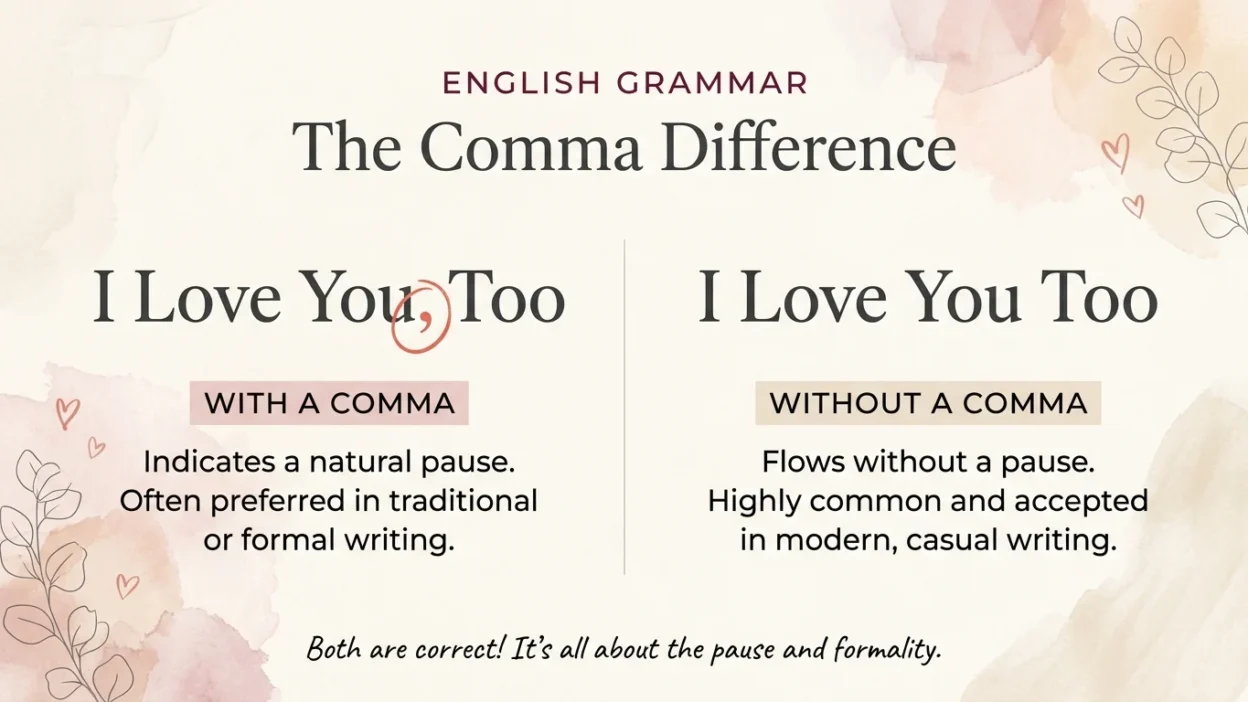
Knowing where to place a comma in “I love you too” can make your writing clearer and help you express affection naturally. Should you write “I love you too,” “I love you, too,” or “I love you, too!”? All three may appear in everyday messages, but punctuation can affect how the sentence is read and how clearly it communicates your meaning.
The most common recommended form is “I love you, too.” The comma separates “too,” meaning “also,” from the rest of the sentence. However, some modern writing styles omit the comma before “too” when the meaning is clear.
Both forms are widely understood, especially in text messages and casual conversations. This guide explains the comma rule, shows when punctuation is optional, and provides examples for romantic messages, everyday conversations, and formal writing.
Quick Answer: Is There a Comma in “I Love You Too”?
The traditional punctuation is “I love you, too.” Place a comma before “too” when it means “also.” You may also see “I love you too” without a comma, particularly in casual writing. Both are understandable, but including the comma is a clear, conventional choice. If you are replying to someone who says “I love you,” you can write, “I love you, too!”
Why Do People Confuse the Comma Rule?
People often wonder whether “too” needs a comma because it can appear in different positions within a sentence. Sometimes it means “also,” while in other sentences it means “excessively,” as in “too much” or “too late.”
When “too” means “also,” it can be set off with a comma, especially at the end of a sentence. However, the comma is not always necessary. Many contemporary style guides and writers allow it to be omitted when the sentence remains clear and the word is closely connected to the rest of the sentence.
In a short affectionate message, the choice is usually stylistic rather than a difference in meaning. The important thing is to make your message clear and use punctuation consistently.
1. “I Love You, Too”: The Traditional Comma Rule
“I love you, too” is a conventional way to write the sentence when “too” means “also.”
The comma creates a small pause and separates the added idea of “also” from the main statement.
Examples:
- “I love you, too.”
- “I miss you, too.”
- “I appreciate you, too.”
- “I want to see you, too.”
- “I am happy for you, too.”
In each example, “too” means “also.” The comma is a useful punctuation choice, particularly in careful or edited writing.
Is “I Love You, Too” Grammatically Correct?
Yes. “I love you, too” is grammatically correct and conventionally punctuated.
It is suitable for text messages, letters, greeting cards, emails, and other forms of personal communication.
For example:
Person A: I love you.
Person B: I love you, too.
The comma is optional in some styles, but it is a safe and widely accepted choice.
2. “I Love You Too”: Is It Correct Without a Comma?
Yes. “I love you too” is also acceptable in many modern writing styles, particularly in informal messages and everyday communication.
When “too” means “also,” some writers omit the comma because the sentence is short and its meaning is obvious.
Examples:
- I love you too.
- I miss you too.
- I understand you too.
- I want to go too.
- I enjoyed the movie too.
These sentences remain clear without commas. The version without a comma is especially common in texting, where people often use simpler punctuation.
Should You Include the Comma in a Text Message?
Either choice can work. If you prefer conventional punctuation, write “I love you, too.” If you are sending a casual message, “I love you too” is also natural.
The comma does not change the basic meaning or make the message more loving. The words and context communicate the affection.
“I Love You, Too” vs. “I Love You Too”: Comparison Table
| Sentence | Is it acceptable? | Best use |
|---|---|---|
| I love you, too. | Yes | Conventional punctuation |
| I love you too. | Yes | Casual messages and modern styles |
| I love you, too! | Yes | An enthusiastic or affectionate reply |
| I love you too! | Yes | Casual, warm messages |
| I love you, Too. | No, in ordinary usage | “Too” should not be capitalized here |
| I, love you too. | No | The comma is incorrectly placed |
The main difference between the first two sentences is punctuation style, not meaning.
When Should You Use a Comma Before “Too”?
1. Use a Comma for Conventional Punctuation
When “too” means “also” at the end of a sentence, using a comma is a traditional and clear choice.
Example: “I love you, too.”
This form works well in carefully written messages, letters, and other edited content.
2. Omit the Comma in Casual Writing if You Prefer
In short, informal sentences, the comma can be left out without causing confusion.
Example: “I love you too.”
This is common in text messages and online conversations.
3. Do Not Confuse “Too” With “Very” or “Excessively”
When “too” means “excessively,” it usually does not take a comma.
Examples:
- I love you too much to leave.
- This shirt is too expensive.
- You are too kind.
- The music is too loud.
In these sentences, “too” modifies a word or phrase. It does not mean “also.”
12 Examples of “I Love You, Too” Comma Rules
Here are examples showing how the comma works in affectionate messages and similar sentences.
- I love you, too. This is the conventional punctuation.
- I love you too. This is also acceptable in casual writing.
- I love you, too! The comma is used with an exclamation mark.
- I love you too! A natural option for an informal text.
- I miss you, too. The comma separates “too” meaning “also.”
- I miss you too. The comma can be omitted in a casual message.
- I care about you, too. A conventionally punctuated sentence.
- I want to be with you, too. The comma is appropriate before final “too.”
- I love you too much to forget you. Here, “too” means “excessively,” so no comma is needed.
- I love you, and I miss you, too. The comma before “too” is a stylistic choice.
- You are too important to me to ignore. “Too” means “so much that,” not “also.”
- I love you, too, more than you know. The commas set off “too” within the sentence.
These examples show that the comma depends on how “too” functions and on the punctuation style you follow.
Common Mistakes to Avoid
1. Thinking the Comma Is Always Required
The comma in “I love you, too” is conventional, but it is not mandatory in every modern style. “I love you too” is also widely accepted.
2. Putting the Comma in the Wrong Place
Incorrect: I, love you too.
Correct: I love you, too.
Do not separate the subject “I” from its verb “love” with a comma.
3. Capitalizing “Too” Without a Reason
Incorrect: I love you, Too.
Correct: I love you, too.
In the middle or at the end of a normal sentence, “too” is lowercase unless another rule requires capitalization.
4. Using a Comma With Every Meaning of “Too”
Incorrect: I love you, too much to leave.
Correct: I love you too much to leave.
Here, “too much” means “to an excessive degree.” The comma is unnecessary.
5. Assuming the Comma Changes the Feeling
“I love you, too” and “I love you too” generally express the same sentiment. A comma may create a slight pause in reading, but it does not automatically make a message warmer, colder, or more romantic.
Memory Trick: How to Remember the Comma
Remember this simple guideline:
When “too” means “also,” a comma before it is often appropriate. When “too” means “excessively,” do not add a comma just because the word is “too.”
Examples:
- Also: I love you, too.
- Excessively: I love you too much.
If you are unsure, “I love you, too” is a reliable choice for conventional punctuation.
American vs. British English
American and British English both use “I love you, too.” The comma before “too” is a matter of punctuation style rather than a major difference between the two varieties.
Some writers in both varieties omit the comma in short sentences, especially in informal messages. Other writers include it as a conventional way to set off “too.”
| English variety | Common form |
|---|---|
| American English | I love you, too. |
| British English | I love you, too. |
| Informal texting | I love you too. |
For formal or carefully edited writing, including the comma is a dependable choice in either variety.
Similar Words and Expressions
Several words and expressions can be used in a similar way to “too,” but their punctuation and meanings may differ.
| Word or expression | Meaning | Example |
|---|---|---|
| Also | In addition | I also love you. |
| As well | In addition | I love you as well. |
| Likewise | In the same way | I love you, likewise. |
| Me too | I feel the same way | “I love you.” “Me too!” |
| In return | As a response to an action or feeling | I return your love. |
“Also,” “as well,” and “too” can express a similar idea. However, “me too” is a short conversational response, and “likewise” can sound more formal or less intimate in a romantic conversation.
Final Verdict: “I Love You, Too” or “I Love You Too”?
Both “I love you, too” and “I love you too” are acceptable. The version with a comma follows conventional punctuation and is a safe choice for careful writing. The version without a comma is also common in modern informal communication.
If you are replying to someone who says “I love you,” you can confidently write “I love you, too!” The comma is a punctuation choice, not a requirement for expressing affection. Choose the form that suits your writing style and the situation.
Frequently Asked Questions
1. Is there a comma in “I love you too”?
A comma is conventionally placed before “too” when it means “also,” so “I love you, too” is a safe choice. However, “I love you too” is also acceptable in many modern styles.
2. Is “I love you too” grammatically correct?
Yes. “I love you too” is grammatically acceptable and widely used, especially in text messages and casual conversations.
3. Is “I love you, too” more correct than “I love you too”?
It follows traditional punctuation more closely, but the version without a comma is also acceptable in many contexts. The difference is generally stylistic rather than grammatical.
4. Should I use a comma before “too” in a text message?
You can use either form. “I love you, too” uses conventional punctuation, while “I love you too” is a natural informal option.
5. Does the comma change the meaning of “I love you too”?
No. Both versions generally mean that you also love the other person. The comma may create a slight pause, but it does not change the basic meaning.
6. Should I write “I love you, too!” or “I love you too!”?
Both are acceptable. Use “I love you, too!” if you prefer conventional punctuation. Use “I love you too!” if you prefer a simpler informal style.
7. Is there a comma in “I love you too much”?
Usually, no. In “I love you too much,” the word “too” means “excessively” and modifies “much,” so a comma is not needed.
8. Is the comma rule different in American and British English?
No significant difference applies here. Both American and British writers use “I love you, too,” although the comma may be omitted in informal writing.
Remember This
- “I love you, too” is the conventional punctuation.
- “I love you too” is also acceptable in many modern styles.
- Use a comma before “too” when you want to set it off to mean “also.”
- Do not add a comma in “I love you too much.”
- The comma does not change the basic meaning of the message.
Conclusion
The comma rule for “I love you too” is straightforward once you understand how “too” is being used. When it means “also,” writing “I love you, too” is a conventional and reliable choice. However, leaving out the comma is also common and acceptable in many informal contexts.
For personal messages, romantic texts, letters, and everyday conversations, either version communicates the same basic feeling. If you want to follow traditional punctuation, choose “I love you, too.” If you prefer a casual style, “I love you too” works just as well.

Lucas Luke is a passionate language writer and content creator at SimileHive, specializing in similes, idioms, metaphors, and figurative language. He enjoys making complex English expressions simple, engaging, and easy to understand for students, writers, and language enthusiasts through well-researched, practical content.