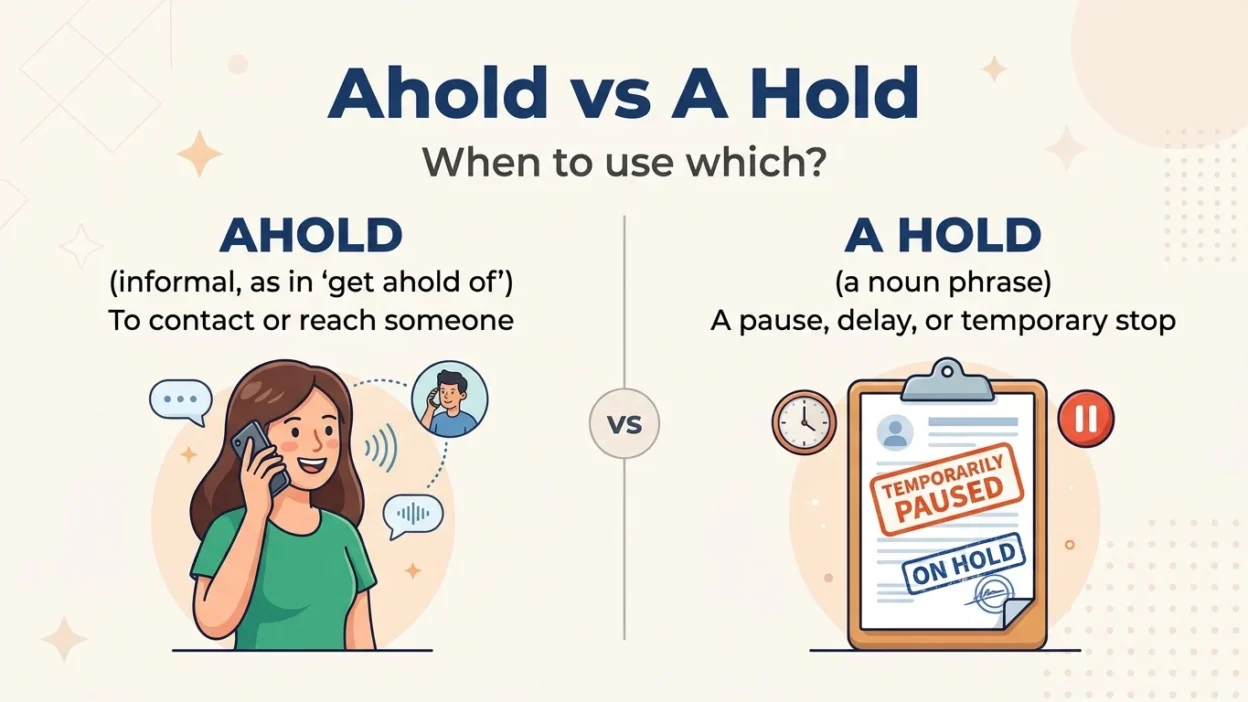
“Ahold” and “a hold” look similar, but they are used differently in English. Ahold is commonly used in the expression “get ahold of,” which means to contact someone, obtain something, or take control of something. A hold is a two word phrase in which “hold” is a noun meaning a grip, a pause, a reservation, or a restriction.
For example, “I finally got ahold of my teacher” means that I finally managed to contact my teacher. In contrast, “The airline placed a hold on my reservation” means that the reservation was temporarily restricted or kept in a particular status. Choosing the right form depends on the meaning of your sentence. This guide explains how to distinguish “ahold” from “a hold,” when to use each expression, and how to avoid common mistakes in everyday writing.
Quick Answer: Ahold vs A Hold
Ahold is usually used in American English in the expression “get ahold of,” meaning to contact, obtain, or grasp something. A hold is a noun phrase referring to a grip, a pause, a reservation, or a restriction. For example, “I got ahold of him” means I contacted him, while “I placed a hold on the account” describes a restriction.
Why Do People Confuse Ahold and A Hold?
People confuse these forms because they sound nearly identical when spoken aloud. The difference becomes clearer when you look at how each expression works in a sentence.
“Ahold” is generally used as part of a fixed expression, especially “get ahold of.” Meanwhile, “a hold” contains the article “a” followed by the noun “hold.”
Compare these examples:
- Ahold: I could not get ahold of my manager.
- A hold: The manager placed a hold on the payment.
In the first sentence, “ahold of” refers to successfully contacting the manager. In the second, “a hold” refers to a restriction on the payment.
The key is to focus on the meaning rather than the sound.
What Does Ahold Mean?
“Ahold” is a word most commonly used in the expression “get ahold of.” This expression can mean to contact someone, obtain something, or take physical or figurative control of something.
It is especially common in American English, particularly in conversational language.
Examples of Ahold
- I finally got ahold of my doctor.
- Can you get ahold of Sarah before the meeting?
- She managed to get ahold of a copy of the report.
- The child tried to get ahold of the balloon.
- I need to get ahold of the customer service team.
When Should You Use Ahold?
Use “ahold” when writing an expression such as “get ahold of,” especially when you mean contacting someone or obtaining something.
Common examples include:
- Contacting someone: I could not get ahold of my friend.
- Obtaining something: He got ahold of the documents.
- Grasping something: The climber got ahold of the rope.
- Taking control: The company tried to get ahold of the situation.
In many contexts, “get hold of” is also correct and is especially common in British English.
What Does A Hold Mean?
“A hold” is a noun phrase consisting of the article “a” and the noun “hold.” Its meaning depends on the context. It can refer to a physical grip, a temporary pause, a reservation, a restriction, or control over something.
Examples of A Hold
- She kept a firm hold on the railing.
- The bank placed a hold on my account.
- Please put the application on hold until Monday.
- I have a hold on two seats for the show.
- The wrestler maintained a hold on his opponent.
When Should You Use A Hold?
Use “a hold” when “hold” functions as a noun and describes a grip, restriction, reservation, or other type of control.
Common situations include:
- Physical grip: He had a hold on the ladder.
- Banking: The bank placed a hold on the transaction.
- Scheduling: We put the project on hold.
- Reservations: She placed a hold on the hotel room.
- Control or influence: The idea had a strong hold on his imagination.
Remember that “on hold” is a common phrase meaning temporarily delayed or waiting.
Ahold vs A Hold: Comparison Table
| Feature | Ahold | A Hold |
|---|---|---|
| Form | Usually written as one word | Written as two words |
| Grammatical role | Used mainly in the expression “get ahold of” | Article plus noun |
| Common meaning | Contact, obtain, or grasp | Grip, restriction, reservation, or pause |
| Example | I got ahold of my teacher. | I placed a hold on the account. |
| Common context | Conversational American English | General and formal English |
| British English alternative | “Get hold of” is common | “A hold” is also standard |
| Can it mean a delay? | Not by itself in the usual expression | Yes, as in “put a hold on something” |
The main distinction is grammatical: “ahold” appears in a set expression, while “a hold” uses “hold” as a noun.
When to Use Each Form
Use Ahold When You Mean Contact Someone
Example: “I tried to get ahold of the manager, but she was unavailable.”
Here, “get ahold of” means to contact the manager.
Use Ahold When You Mean Obtain Something
Example: “He finally got ahold of the original document.”
The sentence means he managed to obtain the document.
Use A Hold When You Mean a Grip
Example: “She had a strong hold on the handle.”
The word “hold” refers to the way she gripped the handle.
Use A Hold When You Mean a Delay or Restriction
Example: “The company placed a hold on the order.”
This means the order was temporarily delayed or restricted.
Use Get Hold Of as Another Correct Option
You do not always need to write “ahold.” The expression “get hold of” is also correct.
Examples:
- I could not get ahold of him.
- I could not get hold of him.
Both sentences mean that the speaker could not contact him. “Get hold of” is especially common in British English and is also widely used in American English.
12 Examples of Ahold vs A Hold
These examples show how the expressions work in different situations.
- Contact: I finally got ahold of my sister.
- Contact: I finally got hold of my sister.
- Obtaining something: She got ahold of the information she needed.
- Physical grip: The child had a tight hold on his mother’s hand.
- Banking: The bank placed a hold on the suspicious transaction.
- Work: We put the project on hold until the budget was approved.
- Travel: I could not get ahold of the airline representative.
- Reservations: The hotel placed a hold on the room for one hour.
- Objects: He tried to get ahold of the rope before slipping.
- Technology: I could not get ahold of technical support.
- Influence: Fear had a powerful hold on his decisions.
- Business: The company put the new order on hold.
Notice that “ahold” is mainly used with “get,” while “a hold” often appears with verbs such as “place,” “put,” “keep,” or “maintain.”
Common Mistakes to Avoid
Mistake 1: Writing A Hold When You Mean Contact Someone
Incorrect: “I could not get a hold of my teacher” is not necessarily wrong, but it is less streamlined than the common alternatives.
Preferred: “I could not get ahold of my teacher.”
Also correct: “I could not get hold of my teacher.”
The form “get a hold of” is also used by many English speakers, particularly in American English, so it should not automatically be treated as incorrect.
Mistake 2: Writing Ahold When You Mean a Restriction
Incorrect: “The bank placed ahold on my account.”
Correct: “The bank placed a hold on my account.”
Here, “hold” is a noun referring to a restriction.
Mistake 3: Assuming Ahold Is Used the Same Way Everywhere
“Ahold” is especially associated with American English. In British English, “get hold of” is often the more familiar choice.
Both forms can be understood, but regional preferences may differ.
Mistake 4: Confusing Hold With On Hold
“Hold” can mean a grip or control, while “on hold” often means temporarily delayed.
Examples:
- “She had a hold on the rope.” This describes a grip.
- “The meeting is on hold.” This means the meeting has been delayed.
Mistake 5: Assuming Every Use of Hold Requires A
“Hold” can be used as a verb without the article “a.”
Example: “Please hold the door open.”
In this sentence, “hold” is a verb, not a noun.
Memory Trick: How to Remember the Difference
Use this simple rule:
Ahold = get in touch or get possession.
A hold = a grip, pause, or restriction.
For example:
- “I got ahold of my friend” means I contacted my friend.
- “I placed a hold on the payment” means I restricted or delayed the payment.
If you can replace the phrase with “contact,” “obtain,” or “grasp,” “get ahold of” may be appropriate. If you mean a grip, delay, or restriction, “a hold” is usually the correct form.
American vs British English
“Ahold” is particularly common in American English, especially in the expression “get ahold of.” However, “get hold of” is also correct in American English and is widely used in British English.
Examples:
- American English: I need to get ahold of my supervisor.
- British English: I need to get hold of my supervisor.
Both sentences mean that the speaker needs to contact the supervisor.
The phrase “a hold” is used in both varieties when “hold” is a noun.
For example, “The bank placed a hold on the account” is understandable in both American and British English.
Similar Words and Expressions
Several expressions are related to “ahold” and “a hold,” but they are not identical in meaning.
1. Get in Touch With
This means to contact someone.
Example: “I need to get in touch with my doctor.”
2. Contact
“Contact” is a direct and neutral verb meaning to communicate with someone.
Example: “Please contact the office tomorrow.”
3. Obtain
“Obtain” means to get or acquire something.
Example: “She obtained a copy of the report.”
4. Grasp
“Grasp” means to take hold of something physically or understand an idea.
Example: “He grasped the handle firmly.”
5. On Hold
“On hold” means temporarily paused or delayed.
Example: “The application is on hold until the documents arrive.”
6. Restriction
A “restriction” is a rule or condition that limits what can happen.
Example: “The bank placed a restriction on the account.”
7. Grip
A “grip” is the way someone holds something firmly.
Example: “He loosened his grip on the steering wheel.”
8. Get Hold Of
This expression means to contact, obtain, or grasp something.
Example: “I finally managed to get hold of the keys.”
Final Verdict: Ahold or A Hold?
Use “ahold” mainly in the expression “get ahold of,” meaning to contact someone, obtain something, or grasp something. Use “a hold” when “hold” is a noun meaning a grip, restriction, reservation, or pause.
For example, “I got ahold of my manager” means you contacted your manager, while “I placed a hold on the payment” means you delayed or restricted the payment.
If you are unsure, remember that “get hold of” is another correct alternative to “get ahold of.” The best choice depends on the meaning of your sentence and the variety of English you are using.
Frequently Asked Questions
1. Is ahold one word or two?
“Ahold” is written as one word when used in expressions such as “get ahold of.” However, “a hold” is written as two words when “hold” is a noun, as in “a hold on the account.”
2. Is ahold grammatically correct?
Yes. “Ahold” is accepted in American English, especially in the expression “get ahold of.” “Get hold of” is also correct and is common in both American and British English.
3. Is it get ahold of or get a hold of?
Both “get ahold of” and “get a hold of” are used in American English to mean contact, obtain, or grasp something. “Get hold of” is also correct and is particularly common in British English.
4. What does get ahold of someone mean?
It means to contact someone or successfully communicate with them.
Example: “I finally got ahold of my teacher” means that I finally managed to contact my teacher.
5. What does put a hold on something mean?
It means to delay, pause, reserve, or restrict something temporarily.
Example: “The bank put a hold on the transaction” means that the transaction was temporarily restricted.
6. Is ahold used in British English?
It is understood, but “get hold of” is generally the more familiar expression in British English. Both expressions can communicate the same meaning.
7. Can ahold mean to grasp something?
Yes. In “get ahold of the rope,” the phrase can mean to grasp the rope. It can also mean to contact someone or obtain something, depending on context.
8. What is the easiest way to remember ahold vs a hold?
Remember that “get ahold of” usually means to contact, obtain, or grasp something. “A hold” is a noun phrase referring to a grip, restriction, reservation, or pause.
Remember This
- Ahold is mainly used in “get ahold of.”
- A hold is a noun phrase.
- “Get ahold of my friend” means contact my friend.
- “Place a hold on the account” means restrict the account.
- “Get hold of” is also correct and common in British English.
- Choose the form that matches your intended meaning.
Conclusion
“Ahold” and “a hold” sound alike, but they serve different purposes in English. “Ahold” commonly appears in “get ahold of,” which means to contact someone, obtain something, or grasp something. “A hold,” on the other hand, is a noun phrase that can describe a physical grip, a restriction, a reservation, or a temporary delay.
To choose correctly, consider what you want to say. If you mean contacting someone, “get ahold of” or “get hold of” will usually work. If you mean a restriction or pause, use “a hold.” Once you recognize this difference, you can use both forms naturally and confidently in everyday writing and conversation.

Adam Aaron is a language enthusiast and content writer at SimileHive, creating clear, engaging guides on similes, idioms, metaphors, and figurative language to help readers improve English confidently every day.