“Isolated” and “scattered” are two English words that describe things separated from others, but they are not interchangeable in every situation. Isolated usually refers to something that is alone, separated, or cut off from its surroundings. Scattered describes things spread out over an area or distributed irregularly rather than gathered in one place. Both words are common in everyday conversation, academic writing, news reports, geography, science, and descriptions of people or objects.
For example, an isolated house may stand far away from other houses, while scattered houses may be spread across a large area. Similarly, an isolated incident happens separately from other incidents, whereas scattered incidents occur at different locations or times. Understanding the difference helps you choose the right word when describing places, objects, events, information, or people. In this guide, you will learn the meanings of both words, explore their differences, and see practical examples that make their correct usage easy to remember.
Quick Answer: Isolated vs Scattered
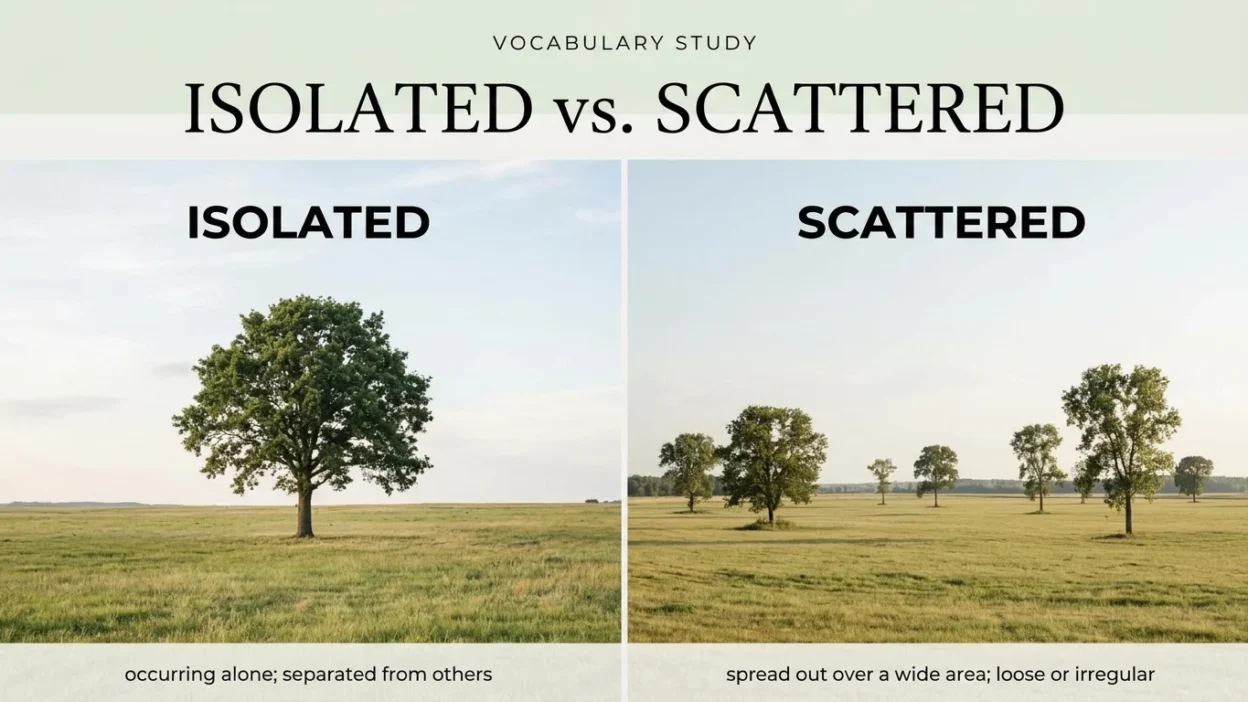
Isolated means alone, separated, or disconnected from other things. Scattered means spread out irregularly across an area or among different places. An isolated object stands apart from its surroundings, while scattered objects are distributed across multiple locations. For example, an isolated tree stands alone, whereas scattered trees grow at different points across a field.
Why Do People Confuse Isolated and Scattered?
People confuse “isolated” and “scattered” because both words describe separation or a lack of close grouping. However, they focus on different aspects of that separation.
“Isolated” emphasizes being alone or cut off from others. “Scattered” emphasizes distribution across an area.
Consider these examples:
- Isolated houses: Houses that stand apart from other buildings, perhaps in a remote location.
- Scattered houses: Houses spread irregularly across a region, with space between them.
The difference becomes clearer when you think about the overall arrangement. An isolated thing is notable because it stands alone or apart. Scattered things form a loose distribution across different places.
What Does Isolated Mean?
“Isolated” is an adjective that describes someone or something separated from others, standing alone, or having little connection with its surroundings.
It can describe physical distance, social separation, unusual events, or individual examples of something.
Examples of Isolated
- The isolated cabin stood deep in the forest.
- She felt isolated after moving to a new city.
- The researchers discovered an isolated village in the mountains.
- This was an isolated incident rather than a regular problem.
- An isolated tree grew in the middle of the field.
When Should You Use Isolated?
Use “isolated” when the main idea is that something is alone, separated, disconnected, or uncommon compared with a larger pattern.
Common contexts include:
- Geography: An isolated island far from the mainland.
- Social situations: A person who feels isolated from friends.
- Events: An isolated mistake that does not happen regularly.
- Science: An isolated system that does not exchange certain things with its surroundings.
- Buildings: An isolated house far from other homes.
For example, “The village remained isolated during the heavy snowfall” suggests that the village was cut off from other places.
What Does Scattered Mean?
“Scattered” is an adjective and the past participle of the verb “scatter.” It describes things spread over an area or distributed among different locations, often irregularly.
The word can refer to physical objects, people, settlements, information, or events.
Examples of Scattered
- Scattered leaves covered the garden.
- Small villages are scattered throughout the valley.
- The papers were scattered across the desk.
- Scattered clouds appeared in the morning sky.
- The students were scattered around the playground.
When Should You Use Scattered?
Use “scattered” when you want to describe several things spread across a space or distributed in different places.
Common contexts include:
- Geography: Scattered islands across the ocean.
- Weather: Scattered showers across a region.
- Objects: Scattered books on the floor.
- People: Tourists scattered throughout the park.
- Information: Scattered notes in several notebooks.
For example, “Scattered houses lined the rural roads” means that the houses were spread out rather than grouped closely together.
Isolated vs Scattered: Comparison Table
| Feature | Isolated | Scattered |
|---|---|---|
| Basic meaning | Alone or separated | Spread across an area |
| Main focus | Separation or disconnection | Distribution or arrangement |
| Typical number | Often one item or one distinct case | Usually multiple items |
| Physical example | An isolated house | Scattered houses |
| Social example | An isolated person | People scattered around a room |
| Event example | An isolated incident | Scattered incidents across several locations |
| Geographic example | An isolated island | Scattered islands |
| Opposite idea | Connected, accompanied, or grouped | Clustered, gathered, or concentrated |
The distinction is not simply about how many things exist. “Isolated” can describe a single item or an individual event, while “scattered” usually highlights how multiple things are spread out.
When to Use Isolated vs Scattered
Use Isolated When Something Stands Alone
Choose “isolated” when something is separated from its surroundings or has little contact with other things.
Example: “The isolated farmhouse was several kilometers from the nearest town.”
The sentence emphasizes the farmhouse’s separation from nearby communities.
Use Scattered When Things Are Spread Out
Choose “scattered” when several objects, people, or places are distributed across an area.
Example: “Farmhouses were scattered across the countryside.”
The sentence emphasizes the distribution of the farmhouses.
Use Isolated for a Single Unusual Event
“Isolated” is often used to describe a one-off occurrence that does not represent a general pattern.
Example: “The company described the error as an isolated incident.”
This suggests that the error was unusual rather than frequent.
Use Scattered for Events or Objects in Different Places
“Scattered” is useful when occurrences or objects appear in various locations without forming a concentrated group.
Example: “Scattered reports of flooding came from different parts of the region.”
The reports originated from different places rather than one central location.
Can Something Be Both Isolated and Scattered?
Yes. The words can describe different aspects of the same situation.
For example, “Several isolated houses were scattered across the valley” means that individual houses stood apart from nearby buildings and were distributed across the valley.
Here, “isolated” describes the separation of each house, while “scattered” describes the overall arrangement of the houses.
12 Examples of Isolated vs Scattered
Here are 12 examples that show the difference in everyday contexts.
- Trees: An isolated tree stood on the hill, while scattered trees grew across the surrounding fields.
- Houses: An isolated house stood far from the village, while scattered houses appeared along the country roads.
- People: One isolated visitor sat away from the group, while scattered visitors occupied different parts of the museum.
- Islands: An isolated island lay far from other land, while scattered islands formed a wide archipelago.
- Events: The manager treated the error as an isolated incident, while scattered errors appeared in several departments.
- Leaves: One isolated leaf rested on the windowsill, while scattered leaves covered the garden path.
- Clouds: An isolated cloud floated above the mountain, while scattered clouds filled different parts of the sky.
- Villages: The isolated village had limited contact with nearby towns, while scattered villages dotted the region.
- Books: An isolated book sat on a separate shelf, while scattered books lay across the classroom.
- Reports: An isolated report mentioned the problem, while scattered reports described similar problems in several locations.
- Students: An isolated student worked alone in a quiet room, while scattered students sat at different tables.
- Problems: The team found an isolated technical fault, while scattered faults affected different parts of the system.
These examples show that “isolated” emphasizes separation, whereas “scattered” emphasizes distribution.
Common Mistakes to Avoid
Mistake 1: Using Isolated When You Mean Spread Out
Incorrect: “Isolated leaves covered the entire lawn.”
This wording suggests that the leaves were separated or individually set apart, not necessarily spread across the lawn.
Better: “Scattered leaves covered the entire lawn.”
Use “scattered” when the emphasis is on an irregular distribution across an area.
Mistake 2: Using Scattered for a Single Separated Object
Awkward: “A scattered house stood far from the village.”
Better: “An isolated house stood far from the village.”
“Scattered” usually describes multiple things distributed across an area. “Isolated” is more suitable when one house stands apart.
Mistake 3: Assuming Isolated Always Means Far Away
“Isolated” can refer to social, emotional, or conceptual separation, not just physical distance.
Example: “He felt isolated even when surrounded by people.”
The person is emotionally disconnected, not physically distant.
Mistake 4: Assuming Scattered Always Means Random
“Scattered” often suggests an irregular arrangement, but the word does not always mean completely random.
Example: “Small communities are scattered along the coastline.”
The communities may follow a natural geographic pattern while still being spread out.
Mistake 5: Confusing Isolated With Rare
An isolated incident is often unusual or separate from a wider pattern, but “isolated” does not always mean rare.
Example: “The isolated building stood behind the main complex.”
Here, the word describes the building’s location rather than how often something occurs.
Memory Trick: How to Remember the Difference
Use this simple memory trick:
Isolated = alone.
Scattered = spread out.
Imagine one tree standing by itself in an empty field. That tree is isolated.
Now imagine many trees growing at different points across a large field. Those trees are scattered.
You can also remember the first letters:
- Isolated: Item apart.
- Scattered: Spread around.
Whenever you are unsure, ask yourself whether you are describing something that stands alone or several things spread across different places.
American vs British English
“Isolated” and “scattered” have essentially the same meanings in American and British English. There is no major regional difference in how these words are used.
Both varieties use “isolated incident” to describe an individual occurrence and “scattered showers” to describe rain expected in different locations.
Examples:
- American English: “Scattered showers are expected this afternoon.”
- British English: “Scattered showers are expected this afternoon.”
The same wording is natural in both varieties. Your choice should depend on meaning, not on whether you are writing for an American or British audience.
Similar Words
Several words are related to “isolated” and “scattered,” but each has a slightly different meaning.
1. Separate
“Separate” means apart from something else or not joined together.
Example: “Please keep the documents in separate folders.”
2. Remote
“Remote” describes a place that is far away from towns, cities, or other populated areas.
Example: “They lived in a remote mountain village.”
A remote place may also be isolated, but “remote” emphasizes distance.
3. Solitary
“Solitary” describes someone or something alone, often without companions.
Example: “A solitary figure walked along the beach.”
4. Dispersed
“Dispersed” means spread or distributed over an area. It is often used in formal, scientific, or technical contexts.
Example: “The population is dispersed across several rural communities.”
5. Distributed
“Distributed” means spread among people, places, or groups, often in an organized way.
Example: “The supplies were distributed among the villages.”
6. Widespread
“Widespread” describes something found across a large area or affecting many people.
Example: “The storm caused widespread damage.”
Unlike “scattered,” “widespread” often emphasizes the broad extent or prevalence of something.
7. Clustered
“Clustered” means grouped closely together.
Example: “The houses were clustered around the village square.”
This is often the opposite arrangement of scattered objects.
8. Concentrated
“Concentrated” describes things gathered closely in one place or focused in one area.
Example: “Most of the rainfall was concentrated in the northern region.”
Final Verdict: Isolated or Scattered?
Choose “isolated” when you mean alone, separated, disconnected, or distinct from a larger group or pattern. Choose “scattered” when you mean spread irregularly across an area or distributed among different locations.
For example, an isolated house stands apart from nearby buildings, while scattered houses appear at different points throughout a region. Both words can describe separated things, but they emphasize different ideas.
The easiest way to remember the difference is to focus on the main picture: isolated means apart, while scattered means spread out.
Frequently Asked Questions
1. What is the main difference between isolated and scattered?
“Isolated” means alone or separated from others. “Scattered” means spread across an area or distributed among different places. An isolated house stands apart, while scattered houses are spread across a region.
2. Can isolated and scattered be used interchangeably?
Not always. They can overlap when describing separated objects, but they emphasize different things. “Isolated” highlights separation, while “scattered” highlights distribution. Choose the word that best expresses the intended meaning.
3. Is isolated singular and scattered plural?
No. Neither word is limited to a particular grammatical number. You can say “an isolated house” or “isolated houses.” You can also say “scattered objects” or describe something as “scattered across the floor.”
4. What does an isolated incident mean?
An isolated incident is an event considered separate from a wider pattern. It often suggests that the event is unusual or has not happened regularly. For example, “The company called the mistake an isolated incident.”
5. What does scattered mean in geography?
In geography, “scattered” describes settlements, islands, houses, or other features distributed across an area rather than concentrated in one place. For example, scattered villages may appear at various points throughout a valley.
6. Can a place be both isolated and scattered?
Yes, depending on what you are describing. Individual houses may be isolated from their nearest neighbors while being scattered across a large region. One word describes separation, and the other describes the overall distribution.
7. What is the opposite of isolated?
Possible opposites include “connected,” “integrated,” “accompanied,” or “surrounded,” depending on the context. For a place, “well connected” may contrast with isolated. For a person, “included” or “socially connected” may express the opposite idea.
8. What is the opposite of scattered?
Common opposites include “clustered,” “grouped,” “gathered,” and “concentrated.” These words describe things brought together rather than spread across an area.
Remember This
- Isolated means alone, separated, or disconnected.
- Scattered means spread out across different places.
- An isolated tree stands by itself.
- Scattered trees grow at different points across a field.
- An isolated incident is separate from a wider pattern.
- Scattered reports come from multiple locations.
- Use the word that matches the arrangement or situation you want to describe.
Conclusion
“Isolated” and “scattered” both describe separation, but they focus on different aspects of it. “Isolated” emphasizes being alone, disconnected, or apart from others. “Scattered” emphasizes the distribution of multiple things across an area. Understanding this distinction helps you describe locations, people, objects, and events more accurately.
When choosing between the two words, picture the situation you want to explain. If something stands alone or is cut off from its surroundings, use “isolated.” If several things are spread across different places, use “scattered.” With this simple distinction in mind, you can use both words confidently in conversation, schoolwork, and professional writing.

Lucas Luke is a passionate language writer and content creator at SimileHive, specializing in similes, idioms, metaphors, and figurative language. He enjoys making complex English expressions simple, engaging, and easy to understand for students, writers, and language enthusiasts through well-researched, practical content.