Are you confused about when to use do and does in English? Both words are forms of the verb do, and they are commonly used to ask questions, make negative sentences, and talk about actions. However, choosing the correct form depends on the subject of the sentence. Using do and does correctly is an essential part of learning English grammar and speaking naturally.
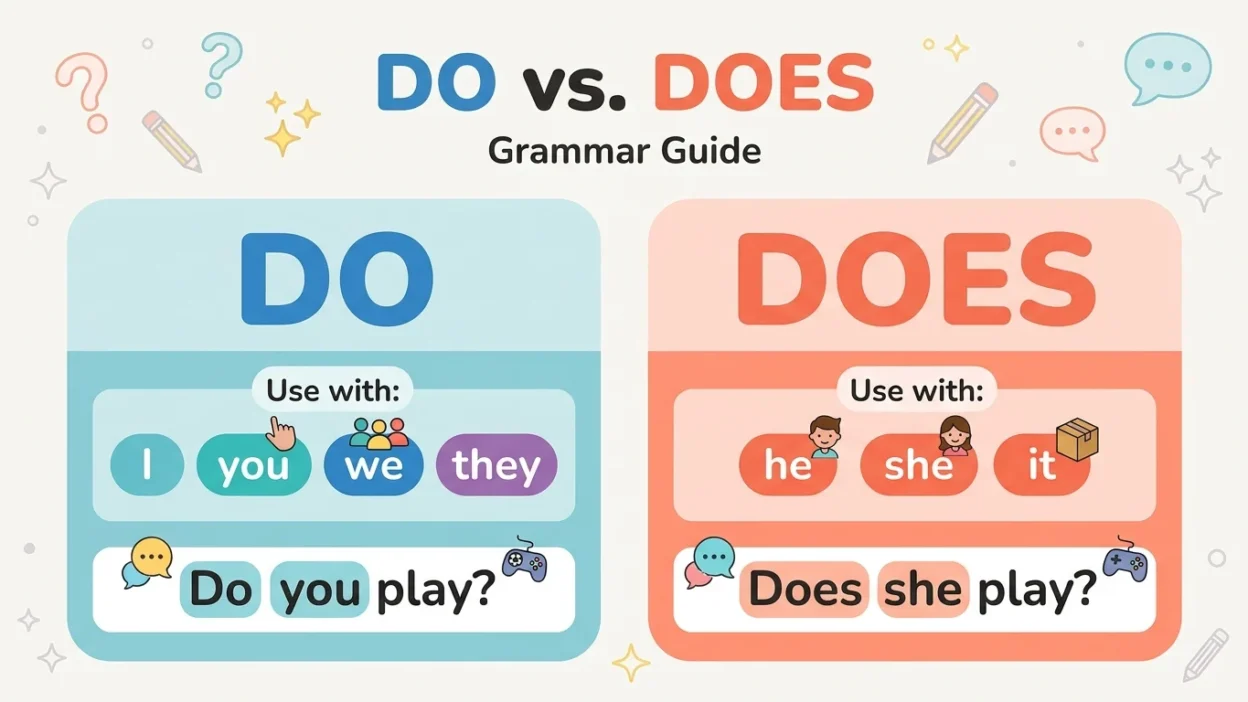
The basic rule is simple: use do with I, you, we, and they, and use does with he, she, and it. For example, say “Do you like coffee?” but “Does she like coffee?” Once you understand this subject rule, you can form questions and negative sentences more confidently. This guide explains the difference between do and does, provides practical examples, highlights common mistakes, and gives you an easy trick to remember the correct form.
Quick Answer
Use do with I, you, we, and they, and use does with he, she, and it in the simple present tense. For example, “Do they work here?” and “Does he work here?” In negative sentences, use “do not” or “does not.” After does, the main verb stays in its base form.
Why Do People Confuse Do and Does?
People often confuse do and does because both words perform similar grammatical functions. They can act as helping verbs in questions and negative sentences, and do can also function as a main verb meaning to perform or complete an action.
The main difference is subject agreement. English uses different forms of certain verbs depending on whether the subject is singular or plural and which pronoun is used.
For example:
- Correct: Do you understand the lesson?
- Correct: Does she understand the lesson?
- Incorrect: Does you understand the lesson?
- Incorrect: Do she understand the lesson?
Remember that you always takes do in standard English, whether you are speaking to one person or several people.
1. Do: Meaning and Usage
Do is used with the subjects I, you, we, and they in the simple present tense. It can help form questions and negative sentences, and it can also be the main verb in a sentence.
Do in Questions
Use do to form simple present questions with I, you, we, and they.
Examples:
- Do you speak English?
- Do they live nearby?
- Do we have enough time?
- Do I need to bring my notebook?
- Do your friends play football?
- Do the students understand the lesson?
Do in Negative Sentences
Use do not or its contraction don’t to make negative sentences with I, you, we, and they.
Examples:
- I do not understand the question.
- You do not need to worry.
- We do not eat meat.
- They do not work on Sundays.
- I don’t like cold coffee.
- They don’t know the answer.
Do as a Main Verb
The word do can also mean to perform or complete an action.
Examples:
- I do my homework every evening.
- You do a great job.
- We do our best to help others.
- They do their shopping on Saturdays.
Remember: Use do with I, you, we, and they in the simple present tense.
2. Does: Meaning and Usage
Does is used with the third person singular subjects he, she, and it, as well as singular nouns such as Ali, my brother, or the teacher, in the simple present tense.
Like do, it can help form questions and negative sentences. It can also function as the main verb.
Does in Questions
Use does to form simple present questions with he, she, it, and singular nouns.
Examples:
- Does he speak English?
- Does she work here?
- Does it rain often in this area?
- Does Ali play cricket?
- Does your brother drive a car?
- Does the teacher explain the lesson clearly?
Does in Negative Sentences
Use does not or its contraction doesn’t to make negative sentences with he, she, it, and singular nouns.
Examples:
- He does not like spicy food.
- She does not drive to work.
- It does not look expensive.
- Ali does not play tennis.
- She doesn’t understand the question.
- My brother doesn’t drink coffee.
Does as a Main Verb
Does is also the third person singular form of the main verb do.
Examples:
- She does her homework after dinner.
- He does a lot of exercise.
- My father does the cooking on weekends.
- The machine does its job well.
Remember: Use does with he, she, it, and singular nouns in the simple present tense.
Do vs. Does: Comparison Table
| Feature | Do | Does |
|---|---|---|
| Subjects | I, you, we, they | He, she, it |
| Singular nouns | Not normally used as the helping verb with a singular third person subject | Used with singular third person nouns |
| Questions | Do you understand? | Does she understand? |
| Negative sentences | I do not agree. | He does not agree. |
| Contraction | Don’t | Doesn’t |
| Main verb example | They do their work. | She does her work. |
When Should You Use Do or Does?
Use Do With I, You, We, and They
Use do when asking questions or forming negative sentences with these subjects.
Examples:
- Do I need to call you?
- Do you enjoy reading?
- Do we have a meeting today?
- Do they live in Lahore?
Negative examples:
- I do not know.
- You don’t need to hurry.
- We don’t agree.
- They don’t play football.
Use Does With He, She, It, and Singular Nouns
Use does with a third person singular subject.
Examples:
- Does he work at the bank?
- Does she know your name?
- Does it work properly?
- Does the bus stop here?
Negative examples:
- He doesn’t work here.
- She does not know the answer.
- It doesn’t look right.
- The bus doesn’t stop here.
12 Examples of Do and Does in Sentences
Here are examples that show the difference in everyday English.
- Do: Do you like reading books?
- Do: Do they play cricket every weekend?
- Do: We do our homework after school.
- Do: I do not understand this rule.
- Do: Do your parents live nearby?
- Do: They don’t watch television very often.
- Does: Does she speak English fluently?
- Does: Does he go to school by bus?
- Does: My sister does her homework at night.
- Does: He doesn’t eat breakfast early.
- Does: Does this phone support wireless charging?
- Does: The shop does not open on Sundays.
Common Mistakes to Avoid
Mistake 1: Using Does With You
Incorrect: Does you like coffee?
Correct: Do you like coffee?
Use do with you, whether you are addressing one person or a group.
Mistake 2: Using Do With He or She
Incorrect: Do she work here?
Correct: Does she work here?
Use does with he, she, and it in simple present questions.
Mistake 3: Adding S to the Main Verb After Does
Incorrect: Does he likes football?
Correct: Does he like football?
When does is used as a helping verb, the main verb stays in its base form. The third person singular ending is already shown by does.
Mistake 4: Using Doesn’t With a Verb Ending in S
Incorrect: She doesn’t likes tea.
Correct: She doesn’t like tea.
After doesn’t, use the base form of the main verb.
Mistake 5: Confusing Questions and Statements
Incorrect: Does she likes music?
Correct question: Does she like music?
Correct statement: She likes music.
In a positive statement, the main verb usually takes an s ending with he, she, or it. In a question using does, the main verb does not take that ending.
A Simple Memory Trick
Remember this rule:
DO = I, You, We, They
DOES = He, She, It
You can also remember the phrase “He, she, it, does.” It is a familiar grammar rhyme that helps many English learners remember the third person singular form.
Try these quick examples:
- I do my homework.
- You do your homework.
- They do their homework.
- She does her homework.
- He does his homework.
One more important rule: after does or doesn’t, use the base form of the main verb.
Correct: Does he play?
Incorrect: Does he plays?
American vs. British English
The basic rules for do and does are the same in American and British English. Both varieties use do with I, you, we, and they, and does with he, she, and it in the simple present tense.
For example:
- American English: Does she work here?
- British English: Does she work here?
Both varieties also use contractions such as don’t and doesn’t in everyday conversation and informal writing. The choice between do and does depends on the subject, not the variety of English.
Similar Words and Forms
Did
Did is the past tense form of do. It is used with all subjects when forming simple past questions and negatives.
Examples:
- Did you call me?
- Did she finish her work?
- They did not attend the meeting.
After did or didn’t, use the base form of the main verb.
Correct: Did she go?
Incorrect: Did she went?
Don’t
Don’t is the contraction of do not. Use it with I, you, we, and they in the simple present tense.
Example: They don’t like loud music.
Doesn’t
Doesn’t is the contraction of does not. Use it with he, she, it, and singular nouns.
Example: He doesn’t like loud music.
Is and Are
Is and are are forms of the verb be. They are not interchangeable with do and does in every sentence.
Examples:
- Is she happy?
- Are they ready?
- Does she work here?
- Do they work here?
Use is or are when the sentence needs a form of be. Use do or does to form questions and negatives with most other verbs in the simple present tense.
Final Verdict
Do and does are both correct, but they are used with different subjects in the simple present tense.
Use do with I, you, we, and they. Use does with he, she, it, and singular nouns.
For example, say “Do they play cricket?” but “Does he play cricket?” Remember that the main verb stays in its base form after does and doesn’t. Following these rules will help you form accurate questions and negative sentences.
Frequently Asked Questions
1. What is the difference between do and does?
Do is used with I, you, we, and they, while does is used with he, she, it, and singular nouns in the simple present tense. For example, “Do you work here?” and “Does she work here?”
2. Do we use do or does with he?
Use does with he. For example, “Does he play cricket?” In a negative sentence, say “He does not play cricket” or “He doesn’t play cricket.”
3. Do we use do or does with you?
Use do with you. For example, “Do you understand?” This rule applies whether you refers to one person or more than one person.
4. Is it “Does she like” or “Does she likes”?
The correct form is “Does she like?” When does acts as a helping verb, the main verb stays in its base form. Do not add s to like.
5. What is the difference between don’t and doesn’t?
Don’t means do not and is used with I, you, we, and they. Doesn’t means does not and is used with he, she, it, and singular nouns. For example, “They don’t agree” and “She doesn’t agree.”
6. Can do and does be used in positive sentences?
Yes. They can be main verbs in positive sentences. For example, “I do my homework” and “She does her homework.” They can also be used for emphasis, as in “I do understand” and “She does understand.”
7. Is it “Do your brother” or “Does your brother”?
The correct question is “Does your brother…?” The phrase your brother refers to one person, so it takes does. For example, “Does your brother play cricket?”
8. What is the past tense of do and does?
The past tense form is did. It is used with all subjects. For example, “Did you call?” and “Did she call?” In negative sentences, use did not or didn’t followed by the base form of the main verb.
Remember This
Use do with I, you, we, and they. Use does with he, she, it, and singular nouns. In questions and negative sentences, the main verb stays in its base form after does or doesn’t. For example, “Does she work?” is correct, not “Does she works?”
Conclusion
Learning the difference between do and does is an important step toward using English grammar correctly. The rule is simple: do goes with I, you, we, and they, while does goes with he, she, it, and singular nouns. These forms help you ask questions, make negative statements, and describe everyday actions.
Practice with short sentences until the subject rule becomes automatic. Remember to use the base form of the main verb after does and doesn’t. With regular practice, you will be able to use both forms confidently in conversations, school assignments, and professional writing.

Charles Kevin is a passionate language writer and researcher at SimileHive, creating clear, engaging content about similes, idioms, metaphors, and figurative language to help readers improve English communication confidently every day.