Choosing between improvement in, improvement on, and improvement to can be confusing because all three expressions describe making something better. However, each phrase is used in a slightly different context. The correct choice depends on if you are talking about progress in a skill or situation, a better version of something, or a change made to an existing thing.
For example, you might say, “There has been an improvement in my English,” when discussing your progress. You might use “an improvement on the original design” to compare two versions. You would say “an improvement to the website” when describing a change that makes the website better. Understanding these differences will help you write clearer sentences and sound more natural in everyday English, academic writing, and professional communication.
Quick Answer
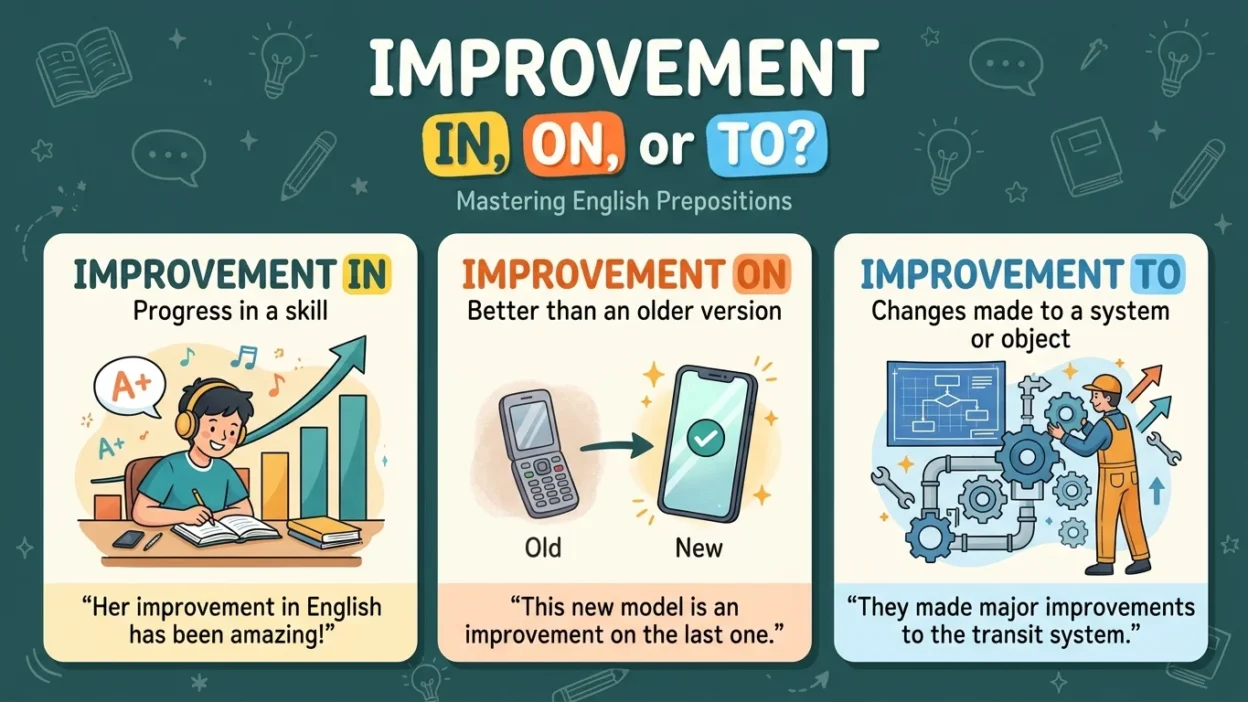
Use improvement in to describe progress in a skill, condition, or situation, as in “an improvement in performance.” Use improvement on to compare something with an earlier version or standard, as in “an improvement on the original.” Use improvement to to describe a change made to something, as in “an improvement to the system.”
Why Do People Confuse These Expressions?
The noun improvement means the process of becoming better or a change that makes something better. The confusion arises because the prepositions in, on, and to can all follow this noun, but they highlight different relationships.
The easiest way to choose the correct preposition is to ask yourself what you want to express:
- Are you describing progress in an area? Use improvement in.
- Are you comparing one version with another? Use improvement on.
- Are you describing a change made to something? Use improvement to.
1. Improvement In: Meaning and Usage
Use improvement in when talking about progress or a positive change in a particular area, quality, skill, condition, or result.
The preposition in identifies the area where the improvement has occurred.
Examples of Improvement In
- There has been a significant improvement in my English.
- We noticed an improvement in customer satisfaction.
- Her improvement in mathematics is impressive.
- The company reported an improvement in sales.
- Regular practice can lead to an improvement in pronunciation.
- There has been a gradual improvement in his health.
- The school wants to see an improvement in students’ writing skills.
- The new policy resulted in an improvement in workplace safety.
Common Expressions With Improvement In
- Improvement in performance
- Improvement in quality
- Improvement in health
- Improvement in behavior
- Improvement in productivity
- Improvement in communication
- Improvement in efficiency
- Improvement in living conditions
Remember: Use improvement in when the focus is on the area or quality that is getting better.
2. Improvement On: Meaning and Usage
Use improvement on when comparing something with an earlier version, previous result, existing method, or established standard. It often suggests that the new version is better than what came before.
Examples of Improvement On
- This year’s results are an improvement on last year’s results.
- The new model is a major improvement on the previous version.
- Her latest essay is an improvement on her first draft.
- The revised plan is an improvement on the original proposal.
- This design is a clear improvement on the old one.
- His latest performance was an improvement on his previous attempt.
- The updated software is an improvement on the earlier release.
- The new method is a noticeable improvement on the traditional approach.
Common Expressions With Improvement On
- An improvement on the original
- An improvement on the previous version
- An improvement on last year’s performance
- An improvement on the existing method
- A clear improvement on the first draft
Remember: Use improvement on when you want to show that one thing is better than another.
In many contexts, especially British English, improvement on is a natural way to express this comparison. Improvement over is also common, particularly in American English.
3. Improvement To: Meaning and Usage
Use improvement to when referring to a change, adjustment, or modification made to something to make it better.
The preposition to points toward the thing that receives the change.
Examples of Improvement To
- We made several improvements to the website.
- The manager suggested an improvement to the current system.
- The city plans to make improvements to its public transport network.
- There have been major improvements to the building.
- The developer introduced an improvement to the mobile application.
- The company is considering improvements to its customer service process.
- The engineers recommended improvements to the machine.
- The school has made improvements to its library facilities.
Common Expressions With Improvement To
- Improvements to the system
- Improvements to the website
- Improvements to the design
- Improvements to the building
- Improvements to the process
- Improvements to the service
- Improvements to the software
- Improvements to the infrastructure
Remember: Use improvement to when the focus is on something that has been changed or upgraded.
Improvement In vs. Improvement On vs. Improvement To: Comparison Table
| Expression | Main meaning | Example |
|---|---|---|
| Improvement in | Progress in an area or quality | There is an improvement in his writing. |
| Improvement on | A better version compared with an earlier one | This draft is an improvement on the original. |
| Improvement to | A change made to something | We made improvements to the draft. |
When Should You Use Each Expression?
Use Improvement In for Progress
Choose this expression when discussing a skill, condition, quality, or measurable result.
Correct: There has been an improvement in employee productivity.
This sentence describes progress in productivity, rather than a specific change made to a product or system.
Use Improvement On for Comparison
Choose this expression when comparing a newer result or version with an earlier one.
Correct: The latest design is an improvement on the previous design.
This sentence tells the reader that the latest design is better than the earlier one.
Use Improvement To for Changes or Modifications
Choose this expression when discussing changes made to an object, system, process, or service.
Correct: The team made improvements to the latest design.
This sentence focuses on the changes made to the design, not simply on comparing two designs.
10 Examples of Improvement In, On, and To
Here are examples that show how each expression works in everyday English.
- Improvement in: There has been a noticeable improvement in her confidence.
- Improvement in: The hospital has reported an improvement in patient care.
- Improvement in: I want to see an improvement in my grammar.
- Improvement on: The new proposal is an improvement on the original plan.
- Improvement on: His second attempt was an improvement on the first.
- Improvement on: This version is a clear improvement on the older model.
- Improvement to: We made an improvement to the booking process.
- Improvement to: The council announced improvements to local roads.
- Improvement to: The update brings several improvements to the application.
- Improvement to: The architect suggested improvements to the building’s layout.
Common Mistakes to Avoid
Mistake 1: Using Improvement On for Every Situation
Incorrect: There has been an improvement on my health.
Correct: There has been an improvement in my health.
Improvement in is the natural choice when describing a change in a person’s health or condition.
Mistake 2: Using Improvement In When Describing a Modification
Less natural for this meaning: We made improvements in the website.
More natural: We made improvements to the website.
Use improvements to when referring to specific changes made to the website.
Mistake 3: Using Improvement To for a Comparison
Less natural: This version is an improvement to the previous version.
More natural: This version is an improvement on the previous version.
The second sentence clearly compares the new version with the old one.
Mistake 4: Forgetting the Article
Incorrect: This is improvement on the original design.
Correct: This is an improvement on the original design.
When improvement refers to one specific positive change or result, it commonly takes the article an.
Mistake 5: Assuming Only One Preposition Is Ever Correct
Sometimes more than one expression can be grammatical, but the meaning or emphasis changes.
For example:
- The improvement in the software’s performance was impressive. This focuses on performance.
- The improvement to the software made it easier to use. This focuses on the change made.
- The new software is an improvement on the old version. This compares two versions.
A Simple Memory Trick
Remember these three connections:
- IN = Area: Improvement in English, health, or performance.
- ON = Comparison: Improvement on the original, previous version, or earlier result.
- TO = Change: Improvement to a website, system, building, or process.
When you are unsure, identify the relationship you want to express. Are you talking about progress, comparing versions, or making changes? That will usually help you choose the right preposition.
American vs. British English
The expressions improvement in, improvement on, and improvement to are used in both American and British English.
There are some differences in preference, but the main distinction is meaning rather than nationality.
- Improvement in: Common in both varieties. For example, “an improvement in performance.”
- Improvement on: Common in both varieties when comparing something with an earlier version. “Improvement over” is also widely used, especially in American English.
- Improvement to: Common in both varieties when describing modifications. For example, “improvements to the transport system.”
You do not need to choose a different preposition simply because you are writing for an American or British audience. Focus on what you want the sentence to mean.
Similar Words and Expressions
Progress In
Use progress in to describe development or advancement in an area.
Example: She has made excellent progress in learning English.
Change To
Use change to when something is altered or replaced.
Example: The company introduced a change to its working hours.
Improvement Over
Use improvement over to compare something favorably with an earlier version or alternative.
Example: The new model is a significant improvement over the previous one.
Improvements In
Use the plural form when referring to several positive developments within an area.
Example: We have seen improvements in customer service and product quality.
Improvements To
Use the plural form when referring to multiple changes made to something.
Example: The team recommended several improvements to the website.
Final Verdict
The correct phrase depends on your intended meaning.
- Improvement in describes progress in an area, such as health, English, performance, or quality.
- Improvement on compares something with an earlier version, result, or standard.
- Improvement to describes a positive change made to a thing, system, or process.
For example, say “an improvement in my English,” “an improvement on the first draft,” and “improvements to the website.”
Frequently Asked Questions
1. Is it improvement in or improvement on?
Both are correct, but they have different uses. Use improvement in to describe progress in an area, such as an improvement in performance. Use improvement on to compare something with an earlier version, such as an improvement on the original design.
2. Is it improvement in or improvement to?
Use improvement in for progress in a quality or condition. Use improvement to for a change made to something. For example, “an improvement in efficiency” describes better efficiency, while “an improvement to the system” describes a change made to the system.
3. Is improvement on grammatically correct?
Yes. Improvement on is grammatically correct when comparing something with an earlier version, result, or standard. For example, “The latest version is an improvement on the original.”
4. Should I say improvement in my English or improvement to my English?
Improvement in my English is the usual choice when you mean that your English skills are getting better. For example, “I have noticed an improvement in my English.” Improvement to my English may be possible in a context discussing specific changes, but it is less natural for general language progress.
5. Is it improvements in the system or improvements to the system?
Both can be correct, depending on the meaning. Improvements in the system can describe progress or better results within the system. Improvements to the system usually refers to specific modifications made to it.
6. Is improvement over correct English?
Yes. Improvement over is a standard expression used to compare something favorably with another version, result, or alternative. For example, “The new method is an improvement over the old one.” It is especially common in American English, although it is also used elsewhere.
7. Can I use improvement in academic writing?
Yes. Improvement in is widely used in academic and professional writing when discussing measurable changes in performance, outcomes, quality, or conditions. For example, “The study found an improvement in reading comprehension.”
8. What is the easiest way to remember the difference?
Think of in as an area, on as a comparison, and to as a change. Say “improvement in performance,” “improvement on the original,” and “improvements to the system.” These patterns will help you choose the correct phrase in most everyday situations.
Remember This
Use improvement in when something gets better in a particular area, improvement on when one version is better than another, and improvement to when a change is made to something. All three expressions are correct when used in the right context.
Conclusion
Choosing between improvement in, improvement on, and improvement to becomes easier when you focus on meaning. The first describes progress in an area, the second compares versions or results, and the third highlights changes made to something. These small differences can make your English clearer and more natural.
When writing or speaking, consider what you want to emphasize. If you are talking about your language skills, use “an improvement in my English.” If you are comparing a new draft with an old one, use “an improvement on the original.” If you are discussing changes to a website or system, use “improvements to the website” or “improvements to the system.” With practice, choosing the right preposition will become much more natural.

Charles Kevin is a passionate language writer and researcher at SimileHive, creating clear, engaging content about similes, idioms, metaphors, and figurative language to help readers improve English communication confidently every day.