Are you unsure whether to write “already” or “all ready”? These expressions sound similar, but they have different meanings and uses. Choosing the correct one can make your English writing clearer and help you avoid common grammar mistakes in emails, school assignments, text messages, and everyday conversations.
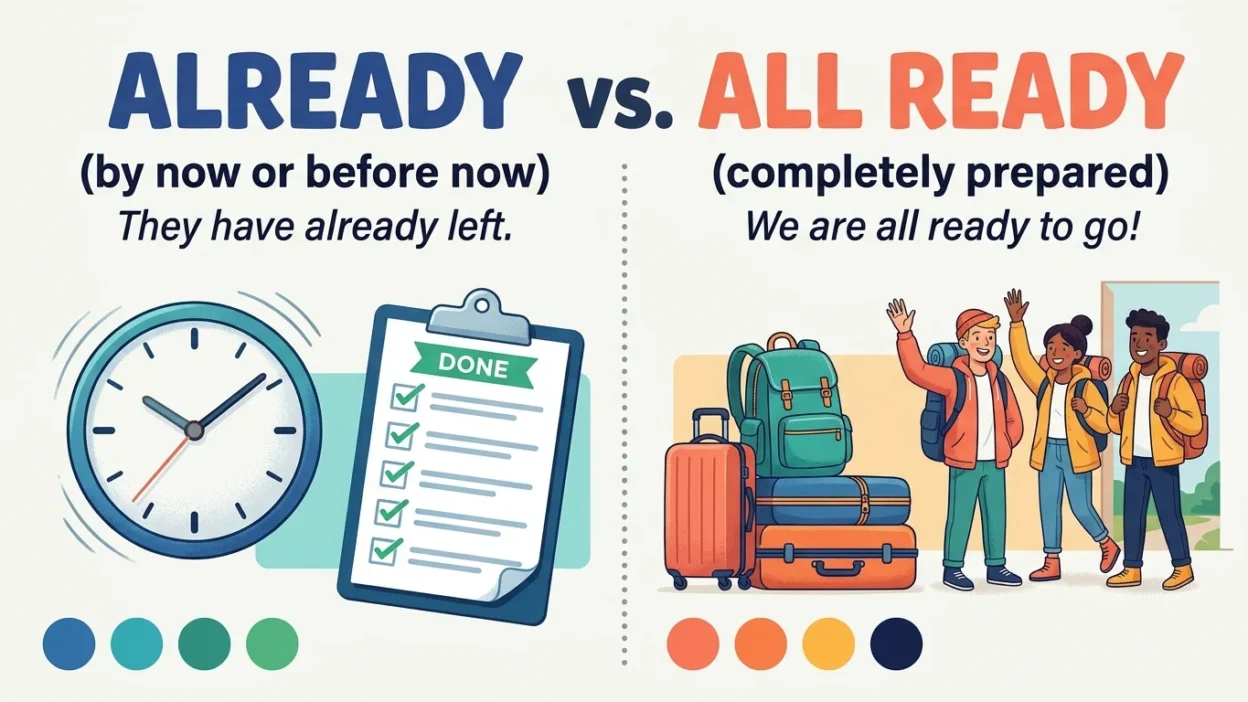
Already is an adverb that means something has happened before now or earlier than expected. For example, “I have already finished my homework.” All ready is a two word phrase that means everyone or everything is completely prepared. For example,
“We are all ready to leave.” Although the two expressions sound alike, they cannot always replace each other. The easiest way to remember the difference is to think of “already” as referring to time and “all ready” as referring to preparation. Once you understand this simple distinction, you can use both expressions confidently.
Quick Answer
Already means something has happened before now or earlier than expected. All ready means everyone or everything is fully prepared. For example, “She has already eaten” describes a completed action, while “She is all ready to leave” means she is prepared to go. Choose the spelling that matches your intended meaning.
Why Do People Confuse Already and All Ready?
People often confuse these expressions because they sound almost identical when spoken. However, their grammatical roles and meanings are different.
Already is one word that modifies a verb, adjective, or other expression to indicate that something happened before now or earlier than expected.
All ready consists of two words. “All” means everyone or everything, and “ready” means prepared.
Compare these examples:
- Already: The children have already eaten.
- All ready: The children are all ready for school.
In the first sentence, the children finished eating before the present moment. In the second sentence, the children are prepared to go to school.
The key is to determine whether you are talking about time or readiness.
What Does Already Mean?
Already is an adverb used to describe something that has happened before a particular time or sooner than expected.
It commonly appears in everyday conversations, written English, questions, and statements about completed actions.
How to Use Already
Already is often used with the present perfect tense, but it can also appear with other verb tenses.
Examples:
- I have already finished my assignment.
- She already knows the answer.
- They had already left when we arrived.
- Have you already booked the tickets?
- The movie has already started.
In each example, already indicates that an action or situation occurred before the time being discussed.
Does Already Mean Earlier Than Expected?
Yes. Already can suggest that something happened sooner than expected.
For example:
“He has already completed the project.”
This sentence may suggest that the project was completed earlier than the speaker expected.
However, already does not always express surprise. It can simply indicate that an action has happened before now.
For example:
“I already know his name.”
This means the speaker knows his name now, perhaps because they learned it previously.
What Does All Ready Mean?
All ready is a phrase made up of the word “all” and the adjective “ready.” It means that everyone or everything is completely prepared.
Use all ready when describing people, objects, or groups that are prepared for something.
How to Use All Ready
Examples:
- We are all ready for the trip.
- The students are all ready for the examination.
- Is everyone all ready to leave?
- The food is all ready to serve.
- They were all ready when the bus arrived.
In these sentences, all ready describes a state of preparation.
Can All Ready Refer to People and Things?
Yes. All ready can refer to a group of people who are prepared or to things that are prepared for use.
For example:
“The team is all ready for the match.”
This means the team is prepared.
“The documents are all ready for submission.”
This means the documents have been prepared and are ready to submit.
Already vs All Ready: Comparison Table
| Feature | Already | All ready |
|---|---|---|
| Spelling | One word | Two words |
| Part of speech | Adverb | Phrase containing an adverb or determiner and an adjective |
| Main meaning | Before now or earlier than expected | Completely prepared |
| Focus | Time or completion | Readiness or preparation |
| Example | I have already eaten. | We are all ready to eat. |
| Common question | Has it happened yet? | Is everyone or everything prepared? |
When Should You Use Already or All Ready?
The correct choice depends on what your sentence means.
When to Use Already
Use already when you want to say that something has happened before now or earlier than expected.
Examples:
- I have already sent the email.
- She already knows about the meeting.
- We had already booked our hotel.
- Have you already completed the form?
- The train has already departed.
A useful test is to replace already with “before now.” If the sentence still makes sense, already is probably correct.
For example:
“I have already eaten.”
“I have eaten before now.”
The meaning is similar, so already is appropriate.
When to Use All Ready
Use all ready when you want to describe everyone or everything as prepared.
Examples:
- We are all ready to begin.
- The children are all ready for bed.
- Are you all ready for the presentation?
- The rooms are all ready for the guests.
- The players were all ready for the game.
A useful test is to replace all ready with “completely prepared.” If the sentence makes sense, the two word phrase is likely correct.
For example:
“We are all ready to leave.”
“We are completely prepared to leave.”
Both sentences communicate the same general idea.
12 Examples of Already and All Ready in Sentences
Here are practical examples that show the difference in everyday English.
Examples Using Already
- I have already completed my homework.
- She already knows the truth.
- We have already eaten dinner.
- The teacher has already explained the lesson.
- Have you already finished reading the book?
- They had already arrived before the event started.
Examples Using All Ready
- We are all ready for the weekend.
- The children are all ready for school.
- Is everyone all ready to start the meeting?
- The bags are all ready for the journey.
- The guests were all ready when the taxi arrived.
- The team is all ready to play.
Notice how already describes when something happened, while all ready describes whether people or things are prepared.
Common Mistakes With Already and All Ready
Mistake 1: Writing All Ready When You Mean Before Now
Incorrect: “I have all ready finished my homework.”
Correct: “I have already finished my homework.”
The sentence describes a completed action, so already is the correct choice.
Mistake 2: Writing Already When You Mean Prepared
Incorrect: “We are already to leave.”
Correct: “We are all ready to leave.”
The intended meaning is that everyone is prepared to leave. Therefore, all ready is needed.
Mistake 3: Assuming Already Always Means Sooner Than Expected
Already can express surprise about an early action, but it can also simply describe something that happened before now.
Example: “I already know the answer.”
This sentence does not necessarily express surprise. It simply indicates existing knowledge.
Mistake 4: Forgetting That All Ready Can Refer to a Group
Incorrect for the intended meaning: “The students are already for the test.”
Correct: “The students are all ready for the test.”
The second sentence means that the students are prepared for the test.
What Is an Easy Memory Trick for Already vs All Ready?
Use this simple trick:
Already = an action happened earlier.
All ready = everyone or everything is prepared.
Think of these examples:
- “I have already packed.” The packing is finished.
- “I am all ready.” I am prepared.
- “They have already arrived.” Their arrival happened before now.
- “They are all ready to leave.” They are prepared to go.
Another helpful trick is to look at the word “ready.” If you can replace the phrase with “prepared,” use two words.
Already vs All Ready in American and British English
The difference between already and all ready is the same in American and British English. Both expressions are standard in both varieties.
American English
Examples:
“I have already finished my work.”
“We are all ready to go.”
British English
Examples:
“I have already finished my work.”
“We are all ready to go.”
There is no regional spelling difference between these expressions. The choice depends entirely on the meaning of the sentence.
Similar Words and Expressions
Learning related words can help you express time and preparation more precisely.
Previously: At an earlier time.
Example: “I had previously visited that city.”
Earlier: Before the present time or before another event.
Example: “She arrived earlier than expected.”
Yet: Used in questions and negative statements about whether something has happened by a particular time.
Example: “Have you finished yet?”
Prepared: Ready for something.
Example: “The team is prepared for the competition.”
Ready: In a suitable condition to do something.
Example: “Dinner is ready.”
Fully prepared: Completely ready for an event or task.
Example: “We are fully prepared for the presentation.”
These expressions can help you avoid confusion when talking about completed actions or readiness.
Final Verdict: Already or All Ready?
Use already when something has happened before now. Use all ready when everyone or everything is prepared.
For example, “I have already finished my work” means the work is complete. “I am all ready to leave” means you are prepared to go.
Both expressions are correct, but they serve different grammatical purposes. Remembering that already relates to time and all ready relates to preparation will help you choose the correct form in everyday writing and conversation.
Frequently Asked Questions
1. Is Already One Word or Two?
Already is one word. It is an adverb that means something happened before now or earlier than expected. All ready is written as two words and means completely prepared.
2. Is It Already or All Ready to Go?
Use “all ready to go” when you mean that everyone or everything is prepared to leave. For example, “We are all ready to go.” Use already when describing an action that has happened, as in “We have already decided to go.”
3. Is “I Am Already Ready” Correct?
Yes. “I am already ready” is grammatically correct. It means you are prepared now or became prepared earlier than expected. “I am all ready” is also correct, but it emphasizes being completely prepared.
4. Can Already and All Ready Be Used in the Same Sentence?
Yes. For example, “We have already packed, and we are all ready to leave.” Already describes the completed packing, while all ready describes the group’s state of preparation.
5. Does Already Mean the Same as Yet?
No. Already usually indicates that something has happened before now, while yet is commonly used in questions and negative sentences to ask or state whether something has happened by now.
Example: “I have already eaten.” “Have you eaten yet?”
6. Is All Ready Grammatically Correct?
Yes. All ready is a correct phrase when it means that everyone or everything is prepared. For example, “The children are all ready for school.”
7. How Can I Remember the Difference Between Already and All Ready?
Remember that already is about time and all ready is about preparation. If you mean “before now,” use already. If you mean “completely prepared,” use all ready.
Remember This
- Already means before now or earlier than expected.
- All ready means everyone or everything is prepared.
- “I have already eaten” describes a completed action.
- “We are all ready to leave” describes preparation.
- Both forms are correct, but they are not interchangeable.
The simplest rule is this: already is about when something happened, while all ready is about being prepared.
Conclusion
Already and all ready sound similar, but their meanings are different. Already is an adverb used to describe an action or situation that occurred before now or earlier than expected. All ready is a two word phrase that describes people or things that are fully prepared. Recognizing whether your sentence refers to time or preparation makes the correct choice much easier.
When writing, ask yourself one simple question: Has something happened, or is someone or something prepared? If the answer concerns a completed action, use already. If it concerns readiness, use all ready. This straightforward distinction will help you avoid common mistakes and use both expressions naturally.

Charles Kevin is a passionate language writer and researcher at SimileHive, creating clear, engaging content about similes, idioms, metaphors, and figurative language to help readers improve English communication confidently every day.