Knowing where to place a comma in “I love you too” can help you write messages that sound natural and grammatically correct. The phrase is common in text messages, romantic conversations, greeting cards, and everyday English. Although the words are simple, punctuation can sometimes cause confusion. Should you write “I love you too” or “I love you, too”? Both forms can be correct, depending on the punctuation style and intended emphasis.
The most common polished form is “I love you, too.” The comma before “too” is often used when “too” means “also.” However, the comma is not always necessary, especially in short, informal sentences. Understanding this small punctuation rule will help you write more confidently, whether you are replying to someone you love, composing a message, or learning English grammar.
Quick Answer
Both “I love you too” and “I love you, too” are correct. The comma before “too” is traditionally used when it means “also,” but it is often optional in short sentences. For careful writing, “I love you, too.” is a safe and widely accepted choice.
Why Do People Confuse the Comma Rule?
People often wonder whether “too” needs a comma because it can appear in different positions within a sentence.
When “too” means “also,” writers sometimes separate it with a comma for clarity or emphasis. In other cases, especially in short sentences, the word fits naturally into the sentence without a pause.
For example:
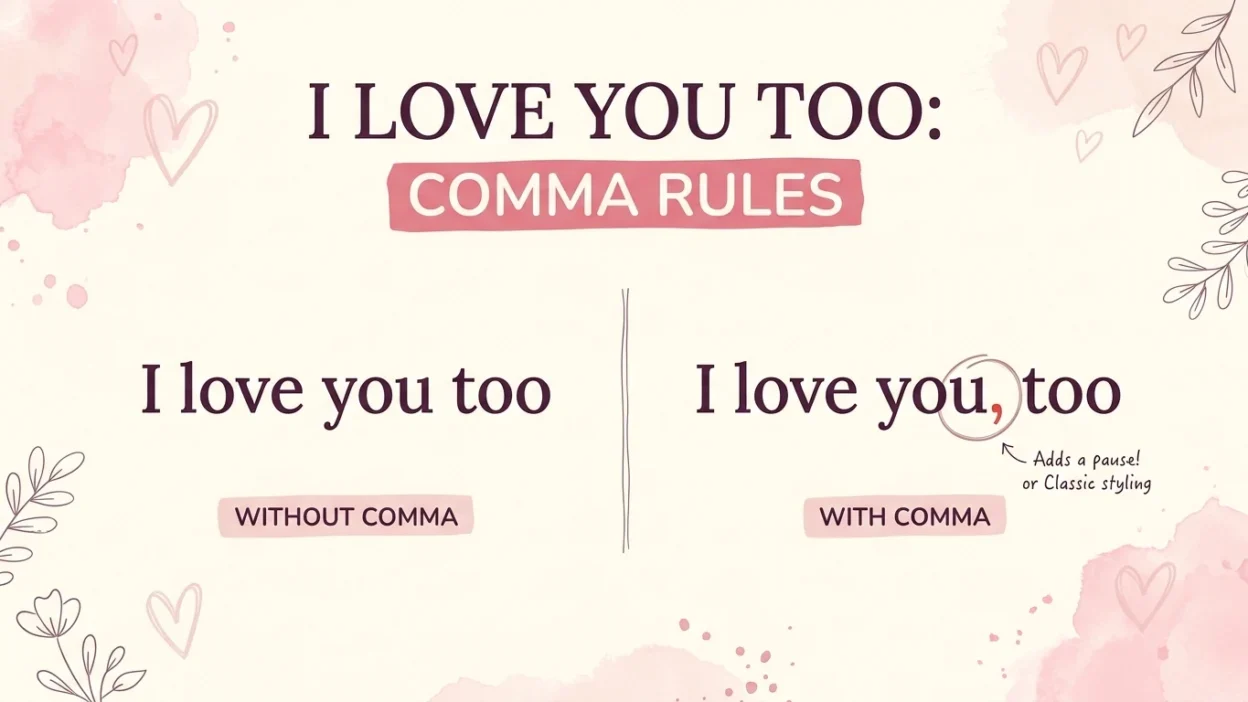
- I love you, too.
- I love you too.
Both sentences communicate the same basic meaning: the speaker also loves the other person.
The difference is mainly punctuation and style, not meaning.
Should You Write “I Love You Too” or “I Love You, Too”?
When to Use a Comma
Use a comma before “too” when you want to follow the traditional punctuation convention or give the word a slight sense of emphasis.
Examples:
- I miss you, too.
- I appreciate your help, too.
- I want to see you, too.
- I love you, too.
In each example, “too” means “also.”
When You Can Leave Out the Comma
In short, straightforward sentences, the comma before “too” is often omitted without causing a grammatical problem.
Examples:
- I love you too.
- I miss you too.
- She wants to come too.
- He understands too.
This style is especially common in text messages, casual emails, and everyday digital communication.
“I Love You Too” vs. “I Love You, Too”: Comparison Table
| Phrase | Correct? | Best use |
|---|---|---|
| I love you too. | Yes | Casual messages and everyday writing |
| I love you, too. | Yes | Traditional punctuation and polished writing |
| I love you, Too. | Usually incorrect | “Too” should not be capitalized mid sentence |
| I, love you too. | Incorrect in ordinary usage | No comma is needed between the subject and verb |
Examples of “I Love You Too” With Correct Punctuation
Here are ten natural examples you can use in everyday conversations.
- I love you too.
- I love you, too.
- Of course, I love you too.
- I really love you, too.
- I miss you, too, sweetheart.
- Thank you, I love you too.
- I love you too, my darling.
- I love you, too. Have a wonderful day.
- You mean so much to me, and I love you, too.
- I love you too! ❤️
Remember that a comma can also be needed elsewhere in a sentence. For example, in “I love you too, sweetheart,” the comma before “sweetheart” separates the term of direct address from the rest of the sentence.
Common Comma Mistakes
Mistake 1: Putting a Comma Between the Subject and Verb
Incorrect: I, love you too.
Correct: I love you too.
A comma should not normally separate the subject “I” from the verb “love.”
Mistake 2: Assuming the Comma Is Always Required
“I love you too” is acceptable without a comma. The comma before “too” is often a matter of punctuation style.
Mistake 3: Forgetting the Comma Before a Name or Term of Affection
Incorrect: I love you too sweetheart.
Correct: I love you too, sweetheart.
When directly addressing someone as “sweetheart,” “dear,” or a person’s name, use a comma to separate that term from the rest of the sentence.
Mistake 4: Using a Capital T in the Middle of a Sentence
Incorrect: I love you, Too.
Correct: I love you, too.
The word “too” should remain lowercase unless it begins a sentence or appears in a title with capitalization rules that require it.
Does “Too” Always Need a Comma?
No. “Too” does not always need a comma. When it means “also,” the comma is often optional, particularly when it appears at the end of a short sentence.
Compare these examples:
- I want some too.
- I want some, too.
Both are acceptable.
However, when “too” means “excessively,” the punctuation depends on the sentence structure.
Example: “The coffee is too hot to drink.”
No comma is needed because “too” modifies the adjective “hot” and means “excessively.”
American vs. British English
American and British English generally follow the same principles for using commas with “too.” In both varieties, writers may use a comma before “too” when it means “also,” although the comma is often omitted in short sentences.
For example:
American English: “I love you, too.”
British English: “I love you too.”
Neither variety requires one spelling or punctuation style exclusively. Consistency and clarity are more important than choosing a particular national variety.
Frequently Asked Questions
1. Is It “I Love You Too” or “I Love You, Too”?
Both are correct. “I love you, too” follows the traditional convention of separating “too” with a comma when it means “also.” “I love you too” is also acceptable, particularly in informal writing.
2. Is There a Comma Before Too?
Sometimes. When “too” means “also,” a comma before it is often used but is not always necessary. In short sentences, leaving out the comma is generally acceptable.
3. Is “I Love You Too” Grammatically Correct Without a Comma?
Yes. “I love you too” is grammatically acceptable. The absence of a comma does not change the sentence’s meaning.
4. Should I Put a Comma Before Too in a Text Message?
You can, but you do not have to. Both “I love you too” and “I love you, too” are natural in text messages. Choose the version that feels right for your tone.
5. Is “I Love You, Too” More Formal?
It can look slightly more polished because it follows the traditional convention of setting off “too” with a comma. However, the comma alone does not make a sentence formal or informal.
6. Do I Need a Comma in “I Love You Too, Baby”?
Yes, a comma before “baby” is appropriate because it is a term of direct address. You can write “I love you too, baby” or “I love you, too, baby.”
7. Does the Comma Change the Meaning?
Usually, no. “I love you too” and “I love you, too” generally have the same meaning. The comma mainly affects punctuation and the way the sentence is presented.
Remember This
Both forms are correct:
I love you too.
I love you, too.
Use the comma if you prefer traditional punctuation or want to emphasize “too.” Leave it out if you prefer a simple, natural style for casual messages. Either way, your meaning remains clear.
Conclusion
The comma rule for “I love you too” is simple once you understand how “too” works. When it means “also,” a comma before it is traditionally acceptable, but it is not compulsory in every short sentence. Both “I love you too” and “I love you, too” are correct.
For polished writing, “I love you, too” is a safe choice. For everyday text messages, “I love you too” is perfectly natural. The most important thing is to use punctuation that keeps your message clear and makes your writing comfortable to read.

Adam Aaron is a language enthusiast and content writer at SimileHive, creating clear, engaging guides on similes, idioms, metaphors, and figurative language to help readers improve English confidently every day.