When writing in English, small differences in spelling and spacing can change the meaning of a phrase. One common question is whether to write “ahold” or “a hold.” Both forms are correct in certain contexts, but they are not interchangeable. Understanding their meanings will help you choose the right expression in everyday conversations, school assignments, emails, and professional writing.
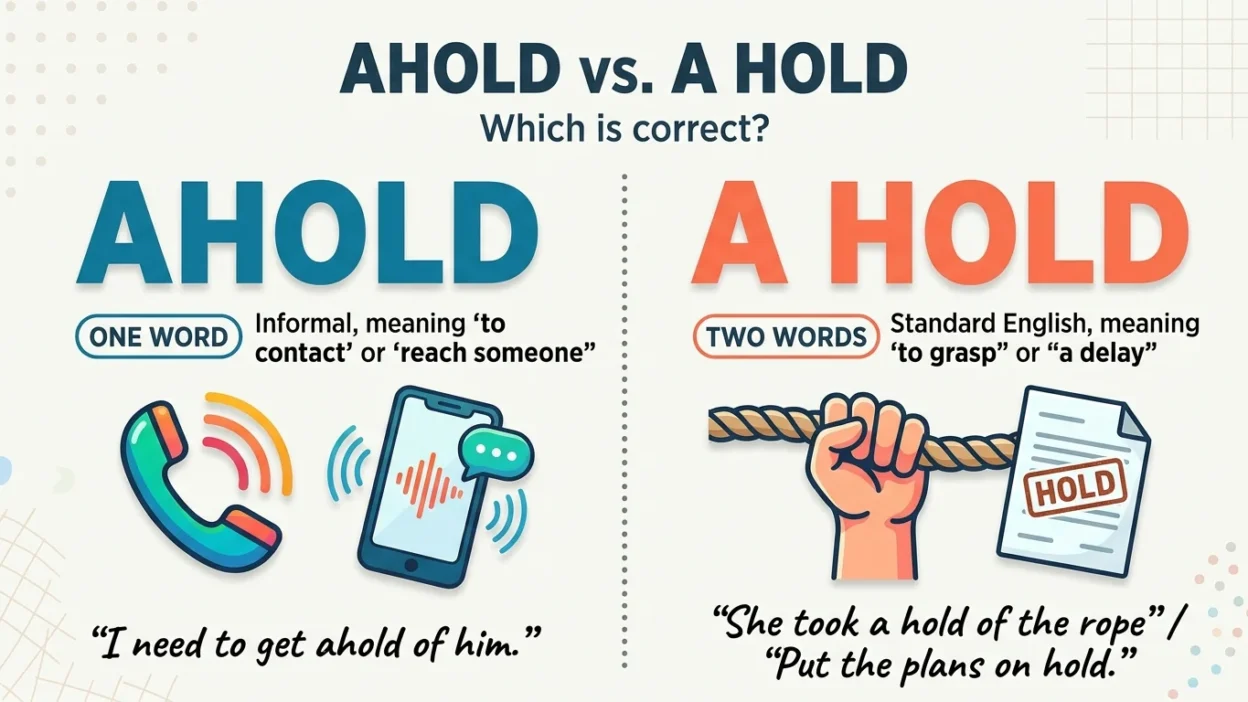
The word “ahold” usually appears in the expression “get ahold of someone,” which means to contact or reach someone. In contrast, “a hold” consists of an article and a noun. It can refer to a grip, a delay, a reservation, or a restriction, depending on the sentence. For example, “I finally got ahold of my teacher” means that you managed to contact your teacher.
However, “Please place a hold on my account” means that you want a restriction placed on the account. Learning the difference between these expressions makes your writing clearer and helps you avoid common English mistakes.
Quick Answer
Ahold or a hold? Both are correct, but they have different uses. “Ahold” is commonly used in the expression “get ahold of,” meaning to contact or reach someone. “A hold” is a noun phrase referring to a grip, delay, reservation, or restriction. Choose the form that matches your intended meaning and the sentence structure.
Why Do People Confuse Ahold and A Hold?
People often confuse “ahold” and “a hold” because they sound similar when spoken aloud. In casual conversation, the space between words is not audible, so it can be difficult to know which spelling is appropriate.
Another reason is that English contains many expressions that combine a verb with a noun or another word. Some expressions are written as one word, while others remain separate.
For example:
- I could not get ahold of my friend.
- She kept a hold on the rope.
In the first sentence, “ahold” is part of a common expression about contacting someone. In the second sentence, “a hold” refers to a grip or grasp.
The easiest way to avoid confusion is to examine the meaning of the entire sentence rather than relying on pronunciation alone.
What Does Ahold Mean?
“Ahold” is an informal word used mainly in American English. It commonly appears after verbs such as “get,” “grab,” and “take,” especially in expressions involving contact or grasping.
Meaning of Ahold
The most familiar expression is “get ahold of someone,” which means to successfully contact or communicate with a person.
Examples:
- I need to get ahold of my manager before the meeting.
- She finally got ahold of her brother.
- Can you get ahold of the customer support team?
- I have been trying to get ahold of you all morning.
“Ahold” can also appear in expressions involving gaining physical control or obtaining a grip on something.
For example:
“He managed to get ahold of the slippery rope.”
Here, the phrase means that he managed to grasp the rope.
Is Ahold One Word?
Yes. “Ahold” is conventionally written as one word in expressions such as “get ahold of.” It is informal and particularly common in American English.
In more formal writing, “contact,” “reach,” or “obtain a firm grip on” may be clearer alternatives, depending on the intended meaning.
What Does A Hold Mean?
“A hold” is a two word phrase consisting of the article “a” and the noun “hold.” The noun has several meanings, including a grip, a delay, a reservation, or a restriction.
Meaning of A Hold
The meaning of “a hold” depends on its context.
1. A grip or grasp
Example: “The climber maintained a hold on the rock.”
Here, “a hold” refers to a grip or something used to support the body.
2. A delay or temporary pause
Example: “The bank placed a hold on the transaction.”
Here, the phrase refers to a restriction or temporary delay.
3. A reservation
Example: “I put a hold on the book at the library.”
This means that the library has reserved the book for the speaker.
4. Control or influence
Example: “The company has a strong hold on the local market.”
In this sentence, “a hold” describes influence or control.
Is A Hold Two Words?
Yes. “A hold” is written as two separate words because “a” is an article and “hold” is a noun.
You can often recognize this structure by replacing “hold” with another noun, such as “reservation,” “grip,” or “restriction,” without changing the basic meaning of the sentence.
Ahold vs. A Hold: Comparison Table
| Feature | Ahold | A hold |
|---|---|---|
| Spelling | One word | Two words |
| Word type | Informal word used in set expressions | Article plus noun |
| Common meaning | Contact or reach someone | Grip, delay, reservation, or restriction |
| Typical example | I got ahold of my friend. | The bank placed a hold on my account. |
| Common usage | Informal American English | Standard English in many contexts |
| Formal alternative | Contact or reach | Grip, restriction, reservation, or delay |
When Should You Use Ahold or A Hold?
Choosing between these forms becomes easier when you identify what you want to communicate.
When to Use Ahold
Use “ahold” when expressing the idea of contacting someone or obtaining a grip on something in a familiar expression.
Examples:
- I finally got ahold of the doctor.
- She could not get ahold of her parents.
- Please help me get ahold of the technician.
- The child grabbed ahold of his father’s hand.
Remember that “get ahold of” is informal. In a formal email, “contact” or “reach” may be a better choice.
For example:
Informal: “I will get ahold of you tomorrow.”
Formal: “I will contact you tomorrow.”
When to Use A Hold
Use “a hold” when the sentence requires the noun “hold” with the article “a.”
Examples:
- The bank placed a hold on my payment.
- She maintained a firm hold on the handle.
- I requested a hold on the library book.
- The airline put a hold on my reservation.
In these sentences, “hold” represents a specific thing, action, or condition rather than the informal expression used to describe contacting someone.
12 Examples of Ahold and A Hold in Sentences
The following examples show how context determines the correct spelling.
Examples Using Ahold
- I need to get ahold of my teacher before class.
- She finally got ahold of the customer service department.
- We could not get ahold of the delivery driver.
- Have you been able to get ahold of your cousin?
- He tried to get ahold of the doctor after lunch.
- The little boy grabbed ahold of his mother’s hand.
Examples Using A Hold
- The bank placed a hold on my account.
- She kept a firm hold on the steering wheel.
- I requested a hold on the book I wanted to borrow.
- The company put a hold on the project.
- The climber found a secure hold on the wall.
- Please place a hold on the payment until we confirm the details.
These examples illustrate the main distinction: “ahold” commonly belongs to an expression about reaching or grasping, while “a hold” identifies a noun with a particular meaning.
Common Mistakes With Ahold and A Hold
English learners and native speakers sometimes use these forms incorrectly because they focus on how a phrase sounds rather than how it functions.
Mistake 1: Using A Hold When You Mean Contact Someone
Incorrect for the intended informal expression: “I could not get a hold of my teacher.”
Preferred in this article’s distinction: “I could not get ahold of my teacher.”
However, “get a hold of” is also an established spelling in English. The three word form is widely used, so it is not automatically incorrect.
Mistake 2: Writing Ahold When You Mean a Restriction
Incorrect: “The bank placed ahold on my account.”
Correct: “The bank placed a hold on my account.”
The sentence refers to a restriction, so the noun phrase “a hold” is appropriate.
Mistake 3: Assuming Ahold Is Always More Correct
Incorrect assumption: “Ahold is always correct because it is one word.”
The correct choice depends on meaning and sentence structure. “Ahold” works in expressions such as “get ahold of,” while “a hold” is necessary when referring to a specific grip, reservation, or restriction.
Mistake 4: Using Informal Language in Every Situation
Informal: “I need to get ahold of the director.”
More formal: “I need to contact the director.”
Both sentences communicate the same general idea, but the second may be more suitable for professional communication.
What Is an Easy Memory Trick for Ahold vs. A Hold?
Use this simple memory trick:
Ahold means reaching. A hold means a thing or condition.
Think of these examples:
- “Get ahold of Sarah” means contact Sarah.
- “Put a hold on the account” means apply a restriction.
- “Keep a hold on the rope” means maintain a grip.
When you are unsure, ask yourself whether “hold” refers to a noun, such as a grip or restriction, or whether you are using the expression “get ahold of” to describe reaching someone.
This simple check will help you choose the appropriate form in most everyday situations.
Ahold vs. A Hold in American and British English
The distinction between “ahold” and “a hold” also involves differences in regional usage.
American English
“Ahold” is commonly used in informal American English, particularly in the expression “get ahold of someone.”
Example: “I have been trying to get ahold of him all day.”
American English also commonly uses “get a hold of,” with three separate words.
British English
British English speakers often prefer expressions such as “get hold of someone” without the article “a.”
Example: “I have been trying to get hold of him all day.”
The phrase “get hold of” is standard British English, although usage varies among speakers and contexts.
Which Form Should You Choose?
For American audiences, “get ahold of” is a familiar informal option. For British audiences, “get hold of” may sound more natural. In formal writing for either audience, “contact” or “reach” is often the clearest choice.
The noun phrase “a hold” remains appropriate in both varieties when referring to a grip, restriction, reservation, or similar concept.
Similar Words and Expressions
Several English expressions have meanings related to “ahold” or “a hold.” Learning them can help you communicate more naturally.
Get hold of: To contact someone or obtain something.
Example: “I need to get hold of the technician.”
Get in touch with: To communicate with someone.
Example: “Please get in touch with me next week.”
Contact: To communicate with a person or organization.
Example: “I will contact the office tomorrow.”
Reach: To successfully communicate with someone.
Example: “I could not reach my supervisor.”
Grip: To hold something firmly.
Example: “She tightened her grip on the bag.”
Reservation: An arrangement to keep something available.
Example: “I made a reservation for Saturday.”
Restriction: A rule or condition that limits something.
Example: “The account has a temporary restriction.”
These alternatives are useful when you want to avoid informal language or make your meaning more precise.
Final Verdict
Both “ahold” and “a hold” are correct, but they serve different purposes.
Use “ahold” in informal expressions such as “get ahold of someone,” meaning to contact or reach that person. Use “a hold” when referring to a noun, such as a grip, delay, reservation, or restriction.
Remember that “get a hold of” is also a widely accepted spelling of the contact expression. The best choice depends on the sentence, your intended meaning, and the style of English you are using.
Frequently Asked Questions
1. Is Ahold One Word or Two?
“Ahold” is one word. It is commonly used in informal expressions such as “get ahold of someone,” meaning to contact or reach a person. “A hold” is two words and refers to a noun, such as a grip, restriction, or reservation.
2. Is Ahold Grammatically Correct?
Yes. “Ahold” is a recognized English word, especially in American English. It is most commonly used in expressions such as “get ahold of.” In formal writing, alternatives such as “contact” and “reach” may be more appropriate.
3. Is It Get Ahold of or Get a Hold Of?
Both “get ahold of” and “get a hold of” are accepted spellings in American English. “Get hold of” is also standard, especially in British English. Choose a form that suits your audience and use it consistently.
4. What Does Get Ahold of Someone Mean?
“Get ahold of someone” means to successfully contact or communicate with that person, usually by phone, message, or another method. For example, “I finally got ahold of my manager” means that the speaker successfully contacted the manager.
5. Is A Hold the Same as Ahold?
No. “Ahold” is commonly used in an informal expression about contacting someone or grasping something. “A hold” is an article followed by a noun and can mean a grip, reservation, restriction, or delay. Their meanings depend on the context.
6. Is Ahold American or British English?
“Ahold” is particularly common in American English. British English speakers often use “get hold of” instead. However, English usage varies, and readers may understand both expressions.
7. Should I Use Ahold in Formal Writing?
It is generally better to use “contact” or “reach” in formal emails, academic assignments, and professional documents when you mean communicating with someone. For example, write “I will contact you tomorrow” instead of “I will get ahold of you tomorrow.”
Remember This
The main difference is simple:
- Ahold: Commonly means to contact or reach someone in the expression “get ahold of.”
- A hold: A noun phrase that can mean a grip, reservation, restriction, or delay.
- Get a hold of: Another accepted spelling of the informal contact expression.
- Get hold of: A common alternative, particularly in British English.
- Contact: A clear and formal alternative when communicating with someone.
If you remember these five points, you will be able to choose the right expression in most everyday writing situations.
Conclusion
Understanding the difference between “ahold” and “a hold” is easier when you focus on meaning rather than pronunciation. “Ahold” is commonly used in informal expressions about contacting someone, while “a hold” refers to a noun such as a grip, restriction, reservation, or delay. Although both forms are correct, they cannot always replace each other.
For everyday American English, “get ahold of” is a natural option. In British English, “get hold of” is often preferred. For formal communication, words such as “contact” and “reach” are clear alternatives. By paying attention to context and choosing the expression that fits your sentence, you can write more accurately and communicate your ideas with confidence.

Lucas Luke is a passionate language writer and content creator at SimileHive, specializing in similes, idioms, metaphors, and figurative language. He enjoys making complex English expressions simple, engaging, and easy to understand for students, writers, and language enthusiasts through well-researched, practical content.