“Set” and “sit” are two commonly confused English verbs because they sound similar and can both describe placing or being in a position. However, they have different meanings and grammatical uses. Understanding the difference between set vs. sit will help you choose the correct verb in everyday conversations, academic writing, and professional communication.
The main difference is simple: set usually means to put something somewhere, while sit means to rest or be in a seated position. Set generally takes an object, whereas sit usually does not. Learning their meanings, verb forms, and common examples will make it easier to use both words correctly.
Quick Answer: Set vs. Sit
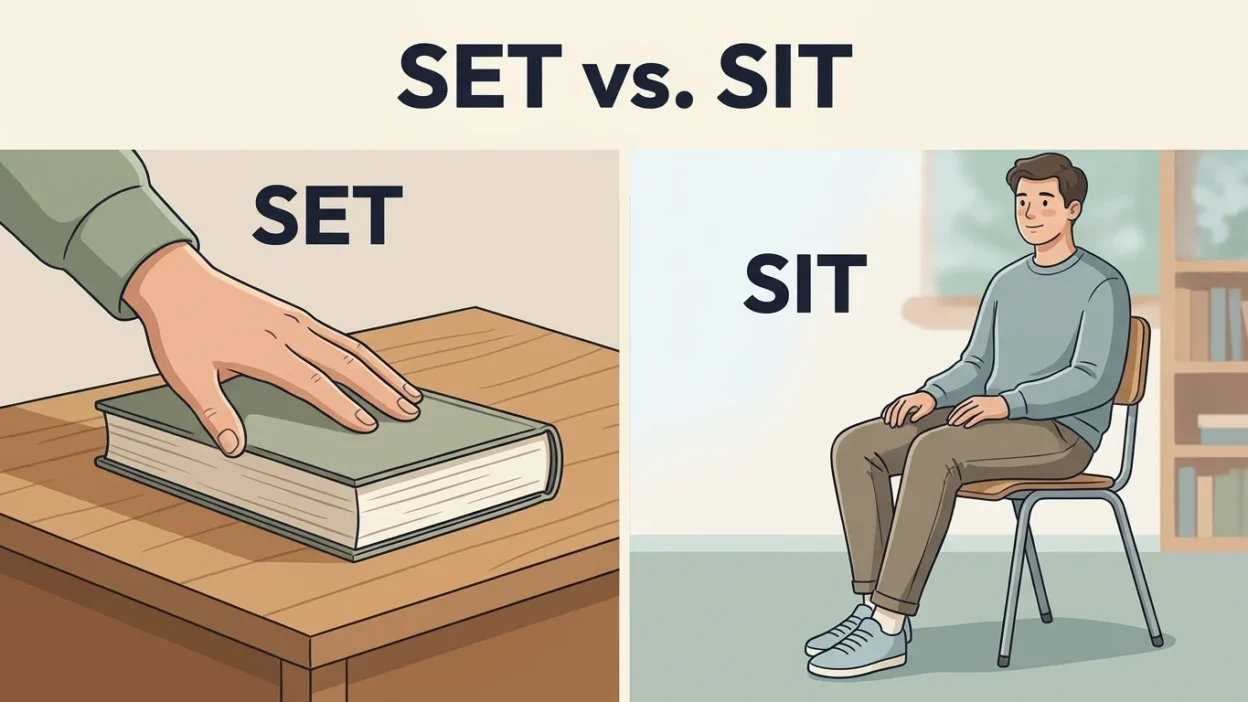
Set means to put or place something in a particular position, as in “Set the book on the table.” Sit means to rest in a seated position, as in “Please sit on the chair.” Set is usually a transitive verb that takes an object, while sit is usually an intransitive verb that does not require one.
Why Do People Confuse Set and Sit?
People often confuse “set” and “sit” because the words look and sound similar. Both can describe positions, and both appear in everyday expressions involving chairs, tables, objects, and people.
The confusion also comes from their verb forms. The past tense of set is set, while the past tense of sit is sat. In addition, people sometimes use “set” when they mean “sit,” especially in informal speech or regional dialects.
The easiest way to remember the difference is to ask yourself one question: Are you placing something, or are you taking a seat?
- If you are placing something, use set.
- If you are taking a seat or resting in a seated position, use sit.
What Does Set Mean?
Set means to put, place, or arrange something in a particular position. It can also mean to establish a time, adjust a device, or prepare something for a purpose.
When “set” means to place something, it generally takes a direct object—the thing being placed.
Examples of Set in Sentences
- Please set the glass on the table.
- She set her bag beside the door.
- He sets the alarm for six every morning.
- We set the chairs around the dining table.
- They set a date for the meeting.
- I set my phone on the desk.
- The teacher set a difficult question for the class.
- Please set the table before dinner.
In these examples, set refers to placing, arranging, adjusting, or establishing something.
Verb Forms of Set
The verb “set” has the same form in the present, simple past, and past participle.
| Verb form | Example |
|---|---|
| Base form | Set |
| Simple present | Set / sets |
| Simple past | Set |
| Past participle | Set |
| Present participle | Setting |
Examples:
- I set my keys on the shelf every evening.
- Yesterday, I set my keys on the shelf.
- I have set my keys on the shelf.
- She is setting the dishes on the table.
Notice that the past tense does not change to “setted.” The correct form is always set.
What Does Sit Mean?
Sit means to rest your body in a seated position, usually with your weight supported by a chair, bench, or another surface. It can also mean to remain in a particular position or location.
Unlike set, sit usually does not require a direct object.
Examples of Sit in Sentences
- Please sit on this chair.
- I like to sit near the window.
- She sits beside her best friend in class.
- We sat outside and enjoyed the sunshine.
- He has sat here for an hour.
- The children are sitting on the floor.
- You can sit wherever you feel comfortable.
- My grandfather likes to sit in the garden after dinner.
In these sentences, sit describes a person or animal resting in a seated position.
Verb Forms of Sit
Unlike set, the verb “sit” changes in the past tense and past participle.
| Verb form | Example |
|---|---|
| Base form | Sit |
| Simple present | Sit / sits |
| Simple past | Sat |
| Past participle | Sat |
| Present participle | Sitting |
Examples:
- I sit here every morning.
- Yesterday, I sat here for two hours.
- I have sat in this chair before.
- She is sitting beside the window.
Remember that the correct past forms are sat, not “sitted.”
Set vs. Sit: Key Differences
| Feature | Set | Sit |
|---|---|---|
| Main meaning | Put or place something | Rest in a seated position |
| Typical use | With an object | Without a direct object |
| Simple past | Set | Sat |
| Past participle | Set | Sat |
| Present participle | Setting | Sitting |
| Example | Set the cup on the table. | Sit on the chair. |
| Memory clue | Set something down | Sit yourself down |
The main grammatical distinction is that set usually describes an action performed on something, while sit usually describes the position or action of the person or animal doing the sitting.
When Should You Use Set?
Use “set” when you mean to place, arrange, adjust, or establish something.
1. When Placing an Object
- Set your phone on the desk.
- She set the plate beside the bowl.
- He set the box near the door.
2. When Arranging Things
- They set the chairs in a circle.
- Please set the table for dinner.
- The staff set the room up for the meeting.
3. When Adjusting a Device
- I set my alarm for 7 a.m.
- She set the temperature to 22 degrees.
- He set the timer for ten minutes.
4. When Establishing Something
- We set a deadline for Friday.
- The school set new rules.
- They set a date for the wedding.
When Should You Use Sit?
Use “sit” when someone or an animal takes or remains in a seated position.
1. When Taking a Seat
- Please sit down.
- You may sit beside me.
- The students sat in their assigned seats.
2. When Describing a Position
- She sits near the front of the classroom.
- The cat sits on the windowsill.
- He was sitting under a tree.
3. When Describing a Length of Time
- I sat through the entire presentation.
- She has sat here since noon.
- We were sitting in the waiting room for an hour.
4. In Common Expressions
- Sit tight means to wait patiently.
- Sit still means to remain in one position without moving.
- Sit down means to take a seated position.
- Sit back can mean to relax or avoid getting involved.
Set vs. Sit in Different Tenses
Understanding the verb forms helps you avoid mistakes when discussing the past, present, or future.
| Tense or form | Set | Sit |
|---|---|---|
| Present | I set the book down. | I sit near the door. |
| Simple past | I set the book down yesterday. | I sat near the door yesterday. |
| Present perfect | I have set the book down. | I have sat near the door. |
| Past perfect | I had set the book down. | I had sat near the door. |
| Present continuous | I am setting the book down. | I am sitting near the door. |
| Future | I will set the book down. | I will sit near the door. |
Notice that “set” remains unchanged in the simple past and past participle, while “sit” changes to “sat.”
Set Down vs. Sit Down: What Is the Difference?
“Set down” and “sit down” are common expressions, but they describe different actions.
Set down means to place an object on a surface.
- Please set down your bag.
- She set down the tray carefully.
- He set down his pen and stood up.
Sit down means to move into a seated position.
- Please sit down and relax.
- He sat down beside his friend.
- We sat down to discuss the problem.
A useful comparison is:
- Set the baby down carefully. You are placing the baby somewhere.
- Sit down carefully. You are taking a seat yourself.
Common Mistakes With Set and Sit
Mistake 1: Using Set Instead of Sit
Incorrect: Please set on the chair.
Correct: Please sit on the chair.
Explanation: Sit describes a person taking a seated position. Set generally requires something to be placed.
Mistake 2: Using Sit Instead of Set
Incorrect: Please sit the book on the desk.
Correct: Please set the book on the desk.
Explanation: The book is being placed on the desk, so set is the appropriate verb.
Mistake 3: Using Sitted Instead of Sat
Incorrect: I sitted beside my brother.
Correct: I sat beside my brother.
Explanation: The simple past and past participle of sit are both sat.
Mistake 4: Using Setted Instead of Set
Incorrect: She setted the cup on the table.
Correct: She set the cup on the table.
Explanation: Set has the same form in the present, simple past, and past participle.
Mistake 5: Confusing Sitting With Setting
Incorrect: He is setting on the sofa.
Correct: He is sitting on the sofa.
Explanation: Sitting describes a seated position. Setting is used when placing or arranging something, or in other meanings of set.
Easy Memory Trick to Remember Set vs. Sit
Use this simple rule:
Set = Something is placed. Sit = Someone takes a seat.
Think of these two examples:
- Set the cup down. You move the cup to a surface.
- Sit down. You move your body into a seated position.
You can also remember the past forms:
- Set → Set → Set
- Sit → Sat → Sat
If the sentence is about placing an object, think of “set.” If it is about sitting on a chair or remaining seated, think of “sit.”
Set vs. Sit in American and British English
The basic meanings and standard verb forms of set and sit are the same in American and British English.
| Usage | American English | British English |
|---|---|---|
| Place an object | Set the bag on the table. | Set the bag on the table. |
| Take a seat | Sit on the chair. | Sit on the chair. |
| Past tense of sit | Sat | Sat |
| Past tense of set | Set | Set |
In some regional or informal varieties of English, speakers may use “set” where standard English would use “sit.” However, for formal writing, exams, and professional communication, use sit for taking a seat and set for placing an object.
Similar Words: Set, Sit, and Seat
These three words are related to position and placement, but their grammatical uses differ.
| Word | Meaning | Example |
|---|---|---|
| Set | Put or place something | Set the bag on the floor. |
| Sit | Rest in a seated position | Sit beside the window. |
| Seat | Provide someone with a place to sit | The usher will seat the guests. |
“Seat” can be a verb that takes an object, as in “The host seated the visitors.” It can also be a noun, as in “Please take your seat.”
Frequently Asked Questions
1. What is the main difference between set and sit?
Set usually means to put or place something somewhere. Sit means to rest in a seated position. For example, “Set the book on the table” refers to placing a book, while “Sit on the chair” refers to taking a seat.
2. Is it set down or sit down?
Both expressions are correct, but they have different meanings. “Set down” means to place an object on a surface, while “sit down” means to move your body into a seated position.
3. Is the past tense of sit set or sat?
The past tense of sit is sat. For example, “I sat beside my friend yesterday.” The word set is not the past tense of sit; it is the base form, past tense, and past participle of the verb set.
4. Is it correct to say “I was sat” or “I was sitting”?
“I was sitting” is the standard choice when describing your own action of being seated. “I was sat” is also used in some regional varieties of British English, but “I was sitting” is generally preferable in formal and international English.
5. Can set be used without an object?
Yes. Although set commonly takes an object, it can also be used without one in certain contexts. For example, “The sun sets in the west.” In this sentence, set means to go below the horizon.
6. Is it set the table or sit the table?
The standard expression is set the table. It means to arrange plates, glasses, cutlery, and other items for a meal. “Sit the table” is not the standard expression for this meaning.
7. Is it sitting or setting on the sofa?
The standard phrase is sitting on the sofa when describing someone resting in a seated position. “Setting on the sofa” is not standard for this meaning, although set can have other uses.
8. What are the past participles of set and sit?
The past participle of set is set, as in “I have set the alarm.” The past participle of sit is sat, as in “I have sat here for an hour.”
Conclusion
The difference between set and sit becomes easy to understand once you focus on the action. Set usually means to put, place, arrange, or establish something. Sit means to rest in a seated position. Although the words are similar, they are not interchangeable in standard English.
Remember the verb forms as well: set, set, set; and sit, sat, sat. With regular practice and attention to sentence meaning, you can use both verbs confidently in conversations, school assignments, and professional writing.
Final verdict: Set something down, but sit yourself down.

Charles Kevin is a passionate language writer and researcher at SimileHive, creating clear, engaging content about similes, idioms, metaphors, and figurative language to help readers improve English communication confidently every day.