Are you confused about whether to write “also has” or “has also”? Both expressions are grammatically correct, but their placement depends on the sentence structure and the emphasis you want to create. The word also means “in addition” or “too,” and it can appear in different positions without changing the main meaning of a sentence.
For example, both “She also has a car” and “She has also bought a car” are correct. However, the first sentence emphasizes that she possesses a car in addition to something else, while the second places also after the auxiliary verb has to add another action or result.
Understanding how also works with main verbs and helping verbs will help you choose the natural word order in everyday conversation, academic writing, and professional communication.
Quick Answer: Also Has vs. Has Also
“Also has” and “has also” are both correct, but they are used in different grammatical structures. Use also has when has is the main verb, as in “She also has a laptop.” Use has also when has is a helping verb in a perfect-tense construction, as in “She has also completed the project.” The placement of also depends mainly on the role of has in the sentence.
Why Do People Confuse Also Has and Has Also?
People often confuse these expressions because also can appear before or after has in grammatically correct sentences. The key is to determine whether has expresses possession or functions as an auxiliary verb.
Compare these examples:
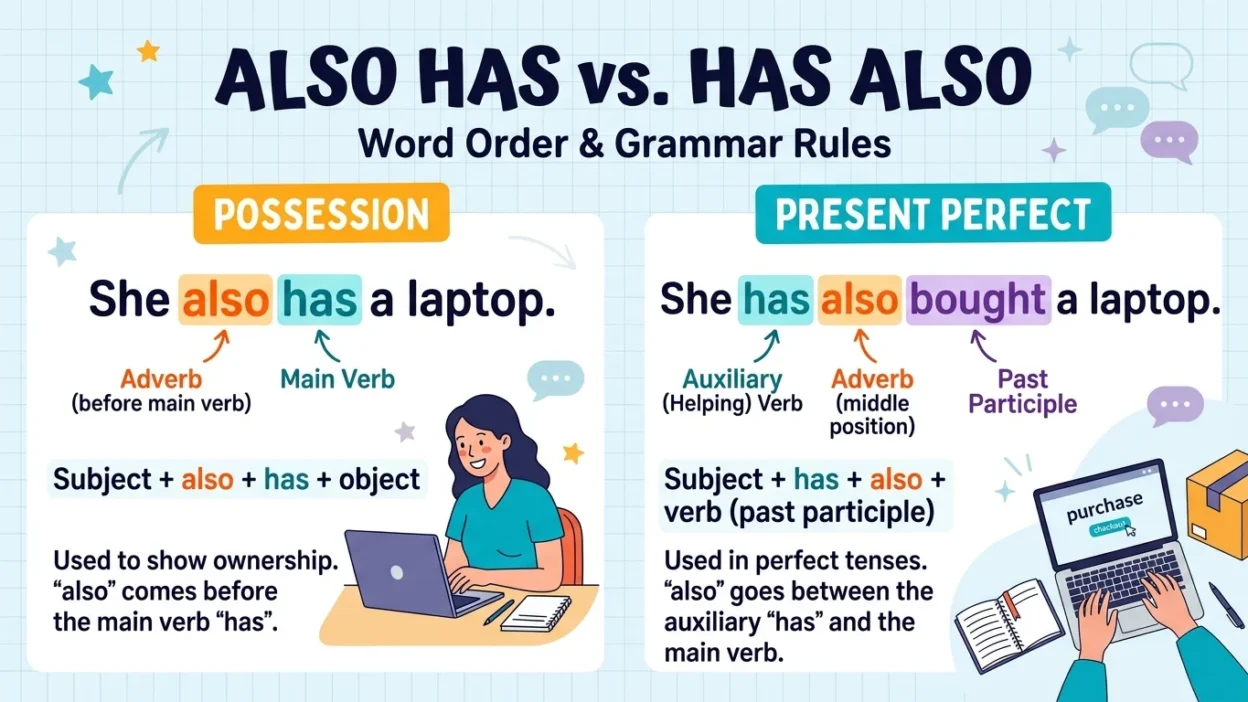
- Also has: She also has a car.
- Has also: She has also purchased a car.
In the first example, has is the main verb expressing possession. In the second, has is a helping verb used with the past participle purchased to form the present perfect tense.
The difference is not that one expression is correct and the other is incorrect. Both are correct when used in the appropriate grammatical structure.
What Does “Also Has” Mean?
Also has means that someone possesses, experiences, or includes something in addition to something already mentioned. Here, has usually functions as the main verb.
Examples of Also Has
- She also has a younger brother.
- He also has a degree in mathematics.
- My friend also has a blue car.
- The company also has an office in London.
- Our school also has a science laboratory.
- She also has excellent communication skills.
- The restaurant also has a vegetarian menu.
- He also has enough experience for the position.
- This phone also has a high-quality camera.
- The university also has a scholarship program.
In these sentences, has expresses possession or a characteristic, and also adds another piece of information.
What Does “Has Also” Mean?
Has also commonly appears when has is a helping verb in the present perfect tense. It adds another action, achievement, experience, or result to the sentence.
The usual structure is:
Subject + has + also + past participle
Examples of Has Also
- She has also completed her assignment.
- He has also applied for the position.
- The company has also announced a new policy.
- My brother has also visited Canada.
- The teacher has also explained the final chapter.
- She has also received a scholarship.
- The team has also won several awards.
- He has also learned French.
- The university has also introduced new courses.
- The manager has also approved the proposal.
In each example, has helps form the present perfect tense, while also adds another action or result.
Also Has vs. Has Also: Key Differences
| Feature | Also Has | Has Also |
|---|---|---|
| Common grammatical structure | Has as the main verb | Has as an auxiliary verb |
| Typical meaning | Possesses or includes something in addition | Has performed another action or achieved another result |
| Example | She also has a laptop. | She has also bought a laptop. |
| Verb after has | Usually a noun or noun phrase | Usually a past participle |
| Tense in the example | Simple present | Present perfect |
These are common patterns rather than absolute rules. Also can move in a sentence depending on what it modifies and the emphasis intended.
When Should You Use “Also Has”?
Use also has when has is the main verb and you want to add information about possession, characteristics, responsibilities, or features.
1. To Express Possession
- She also has a second phone.
- He also has a bicycle.
- My cousin also has a passport.
2. To Describe Skills or Qualities
- She also has strong leadership skills.
- He also has a good sense of humor.
- The candidate also has relevant experience.
3. To Add Information About an Organization
- The school also has a computer lab.
- The company also has international clients.
- The hotel also has a swimming pool.
4. To Describe Additional Features
- This laptop also has a touchscreen.
- The app also has a dark mode.
- The car also has parking sensors.
In each case, also has introduces an additional possession, quality, or feature.
When Should You Use “Has Also”?
Use has also when has helps form the present perfect tense, typically followed by a past participle. This construction is useful for describing additional actions, experiences, and results.
1. To Describe Another Completed Action
- She has also finished her homework.
- He has also submitted the report.
- They have also completed the training.
2. To Add Another Achievement
- She has also won a national award.
- He has also published an article.
- The team has also achieved its target.
3. To Describe Additional Experience
- My sister has also worked abroad.
- He has also studied economics.
- She has also visited several European countries.
4. To Report Additional Developments
- The company has also launched a new product.
- The government has also introduced new regulations.
- The school has also changed its admission policy.
Remember that the same pattern applies to have also with subjects such as I, you, we, and they: “They have also completed the project.”
Can “Also Has” and “Has Also” Be Used in the Same Sentence?
Yes, both expressions can appear in sentences, but they serve different grammatical purposes depending on the verbs involved.
For example:
- She also has a degree and has also completed a professional certification.
- He also has a car and has also purchased a motorcycle.
The first use of has expresses possession. The second has is an auxiliary verb that helps form the present perfect tense.
Can You Say “She Has Also a Car”?
In ordinary modern English, “She also has a car” is more natural than “She has also a car.”
When has is the main verb expressing possession, also normally appears before has or after the object:
- She also has a car.
- She has a car also. (Possible, but less natural in many contexts.)
When has is a helping verb, also commonly appears after it:
- She has also bought a car.
This is a useful distinction for choosing natural word order.
Also Has vs. Has Also: Comparison Examples
| Sentence | Correct? | Explanation |
|---|---|---|
| She also has a laptop. | Yes | Has expresses possession. |
| She has also bought a laptop. | Yes | Has is an auxiliary verb. |
| He also has completed the work. | Grammatically possible, but less neutral | The placement may emphasize he or contrast him with others; “He has also completed the work” is the more usual neutral order. |
| He has also completed the work. | Yes | Has forms the present perfect tense. |
| She has also a laptop. | Usually unnatural | “She also has a laptop” is the normal wording for possession. |
| The company also has launched a product. | Possible, but less usual | “The company has also launched a product” is the standard neutral order for the present perfect. |
Common Mistakes With Also Has and Has Also
Mistake 1: Using “Has Also” Before a Noun to Express Possession
Less natural: She has also a laptop.
Better: She also has a laptop.
Why? When has expresses possession, placing also before has is usually more natural.
Mistake 2: Putting Also in an Awkward Position in the Present Perfect
Less natural: He also has completed the report.
More natural in a neutral statement: He has also completed the report.
Why? With the present perfect, also generally comes after the auxiliary verb has and before the past participle. The earlier placement can be used for special emphasis, but it is not the usual neutral order.
Mistake 3: Forgetting the Past Participle
Incorrect: She has also complete the project.
Correct: She has also completed the project.
Why? The present perfect uses has or have followed by a past participle.
Mistake 4: Confusing Has and Have
Incorrect: They has also completed the assignment.
Correct: They have also completed the assignment.
Why? Use has with he, she, and it in the present perfect. Use have with I, you, we, and they.
A Simple Memory Trick
Remember these two patterns:
- Also has + noun: She also has a book.
- Has also + past participle: She has also read the book.
Ask yourself what comes after has:
- If it is a thing someone possesses, also has is usually the natural choice.
- If it is a past participle describing an action, has also is usually the natural choice.
This trick works for many everyday sentences, although emphasis and sentence structure can sometimes change the position of also.
American vs. British English
The basic rules for also has and has also are the same in American and British English. Both varieties generally place also before a main verb such as has when expressing possession, and after an auxiliary verb in a perfect-tense construction.
| Meaning | American English | British English |
|---|---|---|
| Possession | She also has a car. | She also has a car. |
| Additional completed action | She has also finished. | She has also finished. |
| Additional experience | He has also visited London. | He has also visited London. |
Differences in word order are usually related to emphasis, style, or sentence structure rather than a strict regional rule.
Frequently Asked Questions
1. Is “Also Has” Grammatically Correct?
Yes. “Also has” is correct when has functions as the main verb, especially to express possession. For example, “She also has a laptop.”
2. Is “Has Also” Grammatically Correct?
Yes. “Has also” is common when has is a helping verb in the present perfect tense. For example, “She has also completed the assignment.”
3. Which Is Correct: “She Also Has” or “She Has Also”?
Both are correct, but they usually appear in different constructions. Use “She also has a car” to express possession and “She has also bought a car” to describe an additional completed action.
4. Can I Say “He Also Has Done It”?
Yes, it is grammatically possible, especially when emphasizing he in contrast with other people. However, “He has also done it” is the more usual neutral word order.
5. Should “Also” Come Before or After Has?
When has is a main verb expressing possession, also generally comes before it: “She also has a car.” When has is an auxiliary verb, also usually comes after it: “She has also finished.”
6. Is “Has Also” Used in the Present Perfect Tense?
Yes. For example, “The company has also announced a new policy.” Here, has is the auxiliary verb, announced is the past participle, and also adds another piece of information.
7. Can “Also” Come at the End of a Sentence?
Yes, although this is less common in some contexts. For example, “She has a car also” is possible, but “She also has a car” is usually more natural.
8. What Is the Easiest Way to Remember the Difference?
Use “also has” for additional possession or characteristics, as in “He also has a degree.” Use “has also” for an additional action in the present perfect, as in “He has also earned a degree.”
Remember This
- Also has: Usually used when has is the main verb expressing possession or a characteristic.
- Has also: Usually used when has is an auxiliary verb followed by a past participle.
- She also has a car: Natural for expressing possession.
- She has also bought a car: Natural for describing an additional completed action.
- Both forms are correct when used in the right grammatical structure.
Conclusion
The difference between also has and has also depends mainly on the grammatical role of has. When has expresses possession or a characteristic, “also has” is usually the natural word order. When has helps form the present perfect tense, “has also” is generally preferred before the past participle.
For example, write “She also has a laptop” but “She has also purchased a laptop.” Both sentences are correct because the word order matches the intended structure. By checking whether has is the main verb or an auxiliary verb, you can choose the appropriate expression and make your English clearer and more natural.

Adam Aaron is a language enthusiast and content writer at SimileHive, creating clear, engaging guides on similes, idioms, metaphors, and figurative language to help readers improve English confidently every day.