Choosing between “master’s student” and “MS student” can be confusing, especially when writing an academic CV, university application, email, or professional biography. Both expressions can refer to someone studying for a graduate degree, but they are not always interchangeable. The difference depends on the degree being pursued, the country, and the context in which the phrase is used.
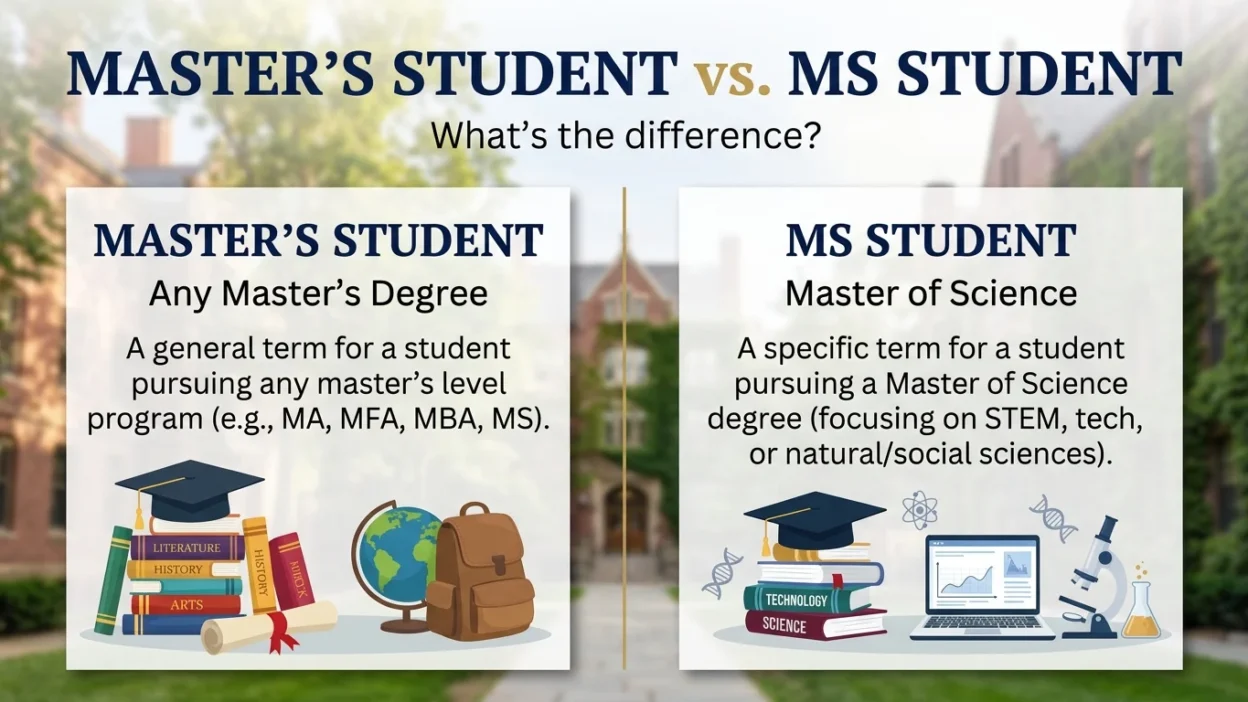
“Master’s student” is a general term for someone enrolled in a master’s degree program. “MS student” usually refers to someone pursuing a Master of Science (MS) degree, particularly in American English.
If you are studying for a master’s degree but do not want to specify its type, “master’s student” is usually the safer and more widely understood choice. If your program specifically awards an MS degree, “MS student” may be more precise.
Quick Answer: Master’s Student vs. MS Student
A master’s student is someone pursuing any master’s degree, including an MA, MS, MBA, or other master’s qualification. An MS student is specifically someone studying for a Master of Science degree. Use “master’s student” when referring to graduate study in general and “MS student” when your degree is officially an MS. Both are correct when used in the appropriate context.
Why Do People Confuse Master’s Student and MS Student?
People often confuse these terms because an MS degree is one type of master’s degree. The two expressions overlap, but they do not have exactly the same meaning.
For example:
- A student pursuing a Master of Science in Computer Science is both a master’s student and an MS student.
- A student pursuing a Master of Arts in English is a master’s student, but not normally an MS student.
- A student pursuing a Master of Business Administration is an MBA student and can also be described as a master’s student.
The key difference is that master’s student is a broad description, while MS student identifies a particular degree type.
What Does Master’s Student Mean?
A master’s student is a person enrolled in a postgraduate or graduate program leading to a master’s degree.
Master’s degrees are offered in many fields, including education, business, science, engineering, literature, public health, and social sciences. Because the phrase does not specify a particular degree title, it works in a wide range of academic situations.
Examples of Master’s Student
- I am a master’s student at a university in Lahore.
- She is a master’s student in English literature.
- He works part-time while studying as a master’s student.
- As a master’s student, I conduct research in my field.
- My sister is a master’s student in business administration.
- The university offers scholarships for international master’s students.
- I met several master’s students at the academic conference.
- She plans to become a lecturer after completing her studies as a master’s student.
These examples are suitable when the exact degree title is unknown, unimportant, or broader than an MS.
What Does MS Student Mean?
An MS student is a student enrolled in a Master of Science degree program. The abbreviation MS is commonly used in the United States. Other institutions and countries may use forms such as MSc or M.Sc. for a similar qualification.
An MS degree is often associated with scientific, technical, analytical, or research-focused subjects, although the subjects available depend on the institution.
Examples of MS Student
- I am an MS student in Computer Science.
- She is an MS student at a university in the United States.
- He hopes to pursue a PhD after completing his degree as an MS student.
- The department invited all MS students to a research seminar.
- I am an MS student specializing in data science.
- The professor supervises several MS students.
- As an MS student, she works on a machine-learning project.
- He applied for a research assistantship as an MS student.
Use this expression when you want to identify your degree specifically as a Master of Science.
Master’s Student vs. MS Student: Key Differences
| Feature | Master’s Student | MS Student |
|---|---|---|
| Meaning | A student pursuing any master’s degree | A student pursuing a Master of Science |
| Scope | Broad | Specific |
| Degree types included | MA, MS, MBA, and other master’s degrees | MS specifically |
| Best use | General academic descriptions | When the official degree is an MS |
| Example | I am a master’s student in English. | I am an MS student in Computer Science. |
| Common context | General conversation, bios, applications | Academic profiles, departmental contexts, degree-specific descriptions |
When Should You Use Master’s Student?
Use master’s student when you want to describe your academic level without naming a specific degree.
1. When the Degree Type Is Not Important
- I am a master’s student interested in research.
- She is a master’s student at a public university.
2. When Your Degree Is Not an MS
- He is a master’s student pursuing an MA in History.
- She is a master’s student in Business Administration.
3. When Writing a General Biography
- I am a master’s student with an interest in education and technology.
- As a master’s student, I hope to contribute to academic research.
4. When Speaking to a Broad Audience
“Master’s student” is a useful choice when readers may be unfamiliar with different degree abbreviations.
For example:
“My name is Sara, and I am a master’s student specializing in public health.”
This sentence is clear even if the reader does not know the official abbreviation of Sara’s degree.
When Should You Use MS Student?
Use MS student when you are enrolled in a Master of Science program and want to identify that qualification specifically.
1. When Your Official Degree Is an MS
- I am an MS student in Software Engineering.
- She is an MS student in Applied Mathematics.
2. When Writing a University Profile
- The lab welcomes applications from motivated MS students.
- The department provides research opportunities for MS students.
3. When Distinguishing Degree Programs
- The university has separate advising services for MA and MS students.
- Both MS and PhD students can apply for the research position.
4. When Your Institution Uses MS as Its Official Abbreviation
If your university calls your qualification an MS, using “MS student” is appropriate in degree-specific contexts. If the official title is MSc, you may prefer “MSc student” to match the institution’s terminology.
Is It Master’s Student, Masters Student, or Master Student?
The most widely accepted form in standard English is master’s student, with an apostrophe.
- Master’s student: Standard form for someone pursuing a master’s degree.
- Masters student: Commonly seen, but generally considered incorrect in this meaning because it omits the possessive apostrophe.
- Master student: Not the usual expression in English for a person pursuing a master’s degree.
The apostrophe in master’s reflects the conventional phrase master’s degree. Therefore, “I am a master’s student” is the recommended form.
Is It MS Student or MS’s Student?
The correct form is MS student, without an apostrophe between MS and student.
The abbreviation MS functions as a modifier that identifies the degree program.
Correct:
- I am an MS student.
- She is an MS student in Physics.
Incorrect for the intended meaning:
- I am an MS’s student.
You can also write “a student pursuing an MS degree,” which is especially clear in formal writing.
Master’s Student vs. MS Student in American and British English
The distinction is mostly about degree naming rather than a strict American-versus-British grammar rule.
| Context | Common wording | Explanation |
|---|---|---|
| General academic English | Master’s student | Refers to any master’s degree |
| American universities | MS student | Often used for a Master of Science program |
| Many UK universities | MSc student | Common where the degree is titled Master of Science |
| International applications | Student pursuing a master’s degree | Clear across different education systems |
Degree abbreviations vary among universities and countries. Always check the official name of your program before using MS, MSc, or another abbreviation.
Common Mistakes to Avoid
Mistake 1: Using MS Student for Every Master’s Degree
Incorrect: I am an MS student in English Literature. (If the program awards an MA rather than an MS.)
Better: I am a master’s student in English Literature.
Use MS student only when the degree is a Master of Science.
Mistake 2: Forgetting the Apostrophe in Master’s Student
Incorrect: I am a masters student.
Correct: I am a master’s student.
Mistake 3: Assuming MS and MSc Are Always the Official Same Title
MS and MSc both commonly refer to Master of Science qualifications, but institutions may use one form specifically. Follow the exact title used by your university.
Mistake 4: Using an Unclear Abbreviation in a Formal Application
Instead of writing only “I am an MS student,” you can write:
“I am pursuing a Master of Science (MS) in Computer Science.”
This is especially useful when writing to people who may not be familiar with your university’s degree abbreviations.
A Simple Memory Trick
Remember these two rules:
- Master’s student = any master’s degree.
- MS student = specifically a Master of Science degree.
If you are unsure which abbreviation your degree uses, write “master’s student” or “student pursuing a master’s degree.” These forms are clear and broadly understood.
Frequently Asked Questions
1. Is It Correct to Say “I Am a Master’s Student”?
Yes. “I am a master’s student” is grammatically correct and commonly used to describe someone enrolled in a master’s degree program.
2. Is MS Student Correct English?
Yes. “MS student” is correct when referring to someone pursuing a Master of Science degree. It is not the best general term for someone pursuing an MA, MBA, or another type of master’s degree.
3. Which Is Better for a CV: Master’s Student or MS Student?
Use the wording that best represents your official degree. For example, write “MS student in Computer Science” if you are pursuing an MS, or use the full degree title, such as “Master of Science in Computer Science candidate,” if that accurately reflects your status. A CV can also list your degree and expected graduation date.
4. Is “Master’s Student” the Same as “Graduate Student”?
Not exactly. A graduate student is a broad term that can include someone pursuing a master’s degree or a doctoral degree, depending on the education system. A master’s student specifically refers to someone pursuing a master’s degree.
5. Should I Write MS Student or MSc Student?
Use the abbreviation your university officially uses. “MS student” is common in the United States, while “MSc student” is common at many British and international institutions.
6. Is “Masters Student” Without an Apostrophe Correct?
In standard writing, master’s student is preferred because it refers to a student pursuing a master’s degree. Use the apostrophe.
7. Can an MS Student Also Be Called a Master’s Student?
Yes. Every student pursuing an MS degree is also a master’s student. However, not every master’s student is an MS student.
8. What Is the Most Formal Way to Describe Someone Studying for a Master’s Degree?
You can write “a student pursuing a master’s degree” or give the full qualification, such as “a student pursuing a Master of Science in Computer Science.” The second option is particularly useful in formal academic contexts.
Remember This
- Master’s student is the general term for someone studying for any master’s degree.
- MS student specifically refers to a student pursuing a Master of Science.
- Write master’s with an apostrophe.
- Use the abbreviation your university officially recognizes.
- When in doubt, “student pursuing a master’s degree” is clear and professional.
Conclusion
Both “master’s student” and “MS student” are correct, but they serve different purposes. “Master’s student” is the broader expression and works for people pursuing any type of master’s degree. “MS student” is more specific and should be used when the student is pursuing a Master of Science.
For everyday conversation, a professional bio, or a general academic introduction, “master’s student” is often the safest choice. For a CV, research profile, or university application, use the official degree title or abbreviation to describe your qualification accurately.

Adam Aaron is a language enthusiast and content writer at SimileHive, creating clear, engaging guides on similes, idioms, metaphors, and figurative language to help readers improve English confidently every day.