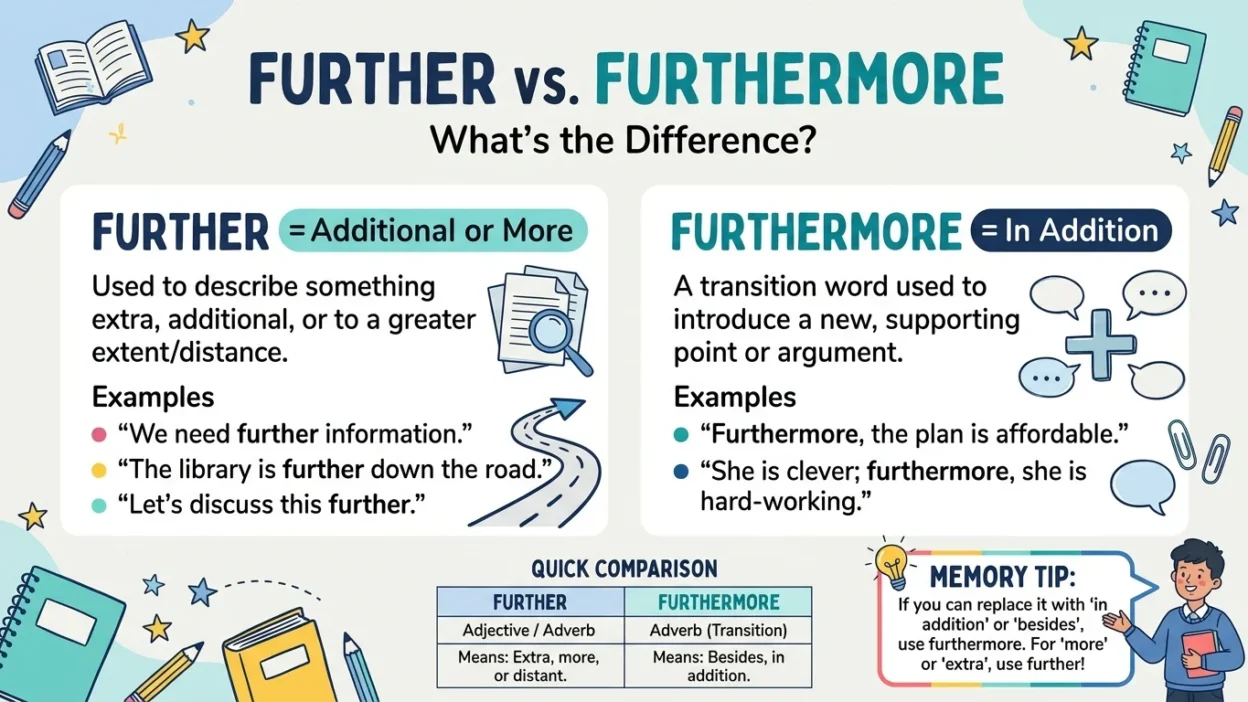
Are further and furthermore interchangeable? Although these two words look similar, they serve different purposes in English. Further can mean “additional,” “to a greater extent,” or “beyond a particular point,” while furthermore means “in addition” and introduces another related point or piece of information. Understanding this difference will help you choose the right word in everyday conversations, academic writing, emails, and professional documents.
For example, you can say, “We need further information before making a decision,” because further describes additional information. However, you can write, “The plan is affordable. Furthermore, it is easy to implement,” because furthermore introduces an additional supporting point.
Both words can connect ideas, but they do not perform the same grammatical function in every sentence. This guide explains their meanings, grammatical roles, differences, common mistakes, and practical examples so you can use further and furthermore confidently.
Quick Answer
Further means additional, more, or to a greater extent. It can function as an adjective, adverb, or verb. Furthermore is a conjunctive adverb meaning “in addition” or “moreover.” Use further to describe something extra or a greater degree, and use furthermore to introduce another supporting point in a sentence or paragraph.
Why Do People Confuse Further and Furthermore?
People confuse these words because both are related to the idea of adding something. However, their grammatical roles and uses are different.
- Further commonly modifies a noun or verb, expressing additional quantity, progress, or extent.
- Furthermore connects ideas by introducing an additional statement or argument.
Compare these examples:
- We need further evidence before reaching a conclusion.
- The evidence is incomplete. Furthermore, it contains several errors.
In the first sentence, further describes the kind of evidence needed. In the second, furthermore introduces an additional reason to question the evidence.
The easiest way to remember the distinction is that further often describes something more, while furthermore adds another point.
First Word: Further
Further means additional, more extensive, or beyond a particular point. Depending on the sentence, it can function as an adjective, an adverb, or a verb.
What Does Further Mean?
The meaning of further depends on how it is used.
1. Further meaning additional
Use further before a noun when referring to something extra or additional.
Examples:
- We need further information about the project.
- The teacher requested further explanation.
- Please contact us if you require further assistance.
- The committee will conduct further research.
In these examples, further means additional or more.
2. Further meaning to a greater extent
Use further to describe a greater degree of progress, development, or action.
Examples:
- We need to investigate the issue further.
- The discussion helped us understand the problem further.
- She wants to develop her skills further.
- The company plans to expand further into international markets.
Here, further means to a greater extent or more completely.
3. Further meaning beyond a point
Further can also refer to greater distance or progress.
Examples:
- We walked further along the road.
- The village is further from the city than we expected.
- The project has progressed further than anticipated.
In contexts involving physical distance, farther is also commonly used, particularly when the distance is measurable.
4. Further as a verb
As a verb, further means to help advance, promote, or develop something.
Examples:
- The scholarship will further her education.
- These discussions may further our understanding of the issue.
- His actions did little to further the company’s goals.
This use is especially common in formal, academic, and professional writing.
Second Word: Furthermore
Furthermore is a conjunctive adverb that means “in addition,” “moreover,” or “what is more.” It introduces another statement that supports, develops, or adds to a previous point.
What Does Furthermore Mean?
Use furthermore when you want to add another relevant fact, reason, or argument.
Examples:
- The course is affordable. Furthermore, it offers flexible schedules.
- The proposal is practical. Furthermore, it can be implemented quickly.
- The hotel is close to the airport. Furthermore, it provides free transportation.
- The candidate has excellent qualifications. Furthermore, she has extensive experience.
In each example, furthermore signals that the writer is adding another supporting point.
How Do You Punctuate Furthermore?
When furthermore introduces a sentence, it is usually followed by a comma.
Examples:
- The product is durable. Furthermore, it is affordable.
- Furthermore, the results support our original hypothesis.
- The plan is effective; furthermore, it is relatively inexpensive.
A semicolon can connect two independent clauses when furthermore appears between them.
Incorrect: The product is durable, furthermore it is affordable.
Correct: The product is durable. Furthermore, it is affordable.
Also correct: The product is durable; furthermore, it is affordable.
The correct punctuation depends on the sentence structure, not just on the word itself.
Further vs. Furthermore: Key Differences
| Feature | Further | Furthermore |
|---|---|---|
| Meaning | Additional, more, or to a greater extent | In addition; moreover |
| Grammatical role | Adjective, adverb, or verb | Conjunctive adverb |
| Main purpose | Describes something extra or greater progress | Adds another related point |
| Common position | Before a noun or after a verb | Often at the beginning of a sentence or between clauses |
| Example | We need further evidence. | Furthermore, the evidence is incomplete. |
| Formality | Common in everyday and formal English | Particularly common in formal writing |
The central difference is that further describes or expresses additional extent, while furthermore introduces an additional statement.
When Should You Use Further or Furthermore?
Choose the word according to the meaning you want to communicate.
When to Use Further
Use further when you mean additional, more, or to a greater extent.
Examples:
- We need further details.
- The investigation will continue further.
- Please provide further clarification.
- She hopes to further her career.
- We discussed the matter further.
A useful test is to ask whether you could replace further with additional or more without changing the sentence’s basic meaning.
For example:
“We need further information.”
This means:
“We need additional information.”
When to Use Furthermore
Use furthermore when introducing another point that supports or expands on what you have already said.
Examples:
- The service is reliable. Furthermore, it is affordable.
- The research was carefully conducted. Furthermore, the results were independently verified.
- He has relevant experience. Furthermore, he communicates effectively.
- The policy will reduce costs. Furthermore, it will improve efficiency.
A useful test is to ask whether in addition or moreover would fit the sentence naturally.
For example:
“The service is reliable. Furthermore, it is affordable.”
This means:
“The service is reliable. In addition, it is affordable.”
Further vs. Furthermore: Comparison Examples
The following table shows how the two words work in different situations.
| Situation | Further | Furthermore |
|---|---|---|
| Information | We need further information. | The information is incomplete. Furthermore, it is outdated. |
| Research | Further research is necessary. | The study is limited. Furthermore, its sample is small. |
| Education | She wants to further her education. | She has excellent grades. Furthermore, she is highly motivated. |
| Business | We need to discuss the issue further. | The plan saves money. Furthermore, it saves time. |
| Explanation | Please provide further details. | The explanation is clear. Furthermore, it includes examples. |
Notice that further often appears within a phrase, whereas furthermore commonly links a new statement to a previous one.
12 Examples of Further and Furthermore in Sentences
Here are practical examples to help you understand the difference.
Examples With Further
- We need further information before approving the application.
- The teacher provided further guidance to the students.
- Please investigate the matter further.
- She decided to further her education abroad.
- The discussion continued further into the evening.
- The company plans to develop its products further.
Examples With Furthermore
- The room is spacious. Furthermore, it receives plenty of natural light.
- The proposal is affordable. Furthermore, it can be completed within the deadline.
- He is an experienced manager. Furthermore, he has excellent leadership skills.
- The article explains the rules clearly. Furthermore, it provides useful examples.
- The journey was tiring. Furthermore, the weather was unpleasant.
- The experiment produced consistent results. Furthermore, other researchers obtained similar findings.
These examples demonstrate that further usually expresses additional quantity or extent, whereas furthermore adds another related idea.
Common Mistakes to Avoid
1. Using Furthermore Before a Noun
Incorrect: We need furthermore information.
Correct: We need further information.
Why? Further modifies the noun information. Furthermore introduces an additional statement rather than describing a noun.
2. Using Further to Introduce an Entire Supporting Point
Awkward: The service is affordable. Further, it is easy to use.
Better: The service is affordable. Furthermore, it is easy to use.
Although further can appear as a formal linking adverb in some contexts, furthermore is the clearer choice when adding a supporting argument.
3. Forgetting the Comma After Furthermore
Less standard: Furthermore the product is easy to use.
Preferred: Furthermore, the product is easy to use.
When furthermore begins a sentence, a comma normally follows it.
4. Using a Comma Splice
Incorrect: The plan is effective, furthermore it is affordable.
Correct: The plan is effective. Furthermore, it is affordable.
Also correct: The plan is effective; furthermore, it is affordable.
Two independent clauses should not normally be joined by a comma alone.
5. Assuming Further and Furthermore Are Always Interchangeable
Incorrect: We require furthermore assistance.
Correct: We require further assistance.
Correct in a different sentence: We require assistance. Furthermore, we need additional equipment.
The two words serve different grammatical purposes, so replacing one with the other does not always work.
6. Overusing Furthermore in Writing
Using furthermore at the beginning of every paragraph can make writing repetitive and overly formal.
Instead, vary your transitions where appropriate:
- In addition
- Moreover
- Also
- Besides
- Additionally
Choose a transition that accurately expresses the relationship between your ideas.
Memory Trick: How to Remember the Difference
Use this simple memory trick:
Further = more of something.
- Further information
- Further assistance
- Further research
Furthermore = one more point.
- The service is fast. Furthermore, it is affordable.
- The evidence is reliable. Furthermore, it is easy to verify.
You can also remember these substitutions:
- If additional fits, consider further.
- If moreover fits, consider furthermore.
These substitutions are useful guides, although the best choice always depends on the context.
American vs. British English: Is There a Difference?
There is no significant difference between American and British English in the basic meanings of further and furthermore. Both words are used in both varieties.
| Feature | American English | British English |
|---|---|---|
| Further information | Correct | Correct |
| Investigate further | Correct | Correct |
| Furthermore, … | Correct | Correct |
| Furthermore as a formal transition | Common | Common |
Both forms are acceptable in academic, professional, and general writing. Furthermore tends to sound more formal than simple alternatives such as also, while further is widely used in both everyday and formal contexts.
Similar Words: Further, Moreover, Additionally, and Farther
Several English words express additional information or greater distance, but their meanings are not identical.
| Word | Meaning | Example |
|---|---|---|
| Further | Additional or to a greater extent | We need further details. |
| Furthermore | In addition; moreover | Furthermore, the plan is affordable. |
| Moreover | In addition, often adding a supporting point | Moreover, the evidence is convincing. |
| Additionally | As an additional point | Additionally, the course includes practice tests. |
| Also | In addition; too | She also speaks French. |
| Farther | Greater physical distance, especially measurable distance | We walked farther than yesterday. |
Further vs. Farther
Further and farther sometimes overlap when describing distance.
- We need to discuss the issue further. (More thoroughly.)
- We walked farther than expected. (A greater distance.)
In modern English, further is also commonly used for distance, so the distinction is not absolute. However, farther is a useful choice when you specifically mean measurable physical distance.
Final Verdict
Both further and furthermore are correct English words, but they serve different purposes.
Use further to mean additional, more extensive, or to a greater extent. It can describe nouns, modify verbs, and function as a verb itself.
Use furthermore to introduce an additional fact, reason, or argument. It is especially useful in essays, reports, business writing, and other contexts where ideas need to be connected clearly.
Remember the simple distinction: further information means additional information, while furthermore introduces another point. Once you understand their grammatical roles, choosing the right word becomes much easier.
Frequently Asked Questions
1. What is the difference between further and furthermore?
Further means additional, more, or to a greater extent. Furthermore means “in addition” and introduces another related point or statement.
Example: “We need further evidence. Furthermore, we need more time.”
2. Is furthermore a formal word?
Yes. Furthermore is generally considered a formal or neutral transition word. It is common in academic writing, business reports, essays, and professional communication. In casual conversation, also or plus may sound more natural.
3. Can further and furthermore be used interchangeably?
Not in every sentence. You can say “further information,” but you would not normally say “furthermore information.” Use furthermore to introduce another statement, not to modify a noun.
4. Should furthermore be followed by a comma?
Usually, yes, when it appears at the beginning of a sentence.
Example: “Furthermore, the results support our conclusion.”
When it connects two independent clauses after a semicolon, a comma normally follows it as well.
5. What are synonyms for furthermore?
Common alternatives include moreover, additionally, in addition, and what is more. The best choice depends on the tone and the relationship between the ideas.
6. What does further information mean?
Further information means additional details or information that may help someone understand a subject more completely.
Example: “Please contact the office for further information.”
7. Is further more than one word?
No. Further is one word, and furthermore is also one word. Writing further more as two words is generally incorrect when you intend to use the transition meaning “in addition.”
8. Can furthermore begin a sentence?
Yes. Furthermore can begin a sentence when you want to add a related fact or argument.
Example: “The method is simple. Furthermore, it produces reliable results.”
Remember This
- Further = additional, more, or to a greater extent.
- Furthermore = in addition; moreover.
- Say further information, not furthermore information.
- Use furthermore to introduce another supporting point.
- Put a comma after furthermore when it begins a sentence.
- Both words are used in American and British English.
Conclusion
The difference between further and furthermore becomes clear when you focus on their grammatical roles. Further expresses something additional or a greater degree and can modify nouns and verbs. Furthermore is a linking word that introduces another relevant statement, making it especially useful in formal and academic writing.
For everyday use, remember the phrases further information, further assistance, and further research. When adding another reason or fact, use furthermore. Practising these patterns will help you write more clearly, avoid common grammatical mistakes, and connect your ideas naturally.

Lucas Luke is a passionate language writer and content creator at SimileHive, specializing in similes, idioms, metaphors, and figurative language. He enjoys making complex English expressions simple, engaging, and easy to understand for students, writers, and language enthusiasts through well-researched, practical content.