English capitalization rules help you know when to write a capital letter instead of a lowercase letter. In English, capital letters are used at the beginning of sentences, in the pronoun I, in proper nouns, in titles, and in several other situations. Learning these rules will make your writing clearer, more professional, and easier to read.
Although some capitalization rules are straightforward, others can be confusing. For example, should you capitalize the days of the week, seasons, job titles, school subjects, or words in a book title? The answer depends on the word’s meaning and how it is used in a sentence.
American and British English also follow slightly different conventions for some titles and headings. This guide explains the most important English capitalization rules with simple explanations, correct and incorrect examples, and practical tips for students, ESL learners, and anyone who wants to improve their writing.
Quick Answer: What Are the Basic Capitalization Rules?
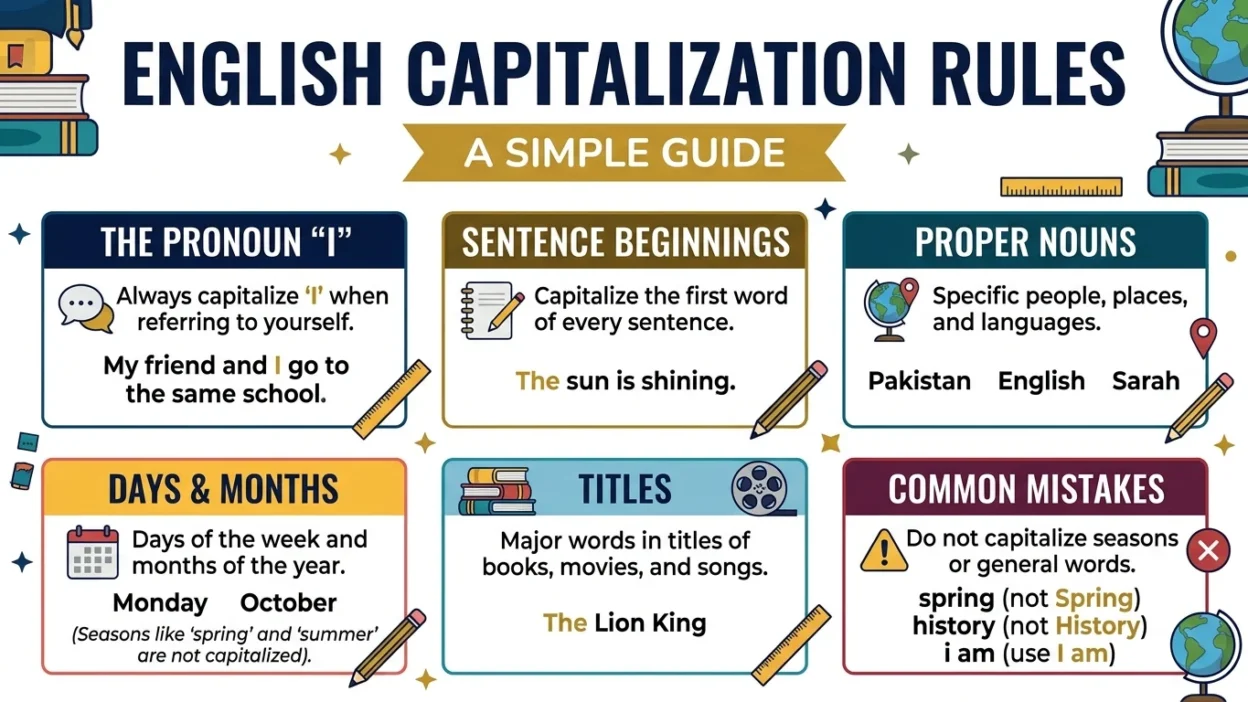
Capitalize the first word of a sentence, the pronoun I, proper nouns, names of people and places, nationalities, languages, days, months, and holidays. Capitalize the first and other important words in titles according to the chosen style. Keep ordinary common nouns, seasons, and most general job titles lowercase unless a specific rule or context requires a capital letter.
Why Are English Capitalization Rules Important?
Capitalization helps readers identify names, distinguish titles from ordinary words, and understand sentence structure. It also makes writing consistent and professional.
Compare these examples:
- Correct: My sister lives in Pakistan.
- Incorrect: my sister lives in pakistan.
The first sentence follows standard capitalization rules. The second does not capitalize the beginning of the sentence or the country name.
Capitalization can also change how a word is understood:
- turkey can refer to a bird.
- Turkey refers to the country.
Correct capitalization is therefore more than a matter of appearance; it can help communicate meaning accurately.
Rule 1: Capitalize the First Word of a Sentence
Always capitalize the first word of a complete sentence.
Examples:
- Today is a beautiful day.
- My brother is studying English.
- We are going to the market.
- She enjoys reading novels.
This rule also applies after a period, question mark, or exclamation mark when a new sentence begins.
Examples:
- Where are you going? I am going home.
- What a wonderful surprise! We are delighted.
However, do not automatically capitalize a word after every colon or semicolon. Capitalization after a colon depends on the sentence structure and the style guide being followed.
Rule 2: Always Capitalize the Pronoun I
The English pronoun I is always capitalized, regardless of where it appears in a sentence.
Examples:
- I am learning English.
- My friend and I are classmates.
- Yesterday, I visited my grandparents.
- She knows that I am telling the truth.
Incorrect: My brother and i went shopping.
Correct: My brother and I went shopping.
Unlike he, she, we, and they, the pronoun I does not become lowercase in the middle of a sentence.
Rule 3: Capitalize Proper Nouns
A proper noun is the specific name of a person, place, organization, or other individual entity. Proper nouns generally begin with capital letters.
Examples:
| Common noun | Proper noun |
|---|---|
| boy | Ahmed |
| country | Pakistan |
| city | Lahore |
| river | Indus River |
| company | Microsoft |
| university | Oxford University |
| language | English |
Example sentences:
- Ahmed lives in Lahore.
- We visited the Indus River.
- She works for Microsoft.
- My cousin studies at Oxford University.
Remember that the general category is lowercase, while the specific name is capitalized.
Rule 4: Capitalize Names of People and Places
Capitalize people’s names, geographical names, and the official names of places.
Examples:
- Fatima is my best friend.
- We traveled to Karachi.
- They visited the United States.
- Mount Everest is the world’s highest mountain above sea level.
- The Nile is a famous river.
Capitalize the official names of geographical features, but do not capitalize general references when they are not part of the name.
Examples:
- We crossed the Indus River.
- The river was flowing quickly.
The word river is capitalized in the proper name Indus River, but it is lowercase when used generically.
Rule 5: Capitalize Days, Months, and Holidays
In English, the names of days, months, and holidays begin with capital letters.
Examples:
- Monday
- Friday
- January
- October
- Eid al-Fitr
- Christmas
- New Year’s Day
Correct sentences:
- My examination is on Monday.
- Her birthday is in October.
- We celebrate Eid al-Fitr with our family.
- Christmas is celebrated on December 25 by many Christians.
Should You Capitalize Seasons?
Usually, do not capitalize the names of seasons when they are used as common nouns.
Correct:
- I enjoy spring.
- We travel during summer.
- The weather is pleasant in autumn.
- It often snows in winter.
Incorrect in ordinary usage:
- I enjoy Spring.
However, capitalize a season when it appears as part of an official name, title, or other expression that requires capitalization.
Rule 6: Capitalize Nationalities, Languages, and Religions
Capitalize the names of nationalities, languages, and religions, as well as the names of their followers when used as proper nouns.
Examples:
- Pakistani
- British
- Chinese
- English
- Urdu
- Arabic
- Islam
- Christianity
- Muslim
- Christian
Correct sentences:
- She speaks English and Urdu.
- My neighbor is Pakistani.
- He is learning Arabic.
- They study Islam at school.
Incorrect: She speaks english and urdu.
Correct: She speaks English and Urdu.
These capitalization conventions apply to nationalities and languages even when the words appear in the middle of a sentence.
Rule 7: Capitalize Titles of Books, Movies, and Other Works
Titles of books, films, articles, songs, and other works can follow different capitalization styles. Two common approaches are title case and sentence case.
What Is Title Case?
In title case, the first and last words and most important words are capitalized. Short articles, conjunctions, and prepositions are often lowercase unless they appear at the beginning or end of the title or the chosen style guide specifies otherwise.
Examples:
- The Great Gatsby
- Pride and Prejudice
- Harry Potter and the Sorcerer’s Stone
- The Lord of the Rings
What Is Sentence Case?
In sentence case, capitalize the first word and proper nouns, but keep most other words lowercase.
Examples:
- The great Gatsby
- How to improve your English
- A guide to effective writing
For published titles, follow the style used by the publisher or the required style guide. Do not assume that every word in every title must be capitalized.
Rule 8: Capitalize Job Titles in Specific Situations
Job titles can be capitalized or lowercase depending on how they are used.
Capitalize a title when it directly precedes a person’s name as an official title.
Examples:
- President Abraham Lincoln
- Professor Smith
- Dr. Ahmed
- Queen Elizabeth II
Use lowercase when referring to a job or position generally.
Examples:
- The president gave a speech.
- My sister is a doctor.
- He wants to become a professor.
- The queen attended the ceremony.
Usage can vary depending on the title, official naming conventions, and the style guide. In formal writing, follow the relevant institutional or publication style.
Rule 9: Capitalize Names of Organizations and Institutions
Capitalize the official names of businesses, schools, universities, government agencies, and other organizations.
Examples:
- United Nations
- World Health Organization
- University of Oxford
- Lahore Grammar School
- Pakistan International Airlines
Correct sentences:
- She studies at the University of Oxford.
- The World Health Organization publishes health guidance.
- He works for Pakistan International Airlines.
When referring to an organization generically, use lowercase.
Example: The university offers several degree programs.
Rule 10: Capitalize the First Word of a Direct Quotation
Capitalize the first word of a complete direct quotation when it forms a sentence.
Examples:
- She said, “We are ready.”
- He asked, “Where are you going?”
- My teacher said, “Practice makes progress.”
However, a quotation fragment incorporated into a larger sentence does not automatically need a capital letter.
Example:
- She described the experience as “a wonderful opportunity.”
The quoted words are a fragment rather than a complete quoted sentence.
Rule 11: Capitalize the Names of Historical Events and Periods
Capitalize the established names of historical events, eras, and periods.
Examples:
- World War II
- the Renaissance
- the Industrial Revolution
- the Middle Ages
- the French Revolution
Some historical labels are style-dependent. For example, the modern era is generally lowercase, while the official name of a specific period may be capitalized.
Correct examples:
- The Industrial Revolution changed manufacturing.
- Many artists flourished during the Renaissance.
- The Middle Ages lasted for several centuries.
Rule 12: Capitalize Acronyms and Initialisms
Acronyms and initialisms are commonly written in capital letters, although some organizations use distinctive official styling.
Examples:
- USA
- UK
- NASA
- WHO
- UN
- ATM
- CEO
Example sentences:
- She works for the UN.
- NASA conducts space research.
- I withdrew money from an ATM.
Some abbreviations use a mixture of uppercase and lowercase letters according to their official styling. Follow the accepted form for the organization, product, or term.
Rule 13: Capitalize Family Titles When Used as Names
Words such as mother, father, mom, and grandmother are capitalized when they function as names or direct forms of address. They are usually lowercase when used as ordinary nouns.
Examples:
- I asked Mother for advice.
- Thank you, Dad.
- My mother works at a hospital.
- His father is a teacher.
- I visited my grandmother yesterday.
A useful test is to ask whether the word is being used in place of a person’s name.
Compare:
- Mom, can you help me?
- My mom can help me.
In the first sentence, Mom is a form of address. In the second, mom is a common noun preceded by a possessive determiner.
Rule 14: Capitalize the First Word of a Letter or Email Greeting
Capitalize the first word of a greeting, whether the message is formal or informal.
Examples:
- Dear Mr. Ahmed,
- Hello, Sarah.
- Good morning, Professor.
- Hi, everyone.
Capitalize the first word of the closing only when it is normally written that way, and capitalize your name as usual.
Examples:
- Best regards,
- Sincerely,
- Yours faithfully,
The capitalization of greetings and closings is generally straightforward, but punctuation conventions may vary by country and writing style.
Rule 15: Capitalize School Subjects Selectively
The names of languages are capitalized, but most general school subjects are lowercase unless they are part of a course’s official name or a title.
Examples:
- I study English and history.
- She enjoys mathematics.
- He is taking biology this year.
- I enrolled in Introduction to Psychology.
Capitalize official course titles as appropriate:
- Introduction to Psychology
- English Literature 101
- History of Modern Europe
Do not capitalize ordinary subject names merely because they are academic subjects.
English Capitalization Rules: Comparison Table
| Word or category | Capitalize? | Example |
|---|---|---|
| Beginning of a sentence | Yes | Today is Monday. |
| Pronoun I | Always | My sister and I agree. |
| People’s names | Yes | Ahmed |
| Countries and cities | Yes | Pakistan, Lahore |
| Days and months | Yes | Monday, January |
| Languages and nationalities | Yes | English, Pakistani |
| Seasons | Usually no | summer |
| General job titles | Usually no | a doctor |
| Official organization names | Yes | United Nations |
| General school subjects | Usually no | history |
| Book and film titles | Depends on style | The Great Gatsby |
| Acronyms | Usually yes | NASA, UN |
Common Capitalization Mistakes to Avoid
Even experienced writers sometimes make capitalization mistakes. The following examples show how to correct them.
1. Capitalizing Every Word in a Sentence
Incorrect: My Sister Lives In Lahore.
Correct: My sister lives in Lahore.
Capitalize proper nouns and words that require capitals, not every word.
2. Writing Days and Months in Lowercase
Incorrect: My birthday is in november.
Correct: My birthday is in November.
Days and months are always capitalized in standard English.
3. Capitalizing Seasons Unnecessarily
Incorrect: I Love Winter And Spring.
Correct: I love winter and spring.
Season names are generally lowercase unless part of a proper name or title.
4. Forgetting to Capitalize I
Incorrect: My friend and i went home.
Correct: My friend and I went home.
The pronoun I is always capitalized.
5. Capitalizing Every Job Title
Incorrect: My Father Is A Doctor.
Correct: My father is a doctor.
General references to family members and occupations are normally lowercase.
6. Using Inconsistent Title Capitalization
Incorrect: the Great Gatsby
Correct in title case: The Great Gatsby
Correct in sentence case: The great Gatsby
Both approaches can be appropriate in different contexts. The important point is to follow one consistent style.
Memory Trick: How to Remember Capitalization Rules
Remember these five essentials:
- S — Start every sentence with a capital letter.
- I — Always capitalize the pronoun I.
- N — Capitalize names of people, places, and organizations.
- D — Capitalize days, months, and holidays.
- L — Capitalize languages and nationalities.
Think of the phrase S-I-N-D-L as a reminder to check the most common capitalization categories when proofreading. It is not a complete list of English rules, but it can help you catch frequent errors.
For titles, seasons, job positions, and academic subjects, pay attention to context and the style guide you are following.
American vs. British English Capitalization Rules
Most capitalization rules are the same in American and British English. Both capitalize the pronoun I, proper nouns, days, months, languages, and the beginning of sentences.
Differences mainly concern style conventions rather than basic grammar.
| Feature | American English | British English |
|---|---|---|
| Days and months | Capitalized | Capitalized |
| Languages and nationalities | Capitalized | Capitalized |
| Pronoun I | Capitalized | Capitalized |
| Book titles | Often title case in many publishing contexts | Often title case or sentence case, depending on the publisher |
| Official titles | Depends on context and style | Depends on context and style |
| Seasons | Generally lowercase | Generally lowercase |
Neither variety requires capitalization of every word in a heading. Always follow the publication’s preferred style when writing for a particular organization, school, or website.
Similar Writing Rules You Should Know
Capitalization is closely related to other writing conventions. Learning these rules together can improve your writing.
- Punctuation rules: Learn when to use periods, commas, colons, semicolons, and quotation marks.
- Proper nouns vs. common nouns: Understand the difference between specific names and general categories.
- Title case vs. sentence case: Learn which words are capitalized in headings and titles.
- Abbreviation rules: Understand how to write acronyms, initialisms, and shortened forms.
- Hyphenation rules: Learn when compound words require hyphens and whether capitalization changes within them.
- Days and months capitalization: Remember that day and month names are capitalized even in the middle of sentences.
- Job title capitalization: Distinguish official titles before names from general job descriptions.
These related conventions help make writing consistent and easier to understand.
Final Verdict: What Are the Main Capitalization Rules in English?
The most important English capitalization rules are simple: capitalize the first word of a sentence, the pronoun I, proper nouns, days, months, holidays, languages, nationalities, and official names.
Other words require more attention to context. Seasons and general job titles are usually lowercase, while book titles, headings, and official positions may follow particular style conventions.
When you are unsure, identify whether the word is a proper noun, the first word of a sentence, or part of a title. Then check the relevant style guide if necessary. Consistency and attention to context will help you capitalize English words correctly.
Frequently Asked Questions
1. What are the basic capitalization rules in English?
Capitalize the first word of a sentence, the pronoun I, proper nouns, names of people and places, languages, nationalities, days, months, and holidays. Capitalize titles according to the style being used.
2. Do you capitalize days of the week and months?
Yes. Always capitalize days and months in standard English.
Examples: Monday, Friday, January, and December.
3. Should seasons be capitalized?
Usually not. Write spring, summer, autumn, and winter in lowercase when referring to the seasons generally. Capitalize them when required by a proper name, title, or other specific convention.
4. Do you capitalize job titles?
Capitalize a job title when it is used as an official title directly before a person’s name, according to the relevant style. General job descriptions are normally lowercase.
Examples: President Lincoln; she is a doctor.
5. Do you capitalize languages and nationalities?
Yes. Capitalize language names and nationalities.
Examples: English, Urdu, Pakistani, British, and Chinese.
6. Do you capitalize school subjects?
Most general school subjects are lowercase, but languages are capitalized. Official course titles are also capitalized according to title conventions.
Examples: mathematics, history, English, and Introduction to Psychology.
7. Do you capitalize every word in a book title?
No. Title case capitalizes most important words, while sentence case capitalizes the first word and proper nouns. Follow the publisher’s or style guide’s conventions.
8. What is the difference between capitalization and uppercase?
Capitalization is the practice of using capital letters where required by writing conventions. Uppercase describes capital letters themselves.
For example, English follows capitalization rules, while ENGLISH is written entirely in uppercase.
Remember This
- Capitalize the first word of every sentence.
- Always capitalize the pronoun I.
- Capitalize proper nouns, including people’s names and geographical names.
- Capitalize days, months, holidays, languages, and nationalities.
- Usually write seasons, general occupations, and school subjects in lowercase.
- Follow the appropriate style for titles, headings, and official positions.
- Keep capitalization consistent throughout your writing.
Conclusion
English capitalization rules help readers understand names, sentence beginnings, titles, and other important information. Once you learn the basic rules, you can avoid many common writing errors. Remember to capitalize the first word of a sentence, the pronoun I, proper nouns, days, months, languages, and nationalities.
Some capitalization decisions depend on context and style, especially when writing titles, referring to job positions, or naming academic courses. When in doubt, consult the relevant style guide and remain consistent. With regular reading and proofreading, capitalization will become a natural part of your English writing.

Adam Aaron is a language enthusiast and content writer at SimileHive, creating clear, engaging guides on similes, idioms, metaphors, and figurative language to help readers improve English confidently every day.