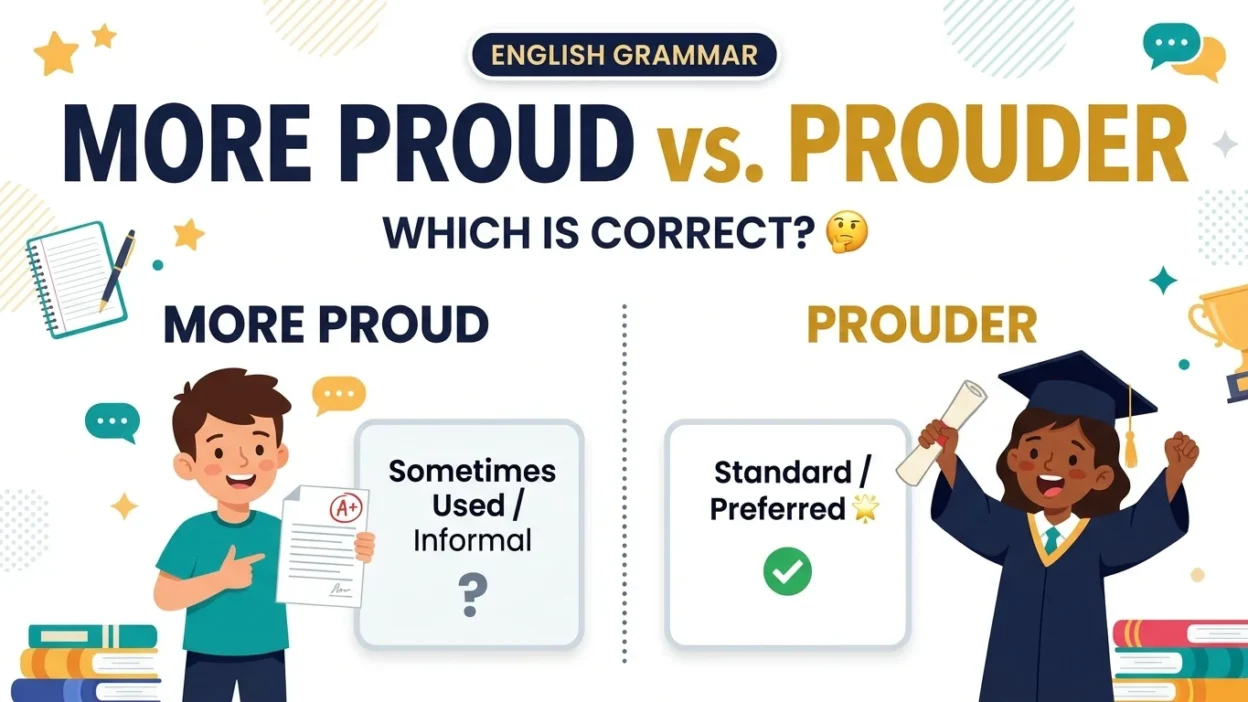
Choosing between more proud and prouder can be confusing, especially for English learners who want to compare feelings of pride naturally. Both expressions are grammatically correct, but they are not always equally natural in every sentence. Understanding how comparative adjectives work will help you choose the right expression with confidence.
The adjective proud describes a feeling of pleasure or satisfaction because of something you have achieved, something someone else has done, or something you value. When you compare two levels of pride, you can use either prouder or more proud. However, prouder is generally the more common and straightforward comparative form, while more proud may be preferred when the writer wants to emphasize the comparison or create a particular rhythm.
Context also matters: a sentence about personal achievement may sound different from one about family, identity, or relationships. In this guide, you will learn the difference between the two expressions, discover when to use each one, and explore practical examples, common mistakes, and frequently asked questions.
Quick Answer
Both more proud and prouder are correct comparative forms of proud. However, prouder is generally the more common choice in everyday English. Use more proud when it better suits the sentence’s emphasis, rhythm, or style. For most ordinary comparisons, prouder is a natural and reliable option.
Why Do People Confuse More Proud and Prouder?
People often confuse these expressions because English has two common ways to form comparative adjectives:
- Adding -er: proud → prouder
- Using more: proud → more proud
Many short adjectives form their comparatives with -er, while longer adjectives often use more. However, English does not follow this pattern perfectly. Some adjectives allow both forms, and proud is one of them.
For example:
- I am prouder of my progress today than I was last year.
- I am more proud of my progress today than I was last year.
Both sentences are grammatically acceptable and express the same basic comparison. The difference is mainly one of usage, emphasis, and style rather than meaning.
First Word: More Proud
More proud is a correct comparative expression formed by placing more before the adjective proud.
It compares two levels of pride and can be useful when a writer wants to emphasize the degree of feeling or when the phrase sounds more natural within a particular sentence.
Meaning of More Proud
More proud means experiencing a greater degree of pride than before or than another person does.
Examples:
- I am more proud of my students than ever before.
- She felt more proud of her achievement after receiving the award.
- He is more proud of his family than he can express in words.
- I could not be more proud of you.
The final example, “I could not be more proud of you,” is a particularly common expression. It means that the speaker feels the greatest possible pride in the person being addressed.
Is More Proud Grammatically Correct?
Yes. More proud is grammatically correct because English permits both prouder and more proud as comparative forms of this adjective.
However, grammatical correctness does not mean that both expressions are equally common in every context. In ordinary comparisons, prouder is often the simpler choice.
Second Word: Prouder
Prouder is the comparative form of the adjective proud, created by adding -er.
It is generally the more common and concise choice for comparing feelings of pride in everyday English.
Meaning of Prouder
Prouder means feeling a greater amount of pride than someone else or than you felt previously.
Examples:
- I am prouder of myself than I was last year.
- She felt prouder after completing the difficult course.
- My parents are prouder of me than ever.
- He grew prouder of his cultural heritage as he learned more about it.
In each example, prouder compares one level of pride with another.
Why Is Prouder Often Preferred?
English commonly forms the comparative of short adjectives by adding -er. Since proud is a short, one-syllable adjective, prouder follows this familiar pattern.
Compare these examples:
- tall → taller
- short → shorter
- kind → kinder
- proud → prouder
This pattern makes prouder an easy and natural choice for everyday conversation and writing.
More Proud vs. Prouder: Key Differences
Although both expressions are correct, prouder is generally more concise, while more proud may provide a different rhythm or emphasis.
| Feature | More proud | Prouder |
|---|---|---|
| Grammatical status | Correct | Correct |
| Meaning | A greater degree of pride | A greater degree of pride |
| Formation | More + proud | Proud + -er |
| Everyday usage | Natural in many contexts | Generally the more common choice |
| Style | May provide extra emphasis | Concise and straightforward |
| Example | I am more proud of her now. | I am prouder of her now. |
The two forms usually communicate the same meaning. Choose the expression that sounds natural in the sentence, while remembering that prouder is a dependable default.
When Should You Use More Proud or Prouder?
Use either form when comparing degrees of pride, but consider the sentence’s context and intended effect.
When to Use Prouder
Use prouder for straightforward comparisons in everyday conversation, schoolwork, and general writing.
Examples:
- I am prouder of my work this year.
- She became prouder of her accomplishments.
- We are prouder of our team after its victory.
- He felt prouder when he realized how much he had improved.
Practical rule: If you are unsure which form to choose, use prouder in an ordinary comparison.
When to Use More Proud
Use more proud when it fits the emphasis, tone, or rhythm you want to create. It is also common in the expression could not be more proud.
Examples:
- I could not be more proud of my daughter.
- She was more proud of her students than of her own achievements.
- He seemed more proud of his contribution after hearing the feedback.
- I am more proud of the effort we made than of the final result.
These examples do not mean that more proud is required in these contexts. In most of them, prouder would also be grammatically acceptable.
More Proud vs. Prouder: Examples in Different Situations
The following examples show how both expressions work in everyday English.
| Situation | More proud | Prouder |
|---|---|---|
| Personal growth | I am more proud of myself today. | I am prouder of myself today. |
| Family | She is more proud of her son now. | She is prouder of her son now. |
| Education | He is more proud of his grades this term. | He is prouder of his grades this term. |
| Achievement | We are more proud of our progress. | We are prouder of our progress. |
| Teamwork | They are more proud of their team now. | They are prouder of their team now. |
Both columns contain acceptable English. The choice often depends on personal style and the surrounding sentence.
12 Examples of More Proud and Prouder in Sentences
Here are practical examples to help you understand how these expressions are used.
- Personal achievement: I am prouder of myself for finishing the project.
- Family: My parents could not be more proud of me.
- Education: She felt prouder after passing her final examination.
- Work: He is more proud of the team’s success than of his individual award.
- Friendship: I have never been prouder of my best friend.
- Sports: The coach was prouder of the players’ teamwork than of the score.
- Personal growth: I am more proud of how far I have come than of where I started.
- Community: Residents felt prouder of their town after the restoration project.
- Creativity: She became prouder of her writing as her skills improved.
- Parenthood: I could not be prouder of my children.
- Professional success: He was prouder of his honesty than of his promotion.
- Achievement after difficulty: We felt more proud of our perseverance after overcoming the challenge.
Notice that more proud and prouder can both communicate an increased feeling of pride. The surrounding words, rather than the comparative form alone, determine the exact meaning of each sentence.
Common Mistakes to Avoid
1. Thinking More Proud Is Always Incorrect
Incorrect rule: “Never use more proud.”
Correction: Both more proud and prouder are grammatically acceptable. Prouder is generally more common in ordinary comparisons, but the other form is not automatically wrong.
2. Thinking Prouder Is Always Better
Although prouder is a reliable default, it is not necessary to replace every instance of more proud. Expressions such as “I could not be more proud of you” are natural and widely used.
3. Using More Prouder
Avoid combining both comparative forms.
Incorrect: I am more prouder of my sister now.
Correct: I am prouder of my sister now.
Also correct: I am more proud of my sister now.
The word more should not normally be added to an adjective that already has the comparative ending -er.
4. Confusing Proud With Pride
Proud is an adjective, while pride is a noun.
- Correct: I am prouder of my achievement.
- Correct: I feel more pride in my achievement.
- Incorrect: I am more pride of my achievement.
Use proud of when describing the feeling and pride in when using the noun.
5. Forgetting the Word Of
When explaining the reason for your pride, English commonly uses proud of.
- Correct: She is prouder of her work.
- Incorrect: She is prouder her work.
6. Using the Comparative Without a Clear Context
A comparative often compares two people, things, situations, or points in time. The comparison can be explicit or understood from context.
- Clear: I am prouder of my progress than I was last year.
- Clear: I feel prouder now.
The second sentence works because the comparison with an earlier time is understood.
Memory Trick: How to Remember the Difference
Remember this simple rule:
Proud → Prouder
For most everyday comparisons, adding -er is your easiest choice.
Think of these familiar patterns:
- fast → faster
- strong → stronger
- proud → prouder
However, remember the special expression:
“I couldn’t be more proud.”
This is a natural and useful phrase that you can learn as a complete expression.
The easiest way to remember the distinction is to use prouder as your default and keep more proud available whenever it sounds more natural or provides the emphasis you want.
American vs. British English: Is There a Difference?
There is no major grammatical difference between American and British English in the use of more proud and prouder. Both forms are acceptable in both varieties.
| Point | American English | British English |
|---|---|---|
| Comparative form | Prouder | Prouder |
| Alternative form | More proud | More proud |
| General preference | Prouder is a natural default | Prouder is a natural default |
| Common expression | I couldn’t be more proud. | I couldn’t be more proud. |
Neither form is exclusively American or British. Differences in individual preferences may occur, but there is no strict regional rule requiring one form over the other.
Similar Words and Related Comparatives
Understanding related adjectives can help you recognize comparative patterns in English.
| Base adjective | Comparative with -er | Comparative with more |
|---|---|---|
| Proud | Prouder | More proud |
| Clever | Cleverer | More clever |
| Simple | Simpler | More simple |
| Quiet | Quieter | More quiet |
| Polite | More polite is the usual form | More polite |
| Happy | Happier | More happy is generally less natural |
These examples illustrate that comparative formation varies across adjectives. Some allow two forms, while others strongly favor one. For proud, both prouder and more proud are acceptable.
Related expressions include:
- Proud of: Feeling satisfaction about someone or something.
- Proud to: Feeling honored or pleased to do something.
- Pride in: The noun phrase used to describe a feeling of satisfaction.
- Proudest: The superlative form, used to describe the greatest degree of pride among three or more comparisons.
Examples:
- I am proud of my students.
- I am proud to represent my school.
- I take pride in my work.
- That was the proudest moment of my life.
Final Verdict: More Proud or Prouder?
Both more proud and prouder are grammatically correct. They express a greater degree of pride, and the difference is generally stylistic rather than a difference in basic meaning.
Choose prouder for most ordinary comparisons. It is concise, natural, and follows the usual comparative pattern for a short adjective.
Use more proud when it suits your sentence’s rhythm, emphasis, or intended tone. Remember that “I couldn’t be more proud of you” is a particularly natural expression.
The key is not to treat one form as correct and the other as incorrect. Learn the usual preference, recognize the exceptions, and choose the form that communicates your meaning clearly.
Frequently Asked Questions
1. Is it more proud or prouder?
Both are correct. Prouder is generally the more common choice for everyday comparisons, while more proud is also acceptable in many contexts.
2. Is more proud grammatically incorrect?
No. More proud is a grammatically acceptable comparative form of proud. It should not automatically be considered an error simply because prouder is often preferred.
3. Is prouder a real word?
Yes. Prouder is the standard comparative form of the adjective proud. It means feeling a greater degree of pride.
4. Can I say, “I am more prouder”?
No. In standard English, avoid using more with prouder in this way because both forms mark the comparative. Say “I am prouder” or “I am more proud.”
5. Which is more natural: “I am prouder of you” or “I am more proud of you”?
Both sentences are natural and grammatically correct. “I am prouder of you” is a concise choice, while “I am more proud of you” can also work depending on the context and emphasis.
6. Is “I couldn’t be more proud of you” correct?
Yes. It is a common expression that communicates the strongest possible feeling of pride. It is grammatically correct and sounds natural in both American and British English.
7. What is the superlative form of proud?
The usual superlative form is proudest. It describes the greatest degree of pride among three or more people, things, or situations.
Example: “Winning the scholarship was the proudest moment of her life.”
8. Should English learners always use prouder?
Not always, but prouder is a useful default for everyday comparisons. Learners should also recognize more proud as correct and understand that both forms may be appropriate depending on context.
Remember This
- Prouder: The usual, concise comparative form.
- More proud: Also correct and useful when it suits the context.
- More prouder: Avoid this form in standard English.
- Proudest: The usual superlative form.
- Proud of: The common expression for identifying the source of pride.
When in doubt, choose prouder for a simple comparison, but do not assume that more proud is wrong.
Conclusion
The difference between more proud and prouder is easier to understand once you recognize that both expressions are grammatically correct. They describe the same basic idea: experiencing a greater degree of pride. Although prouder is generally the more common choice in ordinary comparisons, more proud remains a natural option in many sentences.
For confident English writing, use prouder as your default, learn expressions such as “I couldn’t be more proud of you,” and avoid the redundant form more prouder. With practice, you will be able to choose between these expressions naturally and accurately.

Charles Kevin is a passionate language writer and researcher at SimileHive, creating clear, engaging content about similes, idioms, metaphors, and figurative language to help readers improve English communication confidently every day.