The phrase “is and is” may look unusual in English, but whether it is grammatically correct depends on how it is used in a sentence. The word is is a form of the verb to be. It is commonly used with singular subjects such as he, she, it, and singular nouns. However, repeating the same verb with and does not automatically make a sentence correct or incorrect.
For example, “He is kind and is helpful” can be grammatically correct, although “He is kind and helpful” sounds more natural in everyday English. In contrast, “She is and is happy” is generally incorrect because the first is has no appropriate complement. Understanding the sentence structure helps you decide whether repeating is is necessary, acceptable, or awkward.
In this article, you will learn what “is and is” means, when repeating is is correct, when it is incorrect, and how to use the verb naturally in spoken and written English.
Quick Answer: Is “Is and Is” Correct Grammar?
“Is and is” is not usually a complete or natural expression by itself. However, repeating is in a sentence can be grammatically correct when each occurrence has a clear function. For example, “He is a teacher and is also a writer” is correct. In many sentences, removing the second is makes the wording smoother.
What Does “Is” Mean in English?
Is is the third-person singular present-tense form of the verb to be. It is used with singular subjects, including he, she, it, and singular nouns.
Examples:
- She is happy.
- He is my brother.
- The weather is cold.
- My teacher is helpful.
- This book is interesting.
The verb is can connect a subject to a description, identify someone or something, or help form continuous and passive verb constructions.
Examples:
- Description: The room is clean.
- Identification: He is a doctor.
- Continuous tense: She is studying.
- Passive voice: The letter is written in English.
Is “Is and Is” Grammatically Correct?
The answer depends on the sentence structure. The conjunction and can connect words, phrases, or clauses. When two clauses are joined, each may contain its own verb.
1. When “is and is” is correct
Repeating is can be correct when it belongs to two coordinated clauses or when the sentence structure requires it.
Examples:
- He is a teacher and is also a writer.
- The house is old and is in need of repairs.
- She is confident and is ready for the interview.
- The problem is serious and is getting worse.
- This option is affordable and is available today.
These sentences are grammatically acceptable. However, some can be shortened without changing their basic meaning.
For example:
“He is a teacher and a writer.”
This sounds more concise than “He is a teacher and is also a writer.”
2. When “is and is” is incorrect
Repeating is becomes incorrect when one occurrence is incomplete or does not fit the sentence structure.
Incorrect: She is and is happy.
Correct: She is happy.
Incorrect: My brother is and is a student.
Correct: My brother is a student.
Incorrect: The weather is and is pleasant.
Correct: The weather is pleasant.
In these examples, the first is does not have a clear grammatical role.
“Is and Is” vs. “Is”
| Expression | Example | Explanation |
|---|---|---|
| Is | She is intelligent. | Correct and complete |
| Is and is | She is intelligent and is hardworking. | Grammatically correct, but often less concise |
| Is and | She is intelligent and… | Incomplete unless the sentence continues |
| Is is | He is is happy. | Incorrect in ordinary standard English |
Remember that the same word can appear twice in a sentence when the structure supports it. The problem is not repetition itself but how the repeated word functions.
When Should You Repeat “Is”?
You can repeat is when it improves clarity or separates two clauses that each need a verb.
Use the second “is” when it helps the sentence
- The building is modern and is designed for large families.
- The candidate is qualified and is available to start immediately.
- The task is difficult and is taking longer than expected.
Remove the second “is” when the sentence is clearer without it
- Wordy: She is talented and is creative.
- Better: She is talented and creative.
- Wordy: The restaurant is popular and is affordable.
- Better: The restaurant is popular and affordable.
Both versions may be grammatically correct, but the shorter versions often sound more natural.
10 Example Sentences Using “Is” Correctly
- My sister is a doctor.
- The sky is blue.
- He is learning English.
- The food is delicious.
- This book is useful and is easy to understand.
- She is friendly and is always willing to help.
- The road is narrow and is dangerous at night.
- Our teacher is patient and kind.
- The project is complete and is ready for review.
- This phone is affordable and is available in several colors.
Examples 5, 6, 7, and 9 use is twice in a larger sentence. The repeated verb is grammatically acceptable because it belongs to a coordinated structure.
Common Mistakes to Avoid
Mistake 1: Repeating “is” without a grammatical purpose
Incorrect: He is and is smart.
Correct: He is smart.
Mistake 2: Assuming every repeated verb is wrong
Incorrect assumption: “She is honest and is reliable” must be wrong.
Correction: The sentence is grammatically correct, although “She is honest and reliable” is more concise.
Mistake 3: Using “is” with a plural subject
Incorrect: They is happy.
Correct: They are happy.
Mistake 4: Using “is” with the wrong subject
Incorrect: I is ready.
Correct: I am ready.
A Simple Memory Trick
Remember this rule: Every “is” should have a clear grammatical purpose.
Ask yourself two questions:
- Does the subject agree with is?
- Does the sentence need the repeated verb?
If both answers are yes, repeating is may be correct. If the extra verb makes the sentence incomplete or awkward, remove it or rewrite the sentence.
Frequently Asked Questions
1. Is “is and is” correct English?
It can be correct within a complete sentence, such as “He is polite and is always respectful.” By itself, however, “is and is” is generally not a complete expression.
2. Can I use “is” twice in one sentence?
Yes. For example, “The house is spacious and is close to the school” is grammatically correct. You can also write “The house is spacious and close to the school.”
3. Is “He is and is happy” correct?
No. In ordinary standard English, the first is is incomplete. The natural sentence is “He is happy.”
4. Is “She is beautiful and is intelligent” correct?
Yes. Both instances of is can be grammatically justified, but “She is beautiful and intelligent” is more concise and natural in most contexts.
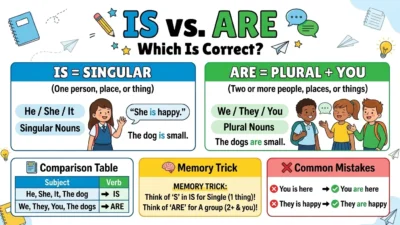
5. What is the difference between “is” and “are”?
Is is generally used with singular third-person subjects, such as he, she, it, and the boy. Are is used with you, we, they, and plural subjects.
Examples: “The boy is ready” and “The boys are ready.”
6. Should I avoid repeating “is” in formal writing?
Not necessarily. Repetition is acceptable when needed for clarity or grammatical structure. However, concise wording is often preferred in formal writing when it preserves the intended meaning.
7. Is “is is” ever correct?
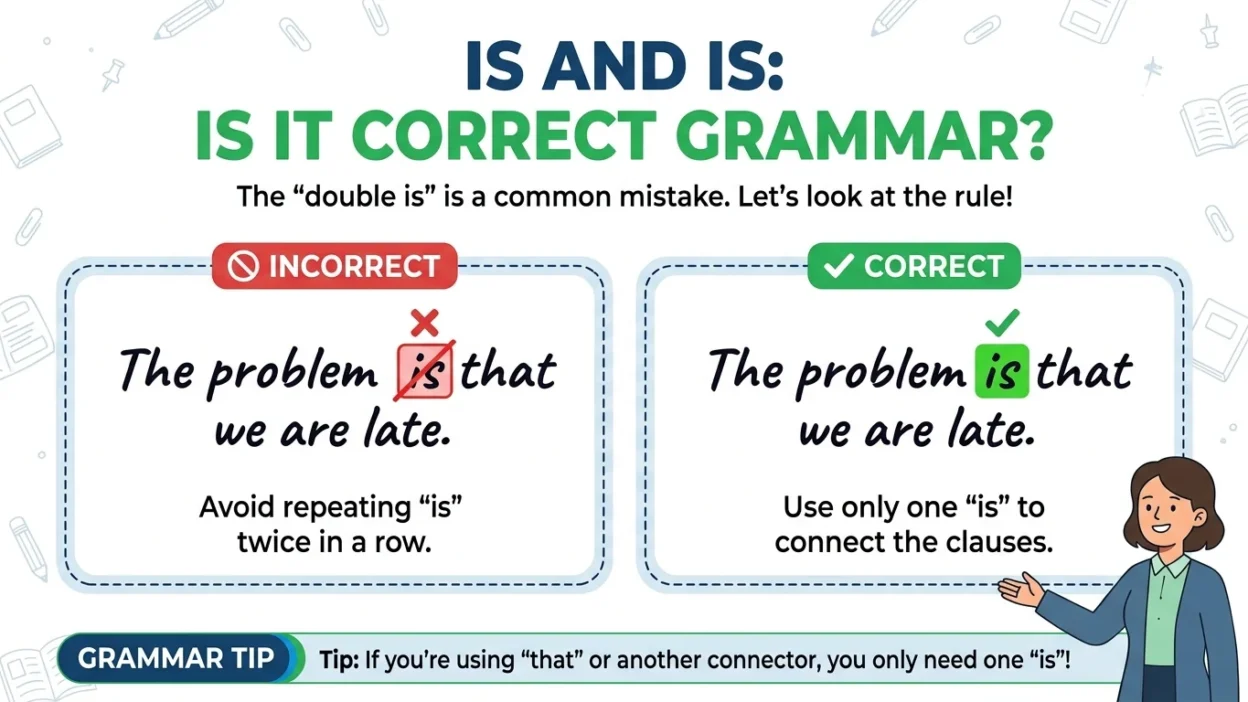
Two consecutive instances of is are generally incorrect in ordinary standard English, as in “He is is happy.” Rare examples may occur when discussing words themselves or in quoted language, but they are not normal sentence constructions.
Remember This
The expression “is and is” is not automatically wrong, but it needs a sentence structure that supports both verbs. A sentence such as “She is talented and is hardworking” is acceptable, while “She is and is happy” is not.
When in doubt, check whether each is has a clear grammatical purpose. If removing the repeated verb makes the sentence shorter and easier to understand, the simpler version is usually the better choice.
Conclusion
The phrase “is and is” can be grammatically correct when the two instances of is belong to separate parts of a properly structured sentence. For example, “The building is old and is undergoing repairs” is correct. However, repeating is without a clear grammatical purpose can make a sentence incorrect or confusing.
For everyday English, focus on clear and natural sentence construction. Use is with the correct subject, repeat it only when the sentence needs it, and prefer concise wording when both versions communicate the same meaning.

Charles Kevin is a passionate language writer and researcher at SimileHive, creating clear, engaging content about similes, idioms, metaphors, and figurative language to help readers improve English communication confidently every day.