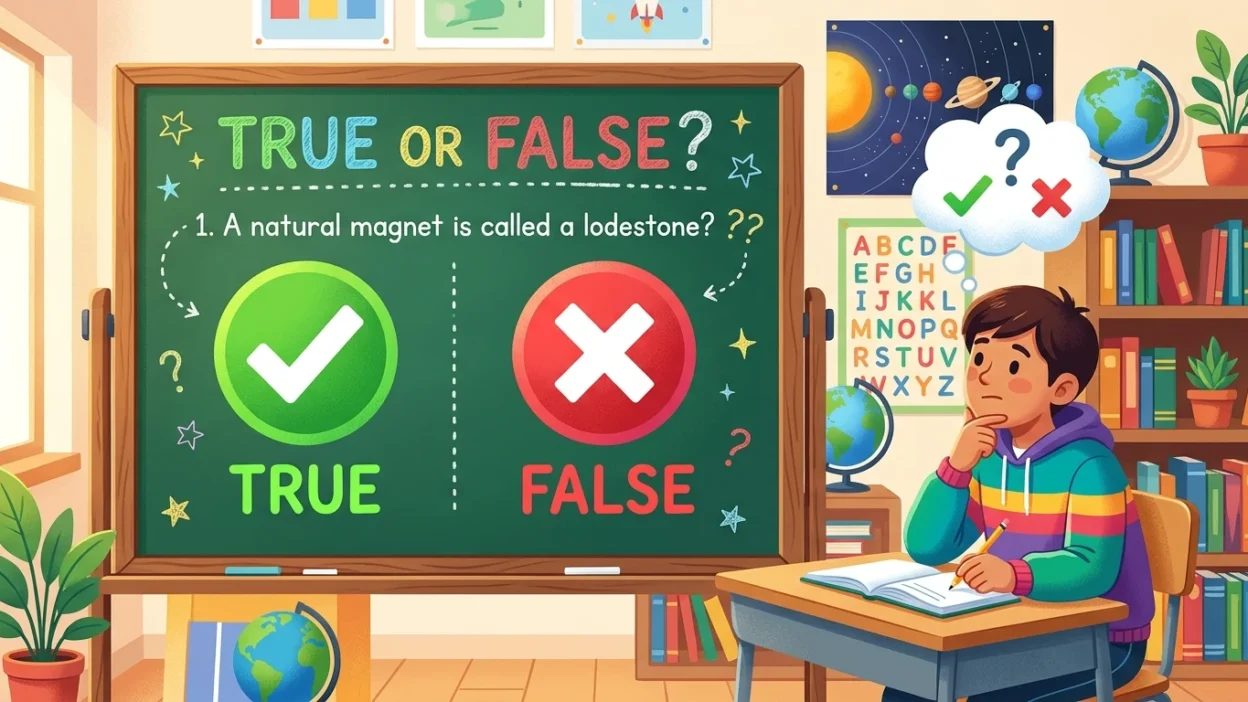
True or false questions are a simple way to test knowledge, check understanding, and improve critical thinking. Each question presents a statement, and the person answering must decide whether it is true or false. These questions are commonly used in classrooms, quizzes, exams, interviews, and general knowledge games.
Whether you are a student, teacher, parent, or quiz enthusiast, practicing true or false questions can help you learn new facts and recognize incorrect information. Below are 50 examples covering general knowledge, science, English grammar, mathematics, geography, history, and everyday life.
Quick Answer
A true or false question asks you to decide whether a given statement is correct or incorrect. For example, “The Earth revolves around the Sun” is true, while “The Sun revolves around the Earth” is false. These questions are useful for testing knowledge and understanding.
What Are True or False Questions?
True or false questions are questions in which you evaluate a statement and select one of two possible answers:
- True: The statement is correct.
- False: The statement is incorrect.
For example:
Statement: Water freezes at 0°C under standard atmospheric pressure.
Answer: True.
Another example:
Statement: All birds can fly.
Answer: False. Some birds, such as penguins and ostriches, cannot fly.
50 True or False Example Questions With Answers
Here are 50 practice statements arranged by subject. Try answering each one before checking the answer.
1. General Knowledge True or False Questions
1. The Earth is the third planet from the Sun.
Answer: True
2. There are eight planets in our solar system.
Answer: True
3. The Pacific Ocean is the smallest ocean in the world.
Answer: False. It is the largest ocean.
4. A year has 12 months.
Answer: True
5. The human body has four lungs.
Answer: False. Humans normally have two lungs.
6. The Great Wall of China is visible from the Moon with the naked eye.
Answer: False. This is a common myth.
7. An adult human normally has 206 bones.
Answer: True
8. The North Pole is located in Antarctica.
Answer: False. Antarctica contains the South Pole.
9. A triangle has three sides.
Answer: True
10. The Sun is a star.
Answer: True
2. Science True or False Questions
11. Water is made up of hydrogen and oxygen.
Answer: True
12. Sound travels faster in air than in water.
Answer: False. Sound generally travels faster in water than in air.
13. Plants use sunlight to make their food through photosynthesis.
Answer: True
14. Humans breathe in oxygen and breathe out carbon dioxide.
Answer: True. However, exhaled air still contains some oxygen.
15. The Moon produces its own light.
Answer: False. It reflects sunlight.
16. Electricity can travel through copper wires.
Answer: True
17. All metals are magnetic.
Answer: False. Only certain metals, such as iron, nickel, and cobalt, are strongly attracted to magnets.
18. The boiling point of pure water is 100°C at standard atmospheric pressure.
Answer: True
19. Light travels faster than sound.
Answer: True
20. A whale is a fish.
Answer: False. A whale is a mammal.
3. English Grammar True or False Questions
21. A noun is a word that names a person, place, thing, or idea.
Answer: True
22. Every sentence must contain an adjective.
Answer: False. A sentence does not need an adjective.
23. The word “quickly” is an adverb.
Answer: True
24. “Their” and “there” have the same meaning.
Answer: False. They have different meanings and uses.
25. A verb expresses an action or a state of being.
Answer: True
26. The word “beautiful” is a noun.
Answer: False. It is an adjective.
27. A question mark is used at the end of a direct question.
Answer: True
28. “She go to school every day” is grammatically correct in standard English.
Answer: False. The correct sentence is “She goes to school every day.”
29. The plural of “child” is “children.”
Answer: True
30. An adjective describes or modifies a noun or pronoun.
Answer: True
4. Mathematics True or False Questions
31. Five plus five equals ten.
Answer: True
32. A square has five sides.
Answer: False. A square has four sides.
33. Zero is an even number.
Answer: True
34. The product of any number and zero is zero.
Answer: True
35. One hundred is greater than one thousand.
Answer: False.
36. A right angle measures 90 degrees.
Answer: True
37. Every prime number is odd.
Answer: False. Two is an even prime number.
38. Half of 50 is 25.
Answer: True
39. The square root of 81 is 9.
Answer: True
40. A rectangle always has four right angles.
Answer: True
5. Geography and History True or False Questions
41. Paris is the capital of France.
Answer: True
42. The Nile is a river in Africa.
Answer: True
43. Mount Everest is the tallest mountain above sea level.
Answer: True
44. Australia is both a country and a continent.
Answer: True. It is commonly described as a country and a continent.
45. The United States declared independence in 1776.
Answer: True
46. The Sahara Desert is located in South America.
Answer: False. It is in North Africa.
47. Japan is an island country in Asia.
Answer: True
48. The First World War ended in 1918.
Answer: True
49. Rome is the capital of Italy.
Answer: True
50. The equator divides the Earth into the Eastern and Western Hemispheres.
Answer: False. It divides the Earth into the Northern and Southern Hemispheres.
True or False Questions Without Answers
Use these questions as a short practice test. Try answering them yourself before checking the answer key.
- The Earth rotates on its axis.
- All insects have six legs.
- The English alphabet has 26 letters.
- A kilogram is heavier than a gram.
- Venus is the closest planet to the Sun.
- Penguins are mammals.
- A week has seven days.
- The plural of “mouse” is “mouses” in every context.
- The human heart pumps blood throughout the body.
- A leap year has 366 days.
Answer Key
| Question | Answer |
|---|---|
| 1 | True |
| 2 | True |
| 3 | True |
| 4 | True |
| 5 | False |
| 6 | False |
| 7 | True |
| 8 | False |
| 9 | True |
| 10 | True |
How to Write Good True or False Questions
If you are preparing a quiz, worksheet, or examination, follow these simple guidelines:
- Use clear language: Make sure the statement is easy to understand.
- Focus on one fact: Avoid combining several facts in one statement.
- Avoid confusing wording: Double negatives can make questions unnecessarily difficult.
- Check factual accuracy: Make sure every answer is supported by reliable information.
- Include a balanced mix: Use both true and false statements.
- Explain incorrect answers: A short explanation helps learners understand their mistakes.
Frequently Asked Questions
1. What is an example of a true or false question?
“The Earth revolves around the Sun” is an example of a true or false question. The correct answer is True.
2. What is an example of a false statement?
“The Moon is bigger than the Sun” is a false statement. The Sun is much larger than the Moon.
3. How do you answer true or false questions?
Read the statement carefully, identify the fact it presents, and decide whether it is correct. Select True if it is accurate and False if it is incorrect.
4. What are true or false questions used for?
They are used in school tests, classroom activities, quizzes, examinations, online assessments, and general knowledge competitions.
5. Are true or false questions good for students?
Yes. They help students review information, test their understanding, identify knowledge gaps, and practice making decisions based on facts.
6. Can a true or false question contain a negative statement?
Yes. For example, “The Sun does not rise in the west” is a true statement. However, negative wording should be used carefully to avoid confusion.
7. How many true or false questions should a quiz contain?
There is no fixed number. A short classroom quiz might contain 10 questions, while a longer examination or practice worksheet may contain 30, 50, or more.
8. Should true or false questions include explanations?
Explanations are helpful, especially in educational settings. They allow students to understand why a statement is correct or incorrect rather than simply memorizing answers.
Remember This
A true or false question presents a statement that you must evaluate.
- True means the statement is correct.
- False means the statement is incorrect.
- A good question should be clear, accurate, and focused on one main idea.
- Explanations make true or false exercises more useful for learning.
Conclusion
True or false questions are an effective way to test knowledge and strengthen understanding. They can cover almost any subject, including English, science, mathematics, history, and general knowledge. Practicing different types of statements helps students become more confident when answering quizzes and examinations.
The 50 examples in this article provide a useful starting point for teachers, students, parents, and anyone who enjoys learning through quizzes. Try creating your own statements, answer them without looking at the solutions, and review the explanations to improve your knowledge.

Charles Kevin is a passionate language writer and researcher at SimileHive, creating clear, engaging content about similes, idioms, metaphors, and figurative language to help readers improve English communication confidently every day.