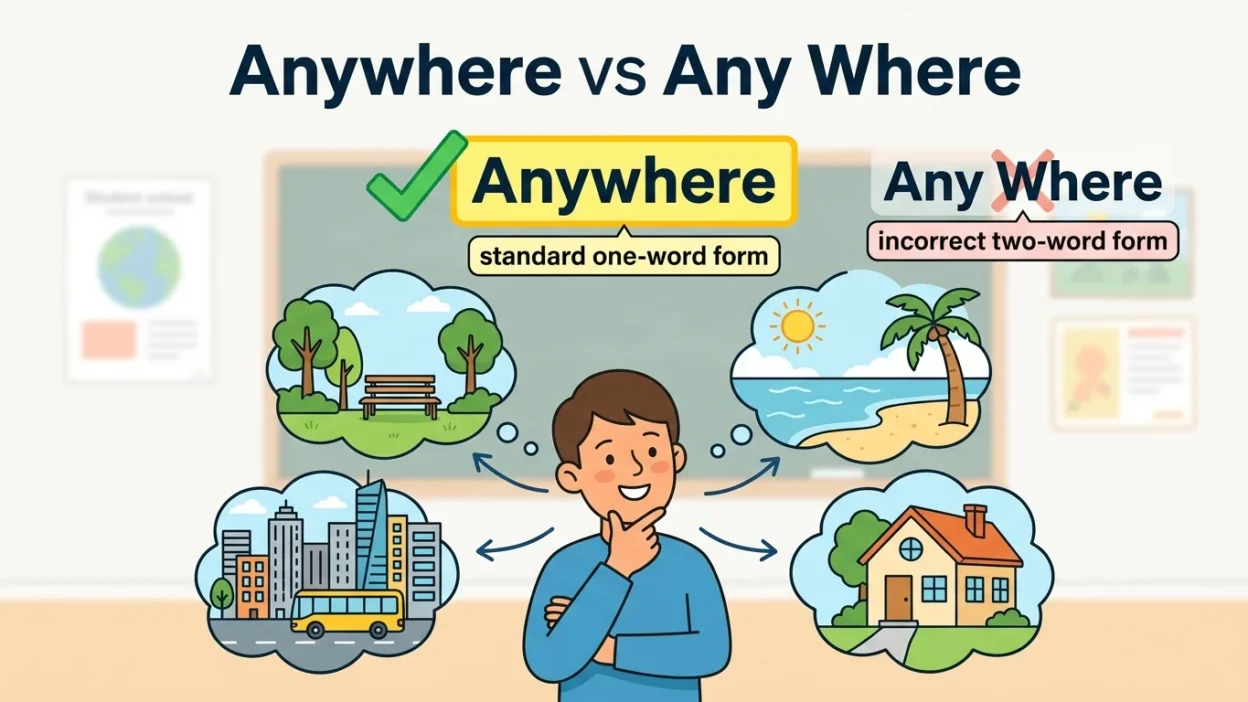
“Anywhere” and “any where” may look almost identical, but they do not have the same use in modern English. Anywhere is the standard one word form and is commonly used to mean any place, to any place, or in any place. It is used in questions, negative sentences, and sentences about unlimited locations. For example, “You can sit anywhere” means you can sit in any place you choose.
Any where written as two separate words is not normally used when you simply mean “any place.” In most ordinary sentences, writing “any where” would be considered incorrect. However, the two words can appear next to each other in unusual grammatical situations where any modifies the noun where, but this is rare in modern English. For everyday writing and speaking, anywhere is almost always the correct choice when you mean “any place.”
Quick Answer
Anywhere is the standard spelling when you mean “any place.” For example, “We can go anywhere.” Any where is rarely used as two separate words and is generally incorrect when you mean “any place.” In normal English, write anywhere as one word.
Why Do People Confuse “Anywhere” and “Any Where”?
The confusion happens because “anywhere” contains two parts that can also exist as separate words.
Any can mean one or more possibilities without specifying which one.
Where relates to a place or location.
When these ideas combine to mean “any place,” English normally writes them as one word:
Anywhere
The same pattern appears in words such as:
somewhere
everywhere
nowhere
These words are normally written as single words when they refer to places.
What Does “Anywhere” Mean?
“Anywhere” is an adverb that means any place or to any place.
It can be used when the exact location does not matter or when many possible locations are available.
Examples:
You can sit anywhere.
This means you can sit in any place.
I can’t find my phone anywhere.
This means I cannot find my phone in any place.
Have you seen him anywhere?
This asks whether you have seen him in any place.
What Does “Any Where” Mean?
“Any where” is not normally used as a fixed phrase meaning “any place.”
In ordinary English, you should not write:
You can go any where you want.
Instead, write:
You can go anywhere you want.
There can be rare contexts where any and where happen to appear next to each other for separate grammatical reasons, but this is not the normal way to express “any place.”
For everyday English, the safest rule is simple:
Use anywhere when you mean any place.
Anywhere vs Any Where
| Form | Meaning | Common Use |
|---|---|---|
| Anywhere | Any place | Standard and very common |
| Any where | Usually not used as a phrase meaning any place | Rare and unusual |
When to Use “Anywhere”
Use anywhere when you mean any place or location.
In positive sentences
You can sit anywhere.
We can meet anywhere in the city.
Put the box anywhere you like.
In negative sentences
I can’t find my keys anywhere.
There is nowhere to park anywhere nearby.
She didn’t go anywhere yesterday.
In questions
Can we go anywhere after dinner?
Did you see him anywhere?
Have you been anywhere interesting recently?
With “if”
You can call me anywhere if you need help.
The exact structure may vary, but anywhere remains one word when it means any place.
12 Examples of “Anywhere”
1. You can sit anywhere you like.
You may choose any place to sit.
2. I can’t find my glasses anywhere.
The speaker cannot find the glasses in any place.
3. Have you seen my notebook anywhere?
The speaker is asking whether the notebook has been seen in any location.
4. We can travel anywhere this summer.
The speakers are open to many possible destinations.
5. Don’t leave your bag anywhere.
This tells someone not to leave the bag in an unspecified place.
6. She doesn’t want to go anywhere tonight.
She does not want to go to any place.
7. Is there anywhere we can sit?
The speaker is asking whether there is any available place to sit.
8. You can park anywhere along this street.
Any suitable location along the street is acceptable.
9. I looked everywhere, but I couldn’t find it anywhere.
The speaker searched many places without finding the object.
10. We could meet anywhere near the station.
The meeting can take place at any suitable location near the station.
11. He would rather stay anywhere than return home.
The sentence emphasizes that many locations are preferable to returning home.
12. Have you traveled anywhere interesting recently?
The speaker is asking whether the person has visited any interesting place.
Anywhere vs Somewhere vs Everywhere vs Nowhere
These four words are easy to compare.
| Word | Meaning | Example |
|---|---|---|
| Anywhere | Any place | You can sit anywhere. |
| Somewhere | An unspecified place | She lives somewhere nearby. |
| Everywhere | All places | We looked everywhere. |
| Nowhere | No place | There was nowhere to sit. |
A useful way to remember them is:
Anywhere = any place
Somewhere = some place
Everywhere = every place
Nowhere = no place
Common Mistakes
Mistake 1: Writing “any where”
Incorrect:
You can go any where you want.
Correct:
You can go anywhere you want.
Mistake 2: Using “anywhere” when “somewhere” is intended
Compare:
I want to go somewhere quiet.
This means the speaker has a place in mind, but it is not specified.
I can go anywhere.
This means any location is acceptable.
Mistake 3: Confusing “anywhere” and “everywhere”
These words have different meanings.
Anywhere means any possible place.
Everywhere means all places.
For example:
You can look anywhere.
This allows any location.
I looked everywhere.
This means the person searched all possible places.
Mistake 4: Confusing “anywhere” and “nowhere”
These are almost opposites.
I can find it anywhere.
This suggests many possible places.
I can find it nowhere.
This means I cannot find it in any place.
Memory Trick
Remember:
Anywhere = any place
If you can replace the word with any place, use anywhere.
For example:
You can sit anywhere.
Becomes:
You can sit in any place.
Since the meaning works, anywhere is correct.
American vs British English
There is no meaningful difference between American English and British English in the spelling of anywhere.
Both varieties use anywhere as the standard one word form when referring to any place.
Examples:
Can we go anywhere?
I can’t find it anywhere.
You can sit anywhere you want.
The same spelling is standard in both varieties.
Similar Words
Somewhere
Means an unspecified place.
I left my phone somewhere in the house.
Everywhere
Means all places.
There were flowers everywhere.
Nowhere
Means no place.
There was nowhere to sit.
Wherever
Means any place or every place that.
You can go wherever you want.
Anywhere
Means any place.
We can meet anywhere.
Anywhere vs Wherever
These words can sometimes have similar meanings, but they are used differently.
Anywhere usually refers to any possible location.
Wherever often introduces a clause and means any place that.
Compare:
You can sit anywhere.
You can sit wherever you want.
Both sentences allow the listener to choose a place, but wherever introduces the additional clause “you want.”
Final Verdict
Anywhere is the correct standard form when you mean “any place.” It is used in questions, negative sentences, and many other constructions involving unspecified or unrestricted locations.
Any where is not normally written as two words when you mean “any place.” Although the words can occasionally appear together in unusual grammatical contexts, this is rare and should not be treated as the normal spelling.
The easiest rule is:
Any place = anywhere
Frequently Asked Questions
Is anywhere one word or two?
Anywhere is normally written as one word when it means “any place.”
Is “any where” correct?
Usually not when you mean “any place.” In standard modern English, use anywhere.
What is the difference between anywhere and any where?
Anywhere is a standard English adverb meaning any place. Any where is not normally used as a phrase with that meaning.
Can I say “I can’t find it any where”?
No. In standard writing, write:
I can’t find it anywhere.
Is anywhere used in American English?
Yes. Anywhere is standard in American English.
Is anywhere used in British English?
Yes. Anywhere is also standard in British English.
What is the opposite of anywhere?
Depending on the meaning, nowhere can be considered an opposite because it means no place.
What is the difference between anywhere and everywhere?
Anywhere means any possible place, while everywhere means all places.
For example:
You can sit anywhere.
There are people everywhere.
Remember This
When you mean any place, write:
Anywhere
Not:
Any where
Examples:
Go anywhere you want.
I can’t find it anywhere.
Have you seen her anywhere?
We can meet anywhere.
A simple memory trick is:
Any place = anywhere
Conclusion
“Anywhere” is the standard one word form used when you mean “any place.” It is extremely common in everyday English and can appear in questions, negative statements, positive sentences, and many other structures. Examples include “Can we go anywhere?” and “I can’t find my keys anywhere.”
“Any where” is generally not correct when you are trying to express the idea of “any place.” In normal English, keep anywhere together as one word. If you remember the simple connection any place = anywhere, you will be able to choose the correct form confidently.

Charles Kevin is a passionate language writer and researcher at SimileHive, creating clear, engaging content about similes, idioms, metaphors, and figurative language to help readers improve English communication confidently every day.