
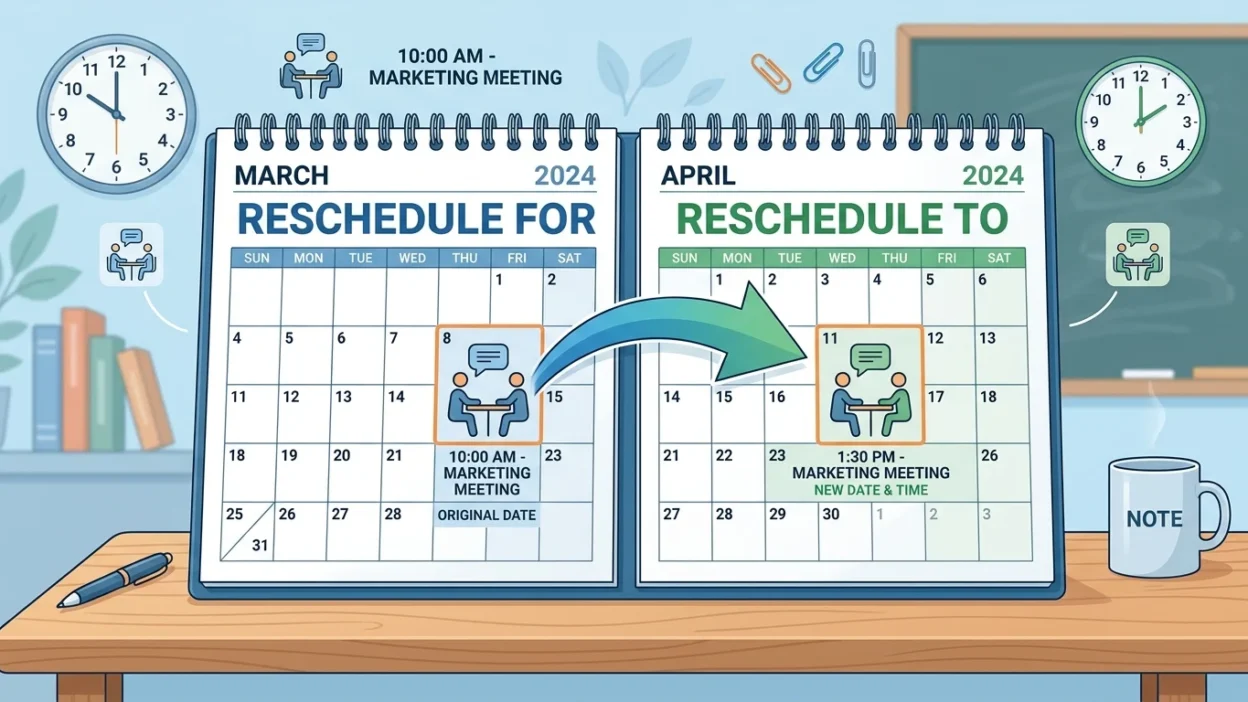
“Reschedule to” and “reschedule for” are both used when talking about changing the date or time of an event, meeting, appointment, class, or other planned activity.
The main difference is how the new time is expressed. Reschedule to usually focuses on changing something to a specific new time or date. For example, “Can we reschedule the meeting to Friday?” means the meeting will be moved to Friday.
Reschedule for is also common and usually focuses on the new date or time that has been arranged for the event. For example, “The appointment was rescheduled for Friday” means Friday is now the planned date for the appointment. In many situations, both forms are natural and can communicate almost the same idea.
The choice often depends on sentence structure and whether you are emphasizing the act of moving something to a new time or the new time that has been arranged.
Quick Answer
Use reschedule to when focusing on moving something to a specific new date or time. Use reschedule for when focusing on the date or time that the event has been arranged for. Both are correct and commonly used. For example, “reschedule the meeting to Monday” and “reschedule the meeting for Monday” are both natural.
Why Do People Confuse “Reschedule To” and “Reschedule For”?
The confusion happens because both to and for can introduce a new date or time.
For example:
Can we reschedule the meeting to Monday?
Can we reschedule the meeting for Monday?
Both sentences can mean that the meeting will now take place on Monday.
The difference is subtle.
To often highlights the movement from the original schedule to a new schedule.
For often highlights the new date or time that has been arranged.
In everyday English, native speakers commonly use both patterns.
What Does “Reschedule To” Mean?
Reschedule to means to move something from its original date or time to a new date or time.
It often emphasizes the change.
For example:
Can we reschedule the meeting to Tuesday?
The meeting was originally planned for another time, but you want to move it to Tuesday.
You can use “to” with:
• dates
• days
• times
• months
• specific appointments
• scheduled events
Examples:
Let’s reschedule the appointment to next week.
The interview was rescheduled to 3 p.m.
They rescheduled the meeting to Friday.
What Does “Reschedule For” Mean?
Reschedule for means to arrange something to happen at a new date or time.
It often places more attention on the new scheduled time.
For example:
The meeting was rescheduled for Friday.
This tells us that Friday is now the planned date.
You can also use “for” with:
• dates
• days
• times
• appointments
• meetings
• events
Examples:
The appointment was rescheduled for Monday.
The exam was rescheduled for next month.
The interview has been rescheduled for 10 a.m.
Reschedule To vs Reschedule For
| Expression | Main Idea | Example |
|---|---|---|
| Reschedule to | Move something to a new time or date | We rescheduled the meeting to Friday. |
| Reschedule for | Arrange something for a new time or date | We rescheduled the meeting for Friday. |
Both can be correct when referring to a new scheduled date or time.
Is “Reschedule To” More Correct Than “Reschedule For”?
No. It is not accurate to say that one is always correct and the other is always incorrect.
Both reschedule to and reschedule for are established English constructions.
The difference is mainly one of emphasis and sentence structure.
Compare:
We rescheduled the appointment to Friday.
This emphasizes the movement of the appointment from its original schedule to Friday.
We rescheduled the appointment for Friday.
This emphasizes the new date assigned to the appointment.
In ordinary conversation, the difference may be very small.
When to Use “Reschedule To”
Use reschedule to when you want to emphasize moving an event from one scheduled time to another.
Example 1
Can we reschedule the meeting to Thursday?
The speaker wants to move the meeting to Thursday.
Example 2
The doctor rescheduled my appointment to next week.
The appointment was moved from its original date.
Example 3
They rescheduled the interview to 2 p.m.
The original interview time was changed to 2 p.m.
Example 4
We had to reschedule the event to Saturday.
The event was moved to Saturday.
Example 5
Could you reschedule the call to tomorrow morning?
The speaker wants the call moved to tomorrow morning.
When to Use “Reschedule For”
Use reschedule for when you want to emphasize the new date or time at which something is now planned.
Example 1
The meeting was rescheduled for Thursday.
Thursday is now the scheduled day.
Example 2
My appointment was rescheduled for next week.
The appointment now has a new date next week.
Example 3
The interview has been rescheduled for 2 p.m.
The new interview time is 2 p.m.
Example 4
The concert was rescheduled for Saturday.
Saturday is the new planned date.
Example 5
The exam was rescheduled for next month.
The exam will now take place next month.
12 Examples of Reschedule To and Reschedule For
1. Can we reschedule the meeting to Monday?
The meeting will be moved to Monday.
2. Can we reschedule the meeting for Monday?
The meeting will now be arranged for Monday.
3. The appointment was rescheduled to next week.
The appointment was moved from its original date to next week.
4. The appointment was rescheduled for next week.
Next week is now the planned time for the appointment.
5. They rescheduled the interview to 10 a.m.
The interview was moved to 10 a.m.
6. They rescheduled the interview for 10 a.m.
The new interview time is 10 a.m.
7. We need to reschedule the class to Friday.
The class needs to be moved to Friday.
8. The class was rescheduled for Friday.
Friday is now the scheduled day for the class.
9. Could we reschedule the call to tomorrow?
The speaker wants to move the call to tomorrow.
10. The call was rescheduled for tomorrow.
Tomorrow is now the planned date for the call.
11. The event was rescheduled to next month.
The event was moved to next month.
12. The event was rescheduled for next month.
Next month is now the new scheduled time.
Two Useful Comparison Tables
| Sentence | What It Emphasizes |
|---|---|
| Reschedule the meeting to Friday | The movement to a new date |
| Reschedule the meeting for Friday | The new date arranged |
| Reschedule the appointment to 3 p.m. | The change from the original time |
| Reschedule the appointment for 3 p.m. | The new appointment time |
Another useful way to see the difference is:
| If you are thinking about… | Natural choice |
|---|---|
| Moving something from its old schedule | Reschedule to |
| The new date or time | Reschedule for |
| A request to move an event | Either can work |
| A statement about the new schedule | Either can work |
Common Mistakes
Mistake 1: Thinking “reschedule for” is always wrong
It is not.
The meeting was rescheduled for Friday is natural English.
Mistake 2: Thinking “reschedule to” is always wrong
It is also correct.
We rescheduled the appointment to Friday is natural English.
Mistake 3: Using “reschedule at”
When talking about a new time, to or for is generally more natural after “reschedule.”
Instead of:
We rescheduled the meeting at 3 p.m.
Use:
We rescheduled the meeting to 3 p.m.
or:
We rescheduled the meeting for 3 p.m.
Mistake 4: Confusing “reschedule” with “schedule”
“Schedule” means to arrange something for a particular time.
“Reschedule” means to change an existing arrangement to a different time.
For example:
We scheduled the meeting for Monday.
The meeting was arranged for Monday.
We rescheduled the meeting for Tuesday.
The existing meeting was changed to Tuesday.
Memory Trick
Think of the two prepositions this way:
To = move to
For = planned for
So:
Reschedule to Friday focuses on moving something to Friday.
Reschedule for Friday focuses on having something planned for Friday.
However, remember that both forms are often interchangeable in everyday English.
American vs British English
Both reschedule to and reschedule for are used in American English and British English.
There is no major difference in meaning between the two varieties.
You may hear:
The meeting was rescheduled to Monday.
and:
The meeting was rescheduled for Monday.
Both are understood naturally in both American and British English.
The choice is more about sentence structure and emphasis than regional English.
Similar Expressions
Move to
“Move to” can mean changing something to a new date or time.
We moved the meeting to Friday.
Postpone
“Postpone” means to delay something until a later time.
They postponed the meeting until Friday.
Put off
“Put off” is an informal way to say postpone.
We had to put off the meeting until next week.
Rearrange
“Rearrange” means to organize something differently.
We rearranged the meeting schedule.
Schedule
“Schedule” means to arrange something for a particular time.
We scheduled the meeting for Friday.
Reschedule vs Postpone
These words are related but not identical.
Reschedule means to change something to a different planned time. The new time could be earlier or later.
Postpone specifically means to delay something until later.
Compare:
We rescheduled the meeting to Thursday.
The meeting could have originally been planned for Tuesday or Friday.
We postponed the meeting until Thursday.
The meeting was moved to a later time.
Final Verdict
Both reschedule to and reschedule for are correct.
Use reschedule to when you want to emphasize moving something to a new date or time.
Use reschedule for when you want to emphasize the new date or time that has been arranged.
In many everyday sentences, both forms sound natural and communicate essentially the same information.
For example, both of these are correct:
We rescheduled the meeting to Friday.
We rescheduled the meeting for Friday.
Frequently Asked Questions
Is it reschedule to or reschedule for?
Both are correct. “Reschedule to” often emphasizes the movement to a new time, while “reschedule for” often emphasizes the new scheduled time.
Is “rescheduled for Monday” correct?
Yes. “The meeting was rescheduled for Monday” is a natural and standard sentence.
Is “rescheduled to Monday” correct?
Yes. “The meeting was rescheduled to Monday” is also natural and correct.
Which sounds more natural, reschedule to or reschedule for?
Both are commonly used. The choice often depends on the sentence and what you want to emphasize.
Can I say “reschedule at 3 p.m.”?
Usually, “reschedule to 3 p.m.” or “reschedule for 3 p.m.” is more natural when talking about the new scheduled time.
What is the difference between schedule and reschedule?
“Schedule” means to arrange something for a time. “Reschedule” means to change an existing arrangement to a different time.
What is the difference between reschedule and postpone?
“Reschedule” means to change the planned time. “Postpone” specifically means to move something to a later time.
Remember This
Reschedule to focuses on the movement:
Move it to Friday.
Reschedule for focuses on the new arrangement:
It is now planned for Friday.
Both are correct:
Reschedule the meeting to Friday.
Reschedule the meeting for Friday.
The difference is usually subtle rather than strict.
Conclusion
“Reschedule to” and “reschedule for” are both correct expressions used to talk about changing the date or time of a planned event. “Reschedule to” often draws attention to the act of moving something from its original schedule to a new time. “Reschedule for” often draws attention to the date or time that has been arranged.
In everyday English, the two expressions frequently overlap. You can naturally say “reschedule the appointment to Monday” or “reschedule the appointment for Monday.”
The important point is that neither form should automatically be treated as incorrect. Choose the one that best fits the structure and emphasis of your sentence.

Lucas Luke is a passionate language writer and content creator at SimileHive, specializing in similes, idioms, metaphors, and figurative language. He enjoys making complex English expressions simple, engaging, and easy to understand for students, writers, and language enthusiasts through well-researched, practical content.