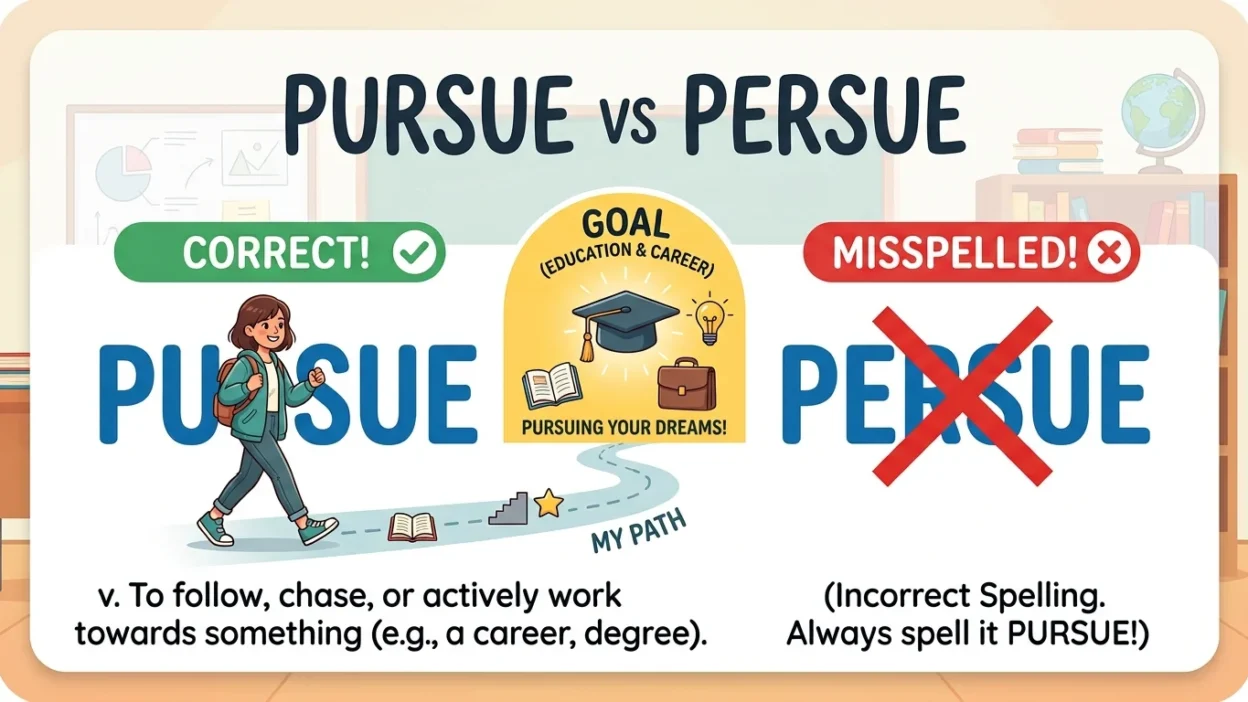
“Pursue” and “persue” are easy to confuse because they look and sound similar. However, pursue is the correct spelling in standard English, while persue is a misspelling.
The word “pursue” can mean to follow someone or something, try to achieve a goal, continue an activity, or work toward something you want. For example, “She decided to pursue a career in medicine” means she decided to work toward that career.
“Persue” is not a standard English word. If you are writing an email, essay, application, report, or any other formal or informal text, use pursue. The confusion often happens because of the pronunciation and because English contains several words that begin with “per.” Learning the correct spelling and connecting “pursue” with its meanings can help you avoid this common spelling mistake.
Quick Answer
Pursue is the correct spelling. Persue is a misspelling and should not be used in standard English. “Pursue” can mean to follow, chase, seek, or work toward something. For example, “He wants to pursue his dream” means he wants to work toward achieving his dream.
Why Do People Confuse “Pursue” and “Persue”?
The main reason for the confusion is pronunciation.
“Pursue” is pronounced roughly like per SOO, which can make some people think it should be spelled “persue.”
However, the correct spelling is:
Pursue
The second letter is u, not e.
A useful way to remember it is to connect “pursue” with words such as:
pursuit
pursuing
pursued
These forms all keep the u after the “p.”
What Does “Pursue” Mean?
Pursue is a verb with several related meanings.
It can mean:
• To follow or chase someone or something
• To try to achieve a goal
• To seek something
• To continue an activity
• To work toward a career or ambition
For example:
The police pursued the suspect.
Here, “pursued” means followed or chased.
Another example:
She wants to pursue a career in teaching.
Here, “pursue” means to work toward or seek a particular career.
What Does “Persue” Mean?
Persue is not a standard English word.
It is simply a common misspelling of pursue.
Incorrect:
He wants to persue his dreams.
Correct:
He wants to pursue his dreams.
If you see “persue” in ordinary English writing, it is almost certainly intended to be “pursue.”
Pursue vs Persue
| Word | Status | Meaning |
|---|---|---|
| Pursue | Correct | To follow, seek, chase, or work toward something |
| Persue | Incorrect | Misspelling of pursue |
How to Use “Pursue”
“Pursue” is commonly used when talking about goals, careers, education, interests, opportunities, and things someone wants to achieve.
It can also be used when talking about physically following or chasing someone or something.
Pursue a Goal
She is pursuing her goal of becoming a writer.
This means she is actively working toward that goal.
Pursue a Career
He decided to pursue a career in engineering.
This means he chose to work toward a career in engineering.
Pursue an Interest
She wants to pursue her interest in photography.
This means she wants to continue developing that interest.
Pursue a Dream
They are pursuing their dream of opening a restaurant.
This means they are working toward making their dream happen.
Pursue Someone
The police pursued the suspect.
Here, “pursued” means followed or chased.
12 Examples of “Pursue”
1. She decided to pursue a career in medicine.
She decided to work toward a medical career.
2. He wants to pursue his dream of becoming an author.
He wants to work toward achieving his dream.
3. The company is pursuing new business opportunities.
The company is actively seeking new opportunities.
4. She continued to pursue her education.
She continued working toward her educational goals.
5. The police pursued the speeding car.
The police followed or chased the car.
6. He plans to pursue a degree in computer science.
He plans to study for that degree.
7. They pursued every possible solution.
They tried to find every possible solution.
8. She chose to pursue her passion for music.
She decided to continue developing her interest in music.
9. The athlete pursued the championship for many years.
The athlete worked toward winning the championship.
10. He is pursuing a better future for his family.
He is actively working toward a better future.
11. The researchers pursued a new approach to the problem.
They explored and worked toward a new approach.
12. She refused to give up and continued to pursue her goal.
She continued working toward her goal despite difficulties.
Pursue vs Follow vs Chase
These words can have similar meanings, but they are not always interchangeable.
| Word | Main Meaning | Example |
|---|---|---|
| Pursue | Follow, seek, or work toward something | She pursued her dream. |
| Follow | Go after or move behind someone or something | The child followed his mother. |
| Chase | Run after someone or something to catch them | The dog chased the ball. |
“Pursue” is especially useful when talking about goals, ambitions, careers, and opportunities.
For example:
She pursued a career in law.
You would not normally say:
She chased a career in law.
Although “chase” can sometimes be used figuratively, “pursue” is more natural in this context.
Pursue vs Persue in Different Forms
One helpful way to remember the spelling is to look at its other forms.
| Form | Correct Spelling |
|---|---|
| Base form | Pursue |
| Third person | Pursues |
| Past tense | Pursued |
| Present participle | Pursuing |
| Noun | Pursuit |
Notice that all of these forms are connected to pursue and pursuit.
The incorrect form “persue” does not become correct in any of these forms.
Common Mistakes
Mistake 1: Writing “persue”
Incorrect:
I want to persue my dreams.
Correct:
I want to pursue my dreams.
Mistake 2: Forgetting the “u”
The correct spelling contains u:
Pursue
A useful visual reminder is:
P U R S U E
Mistake 3: Confusing “pursue” with “peruse”
“Pursue” and “peruse” are completely different words.
Pursue means to follow, seek, or work toward something.
Peruse means to read or examine something carefully, although it can also mean to read through something in a more general sense in modern usage.
For example:
She pursued a new career.
She perused the document.
Mistake 4: Assuming “persue” is an alternative spelling
It is not.
“Persue” is simply a misspelling of “pursue.”
Memory Trick
Remember:
Pursue has U.
You can connect the word with:
Pursue your dreams.
Pursue your goals.
Pursue your career.
Think:
U pursue your goals.
The unusual memory sentence can help you remember that “pursue” contains u after the “p.”
Another useful connection is:
Pursue → Pursuit
Both words contain the same pursu spelling.
American vs British English
There is no spelling difference between American English and British English for pursue.
Both varieties use:
pursue
pursues
pursued
pursuing
pursuit
“Persue” is not the standard spelling in either variety.
Similar Words
Seek
“Seek” means to try to find or obtain something.
She is seeking a new job.
Follow
“Follow” means to go after someone or something.
The dog followed its owner.
Chase
“Chase” means to run after someone or something in an attempt to catch them.
The children chased the ball.
Aim For
“Aim for” means to try to achieve something.
She is aiming for a promotion.
Strive For
“Strive for” means to make a strong effort to achieve something.
He strives for excellence.
Pursue vs Peruse
This is another common word confusion.
| Word | Meaning | Example |
|---|---|---|
| Pursue | Follow, seek, or work toward something | She pursued her dream. |
| Peruse | Read or examine something | He perused the report. |
Remember:
Pursue = go after
Peruse = read or examine
Do not use “peruse” when you mean “pursue.”
Final Verdict
Pursue is the correct spelling.
Persue is a misspelling and is not a standard English word.
Use pursue when you mean to follow, chase, seek, or work toward something.
Examples include:
Pursue a career
Pursue a dream
Pursue a goal
Pursue an opportunity
Pursue a suspect
The easiest spelling rule is:
Pursue has U.
Frequently Asked Questions
Is it pursue or persue?
The correct spelling is pursue. “Persue” is a misspelling.
What does pursue mean?
“Pursue” means to follow, chase, seek, or work toward something.
Is persue a word?
No. “Persue” is not a standard English word. It is a misspelling of “pursue.”
How do you spell pursue?
It is spelled:
P U R S U E
What is an example of pursue?
She wants to pursue a career in medicine.
Here, “pursue” means to work toward or seek a particular career.
What is the noun form of pursue?
The noun form is pursuit.
For example:
The pursuit of knowledge can be rewarding.
Is pursue the same in American and British English?
Yes. The spelling and basic meanings are the same in both varieties.
What is the difference between pursue and peruse?
“Pursue” means to follow, seek, or work toward something. “Peruse” means to read or examine something.
Remember This
The correct spelling is:
Pursue
Not:
Persue
Remember:
Pursue your dreams.
Pursue your goals.
Pursue your career.
The key spelling clue is the u:
P U R S U E
If you are talking about following, seeking, chasing, or working toward something, use pursue.
Conclusion
“Pursue” is the correct spelling, while “persue” is a common spelling mistake. The word “pursue” can mean to follow or chase someone, but it is also frequently used for goals, dreams, careers, education, interests, and opportunities. For example, someone can pursue a degree, pursue a career, or pursue a dream.
The easiest way to remember the spelling is to connect “pursue” with “pursuit.” Both contain the important u spelling. Whenever you mean to follow, seek, chase, or work toward something, choose pursue, not “persue.”

Charles Kevin is a passionate language writer and researcher at SimileHive, creating clear, engaging content about similes, idioms, metaphors, and figurative language to help readers improve English communication confidently every day.