
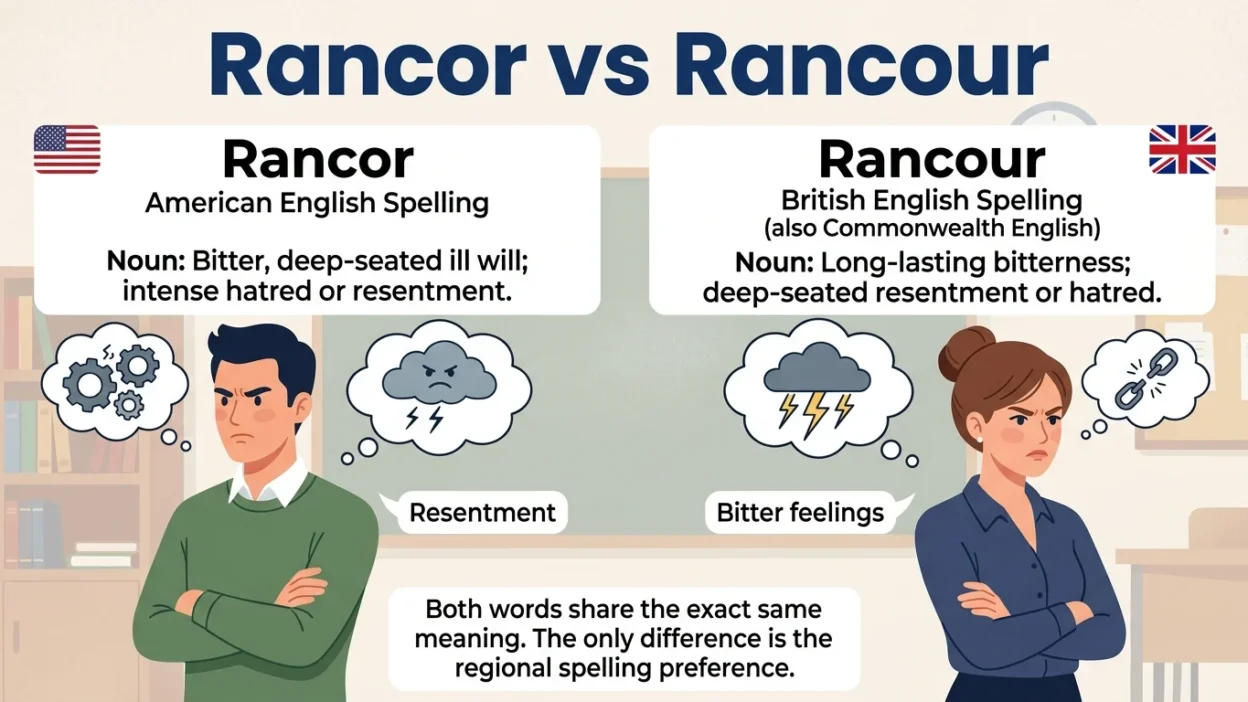
If you are wondering whether the correct spelling is rancor or rancour, the answer is that both are correct. They have exactly the same meaning and pronunciation.
The difference is mainly based on regional spelling. Rancor is the standard spelling in American English, while rancour is the traditional spelling used in British English and several other varieties of English.
Both words mean deep and lasting bitterness, resentment, or anger toward someone. The word is usually used when negative feelings continue for a long time after a disagreement, conflict, or personal injury.
For example, “He left the company without rancor” means that he left without feeling lasting bitterness or resentment. Once you understand the regional spelling difference, choosing between “rancor” and “rancour” becomes simple.
Quick Answer
Rancor and rancour are both correct spellings of the same word. Rancor is preferred in American English, while rancour is preferred in British English and many other varieties. Both mean deep, lasting resentment, bitterness, or hostility.
Why Do People Confuse “Rancor” and “Rancour”?
The confusion comes from the final spelling.
The American form is:
rancor
The British form is:
rancour
The only difference is the letter u.
This is similar to other spelling differences between American and British English, such as:
color / colour
honor / honour
favor / favour
behavior / behaviour
In the same way:
rancor / rancour
The meaning does not change.
What Does “Rancor” Mean?
Rancor means a deep and continuing feeling of anger, bitterness, or resentment toward someone.
For example:
She still felt rancor toward her former business partner.
This means she continued to feel strong bitterness or resentment toward that person.
Rancor usually suggests that the negative feeling has lasted for some time.
What Does “Rancour” Mean?
Rancour has exactly the same meaning as rancor.
It refers to deep or lasting bitterness, resentment, or hostility.
For example:
There was no rancour between the two former colleagues.
This means there was no lasting bitterness or hostility between them.
The spelling rancour is especially common in British English.
Rancor vs Rancour
| Word | Meaning | Main Usage |
|---|---|---|
| Rancor | Deep or lasting resentment | American English |
| Rancour | Deep or lasting resentment | British English and other varieties |
| Meaning | The same | No difference |
| Pronunciation | The same | No difference |
| Spelling | Different | Regional variation |
The most important point is:
Rancor and rancour mean exactly the same thing.
When to Use “Rancor”
Use rancor when following American English spelling conventions.
For example:
He spoke without rancor.
Years of rancor damaged their relationship.
She felt no rancor after the disagreement.
If your audience, school, workplace, or publication follows American English, rancor is the natural spelling.
When to Use “Rancour”
Use rancour when following British English spelling conventions.
For example:
He spoke without rancour.
Years of rancour damaged their relationship.
There was no rancour between the former rivals.
If you are writing for a British English audience, rancour is generally the preferred spelling.
12 Examples of “Rancor” and “Rancour”
1. He left the company without rancor.
He left without lasting bitterness or resentment.
2. She still felt rancor toward her former friend.
She continued to feel deep resentment toward that person.
3. The two families eventually settled their differences without rancor.
They resolved their disagreement without continuing bitterness.
4. Years of rancor had damaged their relationship.
Their long lasting resentment had harmed their relationship.
5. He spoke about his former rival without rancor.
He discussed the rival without showing bitterness.
6. There was no rancour between the two former colleagues.
The former colleagues did not have lasting resentment toward each other.
7. She decided to forgive him and let go of her rancour.
She chose to stop holding onto her bitterness.
8. The dispute created considerable rancor within the organization.
The disagreement caused strong resentment among people in the organization.
9. They managed to disagree without rancour.
They had different opinions without developing lasting bitterness.
10. His criticism was expressed without rancor.
His criticism did not come from personal bitterness.
11. The old rancour slowly disappeared.
The long standing resentment gradually went away.
12. The disagreement ended without rancor.
The disagreement was resolved without continuing hostility.
Two Useful Comparison Tables
| Expression | Meaning | Example |
|---|---|---|
| Rancor | Deep resentment | He spoke without rancor. |
| Rancour | Deep resentment | He spoke without rancour. |
| Resentment | Bitter feeling caused by perceived unfairness | She felt resentment toward her colleague. |
| Bitterness | Strong negative feeling | Years of bitterness affected their relationship. |
| Hostility | Unfriendly or aggressive attitude | There was open hostility between them. |
Another useful comparison:
| Situation | Natural Word |
|---|---|
| American English | Rancor |
| British English | Rancour |
| Canadian English | Both may appear depending on style |
| Formal writing | Follow the spelling system used by your audience |
| Same meaning | Rancor and rancour |
Common Mistakes
Mistake 1: Thinking one spelling is always wrong
Neither spelling is wrong.
Rancor is correct.
Rancour is also correct.
The difference is primarily regional.
Mistake 2: Thinking the meaning changes
The meaning does not change.
Both words mean deep or lasting resentment, bitterness, or hostility.
Mistake 3: Using “rancour” in American English without considering style
“Rancour” can be understood by American readers, but rancor is the standard American spelling.
Mistake 4: Assuming “rancor” is incorrect in British English
British English generally prefers rancour, but “rancor” may still be understood and can appear in contexts influenced by American spelling.
Mistake 5: Pronouncing them differently
The two spellings generally have the same pronunciation.
The extra u in “rancour” does not create a different meaning.
Memory Trick
Think of the familiar pair:
color = American
colour = British
Now apply the same idea:
rancor = American
rancour = British
The extra u is the clue.
So remember:
American: rancor
British: rancour
American vs British English
This is mainly a spelling difference between American and British English.
American English generally uses:
rancor
British English generally uses:
rancour
For example:
American English:
He spoke without rancor.
British English:
He spoke without rancour.
The meaning, pronunciation, grammatical function, and usage are essentially the same.
Other similar spelling patterns include:
color / colour
honor / honour
favor / favour
neighbor / neighbour
rumor / rumour
Rancor vs Resentment
Although rancor and resentment are related, they are not always interchangeable.
Resentment is a feeling of anger or displeasure, often because someone believes they have been treated unfairly.
Rancor usually suggests a deeper and more lasting bitterness or hostility.
Compare:
She felt resentment after being ignored.
Years of rancor remained between the two families.
The second sentence suggests a stronger and more persistent negative feeling.
Rancor vs Bitterness
Bitterness is a general word for a strong negative emotional attitude.
Rancor often suggests deep, continuing resentment toward another person or group.
For example:
He spoke with bitterness about his experience.
He spoke with rancor about his former employer.
Both describe negative feelings, but “rancor” often carries a stronger sense of lasting hostility or resentment.
Is Rancor a Noun?
Yes.
Rancor and rancour are nouns.
They are generally used as uncountable nouns.
For example:
There was considerable rancor between them.
He spoke without rancor.
You would not normally say:
a rancor
when using the word in its ordinary meaning.
Is “Rancor” Formal?
Yes, rancor is generally considered a relatively formal or literary word.
In everyday conversation, people may be more likely to say:
anger
resentment
bitterness
hostility
For example:
More formal:
There was considerable rancor between the two groups.
More everyday:
There was a lot of resentment between the two groups.
Final Verdict
Rancor and rancour are both correct spellings of the same word.
Use rancor in American English.
Use rancour in British English and other varieties that follow British spelling conventions.
Both mean deep, lasting resentment, bitterness, or hostility.
The easiest rule is:
American English = rancor
British English = rancour
Frequently Asked Questions
Is it rancor or rancour?
Both are correct. Rancor is the standard American spelling, while rancour is the standard British spelling.
What does rancor mean?
Rancor means deep and lasting resentment, bitterness, or hostility toward someone.
What does rancour mean?
Rancour has exactly the same meaning as rancor. It is the spelling commonly used in British English.
Is rancour British or American?
Rancour is generally the British spelling. Rancor is generally the American spelling.
Is rancor a noun?
Yes. Rancor is a noun referring to deep or lasting resentment or bitterness.
Is rancor a formal word?
Yes. Rancor is relatively formal and is more common in serious, literary, journalistic, or formal contexts than in casual conversation.
Can rancor and resentment be used interchangeably?
Sometimes, but not always. Rancor usually suggests deeper or more lasting bitterness, while resentment is a broader term for a feeling of displeasure or anger.
How do you remember rancor vs rancour?
Remember the spelling pair color and colour. American English uses rancor, while British English uses rancour.
Remember This
Rancor = American English
Rancour = British English
Both mean:
Deep and lasting resentment or bitterness.
Remember:
• Both spellings are correct.
• The meaning is the same.
• The pronunciation is generally the same.
• Rancor is preferred in American English.
• Rancour is preferred in British English.
• Both words are nouns.
• The word usually describes strong and lasting negative feelings.
Conclusion
The difference between rancor and rancour is simply a matter of spelling preference. Both words have the same meaning and pronunciation, and both describe deep, lasting resentment, bitterness, or hostility. The main distinction is regional: American English generally uses rancor, while British English generally uses rancour.
If you are writing for an American audience, choose rancor. If you are following British English spelling, choose rancour. There is no difference in meaning between them, so the important thing is to follow the spelling convention used by your audience and remain consistent throughout your writing.

Charles Kevin is a passionate language writer and researcher at SimileHive, creating clear, engaging content about similes, idioms, metaphors, and figurative language to help readers improve English communication confidently every day.