
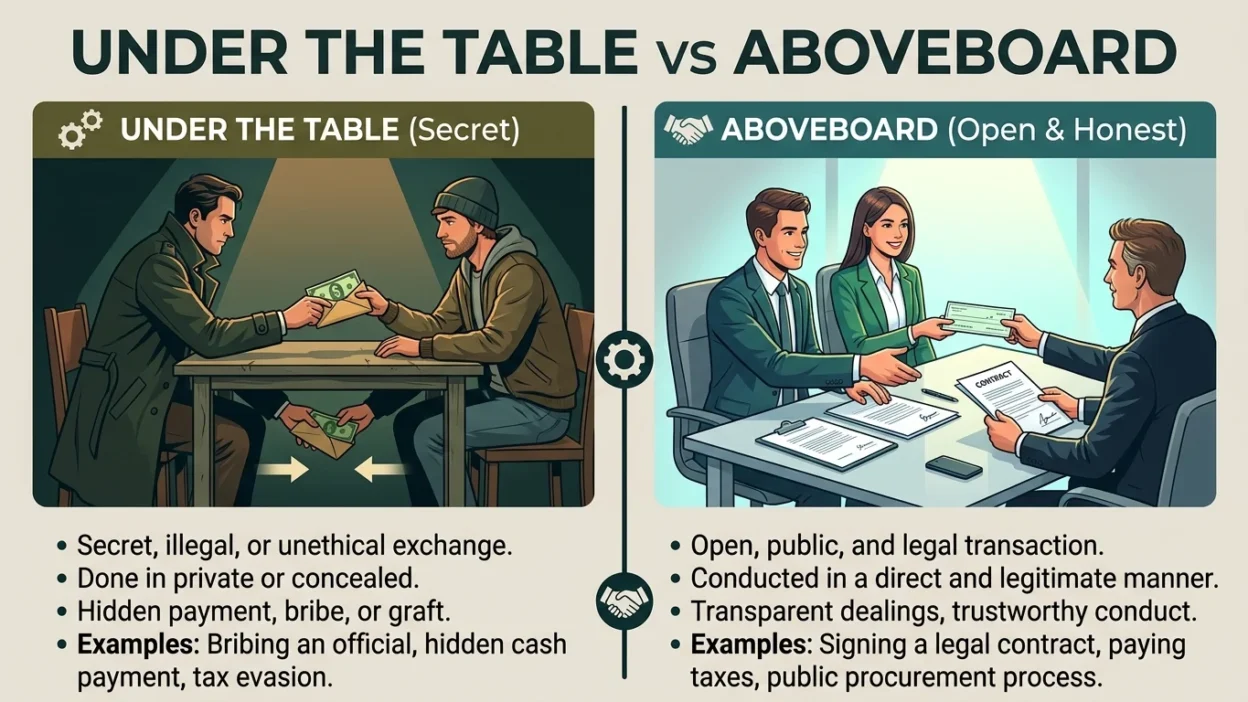
The phrase “under the table” is an idiom that usually means something is done secretly, unofficially, or illegally, especially when money or payments are involved. For example, if someone is paid “under the table,” the payment is made secretly and is often not reported to the government or employer. The phrase can also have a literal meaning when something is physically located beneath a table.
The meaning depends on the context. In everyday conversation, “under the table” is often connected with secret payments, unreported work, hidden deals, or activities that are not officially recorded. Understanding this expression can help you recognize it in conversations, movies, news stories, books, and workplace situations. It is an informal phrase, so it is usually better suited to casual speech than formal writing.
Quick Answer
“Under the table” usually means something is done secretly, unofficially, or without being officially recorded. It is especially common when talking about money or employment. For example, “He was paid under the table” means he received money secretly, often without the payment being officially reported.
Why Do People Confuse “Under the Table”?
The phrase can be confusing because it has both a literal meaning and a figurative meaning.
The literal meaning is simple:
The shoes are under the table.
Here, the shoes are physically beneath the table.
But in:
He was paid under the table.
the phrase is not about the physical location of the money.
It means the payment was made secretly or unofficially.
This figurative use is the meaning people usually want to understand when they ask about the idiom.
What Does “Under the Table” Mean?
When used as an idiom, “under the table” means something is done secretly, unofficially, or outside normal official procedures.
It is especially common with:
Money
Payments
Employment
Business deals
Transactions
For example:
They paid the workers under the table.
This suggests that the workers received money secretly and that the payments were not properly recorded or reported.
The expression can sometimes suggest that the activity is dishonest or illegal, depending on the context.
Is “Under the Table” an Idiom?
Yes.
When “under the table” means secretly or unofficially, it is an idiomatic expression.
The literal words do not explain the figurative meaning.
For example:
The cat is under the table.
This is literal.
They made an under the table payment.
This is figurative.
The second sentence refers to a secret or unofficial payment, not a payment physically located beneath a table.
Under the Table Meaning in Simple English
The easiest way to understand the idiom is:
Under the table = secretly or unofficially
When money is involved, it often means the money is paid without being properly recorded or reported.
For example:
He works under the table.
This usually means he works unofficially and receives payment that is not properly reported.
Under the Table vs Aboveboard
“Under the table” is often contrasted with “aboveboard.”
| Expression | Meaning | Example |
|---|---|---|
| Under the table | Secret, unofficial, or improperly recorded | They made an under the table payment. |
| Aboveboard | Open, honest, and legal | The business keeps all its transactions aboveboard. |
These expressions represent very different ways of handling an activity or transaction.
When to Use “Under the Table”
Use “under the table” when talking about something that is:
• Secret
• Unofficial
• Not properly recorded
• Hidden from authorities or other people
• Sometimes dishonest or illegal
It is especially common in discussions about money and employment.
For example:
He was working under the table.
They offered her an under the table payment.
The company was accused of making under the table deals.
Because the expression can suggest wrongdoing, use it carefully when describing real people or businesses.
12 Examples of “Under the Table”
1. He was paid under the table for the extra work.
This means he received the money secretly or unofficially.
2. She found a job that paid her under the table.
The job paid her unofficially, without properly recording the payments.
3. They offered him an under the table deal.
The deal was secret or unofficial.
4. The contractor was accused of accepting under the table payments.
The contractor was accused of receiving secret or improperly recorded money.
5. Some workers prefer not to work under the table.
They may prefer official employment with proper records and documentation.
6. The company refused to make any under the table payments.
The company did not want to make secret or unofficial payments.
7. He earned extra money under the table.
The phrase suggests that the additional income was earned unofficially.
8. The politician was accused of accepting under the table money.
The phrase suggests secret money that was not properly disclosed.
9. They arranged an under the table agreement.
The agreement was made secretly or unofficially.
10. The restaurant hired several workers under the table.
The workers were employed unofficially rather than through normal employment procedures.
11. We should keep the transaction completely aboveboard instead of doing anything under the table.
The speaker wants the transaction to be open and properly handled.
12. He does some repair work under the table to earn extra cash.
This means he does unofficial work and receives payment that may not be formally recorded.
Two Useful Comparison Tables
| Phrase | Meaning | Example |
|---|---|---|
| Under the table | Secret or unofficial | He was paid under the table. |
| Secretly | Without other people knowing | They secretly discussed the deal. |
| Off the books | Not officially recorded | The worker was paid off the books. |
| Aboveboard | Open and honest | The transaction was completely aboveboard. |
| Officially | Through proper procedures | She was officially hired by the company. |
Another useful comparison:
| Situation | Natural Expression |
|---|---|
| Secret payment | Under the table |
| Unreported work | Under the table |
| Official employment | Officially employed |
| Properly recorded payment | Official payment |
| Open and honest business | Aboveboard |
| Not recorded in official accounts | Off the books |
Common Mistakes
Mistake 1: Taking the idiom literally
If someone says:
He was paid under the table.
they usually do not mean the money was physically placed beneath a table.
The phrase means the payment was made secretly or unofficially.
Mistake 2: Thinking it always means something illegal
“Under the table” often suggests improper or illegal activity, especially with money, but the exact meaning depends on context.
The phrase can describe something unofficial without the speaker explaining the exact legal situation.
Mistake 3: Using it for every secret activity
“Under the table” is particularly common for unofficial transactions, payments, employment, and deals.
For ordinary secret information, words such as secretly, privately, or confidentially may be more natural.
Mistake 4: Confusing it with “under the radar”
These expressions are related but not identical.
Under the table often involves secret or unofficial transactions.
Under the radar means avoiding attention or detection.
For example:
He was paid under the table.
The company operated under the radar for several months.
Memory Trick
Imagine someone secretly passing money beneath a table so nobody else can see it.
That picture can help you remember:
Under the table = secretly or unofficially
Another easy memory trick is:
Under the table = hidden
Aboveboard = open
These two expressions are often opposites in meaning.
American vs British English
“Under the table” is widely understood in both American English and British English.
The expression is commonly used when discussing secret or unofficial payments, employment, or business activities.
Another expression you may hear is “off the books.”
For example:
He was paid under the table.
He was paid off the books.
Both can suggest that the payment was not properly recorded.
In British English, “cash in hand” can also be used in some contexts to describe payment made directly in cash. However, “cash in hand” does not automatically mean the payment is illegal or unreported. Context matters.
Similar Expressions
Off the Books
“Off the books” means something is not included in official financial or employment records.
The payments were kept off the books.
Cash in Hand
This means payment is given directly in cash.
The worker was paid cash in hand.
This expression does not automatically mean the payment is secret or illegal.
Under the Radar
This means something happens without attracting attention.
The business operated under the radar.
On the Side
This can mean doing additional work or earning extra money outside one’s main activity.
He does repair work on the side.
Aboveboard
This means open, honest, and proper.
All our business dealings are aboveboard.
Under the Table vs Off the Books
These expressions are closely related, but they are not exactly identical.
Under the table emphasizes secrecy or unofficial activity.
Off the books emphasizes that something is not included in official records.
For example:
He was paid under the table.
This focuses on the secret or unofficial nature of the payment.
The payments were kept off the books.
This focuses on the fact that the payments were not recorded officially.
Is “Under the Table” Always About Money?
No.
Money is one of the most common contexts, but the phrase can also describe secret or unofficial deals and arrangements.
For example:
They reached an under the table agreement.
Here, the phrase describes a secret agreement rather than a specific payment.
However, money and employment are especially common contexts.
Can “Under the Table” Be Used Literally?
Yes.
The phrase can have a completely literal meaning.
For example:
The children were hiding under the table.
Here, “under the table” simply means physically beneath the table.
The figurative meaning appears when the phrase describes something secret or unofficial.
Compare:
The dog is sleeping under the table.
Literal meaning.
The worker was paid under the table.
Figurative meaning.
Final Verdict
“Under the table” is a common idiom meaning secretly, unofficially, or without proper official recording.
It is especially common when talking about payments, employment, business deals, and financial transactions.
Remember that the phrase can also have a literal meaning when something is physically beneath a table.
The easiest rule is:
Under the table = hidden or unofficial
Aboveboard = open and proper
Frequently Asked Questions
What does “under the table” mean?
“Under the table” usually means secretly or unofficially. It is especially common when discussing payments, employment, and business transactions.
What does “paid under the table” mean?
“Paid under the table” means someone receives money secretly or unofficially, often without the payment being properly recorded or reported.
Is “under the table” an idiom?
Yes. When it means secretly or unofficially, “under the table” is an idiomatic expression.
Does “under the table” mean illegal?
It can suggest illegal or improper activity, especially when discussing unreported money or employment, but the exact legal meaning depends on the situation.
What is another word for “under the table”?
Depending on the context, alternatives include secretly, unofficially, off the books, or covertly.
What is the opposite of “under the table”?
A common opposite is aboveboard, which means open, honest, and proper.
Is “under the table” formal English?
It is a common informal expression. In formal writing, phrases such as unofficially, without proper documentation, or without being formally recorded may be clearer.
Is “under the table” always about money?
No. It can describe secret or unofficial agreements and arrangements, although money and employment are especially common contexts.
Remember This
Under the table = secretly or unofficially.
It is often used for:
• Secret payments
• Unofficial employment
• Hidden business deals
• Unrecorded transactions
• Activities kept outside official procedures
Remember the contrast:
Under the table = hidden
Aboveboard = open
Also remember that the phrase can be literal:
The shoes are under the table.
But when it describes a payment or deal:
They paid him under the table.
the meaning is figurative.
Conclusion
The phrase “under the table” is a useful English idiom that usually describes something secret, unofficial, or not properly recorded. It is especially common when people talk about money, employment, business transactions, or private deals.
For example, someone who is “paid under the table” receives money unofficially, often without the payment being properly recorded or reported.
The phrase can also be used literally when something is physically beneath a table, so context is important. In figurative use, it often carries a suggestion of something improper or hidden.
If you want to describe an open and honest activity, “aboveboard” is a useful contrasting expression. Remember the simple rule: under the table means hidden or unofficial, while aboveboard means open and proper.

Adam Aaron is a language enthusiast and content writer at SimileHive, creating clear, engaging guides on similes, idioms, metaphors, and figurative language to help readers improve English confidently every day.