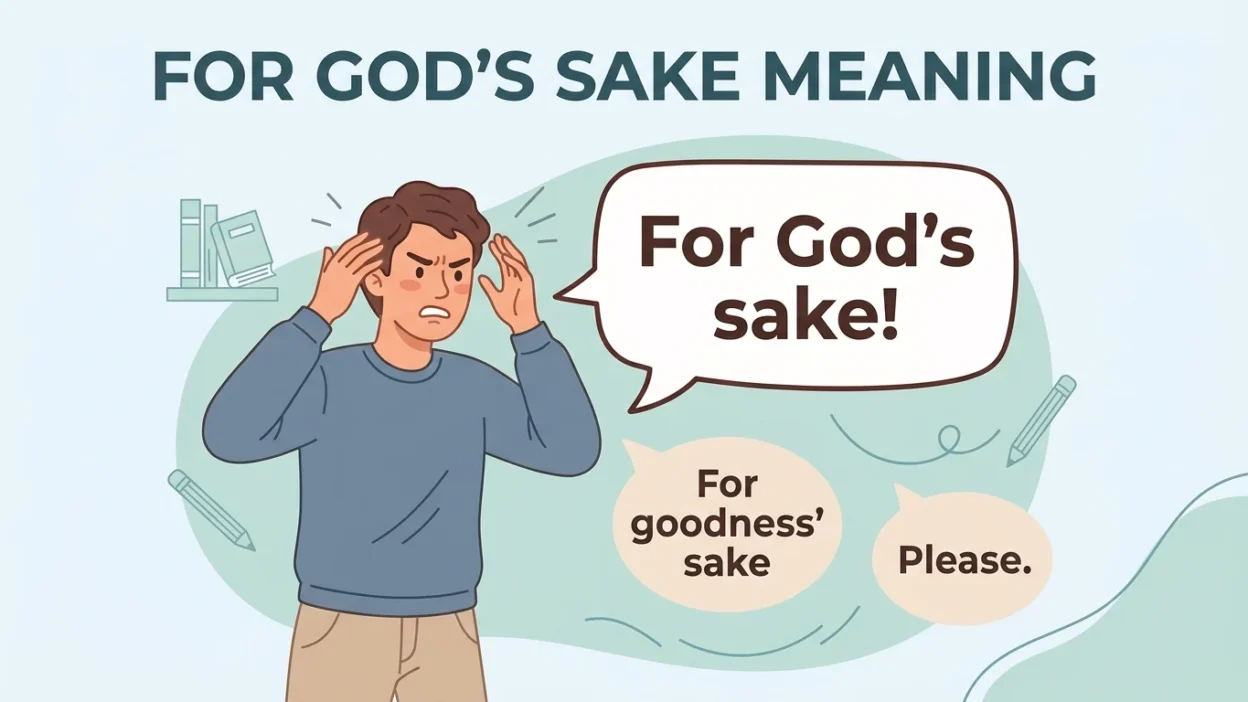
“For God’s sake” is an English expression used to show strong emotion, especially annoyance, frustration, surprise, impatience, or urgency. For example, if someone says, “For God’s sake, be careful!” they are strongly asking another person to be careful. The phrase does not usually refer literally to God. Instead, it is commonly used as an emotional expression.
The phrase can sound quite strong, so it is important to understand the situation before using it. Some people use it casually in everyday conversation, while others may avoid it because it contains a reference to God and can sound disrespectful or inappropriate in certain settings. Similar expressions include “for goodness’ sake,” “for heaven’s sake,” and “please.” The exact tone depends on the speaker’s voice and the situation.
Quick Answer
“For God’s sake” is an expression used to show strong emotion such as frustration, annoyance, impatience, surprise, or urgency. It usually means something like “please” or “I am very frustrated”, depending on context. For example, “For God’s sake, stop shouting!” expresses strong frustration.
Why Do People Say “For God’s Sake”?
People use “for God’s sake” when ordinary words do not seem strong enough to express their feelings.
For example:
Please stop making that noise.
This is a normal request.
But:
For God’s sake, stop making that noise!
This sounds much more emotional and frustrated.
The expression adds emphasis to what the speaker is saying.
It can express:
• Frustration
• Annoyance
• Impatience
• Urgency
• Surprise
• Exasperation
The exact emotion depends on the context and tone of voice.
What Does “For God’s Sake” Mean?
The phrase “for God’s sake” does not usually have a literal meaning in everyday conversation.
It is an idiomatic expression used to emphasize a statement or request.
For example:
For God’s sake, be careful!
The speaker is strongly telling someone to be careful.
Another example:
For God’s sake, I told you yesterday!
The speaker is expressing frustration because they believe they have already explained something.
In simple English, the expression can often be understood as:
Please!
Come on!
I am very frustrated!
Pay attention!
However, these are not exact replacements in every situation.
Is “For God’s Sake” an Idiom?
Yes.
When used to express emotion, “for God’s sake” is an idiomatic expression.
The words do not normally refer to a literal action done for God’s benefit.
For example:
For God’s sake, hurry up!
The speaker is not literally asking someone to hurry for God’s benefit.
The phrase adds emotional force to the request.
Is “For God’s Sake” Offensive?
It can be considered offensive or inappropriate by some people, especially in religious or formal contexts.
The phrase contains a direct reference to God, so some speakers may consider it disrespectful, particularly when used as an angry exclamation.
However, many English speakers use it as a common idiomatic expression without intending a religious meaning.
Whether it sounds offensive depends on:
• The speaker
• The listener
• The culture
• The situation
• The speaker’s tone
If you want a softer alternative, you can say:
For goodness’ sake
For heaven’s sake
Please
Come on
When to Use “For God’s Sake”
You can use “for God’s sake” in informal situations when you want to express strong emotion.
For example, you might use it when:
• You are frustrated
• You are impatient
• You want someone to act quickly
• You are surprised
• You strongly want someone to stop doing something
• You are emphasizing an important request
It is usually better to avoid the phrase in formal writing, professional communication, or situations where religious language may be sensitive.
12 Examples of “For God’s Sake”
1. For God’s sake, be careful!
The speaker is strongly warning someone to be careful.
2. For God’s sake, stop shouting!
The speaker is very frustrated by the shouting.
3. For God’s sake, hurry up!
The speaker wants someone to move faster and sounds impatient.
4. For God’s sake, listen to me!
The speaker strongly wants the other person to pay attention.
5. For God’s sake, don’t touch that!
The speaker is giving a strong warning.
6. For God’s sake, what are you doing?
The speaker is surprised, frustrated, or angry about someone’s actions.
7. For God’s sake, give me a minute!
The speaker wants the other person to stop rushing them.
8. For God’s sake, we have to leave now!
The speaker is emphasizing urgency.
9. For God’s sake, I already explained this!
The speaker is frustrated because they believe they have already given the explanation.
10. For God’s sake, don’t forget your keys!
The speaker strongly emphasizes the warning.
11. For God’s sake, can everyone just be quiet?
The speaker is very frustrated by the noise.
12. For God’s sake, look where you’re going!
The speaker is strongly warning someone to pay attention.
Two Useful Comparison Tables
| Expression | Main Meaning | Strength |
|---|---|---|
| For God’s sake | Strong emotion or frustration | Strong |
| For goodness’ sake | Strong emotion or frustration | Moderate |
| For heaven’s sake | Strong emotion or impatience | Moderate |
| Please | Polite request | Mild |
| Come on | Impatience or encouragement | Mild to moderate |
Another useful comparison:
| Situation | Natural Expression |
|---|---|
| Polite request | Please be careful. |
| Mild frustration | Come on, be careful. |
| Strong frustration | For goodness’ sake, be careful. |
| Very strong emotional request | For God’s sake, be careful! |
| Formal situation | Please be careful. |
Common Mistakes
Mistake 1: Taking the phrase literally
In most everyday uses, “for God’s sake” is not a literal statement about doing something for God.
It is an emotional expression.
Mistake 2: Using it in formal situations
The expression can sound emotional, informal, or even rude.
Instead of:
For God’s sake, send me the report today.
a professional email would usually say:
Please send me the report today.
Mistake 3: Thinking it always means anger
The phrase often expresses frustration, but tone and context can change the emotion.
It can also express:
Urgency
Surprise
Impatience
Exasperation
Mistake 4: Assuming everyone finds it acceptable
Some people may be uncomfortable with expressions that use God’s name.
If you are unsure about your audience, a softer expression is safer.
Mistake 5: Confusing “for God’s sake” with “for goodness’ sake”
These expressions are similar, but “for goodness’ sake” is generally softer and avoids a direct religious reference.
Memory Trick
Think:
For God’s sake = strong emotion
Whenever you hear the phrase, look at what comes after it.
For God’s sake, stop!
Strong frustration.
For God’s sake, hurry!
Strong impatience or urgency.
For God’s sake, be careful!
Strong warning.
The phrase makes the sentence more emotional.
American vs British English
“For God’s sake” is widely used in both American English and British English.
There is no major difference in its basic meaning.
However, everyday use can vary between speakers and social groups.
British English also commonly uses expressions such as:
For goodness’ sake
For heaven’s sake
American English speakers also use these alternatives.
The level of acceptability depends more on the speaker, audience, and situation than on the variety of English.
For God’s Sake vs For Goodness’ Sake
These expressions are closely related.
For God’s sake is stronger and directly refers to God.
For goodness’ sake is generally softer and avoids the religious reference.
Compare:
For God’s sake, stop making that noise!
For goodness’ sake, stop making that noise!
Both express frustration, but the first can sound stronger.
For God’s Sake vs For Heaven’s Sake
For heaven’s sake is another similar expression.
Both can express:
• Frustration
• Impatience
• Surprise
• Urgency
For example:
For God’s sake, hurry up!
For heaven’s sake, hurry up!
The meaning is very similar, although individual speakers may feel that one sounds stronger or more natural than the other.
Is “For God’s Sake” a Curse Word?
“For God’s sake” is not normally classified as a traditional swear word in the same way as many vulgar curse words.
However, it is an exclamation that uses a religious reference, and some people may consider it disrespectful or inappropriate.
Its tone can also make it sound rude.
If you want a safer alternative, use:
For goodness’ sake
For heaven’s sake
Please
Come on
Can You Use “For God’s Sake” in Writing?
Yes, but it depends on the type of writing.
It can appear naturally in:
Dialogue
Fiction
Informal messages
Personal writing
For example:
“For God’s sake, what happened?” she asked.
However, it is usually not appropriate for formal business writing or academic writing unless you are directly quoting someone or writing dialogue.
Final Verdict
“For God’s sake” is an informal idiomatic expression used to show strong emotion, especially frustration, annoyance, impatience, urgency, or surprise.
It usually does not have a literal religious meaning in everyday conversation.
The phrase can sound strong, so it should be used carefully. In formal or sensitive situations, expressions such as “please,” “for goodness’ sake,” or “for heaven’s sake” may be more appropriate.
Remember:
For God’s sake = a strong emotional expression
Frequently Asked Questions
What does “for God’s sake” mean?
“For God’s sake” is an expression used to show strong emotion, such as frustration, annoyance, impatience, urgency, or surprise.
Is “for God’s sake” a bad word?
It is not usually considered a traditional swear word, but some people may consider it disrespectful or inappropriate because it uses a reference to God.
Is “for God’s sake” rude?
It can sound rude or aggressive depending on the situation and tone. It is generally better suited to informal situations.
Is “for God’s sake” an idiom?
Yes. It is an idiomatic expression used to emphasize strong feelings rather than a literal request involving God.
What is a polite alternative to “for God’s sake”?
Depending on the context, you can say “please,” “for goodness’ sake,” “for heaven’s sake,” or “come on.”
Can I use “for God’s sake” in a formal email?
It is generally better to avoid it in formal emails because it can sound emotional or inappropriate. Use a direct and polite request instead.
Is “for God’s sake” used in American English?
Yes. It is widely understood and used in American English.
Is “for God’s sake” used in British English?
Yes. It is also widely understood and used in British English.
Remember This
For God’s sake = a strong expression of emotion.
It can show:
• Frustration
• Annoyance
• Impatience
• Urgency
• Surprise
• Exasperation
For a softer alternative, remember:
For God’s sake → strong
For goodness’ sake → softer
Please → polite and neutral
Use the expression carefully because some people may consider religious expressions sensitive or inappropriate.
Conclusion
“For God’s sake” is a common English expression used to add strong emotion to a statement or request. It is especially common when someone feels frustrated, impatient, surprised, or strongly concerned about something. In most everyday uses, it is not meant literally. Instead, it works as an emotional expression that gives extra force to the speaker’s words.
The phrase is natural in both American and British English, but it is informal and can sometimes sound rude or disrespectful. This is especially important when speaking with people who may be sensitive about religious language. If you want a softer option, “for goodness’ sake,” “for heaven’s sake,” or simply “please” can work well. Understanding the tone and context will help you use this expression naturally and appropriately.

Charles Kevin is a passionate language writer and researcher at SimileHive, creating clear, engaging content about similes, idioms, metaphors, and figurative language to help readers improve English communication confidently every day.