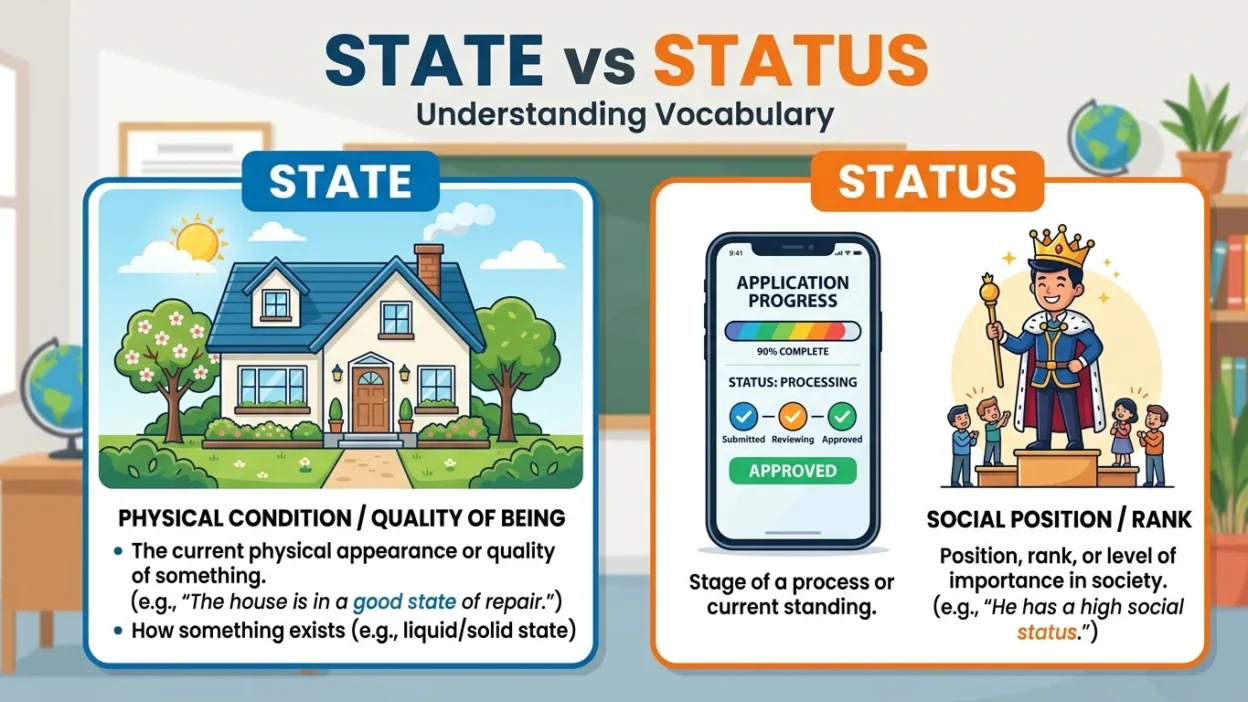
State and status are related words, but they do not always mean the same thing. State usually describes the condition or situation that someone or something is in.
Status usually describes a person’s position, condition, rank, or current situation in a particular context. For example, “The house is in a poor state” describes its condition, while “What is the status of the project?” asks about its current progress.
These two words can sometimes overlap, especially when talking about a current situation or condition. However, they are used differently in many everyday sentences. Understanding the difference between state vs status can help you choose the right word in conversations, emails, academic writing, and professional situations.
In simple terms, think of state as the condition something is in and status as the position or current standing of something or someone.
Quick Answer
State usually means the condition, situation, or form that someone or something is in. Status usually means a person’s position, rank, standing, or current situation. For example, “The car is in good state” describes its condition, while “What is the status of my order?” asks about its current progress.
Why Do People Confuse State and Status?
People often confuse these words because both can describe a current condition or situation.
For example:
The patient is in a stable state.
The patient’s status is stable.
Both sentences can communicate information about the patient’s current condition, although the word choice and context differ.
The main difference becomes clearer when we look at their common uses.
State often focuses on:
• Condition
• Situation
• Form
• Physical or mental condition
• A particular stage of something
Status often focuses on:
• Position
• Rank
• Standing
• Current progress
• Official condition
• Social or professional position
What Does “State” Mean?
State is a noun that commonly means the condition or situation that a person or thing is in at a particular time.
For example:
The building is in a terrible state.
This means the building is in very poor condition.
Another example:
The machine is in working state.
Here, state refers to the condition or condition of operation.
The word state has many other meanings too. It can refer to a political division, a condition of something, or an officially defined situation.
For example:
Texas is a state in the United States.
Here, state has a completely different meaning.
What Does “Status” Mean?
Status is a noun that usually refers to a person’s position, rank, standing, or current situation.
For example:
What is the status of my application?
This asks about the current stage or progress of the application.
Another example:
She has a high social status.
Here, status refers to her position or standing in society.
Status is especially common when discussing:
• Jobs
• Applications
• Orders
• Projects
• Relationships
• Social position
• Legal situations
• Official records
State vs Status at a Glance
| Word | Main Meaning | Common Uses |
|---|---|---|
| State | Condition or situation | Physical condition, situation, form |
| Status | Position, standing, or current situation | Applications, projects, social position, official records |
| State | A particular condition at a given time | State of health, state of repair |
| Status | Current position or progress | Project status, order status |
State vs Status: The Main Difference
The easiest way to understand the difference is:
State = condition
Status = position or current standing
Consider these examples:
The car is in excellent state.
This describes the car’s condition.
What is the status of the car repair?
This asks about the current progress or situation of the repair.
Another example:
The patient is in a critical state.
This describes the patient’s condition.
The patient’s status has changed.
This refers to the patient’s current situation or official condition.
When to Use “State”
Use state when you are talking about the condition or form of something.
Physical condition
The house is in a poor state.
Emotional condition
He was in a confused state.
General condition
The machine is in excellent state.
Situation
The country is in a difficult state.
Form or condition
Water can exist in a solid state.
Here, state means a particular form or condition.
When to Use “Status”
Use status when you are talking about someone’s position, standing, progress, or official situation.
Application progress
What is the status of my application?
Order progress
I checked the status of my order.
Social position
His social status changed after he became famous.
Relationship
What is your relationship status?
Official situation
The case has legal status.
Project progress
Can you give me an update on the project status?
State vs Status in Common Phrases
| With State | With Status |
|---|---|
| State of health | Health status |
| State of mind | Relationship status |
| State of repair | Application status |
| State of emergency | Legal status |
| State of confusion | Social status |
| State of affairs | Project status |
| State of readiness | Order status |
| State of being | Official status |
Some phrases overlap, but the words are not automatically interchangeable.
Two Useful Comparison Tables
| Sentence | Meaning |
|---|---|
| The house is in a poor state. | The house is in poor condition. |
| What is the status of the house sale? | What is happening with the house sale? |
| She was in a nervous state. | She was nervous or emotionally unsettled. |
| What is her employment status? | What is her current employment position? |
| The machine is in good state. | The machine is in good condition. |
| What is the status of the machine repair? | What is the progress of the repair? |
Another useful comparison:
| If You Mean… | Use |
|---|---|
| Condition | State |
| Physical condition | State |
| Emotional condition | State |
| Form or condition | State |
| Current progress | Status |
| Social position | Status |
| Official position | Status |
| Relationship situation | Status |
| Application progress | Status |
| Order progress | Status |
12 Examples of “State”
1. The house is in a terrible state.
This means the house is in very poor condition.
2. She was in a relaxed state.
This means she was relaxed.
3. The car is in excellent state.
This describes the car’s condition.
4. The patient is in a stable state.
This describes the patient’s current condition.
5. The room was left in a messy state.
This means the room was left messy.
6. The country is in a difficult state.
This describes the country’s general situation.
7. The machine is in working state.
This means the machine is functioning.
8. He was in a confused state.
This means he was confused.
9. The building is in a dangerous state.
This means the building is in poor or unsafe condition.
10. The water changed to a solid state.
Here, state refers to a physical form.
11. The garden is in good state after the rain.
This describes the garden’s condition.
12. The company is in a strong financial state.
This describes the company’s financial condition.
12 Examples of “Status”
1. What is the status of my application?
This asks about the current progress of the application.
2. I checked the status of my order.
This asks or tells you where the order currently stands.
3. What is your relationship status?
This asks whether someone is single, married, dating, or in another relationship situation.
4. The project status has changed.
This means the current situation or progress of the project has changed.
5. Her social status increased after the promotion.
This refers to her position or standing.
6. Please check the patient’s status.
This asks for information about the patient’s current situation or condition.
7. The application is still under review according to its status.
This refers to the current stage of the application.
8. His legal status is unclear.
This refers to his official legal position or situation.
9. The website shows the delivery status.
This tells you the current stage of the delivery.
10. The employee’s employment status has changed.
This refers to the employee’s current employment position or classification.
11. We need an update on the project status.
This asks for information about the project’s current progress.
12. The patient’s status improved overnight.
Here, status refers to the patient’s current medical situation.
Can “State” and “Status” Be Interchangeable?
Sometimes, but not always.
For example:
What is the current state of the project?
What is the current status of the project?
Both can be understood, but status is especially common when asking about the progress or current position of a project.
Similarly:
The patient is in a serious state.
The patient’s status is serious.
Both can communicate information about the patient’s condition, although the exact wording and context differ.
The important point is that the two words have overlapping meanings but are not complete synonyms.
Common Mistakes
Mistake 1: Using “status” for every type of condition
Not every condition should be called a status.
Incorrect or unnatural:
The building is in a terrible status.
Better:
The building is in a terrible state.
Mistake 2: Using “state” when talking about progress
When asking about an application, order, or project, status is often the natural choice.
Better:
What is the status of my application?
Mistake 3: Confusing social status with physical condition
Social status refers to a person’s position or standing.
It does not mean their physical condition.
Mistake 4: Forgetting that “state” has other meanings
State can also refer to a political division.
For example:
California is a state in the United States.
This meaning is unrelated to status.
Mistake 5: Thinking the words always replace each other
Although the words overlap in some contexts, replacing one with the other can make a sentence unnatural or change its meaning.
State vs Status Memory Trick
Use this simple memory trick:
State = situation or condition
Status = standing or current position
Think:
State tells you what condition something is in.
Status tells you where something currently stands.
For example:
State of the car = condition of the car
Status of the repair = progress of the repair
This simple distinction works in many everyday situations.
American vs British English
State and status are used in both American English and British English.
There is no major difference in their basic meanings.
Both varieties commonly use expressions such as:
state of mind
state of health
state of affairs
relationship status
employment status
application status
legal status
The exact preference can vary depending on the context, but the distinction between condition and position is broadly useful in both varieties of English.
State vs Condition
State and condition can be very close in meaning.
For example:
The building is in a poor state.
The building is in poor condition.
Both describe the physical condition of the building.
However, state can have a wider range of meanings.
For example:
a solid state
a state of mind
a state of emergency
So, condition is often a good synonym for one meaning of state, but not for every meaning.
Status vs Position
Status and position can also overlap.
For example:
She has a high social status.
She has a high social position.
However, status is often more natural when talking about social standing, official classification, or current standing.
Position can also refer to a job or physical location.
For example:
He applied for a management position.
Here, status would not mean the same thing.
Is “State of Status” Correct?
Usually, no.
State and status can both describe a situation, but they are normally used separately according to their meaning.
For example:
The state of the building is poor.
The status of the project is uncertain.
Using both words together without a specific reason can sound repetitive or unnatural.
Is “Current State” Correct?
Yes.
Current state means the condition or situation something is in now.
For example:
We need to understand the current state of the economy.
It can describe a physical, emotional, social, technical, or general condition depending on the context.
Is “Current Status” Correct?
Yes.
Current status means the present position, situation, progress, or official condition of something.
For example:
Please check the current status of my application.
It is especially common in professional, administrative, technical, and business contexts.
Final Verdict
State and status are related but different words.
Use state when you are mainly talking about a condition, situation, or form.
Use status when you are mainly talking about a position, standing, progress, or official situation.
The easiest way to remember the difference is:
State = condition
Status = current standing or position
For example:
The car is in good state.
This describes its condition.
What is the status of the repair?
This asks about the repair’s current progress.
Frequently Asked Questions
What is the difference between state and status?
State usually refers to a condition or situation, while status usually refers to a position, standing, progress, or official situation.
Is state a synonym for status?
Sometimes they can overlap, especially when describing a current situation. However, they are not complete synonyms and are used differently in many contexts.
What does state mean?
State can mean the condition, situation, or form that someone or something is in. It can also mean a political division, such as a state in the United States.
What does status mean?
Status usually means someone’s or something’s position, standing, classification, or current situation.
Should I say state of the project or status of the project?
Both can be understood, but status of the project is especially natural when you are asking about its current progress or position.
Should I say state of health or health status?
Both expressions are possible. State of health focuses on a person’s condition, while health status can sound more formal and may refer to a person’s current health classification or condition.
What is social state?
“Social state” is not normally the standard expression when talking about someone’s position in society. Social status is the usual phrase.
What is the easiest way to remember state vs status?
Remember:
State = condition
Status = standing or current position
This simple distinction will help you choose the right word in most everyday situations.
Remember This
State = condition, situation, or form
Status = position, standing, progress, or official situation
Examples:
State of mind = mental condition
State of repair = physical condition
Application status = current progress
Social status = social position
Relationship status = current relationship situation
When you are talking about what condition something is in, think of state.
When you are talking about where something currently stands, think of status.
Conclusion
The words state and status are closely related, but they have different common uses. State usually focuses on the condition, situation, or form of someone or something. It appears in expressions such as “state of mind,” “state of health,” and “state of repair.” Status usually focuses on position, standing, progress, or official situation, as in “application status,” “social status,” and “relationship status.”
When you are unsure which word to use, ask yourself what you are describing. If you mean the condition, choose state. If you mean the current position, progress, or standing, choose status. Once you learn this simple distinction, choosing between these two words becomes much easier.

Adam Aaron is a language enthusiast and content writer at SimileHive, creating clear, engaging guides on similes, idioms, metaphors, and figurative language to help readers improve English confidently every day.