The progressive tense, also called the continuous tense, is used to describe an action that is happening over a period of time. It shows that an action is in progress rather than simply stating that it happens or happened.
For example, “She is reading a book” tells us that the reading is happening now. Progressive forms can describe actions happening now, actions that were in progress in the past, actions that will be in progress in the future, and actions that continued for a period before another event.
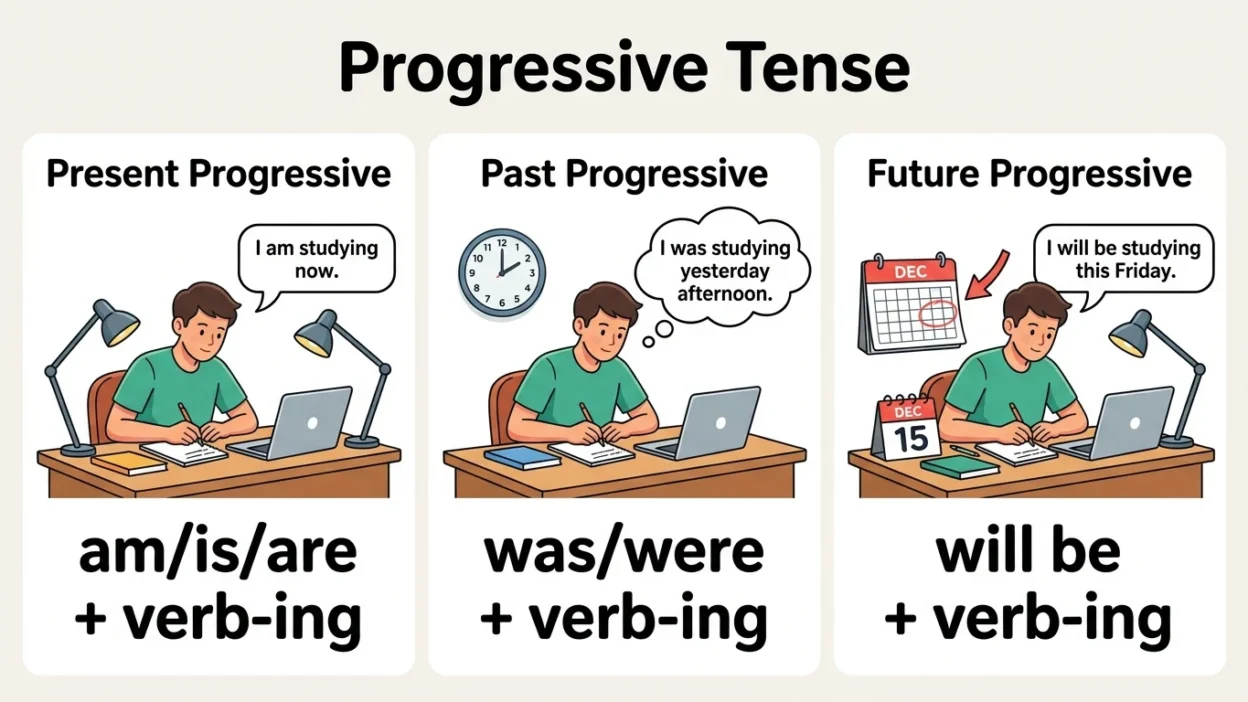
English has three main progressive tenses: present progressive, past progressive, and future progressive. Each one uses a form of the verb be followed by the main verb ending in ing.
Learning this structure makes it much easier to talk about temporary actions, ongoing activities, changing situations, and actions happening around a particular time.
Quick Answer
The progressive tense describes an action that is ongoing or in progress. It is formed with a form of be + verb ending in ing. For example, “I am studying” is present progressive, “I was studying” is past progressive, and “I will be studying” is future progressive.
What Is the Progressive Tense?
The progressive tense is a verb form that shows an action is ongoing.
Compare these sentences:
I study English.
I am studying English.
The first sentence describes a regular activity or general fact.
The second sentence shows that the activity is happening now or around the present time.
The progressive form is especially useful when you want to show that something is happening at a particular moment or during a particular period.
Why Is It Called “Progressive”?
The word progressive refers to something that is continuing or developing.
When you say:
She is cooking.
The action is not presented as a completed event. It is shown as something that is currently in progress.
The progressive tense therefore helps us focus on the process or duration of an action.
Progressive Tense Formula
The basic structure is:
Subject + be + verb ending in ing
The form of be changes according to the tense.
| Tense | Formula | Example |
|---|---|---|
| Present progressive | am, is, are + verb ending in ing | She is working. |
| Past progressive | was, were + verb ending in ing | She was working. |
| Future progressive | will be + verb ending in ing | She will be working. |
The main verb stays in its ing form, while the helping verb changes.
The Three Main Progressive Tenses
English commonly uses three progressive tenses.
1. Present Progressive
The present progressive describes something happening now or around the present time.
I am learning English.
She is watching television.
They are playing football.
2. Past Progressive
The past progressive describes an action that was in progress at a particular time in the past.
I was studying at 8 p.m.
She was cooking when I arrived.
They were playing football when it started raining.
3. Future Progressive
The future progressive describes an action that will be in progress at a particular time in the future.
I will be studying at 8 p.m.
She will be working tomorrow morning.
They will be traveling next week.
Present Progressive Tense
The present progressive, also called the present continuous, is used for actions happening now or around the current period.
Formula
Subject + am/is/are + verb ending in ing
Examples:
I am reading.
He is sleeping.
She is writing.
We are learning.
They are working.
When Do We Use the Present Progressive?
Action happening now
She is talking on the phone.
The action is happening at the moment of speaking.
Temporary situation
I am staying with my uncle this week.
The situation is temporary.
Changing situation
The weather is getting warmer.
The situation is changing over time.
Current activity
He is studying for his exams.
The activity may not be happening at this exact second, but it is part of his current activities.
Future arrangement
The present progressive can also describe a planned future event.
I am meeting my friend tomorrow.
This is a future arrangement even though the verb is in the present progressive.
Past Progressive Tense
The past progressive, also called the past continuous, describes an action that was happening at a particular time in the past.
Formula
Subject + was/were + verb ending in ing
Examples:
I was sleeping.
She was studying.
He was driving.
We were talking.
They were playing.
When Do We Use the Past Progressive?
Action in progress at a specific past time
I was watching television at 9 p.m.
The action was happening at that particular time.
Longer action interrupted by another event
I was sleeping when the phone rang.
The sleeping was already in progress when the phone rang.
Two actions happening at the same time
She was cooking while I was cleaning.
Both actions were happening during the same period.
Background information
The sun was shining, and people were walking through the park.
The progressive tense creates background information in a story.
Future Progressive Tense
The future progressive, also called the future continuous, describes an action that will be in progress at a particular time in the future.
Formula
Subject + will be + verb ending in ing
Examples:
I will be working.
She will be studying.
They will be traveling.
We will be waiting.
When Do We Use the Future Progressive?
Action in progress at a future time
At 10 tomorrow morning, I will be working.
The action will be happening at that future time.
Expected activity
She will be studying during the afternoon.
This describes an activity expected to be in progress.
Polite questions about plans
Will you be using the car tonight?
This can sound softer and more natural than asking directly about someone’s plans.
Progressive Tense vs Simple Tense
The progressive tense and simple tense can express different ideas.
| Simple Tense | Progressive Tense |
|---|---|
| I work every day. | I am working now. |
| She reads every evening. | She is reading now. |
| They played football yesterday. | They were playing football at 5 p.m. |
| He will work tomorrow. | He will be working at noon tomorrow. |
The simple tense often focuses on facts, habits, completed actions, or general situations.
The progressive tense focuses on actions that are happening or continuing around a particular time.
Progressive Tense Examples
Present Progressive
1. I am learning English.
The activity is happening around the present time.
2. She is writing an email.
The writing is currently in progress.
3. They are playing outside.
The action is happening now.
4. We are waiting for the bus.
The waiting is currently happening.
Past Progressive
5. I was sleeping when you called.
The sleeping was already in progress when the call happened.
6. She was cooking dinner at 7 p.m.
The cooking was happening at that particular time.
7. They were talking when the teacher entered.
The talking was in progress when another event happened.
8. We were watching a movie last night.
The activity continued during a period in the past.
Future Progressive
9. I will be working tomorrow morning.
The work will be in progress during that future period.
10. She will be traveling next week.
The traveling will be happening during that period.
11. They will be studying at 8 p.m.
The studying will be in progress at that future time.
12. We will be waiting for you.
The waiting will be ongoing when you arrive.
Two Useful Comparison Tables
| Sentence | Tense | Meaning |
|---|---|---|
| I work every day. | Present simple | Regular activity |
| I am working now. | Present progressive | Activity happening now |
| I worked yesterday. | Past simple | Completed past action |
| I was working at 5 p.m. | Past progressive | Action in progress at a past time |
| I will work tomorrow. | Future simple | Future action |
| I will be working at 5 p.m. | Future progressive | Action in progress at a future time |
Another useful comparison:
| Situation | Example |
|---|---|
| Habit | I walk to work every day. |
| Happening now | I am walking to work now. |
| Completed past action | I walked to work yesterday. |
| Past action in progress | I was walking to work when it started raining. |
| Future action | I will walk to work tomorrow. |
| Future action in progress | I will be walking to work at 8 a.m. |
Progressive Tense in Negative Sentences
To make a progressive sentence negative, add not after the form of be.
Present Progressive
I am not sleeping.
She is not working.
They are not listening.
Past Progressive
I was not sleeping.
He was not working.
They were not listening.
Future Progressive
I will not be sleeping.
She will not be working.
They will not be traveling.
Common contractions include:
is not = isn’t
are not = aren’t
was not = wasn’t
were not = weren’t
will not = won’t
Progressive Tense in Questions
To form a question, place the helping verb before the subject.
Present Progressive
Are you working?
Is she sleeping?
Are they coming?
Past Progressive
Were you studying?
Was he driving?
Were they waiting?
Future Progressive
Will you be working tomorrow?
Will she be traveling next week?
Will they be staying here?
Progressive Tense With “When” and “While”
The progressive tense often appears with when and while.
When
I was sleeping when the phone rang.
The progressive action was already happening when another action occurred.
While
She was cooking while I was cleaning.
The two actions were happening at the same time.
A common pattern is:
Past progressive + when + past simple
For example:
We were eating when the lights went out.
Another common pattern is:
Past progressive + while + past progressive
For example:
I was reading while my brother was watching television.
Common Mistakes
Mistake 1: Forgetting the helping verb
Incorrect:
She reading a book.
Correct:
She is reading a book.
The progressive tense needs a form of be.
Mistake 2: Using the wrong form of “be”
Incorrect:
They is playing football.
Correct:
They are playing football.
Use the correct form of be with the subject.
Mistake 3: Forgetting “ing”
Incorrect:
I am study English.
Correct:
I am studying English.
Mistake 4: Using progressive tense for every action
Not every sentence needs the progressive tense.
For example:
I know the answer.
We normally do not say:
I am knowing the answer.
Some verbs usually describe states rather than ongoing physical activities.
Mistake 5: Confusing simple and progressive meaning
I read every day.
This describes a habit.
I am reading now.
This describes an action happening now.
The choice changes the meaning.
Verbs That Usually Do Not Use the Progressive Form
Some verbs are commonly called stative verbs because they describe states, feelings, possession, opinions, or mental conditions.
Common examples include:
know
believe
understand
like
love
hate
want
need
own
belong
For example:
I understand the question.
This is normally more natural than:
I am understanding the question.
However, some verbs can have both stative and progressive uses depending on their meaning.
Progressive Tense Memory Trick
Remember:
Progressive = action in progress
Look for:
be + verb ending in ing
Examples:
am working
is reading
are playing
was sleeping
were talking
will be studying
If you see a form of be followed by an ing verb, you are probably looking at a progressive construction.
American vs British English
The progressive tense is used in both American English and British English.
The basic rules are the same.
Both varieties use forms such as:
I am working.
She is studying.
They were playing.
We will be traveling.
There can be differences in how frequently progressive forms are used in particular expressions, but the core grammar is shared by both varieties.
Progressive vs Continuous
Progressive tense and continuous tense are two names for the same general tense system.
For example:
Present progressive
and
Present continuous
refer to the same tense.
Likewise:
Past progressive = past continuous
Future progressive = future continuous
“Continuous” emphasizes that the action continues, while “progressive” is the term commonly used in many grammar books.
Is Progressive Tense the Same as Continuous Tense?
Yes.
In most English grammar discussions, progressive tense and continuous tense refer to the same grammatical forms.
For example:
She is studying.
This can be called either the present progressive or the present continuous.
Both names are correct.
Final Verdict
The progressive tense is used to show that an action is ongoing or in progress.
Its basic structure is:
Form of be + verb ending in ing
The three main forms are:
Present progressive: I am working.
Past progressive: I was working.
Future progressive: I will be working.
Use the progressive tense when you want to focus on an action happening around a particular time, a temporary activity, a developing situation, or an action that was in progress when another event happened.
Frequently Asked Questions
What is the progressive tense?
The progressive tense describes an action that is ongoing or in progress. It uses a form of be followed by a verb ending in ing.
What are the three progressive tenses?
The three main progressive tenses are the present progressive, past progressive, and future progressive.
What is the formula for the progressive tense?
The general formula is form of be + verb ending in ing. The form of be changes depending on the tense and subject.
Is progressive the same as continuous?
Yes. Progressive tense and continuous tense are generally two names for the same tense forms.
What is an example of present progressive?
She is reading a book.
The reading is shown as an action happening around the present time.
What is an example of past progressive?
She was reading a book when I called.
The reading was already in progress when the call happened.
What is an example of future progressive?
She will be reading at 8 p.m.
The reading will be in progress at that future time.
Why do we use the progressive tense?
We use it to focus on ongoing actions, temporary activities, changing situations, or actions happening around a particular time.
Remember This
Progressive tense = action in progress.
The basic pattern is:
Be + verb ending in ing
Remember the three main forms:
Present: I am working.
Past: I was working.
Future: I will be working.
If you want to show that an action is continuing or happening around a particular time, the progressive tense is often the right choice.
Conclusion
The progressive tense is an important part of English grammar because it helps speakers show that an action is ongoing. Instead of simply saying that something happens, the progressive form focuses on the action while it is happening.
The present progressive describes current or temporary activities, the past progressive describes actions that were in progress in the past, and the future progressive describes actions that will be in progress at a future time.
The most important rule to remember is form of be + verb ending in ing. Once you understand this structure, the progressive tense becomes much easier to recognize and use.
Pay attention to the time of the action and ask whether you want to focus on the action as something ongoing. If you do, a progressive form may be the natural choice.

Charles Kevin is a passionate language writer and researcher at SimileHive, creating clear, engaging content about similes, idioms, metaphors, and figurative language to help readers improve English communication confidently every day.