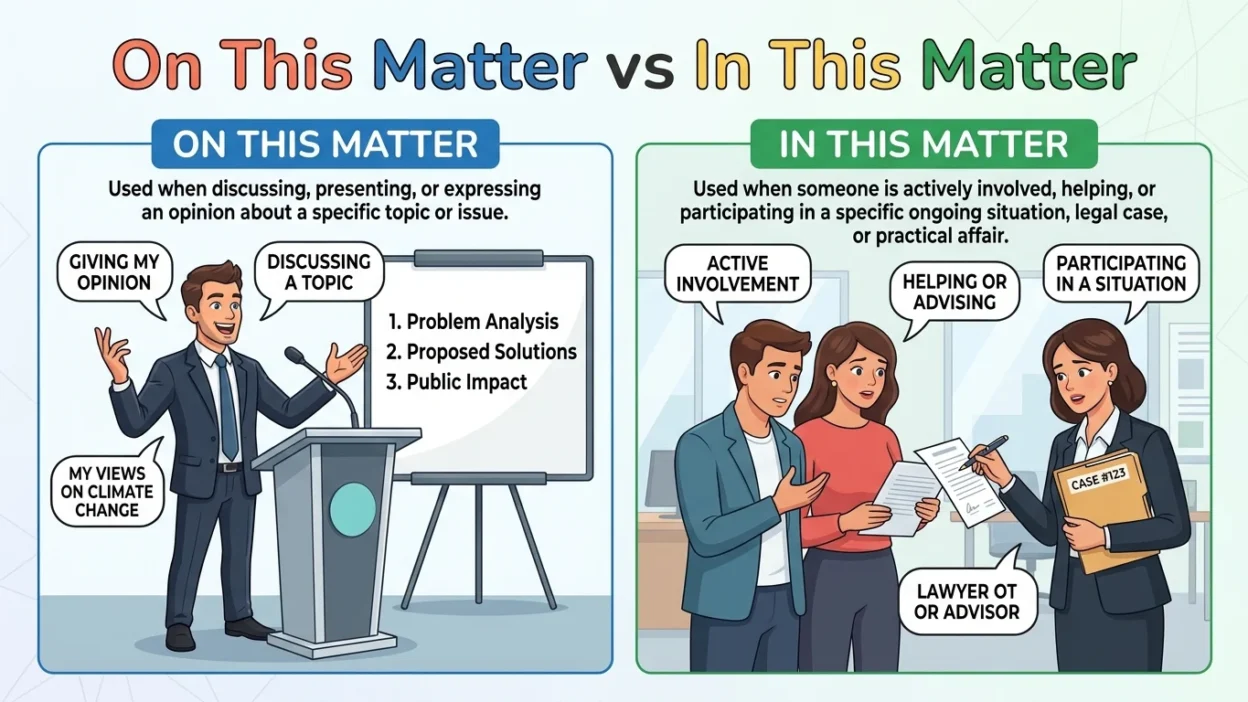
“On this matter” and “in this matter” can both refer to a particular subject, issue, or situation, but they are not always used in exactly the same way. On this matter is commonly used when talking about an opinion, position, decision, statement, or action concerning a specific issue. For example, “We agree on this matter” means that we have the same opinion about the issue.
In this matter is also grammatically correct, but it often emphasizes involvement, circumstances, or what happens within a particular situation. For example, “I need your help in this matter” means that your help is needed with this situation.
In everyday English, “on this matter” is often more natural when discussing opinions or specific points, while “in this matter” is common when referring to someone’s involvement or assistance. The best choice depends on the verb and the intended meaning.
Quick Answer
“On this matter” usually means about this issue or concerning this subject, especially when discussing opinions, decisions, or positions. “In this matter” often means in this situation or concerning this particular case, especially when discussing help, involvement, or responsibility. Both are correct, but the surrounding words determine which sounds more natural.
Why Do People Confuse “On This Matter” and “In This Matter”?
People confuse these phrases because both can introduce a particular issue, subject, or situation.
For example:
We agree on this matter.
I need your help in this matter.
Both sentences refer to the same general issue, but the preposition changes the relationship between the verb and the matter.
The easiest way to understand the difference is:
On this matter = concerning this issue
In this matter = in this situation or case
However, this is not an absolute rule. English uses certain prepositions naturally with particular verbs and expressions, so learning common combinations is important.
What Does “On This Matter” Mean?
“On this matter” usually means about this issue, concerning this subject, or regarding this particular point.
It is especially common when discussing:
• Opinions
• Decisions
• Agreements
• Disagreements
• Views
• Statements
• Positions
• Policies
For example:
We agree on this matter.
This means:
We have the same opinion about this issue.
Another example:
I have nothing more to say on this matter.
This means:
I have nothing more to say about this issue.
What Does “In This Matter” Mean?
“In this matter” usually refers to a particular situation, case, or issue in which someone is involved.
It is commonly used with expressions involving:
• Help
• Assistance
• Involvement
• Responsibility
• Action
• Judgment
• Experience
• Decisions
For example:
I need your help in this matter.
This means:
I need your help with this situation.
Another example:
She has experience in this matter.
This means she has experience dealing with this particular issue or situation.
On This Matter vs In This Matter
| Phrase | Common Meaning | Typical Use |
|---|---|---|
| On this matter | About or concerning this issue | Opinions, views, decisions, statements |
| In this matter | In this situation or case | Help, involvement, responsibility, action |
| On this subject | About this subject | Discussion and opinions |
| In this situation | Within or concerning this situation | Circumstances and actions |
The two expressions can overlap, but their natural uses often differ.
The Main Difference
A simple way to remember the difference is:
On this matter focuses more on the subject being discussed.
In this matter focuses more on the situation or case in which something is happening.
Compare:
What is your opinion on this matter?
You are asking for someone’s opinion about the issue.
Can you help me in this matter?
You are asking someone to become involved in or assist with the situation.
Another example:
We disagree on this matter.
The disagreement concerns the issue.
He was involved in this matter.
His involvement relates to the situation.
When to Use “On This Matter”
Use on this matter when you are talking about someone’s thoughts, opinions, position, or statements concerning an issue.
Opinions
What is your opinion on this matter?
Agreement
We agree on this matter.
Disagreement
They disagree on this matter.
Position
The company has taken a firm position on this matter.
Statements
I have already spoken on this matter.
Decisions
We need to make a decision on this matter.
In these examples, on connects naturally with the idea of discussing or taking a position about an issue.
When to Use “In This Matter”
Use in this matter when you are talking about involvement, assistance, responsibility, or action within a particular situation.
Help
I need your help in this matter.
Assistance
Thank you for your assistance in this matter.
Involvement
She was not involved in this matter.
Experience
He has considerable experience in this matter.
Responsibility
We need someone with experience to advise us in this matter.
Action
The authorities have taken action in this matter.
Here, in presents the matter as a situation or case.
On This Matter vs In This Matter in Formal Writing
Both expressions can appear in formal writing.
For example:
We appreciate your cooperation on this matter.
This is common in professional emails and letters.
You might also see:
We appreciate your assistance in this matter.
This is also formal and natural.
The choice often depends on the noun or verb being used.
Common formal combinations include:
agree on this matter
comment on this matter
decide on this matter
cooperate on this matter
assistance in this matter
help in this matter
involvement in this matter
experience in this matter
Two Useful Comparison Tables
| Expression | Meaning | Example |
|---|---|---|
| Opinion on this matter | Opinion about the issue | What is your opinion on this matter? |
| Decision on this matter | Decision concerning the issue | We will make a decision on this matter. |
| Agreement on this matter | Agreement about the issue | They reached an agreement on this matter. |
| Comment on this matter | Comment about the issue | She refused to comment on this matter. |
| Help in this matter | Help with the situation | I need your help in this matter. |
| Assistance in this matter | Assistance with the situation | Thank you for your assistance in this matter. |
| Involvement in this matter | Participation in the situation | He denied any involvement in this matter. |
| Experience in this matter | Experience dealing with the situation | She has experience in this matter. |
Another useful comparison:
| If You Mean… | Usually Use |
|---|---|
| Opinion about an issue | On this matter |
| Comment about an issue | On this matter |
| Agreement about an issue | On this matter |
| Decision concerning an issue | On this matter |
| Help with a situation | In this matter |
| Assistance with a situation | In this matter |
| Involvement in a case | In this matter |
| Experience dealing with an issue | In this matter |
12 Examples of “On This Matter”
1. What is your opinion on this matter?
This asks someone what they think about the issue.
2. We completely agree on this matter.
The speakers share the same opinion about the issue.
3. I have nothing more to say on this matter.
The speaker has no further comments about the issue.
4. The two sides disagree on this matter.
They have different opinions about the issue.
5. The manager has not commented on this matter.
The manager has not made a statement about the issue.
6. We need to reach a decision on this matter.
A decision needs to be made concerning the issue.
7. The company has taken a clear position on this matter.
The company has expressed its position concerning the issue.
8. I would like your advice on this matter.
The speaker wants advice about the issue.
9. We should focus on this matter first.
The speaker wants attention directed toward this issue.
10. The committee will vote on this matter tomorrow.
The committee will make a decision concerning the issue.
11. He refused to comment on this matter.
He refused to discuss the issue.
12. We need more information on this matter.
The speaker needs more information about the issue.
12 Examples of “In This Matter”
1. I need your help in this matter.
The speaker needs assistance with the situation.
2. Thank you for your assistance in this matter.
The speaker is thanking someone for helping with the situation.
3. She was not involved in this matter.
She did not participate in or become involved in the situation.
4. He has considerable experience in this matter.
He has experience dealing with this issue or situation.
5. We need your cooperation in this matter.
The speaker wants the person’s cooperation regarding the situation.
6. I trust your judgment in this matter.
The speaker trusts the person’s judgment concerning this situation.
7. The lawyer advised us in this matter.
The lawyer provided advice concerning the particular case.
8. We need someone experienced in this matter.
The speaker wants someone who knows how to deal with the issue.
9. The authorities are investigating the matter.
The situation is being investigated.
10. Please contact me if you need assistance in this matter.
The speaker offers help concerning the situation.
11. He played an important role in this matter.
He had an important role in the situation.
12. We appreciate your patience in this matter.
The speaker appreciates someone’s patience while dealing with the situation.
Can “On This Matter” and “In This Matter” Be Interchanged?
Sometimes, but not always.
Consider:
What is your opinion on this matter?
This is natural.
What is your opinion in this matter?
This sounds unusual in standard everyday English.
Now consider:
I need your help in this matter.
This is natural.
I need your help on this matter.
This can also be correct and is commonly used, especially in professional English.
So the difference is not always a strict rule. Collocation, meaning the words that naturally occur together, plays an important role.
“Help on This Matter” vs “Help in This Matter”
Both can be correct.
I need your help on this matter.
This emphasizes the particular issue or task.
I need your help in this matter.
This emphasizes the situation or case.
In everyday English, both may sound natural depending on the context.
For example:
Can you help me on this matter?
This can mean:
Can you help me with this particular issue?
Similarly:
Can you help me in this matter?
This can mean:
Can you help me with this situation?
The difference is subtle.
Common Mistakes
Mistake 1: Assuming “on” always means discussion
Although on this matter is common with opinions and comments, it can also appear with decisions, actions, cooperation, and other expressions.
Mistake 2: Assuming “in” is always wrong
In this matter is completely correct in many expressions.
For example:
I need your assistance in this matter.
Mistake 3: Using “in” with opinion
A common natural expression is:
What is your opinion on this matter?
Not usually:
What is your opinion in this matter?
Mistake 4: Thinking the difference is always absolute
Some expressions can naturally use either preposition.
For example:
We need your help on this matter.
We need your help in this matter.
Both can work.
Mistake 5: Ignoring common word combinations
English prepositions often depend on the words around them.
Learn common combinations rather than trying to apply one rule to every sentence.
Memory Trick
Remember:
On = about the issue
In = within the situation
For example:
My opinion on this matter
means:
My opinion about this issue.
My help in this matter
means:
My help with this situation.
This is not a perfect rule for every sentence, but it is a useful starting point.
American vs British English
“On this matter” and “in this matter” are used in both American English and British English.
There is no major difference in their basic meanings.
Both varieties commonly use expressions such as:
opinion on this matter
comment on this matter
decision on this matter
help in this matter
assistance in this matter
involvement in this matter
The choice generally depends on the expression and context rather than a major American or British English difference.
Similar Expressions
Regarding This Matter
Regarding this matter, we need more information.
This means about this issue.
Concerning This Matter
We have questions concerning this matter.
This also means about this issue.
With Regard to This Matter
With regard to this matter, we will contact you soon.
This is formal and means concerning this issue.
About This Matter
I would like to talk about this matter.
This is simpler and more conversational.
In This Regard
In this regard, we need more information.
This means in relation to this point or aspect.
On This Matter vs About This Matter
About this matter is usually more conversational.
On this matter can sound more formal and is common in professional or official communication.
Compare:
I want to talk about this matter.
I would like to comment on this matter.
Both are natural, but the second sounds more formal.
Is “On This Matter” Formal?
It can be.
For example:
We will provide further information on this matter.
This sounds professional and formal.
However, it is also perfectly normal in everyday English.
Is “In This Matter” Formal?
It can also sound formal, especially in expressions such as:
Thank you for your assistance in this matter.
This phrase is particularly common in professional correspondence.
In casual conversation, people may simply say:
Thanks for helping me with this.
Final Verdict
Both “on this matter” and “in this matter” are correct expressions, but they are commonly used in different contexts.
Use “on this matter” when referring to an issue, subject, opinion, comment, decision, or position.
Use “in this matter” when referring to involvement, assistance, help, responsibility, experience, or a situation.
A useful guide is:
On this matter = about this issue
In this matter = in this situation or case
However, English prepositions depend heavily on common word combinations, so do not treat this as an absolute rule.
Frequently Asked Questions
Is “on this matter” correct?
Yes. “On this matter” is a natural expression meaning about or concerning a particular issue.
Is “in this matter” correct?
Yes. “In this matter” is also correct and often refers to involvement, assistance, responsibility, or a particular situation.
Which is more common, “on this matter” or “in this matter”?
Neither is always more correct. The best choice depends on the words around the phrase and what you want to express.
Should I say “opinion on this matter” or “opinion in this matter”?
Opinion on this matter is the natural choice when asking what someone thinks about an issue.
Should I say “help on this matter” or “help in this matter”?
Both can be correct. “Help on this matter” often focuses on the particular issue or task, while “help in this matter” can emphasize the situation or case.
What is the difference between “on this matter” and “about this matter”?
Both can mean concerning a particular issue. “On this matter” can sound somewhat more formal, while “about this matter” is generally more conversational.
Is “in this matter” formal?
It can be. Expressions such as “Thank you for your assistance in this matter” are especially common in professional and formal communication.
What is an easy way to remember the difference?
Think:
On this matter = about the issue
In this matter = within the situation
Then check the common expression used with the verb or noun.
Remember This
On this matter usually focuses on the issue being discussed.
In this matter usually focuses on the situation or case.
Examples:
What is your opinion on this matter?
I need your help in this matter.
She commented on this matter.
He was involved in this matter.
The most important thing is to learn natural word combinations rather than trying to force one preposition into every sentence.
Conclusion
“On this matter” and “in this matter” are both useful expressions for talking about an issue or situation. “On this matter” is especially common when discussing opinions, comments, decisions, agreements, and positions. “In this matter” often appears when talking about help, assistance, involvement, experience, responsibility, or someone’s role in a particular situation.
The difference can sometimes be subtle because both expressions may refer to the same general issue. When choosing between them, consider the word that comes before the phrase and the meaning you want to express.
In many cases, learning common combinations such as “opinion on this matter” and “assistance in this matter” is the easiest way to sound natural and confident in English.

Lucas Luke is a passionate language writer and content creator at SimileHive, specializing in similes, idioms, metaphors, and figurative language. He enjoys making complex English expressions simple, engaging, and easy to understand for students, writers, and language enthusiasts through well-researched, practical content.