
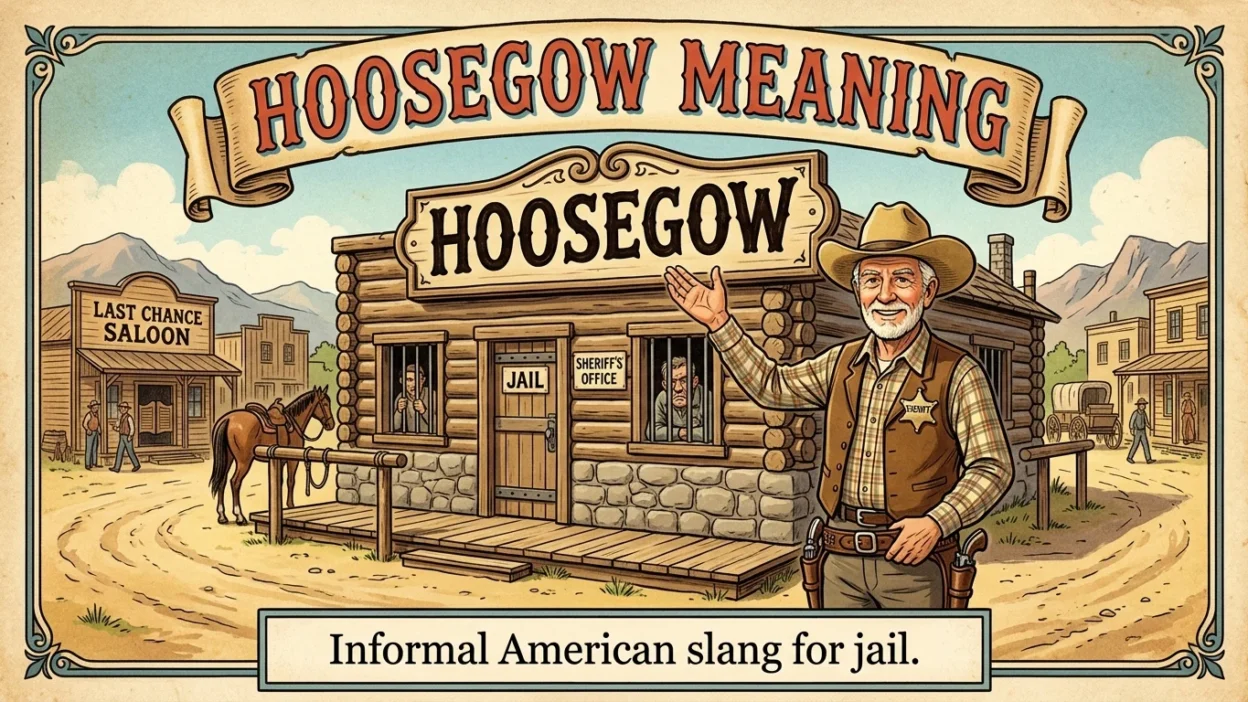
“Hoosegow” is an informal American slang word meaning jail, prison, or a place where someone is held by the authorities. If someone says, “He ended up in the hoosegow,” they mean that he ended up in jail. The word is humorous, old fashioned, and often used in a playful way rather than as a serious legal term.
You may come across “hoosegow” in old Western movies, American literature, television shows, jokes, or informal conversations. It is especially associated with American slang from the early twentieth century and with Western or cowboy speech.
The word does not usually appear in formal writing. In this article, we will explain the hoosegow meaning, its possible origin, how to use it naturally, and provide clear examples so you can understand this unusual English word.
Quick Answer
Hoosegow means jail or prison. It is an informal American slang term that often sounds humorous, old fashioned, or playful. For example, “The sheriff sent the thief to the hoosegow” means “The sheriff sent the thief to jail.” You are more likely to hear it in informal or fictional contexts than in modern formal English.
What Does “Hoosegow” Mean?
Hoosegow is a slang term for:
• Jail
• Prison
• A place where someone is detained
• A local jail or lockup
For example:
He spent the night in the hoosegow.
This simply means:
He spent the night in jail.
The word often creates a humorous or old time American feeling.
Hoosegow Meaning in Simple English
In very simple English:
Hoosegow = jail
If someone says:
“He was thrown in the hoosegow.”
They mean:
“He was put in jail.”
The word does not describe a special type of prison. It is simply a slang word for jail or prison.
Is “Hoosegow” a Real Word?
Yes. Hoosegow is a recognized English slang word.
However, it is not a common everyday word in modern English. Most people would normally say:
jail
prison
lockup
detention center
“Hoosegow” is much more informal and often deliberately humorous.
Hoosegow Origin
The word hoosegow is generally associated with American slang and is believed to have developed from Spanish influence.
It is commonly connected with the Spanish word juzgado, meaning a court or courthouse. Through changes in pronunciation and usage among English speakers in the American Southwest, the word developed into forms such as hoosegow.
The exact history and pronunciation changes are not completely certain, but the word became established as American slang for jail.
Its association with the American Southwest and Western culture helped make it recognizable in cowboy stories and Western entertainment.
Why Does “Hoosegow” Sound Funny?
“Hoosegow” sounds unusual to modern English speakers because it is an old slang expression that is not commonly used in everyday conversation today.
It can create an old Western or humorous feeling.
Compare:
He went to jail.
This sounds completely normal and modern.
He went to the hoosegow.
This sounds playful, old fashioned, or like something from a Western story.
How to Use “Hoosegow”
Use hoosegow when you want an informal, humorous, or old fashioned way to refer to jail.
It is especially suitable in:
• Fiction
• Humor
• Informal storytelling
• Western themed writing
• Dialogue
• Jokes
• Descriptions of old fashioned American speech
It is generally not appropriate for formal legal or professional writing.
For example, in a formal report, you would write:
The suspect was taken to jail.
Not:
The suspect was taken to the hoosegow.
The second sentence sounds deliberately informal or humorous.
Hoosegow vs Jail
| Word | Meaning | Style |
|---|---|---|
| Hoosegow | Jail or prison | Slang, humorous, old fashioned |
| Jail | Place where people are detained | Common and neutral |
| Prison | Institution for people serving sentences | Standard |
| Lockup | Place for temporary detention | Informal |
| Detention center | Place where people are held | Formal or official |
12 Examples of “Hoosegow”
1. The sheriff sent the thief to the hoosegow.
This means the sheriff sent the thief to jail.
2. He spent the night in the hoosegow.
This means he spent the night in jail.
3. The outlaw ended up in the hoosegow.
Here, hoosegow means jail.
4. Nobody wanted to spend a weekend in the hoosegow.
The speaker means nobody wanted to spend a weekend in jail.
5. The sheriff warned him that he could land in the hoosegow.
This means the sheriff warned him that he could end up in jail.
6. After the fight, the man was taken to the hoosegow.
The man was taken to jail.
7. The cowboy joked that he had already spent time in the hoosegow.
He was joking about having been in jail.
8. The movie showed the villain being thrown into the hoosegow.
The villain was put in jail.
9. He did not want to return to the hoosegow.
He did not want to go back to jail.
10. The old sheriff had sent many criminals to the hoosegow.
The sheriff had sent many criminals to jail.
11. One more mistake could land him in the hoosegow.
This means another mistake could result in him being put in jail.
12. The prisoner joked about the food in the hoosegow.
The prisoner was joking about the food in jail.
Hoosegow in a Sentence
Here are some natural examples:
He spent two nights in the hoosegow.
The sheriff threatened to put him in the hoosegow.
Nobody wants to end up in the hoosegow.
The outlaw was finally caught and sent to the hoosegow.
The old Western movie used “hoosegow” several times.
These sentences all use the word to mean jail.
Is “Hoosegow” Formal or Informal?
Hoosegow is informal.
It is a slang expression, so you should generally avoid it in formal writing.
For example, in a legal document, use:
The defendant was taken to jail.
In a humorous story, you could write:
By sunset, the outlaw was sitting in the hoosegow.
The second example intentionally creates an informal and old fashioned atmosphere.
Hoosegow vs Prison
Although “hoosegow” can refer to prison, it is most commonly understood as a slang term for jail.
There is also an important difference between the ordinary words jail and prison.
Jail commonly refers to a place where people are held temporarily, often before trial or for shorter sentences.
Prison generally refers to a facility where people serve longer criminal sentences.
However, hoosegow is a slang term and does not make this legal distinction itself.
Hoosegow vs Lockup
Lockup is another informal word for a place where people are temporarily held by the police.
For example:
He was taken to the local lockup.
He was taken to the hoosegow.
Both can refer to jail, but hoosegow sounds much more old fashioned and humorous.
Common Mistakes
Mistake 1: Thinking Hoosegow Is a Person
“Hoosegow” does not mean a person.
It refers to jail or prison.
Incorrect interpretation:
The hoosegow arrived at the station.
Correct meaning:
The hoosegow was the jail.
Mistake 2: Using It in Formal Writing
Because hoosegow is slang, it is usually inappropriate for formal legal, academic, or professional writing.
Use jail, prison, or another precise term instead.
Mistake 3: Thinking It Refers to a Specific Jail
“Hoosegow” is not normally the official name of one particular prison.
It is a general slang term for jail or prison.
Mistake 4: Thinking It Is Modern Everyday English
Most modern speakers do not regularly use “hoosegow.”
It is much more likely to appear in humorous, historical, fictional, or Western contexts.
Comparison Table
| Expression | Meaning | Example |
|---|---|---|
| Hoosegow | Jail or prison | He landed in the hoosegow. |
| Jail | Place for detention | He was taken to jail. |
| Prison | Place where sentences are served | He was sent to prison. |
| Lockup | Temporary detention place | He spent the night in lockup. |
| Detention center | Official place for holding people | He was taken to a detention center. |
Is “Hoosegow” American English?
Yes. Hoosegow is strongly associated with American English, particularly American slang.
It is especially connected with the American Southwest and old Western culture.
British English speakers may recognize the word, especially from American movies, books, or television, but it is not a normal British English word for jail.
Hoosegow in Western Stories
The word is particularly useful in stories involving:
• Cowboys
• Sheriffs
• Outlaws
• The American frontier
• Old Western towns
• Historical American settings
For example:
“You better behave yourself, or you’ll land in the hoosegow.”
This sounds like dialogue from an old Western or a humorous imitation of one.
A modern character would usually say:
“You better behave yourself, or you’ll end up in jail.”
Similar Words
Jail
The most common everyday word for a place where people are detained.
Prison
A facility where people generally serve criminal sentences.
Lockup
An informal word for a place where someone is temporarily held.
Cell
A room in a jail or prison where a person is held.
Detention Center
A more formal term for a facility where people are detained.
Penitentiary
A formal word for a prison, especially one used for people convicted of crimes.
Memory Trick
Think:
Hoosegow = jail
You can remember it as an old American slang word that sounds like something a cowboy might say.
Imagine a sheriff saying:
“Off to the hoosegow!”
That mental picture can help you remember the meaning.
Final Verdict
Hoosegow means jail or prison.
It is an informal American slang word that often sounds humorous, old fashioned, or Western.
For everyday modern English, use jail or prison instead.
Use hoosegow mainly when you want an old fashioned, humorous, fictional, or Western style.
Frequently Asked Questions
What does hoosegow mean?
“Hoosegow” means jail or prison. It is an informal American slang term.
Is hoosegow a slang word?
Yes. Hoosegow is American slang and is generally informal and humorous.
Where did the word hoosegow come from?
The word is generally believed to have developed through American Spanish influence and is commonly connected with the Spanish word “juzgado,” meaning a court or courthouse.
Is hoosegow still used today?
It is still recognized, but it is not common in ordinary modern conversation. You are more likely to see it in fiction, humor, Western stories, or references to old American slang.
Is hoosegow the same as jail?
Yes. Hoosegow is an informal slang word for jail or prison.
Is hoosegow a formal word?
No. It is informal slang and should generally be avoided in formal writing.
Is hoosegow American English?
Yes. It is strongly associated with American English, especially American Southwest slang and Western culture.
Can I use hoosegow in a sentence?
Yes. For example:
“The outlaw ended up in the hoosegow.”
This means:
“The outlaw ended up in jail.”
Remember This
Hoosegow = jail
It is:
American
Informal
Slang
Often humorous or old fashioned
If you see “hoosegow” in a story or conversation, think jail.
Conclusion
“Hoosegow” is an interesting piece of American slang that means jail or prison. Although the word is still recognized, it is not common in ordinary modern English. It often creates a humorous, old fashioned, or Western feeling, which is why it appears in cowboy stories, movies, jokes, and fictional dialogue.
If you need a neutral modern word, use jail or prison. If you are reading an old American story or watching a Western and hear someone mention the “hoosegow,” you now know exactly what they mean. The easiest way to remember it is simply: hoosegow means jail.

Lucas Luke is a passionate language writer and content creator at SimileHive, specializing in similes, idioms, metaphors, and figurative language. He enjoys making complex English expressions simple, engaging, and easy to understand for students, writers, and language enthusiasts through well-researched, practical content.