
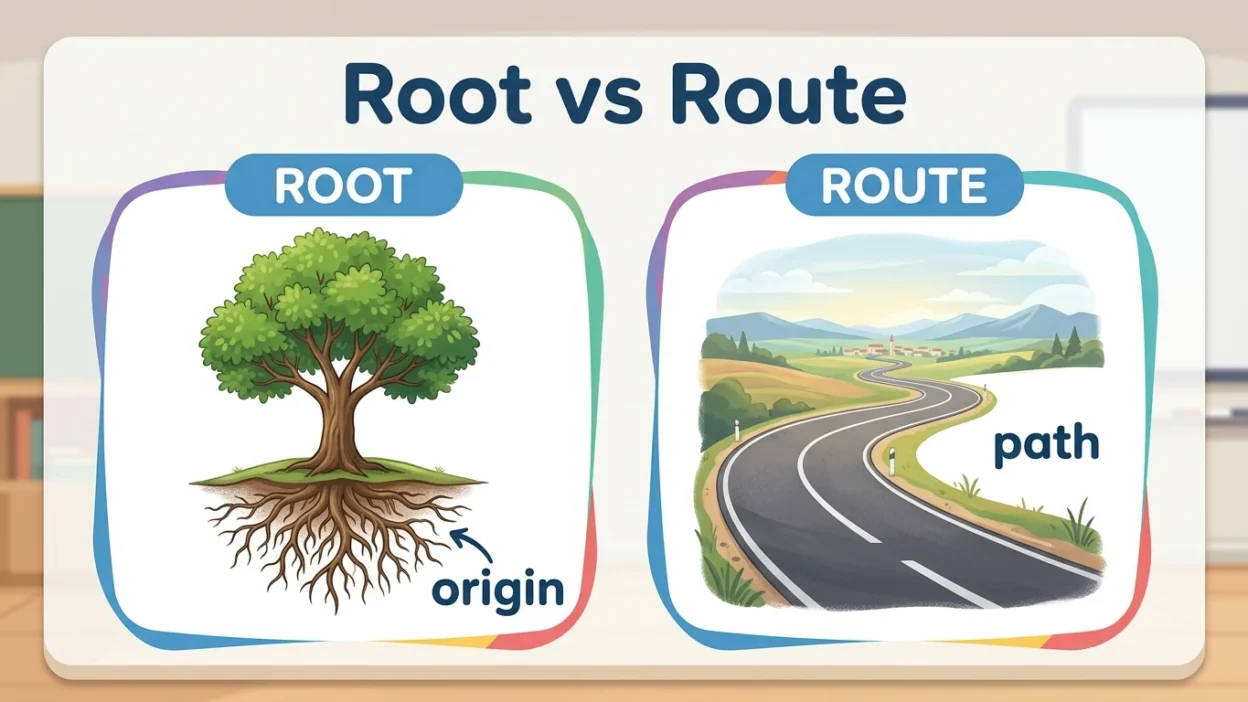
“Root” and “route” are different words with different meanings, even though they can sound the same in some varieties of English. Root can refer to the part of a plant under the ground, the source of something, or the process of establishing a connection or foundation. Route usually means a path, direction, or way from one place to another.
The confusion becomes stronger because the two words can be pronounced differently depending on the speaker and the variety of English. In American English, route can commonly be pronounced like “root” or like “rowt.” However, their meanings remain different. In this article, we will explain root vs route, show you how to use each word correctly, provide plenty of examples, and give you an easy memory trick.
Quick Answer
Root usually means the underground part of a plant, the source or origin of something, or a foundation. Route means a path or way used to travel from one place to another. For example, “The tree has deep roots” and “We took a different route home.” They may sound similar, but their meanings are different.
Why Do People Confuse “Root” and “Route”?
People often confuse these words because they can be pronounced similarly.
For example:
Root
Route
In some forms of English, both can sound like “root.”
However, spelling and meaning are different.
Compare:
The plant has strong roots.
Here, roots are parts of a plant.
We took a different route.
Here, route means a path or way to travel.
The easiest way to remember the difference is to connect each word with its main meaning.
Root = origin, foundation, or plant part
Route = path or way
What Does “Root” Mean?
Root has several common meanings.
1. The Part of a Plant
A root is the part of a plant that usually grows underground and helps support the plant and absorb water and nutrients.
Example:
The tree has very deep roots.
Another example:
Water helps the roots of the plant grow.
2. The Source or Origin of Something
Root can also mean the basic source or origin of something.
Example:
We need to find the root of the problem.
This means we need to find the basic cause of the problem.
You might also hear:
The root cause
This means the main or underlying cause.
3. A Foundation or Connection
Root can describe something firmly established.
For example:
Her family has deep roots in the community.
This means her family has a long and strong connection to the community.
4. To Establish Yourself
As a verb, root can mean to establish yourself firmly in a place.
Example:
After years of traveling, they decided to put down roots in the city.
This means they decided to settle there and build a stable life.
What Does “Route” Mean?
Route means a path, direction, or way used to travel from one place to another.
For example:
We took the shortest route home.
Here, route means the path used to get home.
You can use route for roads, journeys, transportation, delivery paths, and even plans or processes.
Travel Route
This route takes us through the mountains.
Bus Route
I take the same bus route every morning.
Delivery Route
The driver changed his delivery route.
Internet or Communication Route
The word can also be used more broadly to describe a way something travels or is directed.
For example:
The message was routed through another server.
Root vs Route
| Word | Main Meaning | Example |
|---|---|---|
| Root | Part of a plant | The tree has strong roots. |
| Root | Source or cause | We found the root of the problem. |
| Root | Foundation or connection | The family has deep roots here. |
| Route | Path or way | We took a different route. |
| Route | Travel direction | This route leads to the airport. |
| Route | Course or process | The package was sent by a different route. |
The Main Difference
The simplest distinction is:
Root = where something begins or is firmly connected
Route = the way something travels
For example:
The roots of the tree are deep.
The word refers to the plant’s foundation.
The route to the village is difficult.
The word refers to the path used to reach the village.
Think of it this way:
A root helps hold something in place.
A route helps something get from one place to another.
When to Use “Root”
Use root when talking about plants, origins, causes, foundations, or deep connections.
Plants
The roots of this tree are very strong.
Problems
We need to find the root of the problem.
Causes
Fear was at the root of his decision.
Family History
Her family has roots in the region.
Culture
The tradition has deep roots in local culture.
Establishing Yourself
They decided to put down roots in the town.
When to Use “Route”
Use route when talking about paths, roads, travel, transportation, directions, or ways of reaching a destination.
Roads
Which route should we take?
Travel
We chose a scenic route.
Public Transportation
This bus route is very busy.
Directions
The GPS suggested a faster route.
Delivery
The company changed its delivery route.
Journey
Our route took us through several small villages.
12 Examples of “Root”
1. The tree has deep roots.
The word refers to the underground parts of the tree.
2. We need to find the root of the problem.
Here, root means the basic cause.
3. These plants have strong roots.
Here, root refers to the plant structure.
4. Her family has deep roots in the city.
This means her family has a long connection to the city.
5. The tradition has ancient roots.
This means the tradition began a long time ago.
6. Stress may be at the root of the problem.
Here, root means the underlying cause.
7. The roots of the plant were damaged.
The sentence refers to the part of the plant below the ground.
8. They wanted to put down roots in the community.
This means they wanted to settle and establish a stable life.
9. The movement has its roots in local history.
This means the movement originated in local history.
10. The gardener carefully protected the roots.
The word refers to the underground plant parts.
11. The conflict has deep historical roots.
This means the conflict has important causes or origins in history.
12. She is proud of her cultural roots.
This means she feels connected to her cultural background and origins.
12 Examples of “Route”
1. We took the fastest route home.
Route means the path used to travel home.
2. Which route leads to the airport?
Route means the way to reach the airport.
3. The GPS showed us a shorter route.
The route is the path suggested by the navigation system.
4. This bus route stops near my house.
Route means the regular path followed by the bus.
5. We chose a scenic route through the mountains.
The route is the path taken during the journey.
6. The driver changed his route because of traffic.
Route means the path used by the driver.
7. The delivery company created a new route.
The route is the planned path for deliveries.
8. The hiking route was difficult.
Route means the path followed by hikers.
9. We need to find another route to the village.
Route means another way of getting there.
10. The train follows the same route every day.
Route refers to the path followed by the train.
11. The package was sent by a different route.
Route refers to the way the package traveled.
12. Our route included several historic towns.
Route means the course followed during the journey.
Root vs Route: Common Mistakes
Mistake 1: Using “Route” for a Plant
Incorrect:
The tree has deep routes.
Correct:
The tree has deep roots.
The underground part of a plant is a root.
Mistake 2: Using “Root” for a Travel Path
Incorrect:
We took a different root home.
Correct:
We took a different route home.
A travel path is a route.
Mistake 3: Confusing “Root Cause” and “Route”
The correct expression is:
root cause
Not:
route cause
For example:
We need to identify the root cause of the problem.
Mistake 4: Confusing “Route” With “Root” Because of Pronunciation
Some speakers pronounce route like root, but this does not mean they are the same word.
For example:
The route is long.
and:
The roots are deep.
The pronunciation may be similar, but the meanings and spellings are different.
Comparison Table
| Sentence | Correct Word | Why |
|---|---|---|
| The plant has deep ___ | Root | A plant has roots |
| We took a different ___ | Route | A route is a path |
| Find the ___ cause | Root | Root means underlying cause |
| Which ___ goes to the airport? | Route | Route means way or path |
| The tree’s ___ were damaged | Roots | Plant structure |
| The bus ___ changed | Route | Transportation path |
| Cultural ___ are important | Roots | Origins and connections |
| The hiking ___ is difficult | Route | Travel path |
Root vs Route Pronunciation
Pronunciation can make these words especially confusing.
Root is generally pronounced like “root.”
Route has more than one accepted pronunciation in English.
It can be pronounced like:
“root”
or
“rowt”
The pronunciation of route varies by region and speaker.
For this reason, you should not rely only on pronunciation when deciding whether someone means root or route. Context usually makes the meaning clear.
American vs British English
Both root and route are used in American and British English with the same basic meanings.
The main difference is that route has pronunciation variation.
In American English, both pronunciations of route are widely heard.
In British English, route is commonly pronounced like “root,” although pronunciation can vary among speakers.
The spelling remains route when you mean a path or way.
For example:
We took a different route.
Do not change the spelling to root simply because the pronunciation may sound similar.
Similar Words
Root vs Origin
Root can mean the source or origin of something.
Origin directly means where something begins.
Example:
The origin of the tradition is unclear.
The tradition has ancient roots.
Route vs Path
Both can refer to a way from one place to another.
Path often suggests a physical track or walkway.
Route often suggests a planned or chosen way of traveling.
Route vs Road
A road is a physical surface or roadway.
A route is the way or course taken from one place to another.
For example:
This road is closed.
We need to choose another route.
Root vs Cause
Cause means something that produces an effect.
Root can refer to the deeper or underlying cause.
For example:
We need to understand the cause of the problem.
We need to find the root cause of the problem.
Is “Route” Pronounced Like “Root”?
Sometimes.
The word route has two common pronunciations in English. Some speakers pronounce it like root, while others pronounce it like rowt.
The word root, however, has its own spelling and meaning.
So even when they sound alike, they should not be confused in writing.
Is “Root” Always About Plants?
No.
Root has several meanings.
It can refer to:
Plant parts
Origins
Causes
Foundations
Family or cultural connections
For example:
The tree has strong roots.
The problem has deep roots.
She is proud of her cultural roots.
Is “Route” Only Used for Travel?
No.
Although route is strongly connected with travel, it can also describe a way or course through which something moves or is directed.
For example:
The message was routed through another system.
The word can also appear in business, transportation, technology, communication, and planning.
Memory Trick
Remember:
Root = origin or foundation
Route = path
You can also picture them:
Root → tree → underground
Route → road → destination
If you are talking about where something comes from, think root.
If you are talking about where something goes, think route.
Final Verdict
Root and route are different words with different meanings.
Use root for plant parts, origins, causes, foundations, and deep connections.
Use route for paths, roads, directions, journeys, transportation, and ways of reaching a destination.
Remember:
Root = origin or foundation
Route = path or way
Even though route can be pronounced like root, the spelling and meaning are different.
Frequently Asked Questions
What is the difference between root and route?
Root usually refers to a plant part, origin, cause, foundation, or deep connection. Route means a path or way from one place to another.
Is root and route pronounced the same?
Sometimes. Route can be pronounced like root in some varieties of English. It can also have a pronunciation like “rowt.”
Is “root cause” or “route cause” correct?
Root cause is correct. It means the underlying or basic cause of a problem.
Is it “travel root” or “travel route”?
Travel route is correct because route means a path or way of traveling.
Is “the roots of a tree” correct?
Yes. A tree has roots, which usually grow underground and help support the tree and absorb water and nutrients.
What does “deep roots” mean?
“Deep roots” can literally refer to deep plant roots. Figuratively, it can mean a strong or long lasting connection to a place, culture, tradition, or history.
What does “route” mean in a sentence?
Route means a path, direction, or way used to travel from one place to another.
For example:
We took a different route home.
Can “root” be a verb?
Yes. “Root” can be a verb with several meanings, including establishing yourself in a place. For example, “They decided to put down roots in the town.”
Remember This
Root = origin, foundation, or plant part.
Route = path, direction, or way.
Think:
Roots hold a plant in place.
Routes take you somewhere.
If you remember that simple difference, you can easily choose between root and route in most sentences.
Conclusion
“Root” and “route” are easy to confuse because route can sometimes be pronounced like root. However, their meanings are clearly different. A root can be part of a plant, the source of something, an underlying cause, or a deep connection. A route is a path, direction, or way used to travel or move from one place to another.
When you are writing, focus on meaning rather than pronunciation. If you mean an origin, foundation, cause, or plant part, use root. If you mean a path, direction, or way to reach a destination, use route. Once you connect root with origin and route with path, the difference becomes much easier to remember.

Charles Kevin is a passionate language writer and researcher at SimileHive, creating clear, engaging content about similes, idioms, metaphors, and figurative language to help readers improve English communication confidently every day.