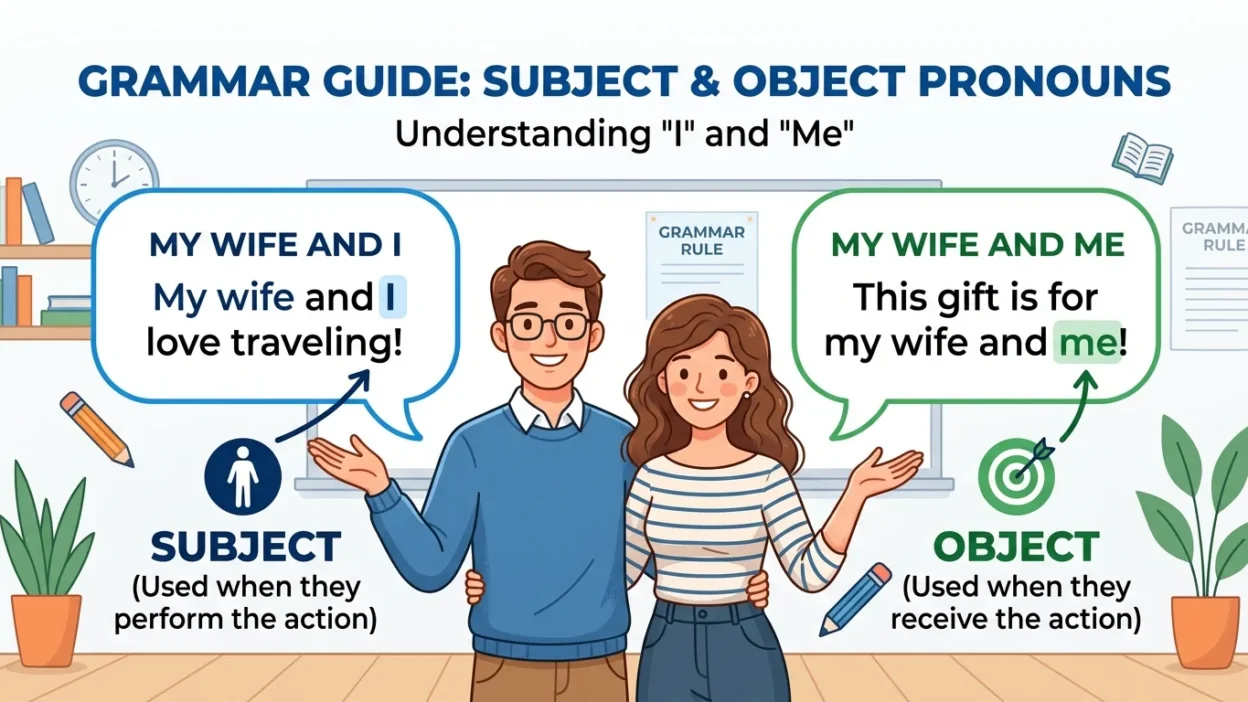
“My wife and I” and “my wife and me” can both be correct, but they are used in different parts of a sentence. The key is to understand whether the phrase is acting as the subject or the object. For example, you would say, “My wife and I went to the store,” but “The teacher spoke to my wife and me.” Many English learners find this confusing because both phrases refer to the same two people.
The easiest way to choose the correct form is to temporarily remove “my wife.” If the sentence still sounds correct with “I,” use “my wife and I.” If it sounds correct with “me,” use “my wife and me.” This simple trick works in most everyday situations.
In this article, we will explain the difference between “my wife and I” and “my wife and me,” show you when to use each one, and give you plenty of examples.
Quick Answer
Use “my wife and I” when the phrase is the subject doing the action. Use “my wife and me” when the phrase is the object receiving the action or following a preposition. For example, “My wife and I traveled” is correct, while “She called my wife and me” is correct.
Why Do People Confuse “My Wife and I” and “My Wife and Me”?
The confusion usually happens because people have heard “my wife and I” used frequently in formal speech and writing.
Some speakers mistakenly think “my wife and I” is always more correct or polite. It is not. The correct choice depends on the grammatical role of the phrase.
Compare these sentences:
My wife and I went shopping.
The manager spoke to my wife and me.
In the first sentence, the two people are performing the action. They are the subject.
In the second sentence, the two people are receiving the action. They are the object.
When to Use “My Wife and I”
Use “my wife and I” when you and your wife are the subjects of the sentence.
In simple terms, use it when you are the people doing the action.
Examples
My wife and I went to the restaurant.
Both people went to the restaurant.
My wife and I enjoyed the movie.
Both people enjoyed the movie.
My wife and I are planning a vacation.
Both people are planning the vacation.
My wife and I bought a new table.
Both people bought the table.
The Simple Test
Remove “my wife” from the sentence.
“My wife and I went to the restaurant.”
becomes:
“I went to the restaurant.”
That sounds correct, so “my wife and I” is correct.
When to Use “My Wife and Me”
Use “my wife and me” when the phrase is the object of the sentence or comes after a preposition.
The object is usually the person receiving the action.
Examples
The waiter brought my wife and me some water.
She invited my wife and me to dinner.
The doctor spoke with my wife and me.
The company sent my wife and me an email.
You can also use “my wife and me” after prepositions such as to, for, with, from, between, and about.
Examples
This gift is for my wife and me.
She came with my wife and me.
The decision was made between my wife and me.
They were talking about my wife and me.
The Simple Test
Remove “my wife” from:
“The teacher spoke to my wife and me.”
You get:
“The teacher spoke to me.”
That sounds correct, so “my wife and me” is correct.
My Wife and I vs My Wife and Me
| Phrase | Grammatical role | Example |
|---|---|---|
| My wife and I | Subject | My wife and I went shopping. |
| My wife and me | Object | She invited my wife and me. |
| My wife and I | People doing the action | My wife and I cooked dinner. |
| My wife and me | People receiving the action | He called my wife and me. |
| My wife and I | Subject of a verb | My wife and I agree. |
| My wife and me | Object of a preposition | This is important to my wife and me. |
Another Easy Way to Remember
Think of it this way:
I = subject
Me = object
So:
My wife and I = subject
My wife and me = object
For example:
My wife and I watched a movie.
Ask, “Who watched the movie?”
“My wife and I.”
Now look at:
The movie impressed my wife and me.
Ask, “Who was impressed?”
“My wife and me.”
12 Examples of “My Wife and I”
- My wife and I went to the beach.
- My wife and I cooked dinner together.
- My wife and I are looking for a new house.
- My wife and I visited our friends yesterday.
- My wife and I enjoyed the concert.
- My wife and I decided to stay home.
- My wife and I love traveling.
- My wife and I watched a movie last night.
- My wife and I are planning our anniversary.
- My wife and I received a wonderful gift.
- My wife and I work in the same city.
- My wife and I agreed with the decision.
In every example, “my wife and I” is the subject performing or experiencing the action.
12 Examples of “My Wife and Me”
- She invited my wife and me to dinner.
- The teacher spoke to my wife and me.
- They gave my wife and me some useful advice.
- The gift was for my wife and me.
- He asked my wife and me a question.
- The manager contacted my wife and me.
- She traveled with my wife and me.
- The decision affected my wife and me.
- They were talking about my wife and me.
- The doctor explained everything to my wife and me.
- The invitation was sent to my wife and me.
- Nobody asked my wife and me about the problem.
In these examples, “my wife and me” is the object or follows a preposition.
Common Mistakes
Mistake 1: Using “My Wife and I” Everywhere
A common mistake is:
She invited my wife and I to dinner.
This is incorrect in standard English.
The correct sentence is:
She invited my wife and me to dinner.
Remove “my wife”:
She invited I to dinner.
That clearly sounds wrong.
So use me.
Mistake 2: Using “My Wife and Me” as the Subject
Another common mistake is:
My wife and me went shopping.
The correct sentence is:
My wife and I went shopping.
Remove “my wife”:
Me went shopping.
That does not work in standard English.
So use I.
Mistake 3: Thinking “I” Sounds More Formal
Some people believe “I” is always more formal or grammatically correct.
That is not true.
The choice between I and me depends on grammar, not formality.
Correct:
My wife and I attended the meeting.
Correct:
The manager thanked my wife and me.
Both are grammatically correct.
Comparison Table
| Sentence | Correct? | Reason |
|---|---|---|
| My wife and I went home. | Yes | Subject |
| My wife and me went home. | No | “Me” cannot be the subject here |
| She called my wife and me. | Yes | Object |
| She called my wife and I. | No | “I” cannot be the object here |
| This is for my wife and me. | Yes | Object of “for” |
| This is for my wife and I. | No | “I” is incorrect after “for” |
| My wife and I enjoyed it. | Yes | Subject |
| They helped my wife and me. | Yes | Object |
What About “My Wife and I” After “Between”?
This is another area where people sometimes make mistakes.
The standard expression is:
Between my wife and me
For example:
Between my wife and me, we have decided to wait.
More naturally, you might say:
Between my wife and me, there is a strong understanding.
Not:
Between my wife and I
The reason is simple. Between is a preposition, so it is followed by the object form me.
What About “My Wife and I” After “With”?
Use “my wife and me” after “with.”
Correct:
He had dinner with my wife and me.
Incorrect:
He had dinner with my wife and I.
Remove “my wife”:
He had dinner with me.
That shows why “me” is correct.
American vs British English
American and British English generally follow the same grammatical rule here.
In both varieties:
My wife and I went home.
She spoke to my wife and me.
There is no major American versus British difference in choosing between “I” and “me” in these constructions.
The main issue is whether the phrase is functioning as a subject or an object.
Similar Expressions
You may also see these forms:
My husband and I
My husband and me
My friend and I
My friend and me
John and I
John and me
The same rule applies.
For example:
John and I went to the store.
But:
She called John and me.
My Friend and I vs My Friend and Me
The same test works with other people.
My friend and I went shopping.
Remove “my friend”:
I went shopping.
Correct.
Now:
The teacher helped my friend and me.
Remove “my friend”:
The teacher helped me.
Correct.
This is why the rule is useful beyond sentences about spouses.
Memory Trick
Remember:
I do the action.
Me receives the action.
So:
My wife and I went to the store.
I am part of the subject.
But:
She called my wife and me.
Me is part of the object.
Another quick trick is to remove “my wife.”
If I sounds right, use my wife and I.
If me sounds right, use my wife and me.
Final Verdict
Both “my wife and I” and “my wife and me” are correct expressions.
Use “my wife and I” when the phrase is the subject:
My wife and I went to the party.
Use “my wife and me” when the phrase is the object or follows a preposition:
They invited my wife and me to the party.
The easiest test is to remove “my wife.” If I works, choose “my wife and I.” If me works, choose “my wife and me.”
Frequently Asked Questions
Is “my wife and I” always correct?
No. It is correct when the phrase is the subject. For example, “My wife and I went shopping” is correct. But “She invited my wife and I” is incorrect because the phrase is the object.
Is “my wife and me” grammatically correct?
Yes. “My wife and me” is correct when the phrase is an object or follows a preposition.
For example:
She called my wife and me.
Which is correct: “my wife and I went” or “my wife and me went”?
“My wife and I went” is correct because the phrase is the subject of “went.”
Which is correct: “between my wife and I” or “between my wife and me”?
“Between my wife and me” is the standard grammatical form because “between” is a preposition.
Can I say “with my wife and I”?
In standard English, use “with my wife and me.”
For example:
I went to the meeting with my wife and me would usually need restructuring because the speaker is already “I.” But when another person is speaking, “She went with my wife and me” is correct.
Is “my wife and I” more formal than “my wife and me”?
Not necessarily. The difference is grammatical, not simply formal. “I” is used for subjects, while “me” is used for objects.
Does the same rule apply to “my husband and I”?
Yes. The same rule applies.
My husband and I went home.
She spoke to my husband and me.
Remember This
My wife and I = subject
My wife and me = object
Try removing “my wife.”
I went sounds correct, so say my wife and I went.
She called me sounds correct, so say she called my wife and me.
That one simple test can help you choose correctly in most situations.
Conclusion
“My wife and I” and “my wife and me” are both correct, but they have different grammatical jobs. Use “my wife and I” when you and your wife are doing or experiencing the action. Use “my wife and me” when someone is doing something to you and your wife or when the phrase follows a preposition.
The best way to remember the difference is to remove “my wife” and check whether “I” or “me” fits. If you would say “I,” use “my wife and I.” If you would say “me,” use “my wife and me.” Once you learn this simple test, choosing between the two becomes much easier.

Adam Aaron is a language enthusiast and content writer at SimileHive, creating clear, engaging guides on similes, idioms, metaphors, and figurative language to help readers improve English confidently every day.