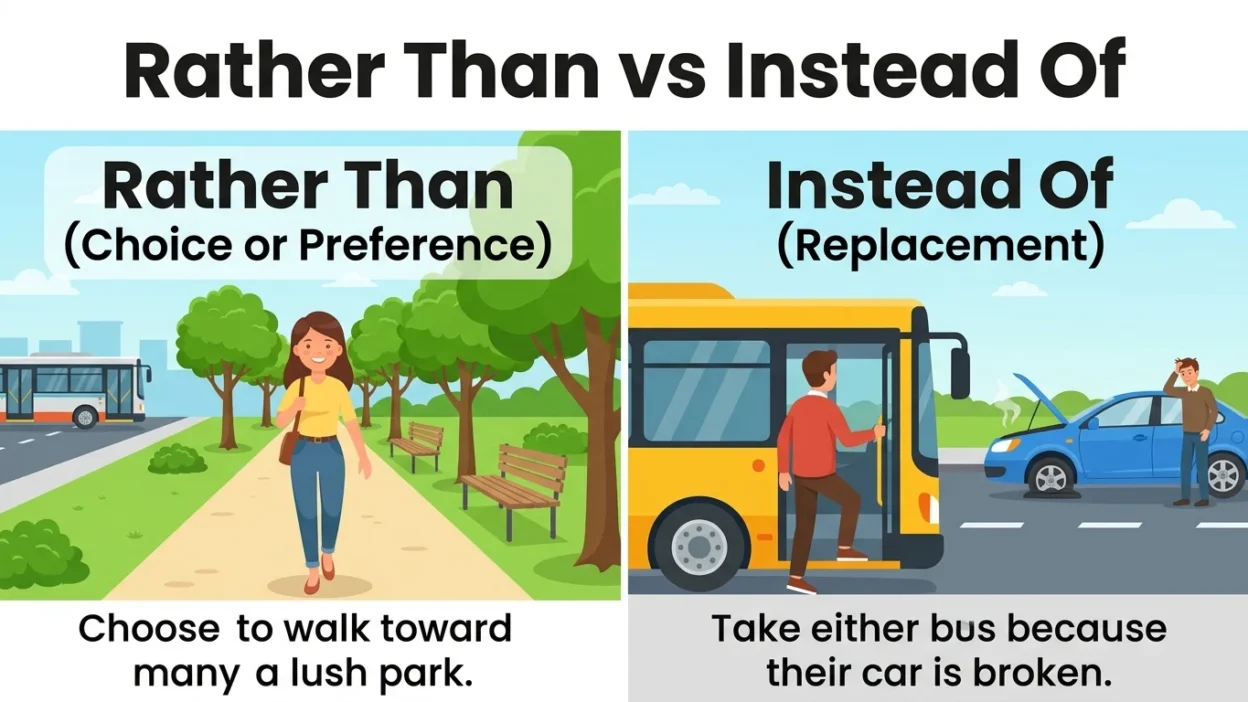
“Rather than” and “instead of” are closely related expressions used to show a choice, preference, or replacement. In many sentences, they can have very similar meanings. For example, “I stayed home rather than going out” and “I stayed home instead of going out” both show that staying home was chosen in place of going out.
However, the grammar and tone can be slightly different. Rather than often emphasizes a preference or choice between two possibilities, while instead of usually emphasizes replacement. “Instead of” is commonly followed by a noun, pronoun, or gerund, while “rather than” can be followed by different grammatical forms depending on the sentence. Understanding these patterns will help you use both expressions naturally.
Quick Answer
“Rather than” and “instead of” can both mean “in place of” or “as an alternative to.” “Rather than” often emphasizes a choice or preference, while “instead of” focuses more directly on replacement. For example, “I chose tea rather than coffee” and “I chose tea instead of coffee” have nearly the same meaning.
Why Do People Confuse “Rather Than” and “Instead Of”?
People often confuse these expressions because they can be used in very similar situations.
Compare:
She walked rather than taking the bus.
She walked instead of taking the bus.
Both sentences tell us that she walked and did not take the bus.
The main difference is often the emphasis.
Rather than can highlight the choice or preference.
Instead of can highlight the replacement.
The grammar can also vary, so it is useful to learn the common structures for each expression.
What Does “Rather Than” Mean?
“Rather than” means instead of, in preference to, or as an alternative to something.
It is often used when someone chooses one thing over another.
For example:
I would walk rather than wait.
The speaker prefers walking to waiting.
Another example:
She chose to study rather than go to the party.
The sentence presents studying as the preferred choice.
“Rather than” can also be used to connect two descriptions or actions.
What Does “Instead Of” Mean?
“Instead of” means in place of or as a replacement for something.
For example:
I had tea instead of coffee.
This means tea replaced coffee as the drink chosen.
Another example:
He took the train instead of the bus.
The train was used in place of the bus.
“Instead of” is very common in everyday English.
Rather Than vs Instead Of
| Expression | Main Meaning | Common Function |
|---|---|---|
| Rather than | Instead of or in preference to | Choice or preference |
| Instead of | In place of or as a replacement for | Replacement or alternative |
In many situations, both expressions are possible.
For example:
We stayed home rather than going out.
We stayed home instead of going out.
Both are natural.
When to Use “Rather Than”
Use rather than when you want to emphasize a choice, preference, or alternative.
For example:
I would walk rather than drive.
She chose to wait rather than complain.
He decided to study rather than watch television.
It is also common in more formal or carefully structured writing.
For example:
The company focused on quality rather than quantity.
This presents two alternatives and shows which one was preferred.
When to Use “Instead Of”
Use instead of when you want to show that one thing was used, done, or chosen in place of another.
For example:
I drank water instead of soda.
She called me instead of sending an email.
We took a taxi instead of walking.
“Instead of” is especially natural in everyday conversation.
Grammar After “Instead Of”
One important grammar rule is that instead of is normally followed by a noun, pronoun, or gerund.
Noun
I had tea instead of coffee.
Pronoun
She went instead of him.
Gerund
He stayed home instead of going out.
The gerund form is especially important when talking about two actions.
For example:
She studied instead of watching television.
Not:
She studied instead of watch television.
Grammar After “Rather Than”
Rather than can be followed by different grammatical forms.
For example:
I chose tea rather than coffee.
Noun after “rather than.”
She walked rather than taking the bus.
Gerund after “rather than.”
He decided to stay rather than leave.
Verb forms after “rather than.”
They focused on quality rather than quantity.
Nouns are being compared.
Because “rather than” has more flexibility, the structure depends on the sentence.
Rather Than vs Instead Of With Verbs
Both expressions can be used when comparing actions.
For example:
I stayed home rather than going out.
I stayed home instead of going out.
Both are correct.
Another example:
She called rather than sending a message.
She called instead of sending a message.
Again, both are natural.
The important point with instead of is that the verb normally takes the ing form.
12 Examples of “Rather Than”
1. I would walk rather than take the bus.
The speaker prefers walking.
2. She chose tea rather than coffee.
She selected tea as her preference.
3. He decided to stay home rather than go out.
He preferred staying home.
4. We focused on quality rather than quantity.
Quality was given greater importance.
5. She studied rather than watched television.
She chose studying over watching television.
6. I would call rather than send an email.
The speaker prefers calling.
7. They chose to repair the car rather than buy a new one.
Repairing the car was preferred.
8. He listened rather than argued.
He chose to listen instead of arguing.
9. She saved her money rather than spending it.
Saving was preferred to spending.
10. We decided to leave early rather than wait.
Leaving early was chosen over waiting.
11. He used simple words rather than complicated ones.
The speaker chose simple language.
12. I would stay quiet rather than cause an argument.
The speaker prefers staying quiet.
12 Examples of “Instead Of”
1. I had tea instead of coffee.
Tea replaced coffee.
2. She walked instead of taking the bus.
Walking replaced taking the bus.
3. He stayed home instead of going to the party.
Staying home replaced going to the party.
4. We used water instead of juice.
Water was chosen in place of juice.
5. She called instead of sending a message.
Calling replaced messaging.
6. He studied instead of watching television.
Studying replaced watching television.
7. They bought a used car instead of a new one.
The used car was chosen in place of a new car.
8. I cooked dinner instead of ordering food.
Cooking replaced ordering food.
9. She took the stairs instead of using the elevator.
The stairs were used in place of the elevator.
10. He worked from home instead of going to the office.
Working from home replaced going to the office.
11. We stayed inside instead of going to the park.
Staying inside replaced going to the park.
12. She sent a message instead of calling.
Messaging replaced calling.
Two Useful Comparison Tables
| Rather Than | Instead Of |
|---|---|
| I walked rather than taking the bus. | I walked instead of taking the bus. |
| She chose tea rather than coffee. | She chose tea instead of coffee. |
| He stayed home rather than going out. | He stayed home instead of going out. |
| We studied rather than watching television. | We studied instead of watching television. |
| They repaired it rather than buying a new one. | They repaired it instead of buying a new one. |
Another useful comparison:
| Situation | Natural Expression |
|---|---|
| Showing a preference | Rather than |
| Showing replacement | Instead of |
| Comparing two choices | Rather than |
| Everyday replacement | Instead of |
| Formal comparison | Rather than |
| Everyday conversation | Instead of |
These are tendencies, not strict rules. Both expressions can work in many of the same sentences.
Common Mistakes
Mistake 1: Using the wrong verb form after “instead of”
A common mistake is:
I stayed home instead of go out.
The natural form is:
I stayed home instead of going out.
After “instead of,” use a noun, pronoun, or gerund when you are describing an action.
Mistake 2: Thinking “rather than” and “instead of” are completely different
They overlap significantly.
For example:
I chose tea rather than coffee.
I chose tea instead of coffee.
Both are correct and have almost the same meaning.
Mistake 3: Assuming “rather than” is only formal
“Rather than” is common in both everyday and formal English.
For example:
I would walk rather than wait.
This is perfectly natural in conversation.
Mistake 4: Using “instead of” when you mean preference
Sometimes rather than sounds better when the main idea is preference.
For example:
I would stay home rather than go out.
This clearly presents staying home as the preferred choice.
Mistake 5: Forgetting the meaning of “rather”
In rather than, “rather” contributes to the idea of choosing one option over another.
For example:
She chose to read rather than watch television.
The sentence shows a preference between two activities.
Memory Trick
Use this simple rule:
Rather than = choose this, not that
Instead of = use this in place of that
For example:
I would walk rather than drive.
This emphasizes the choice.
I walked instead of driving.
This emphasizes what replaced driving.
The meanings are often very close, so context determines which expression sounds more natural.
American vs British English
“Rather than” and “instead of” are standard in both American English and British English.
There is no major difference in spelling or basic meaning between the two varieties.
Both American and British speakers commonly say:
I chose tea rather than coffee.
I chose tea instead of coffee.
She stayed home rather than going out.
She stayed home instead of going out.
The choice usually depends on sentence structure, emphasis, and personal style rather than regional English.
Rather Than vs Instead Of in Formal Writing
Both expressions can be used in formal writing.
However, rather than is often useful when comparing two ideas, choices, or priorities.
For example:
The organization focused on prevention rather than treatment.
This creates a clear contrast between two concepts.
“Instead of” can also work:
The organization focused on prevention instead of treatment.
Both are grammatically possible, although the first can sound more deliberate when presenting a contrast.
Rather Than vs Instead Of With Nouns
Both can be followed by nouns.
She chose tea rather than coffee.
She chose tea instead of coffee.
Both sentences are correct.
The first can emphasize the choice or preference.
The second can emphasize that tea replaced coffee.
Rather Than vs Instead Of With Gerunds
Both can be followed by an ing form.
He stayed home rather than going out.
He stayed home instead of going out.
Both are natural.
Remember that after instead of, the gerund is especially important when comparing two actions.
Is “Rather Than” More Formal Than “Instead Of”?
Not necessarily.
Both expressions are used in everyday English and formal writing.
However, rather than can sometimes sound more formal or deliberate when it is used to create a contrast.
For example:
The company values quality rather than speed.
This sounds suitable for formal writing.
But “instead of” is also perfectly possible:
The company values quality instead of speed.
The difference is mainly one of emphasis and style.
Final Verdict
“Rather than” and “instead of” often have the same basic meaning and can be interchangeable in many sentences.
Use rather than when emphasizing a choice, preference, or contrast.
Use instead of when emphasizing that one thing replaces another.
Remember:
Rather than = in preference to
Instead of = in place of
Both are correct, and the best choice depends on the sentence and the emphasis you want.
Frequently Asked Questions
What is the difference between “rather than” and “instead of”?
Both can mean “in place of,” but “rather than” often emphasizes choice or preference, while “instead of” often emphasizes replacement.
Can “rather than” and “instead of” be used interchangeably?
Yes, in many sentences they can be used interchangeably without changing the basic meaning.
Is “rather than” grammatically correct?
Yes. “Rather than” is a standard English expression used to show preference, choice, or contrast.
Is “instead of” followed by a verb?
When “instead of” is followed by an action, the verb normally takes the ing form.
For example:
She stayed home instead of going out.
Can I say “rather than going”?
Yes.
For example:
He stayed home rather than going to the party.
This is completely natural.
Which is more common in everyday English?
Both are common. “Instead of” is especially common for everyday replacement, while “rather than” is also very natural when expressing a preference or contrast.
Is “rather than” more formal?
It can sometimes sound more deliberate or formal, especially when comparing ideas, but it is also common in everyday conversation.
What is another word for “instead of”?
Depending on the sentence, alternatives include in place of, in lieu of, as an alternative to, or rather than.
Remember This
Rather than = in preference to
Instead of = in place of
Use rather than:
• To show preference
• To compare choices
• To create contrast
• To emphasize one option over another
Use instead of:
• To show replacement
• To describe what was used in place of something else
• In everyday situations
• Before a noun, pronoun, or gerund
For example:
I walked rather than drove.
I walked instead of driving.
Both communicate a similar idea.
Conclusion
“Rather than” and “instead of” are two closely related English expressions that often communicate the same basic idea. Both can show that one action, object, or choice was selected in place of another. The main difference is one of emphasis. Rather than often highlights preference or contrast, while instead of often highlights replacement.
Both expressions are common in American and British English. If you are talking about an everyday replacement, instead of is a very natural choice. If you are comparing two possibilities or emphasizing a preference, rather than can be especially useful. Once you understand these small differences, both expressions become easy to use naturally.

Adam Aaron is a language enthusiast and content writer at SimileHive, creating clear, engaging guides on similes, idioms, metaphors, and figurative language to help readers improve English confidently every day.