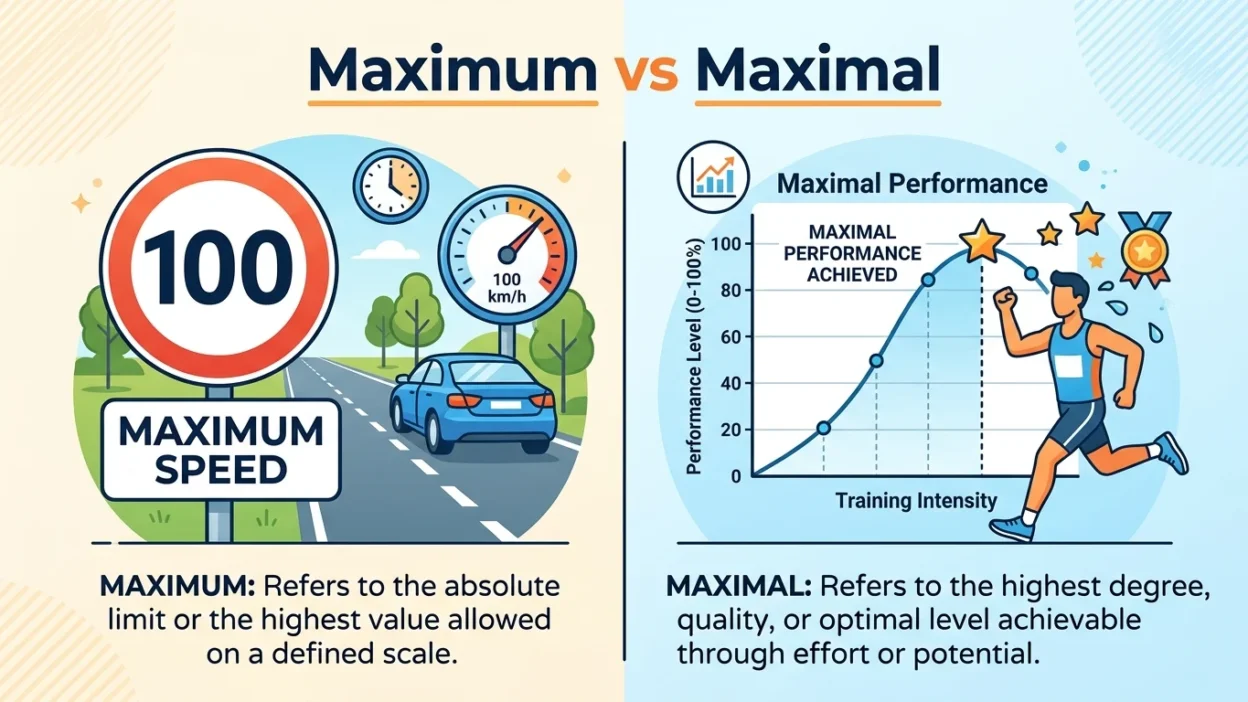
Maximum and maximal are closely related words, but they are used differently in English. Maximum can be a noun, adjective, or sometimes a verb, and it commonly refers to the greatest possible amount, number, level, or degree. For example, “The maximum speed is 100 kilometers per hour” means 100 kilometers per hour is the highest permitted speed.
Maximal is an adjective that means as great as possible or having the greatest possible value under particular conditions. It is more common in technical, scientific, mathematical, and academic contexts. For example, “The researchers achieved maximal performance” means they achieved the greatest level of performance possible under the relevant conditions. Knowing the difference helps you choose the natural word for everyday English and specialized writing.
Quick Answer
Maximum usually refers to the greatest amount, number, level, or limit. Maximal means as great as possible and is mainly used as an adjective, especially in technical or academic contexts. For everyday English, maximum is usually more natural. For example, “maximum speed” is common, while “maximal speed” sounds more specialized.
Why Do People Confuse “Maximum” and “Maximal”?
People confuse these words because both are connected with the idea of something being as great as possible.
For example:
The maximum speed is 120 km/h.
The system achieved maximal efficiency.
Both sentences describe something reaching or representing a high limit.
However, the grammar and context are different.
Maximum can function as a noun and adjective.
Maximal is an adjective.
The two words are related, but they are not always interchangeable.
What Does “Maximum” Mean?
Maximum means the greatest possible amount, number, level, degree, or limit.
For example:
The maximum capacity is 500 people.
This means 500 is the greatest number of people the place can hold.
As an adjective:
The maximum temperature will be 35°C.
Here, “maximum” describes the highest temperature.
As a noun:
The temperature reached a maximum of 35°C.
Here, “maximum” means the highest point or value.
What Does “Maximal” Mean?
Maximal is an adjective meaning as great as possible or having the greatest possible value under particular conditions.
For example:
The treatment produced maximal results.
This means the results reached the greatest possible level under the relevant conditions.
Another example:
The machine was operating at maximal efficiency.
This means the machine was operating at its highest possible efficiency.
“Maximal” is more common in specialized contexts such as mathematics, science, medicine, linguistics, and academic writing.
Maximum vs Maximal
| Word | Part of Speech | Main Meaning | Common Use |
|---|---|---|---|
| Maximum | Noun and adjective | Greatest amount, level, number, or limit | Everyday and technical English |
| Maximal | Adjective | As great as possible | Technical and academic English |
The simplest distinction is:
Maximum = the greatest limit or amount
Maximal = as great as possible
When to Use “Maximum”
Use maximum when talking about a highest limit, amount, number, or level.
For example:
The maximum speed is 80 mph.
There is a maximum of four students per group.
The maximum temperature reached 40°C.
The room has a maximum capacity of 200 people.
“Maximum” is extremely common in everyday English.
You will see it on:
Signs
Instructions
Tickets
Rules
Forms
Product labels
Scientific reports
When to Use “Maximal”
Use maximal when you need an adjective meaning as great as possible, especially when discussing a particular condition, process, or technical measurement.
For example:
The drug produced maximal pain relief.
The researchers observed maximal activity.
The system was operating at maximal efficiency.
The experiment required maximal effort.
Although these sentences are grammatically possible, everyday English may often prefer maximum, greatest, or highest, depending on the sentence.
Maximum and Maximal in Everyday English
In ordinary conversation, maximum is much more common.
For example:
The maximum speed is 60 mph.
This sounds completely natural.
You could technically say:
The maximal speed is 60 mph.
But this sounds more technical and is not the normal choice for an ordinary speed limit.
Similarly:
Get the maximum benefit from the program.
is more natural in everyday English than:
Get the maximal benefit from the program.
The second version sounds more specialized.
Maximum and Maximal in Technical English
In technical writing, maximal can be useful because it can describe something that reaches the greatest possible value under a particular set of conditions.
For example:
The algorithm finds a maximal solution.
The experiment produced maximal activation.
The patient reached maximal exercise capacity.
The word can be especially useful when writers need to distinguish a particular technical concept from the ordinary idea of a maximum.
Maximum vs Maximal in Mathematics
Both words can appear in mathematics, but they can have different technical meanings.
A maximum is the greatest value in a particular set or under particular conditions.
For example:
The maximum of the function is 10.
10 is the maximum value.
The adjective maximal can describe something that cannot be extended or increased while preserving certain conditions.
For example, mathematics may use terms such as:
maximal element
maximal set
maximal solution
In these contexts, maximal has a specific technical meaning and should not simply be replaced with maximum.
12 Examples of “Maximum”
1. The maximum speed is 100 kilometers per hour.
The sentence gives the highest permitted speed.
2. The room has a maximum capacity of 300 people.
Three hundred is the greatest number of people allowed or possible.
3. You can stay for a maximum of two hours.
Two hours is the greatest permitted amount of time.
4. The maximum temperature today will be 32°C.
This refers to the highest temperature expected.
5. The elevator has a maximum weight limit.
The sentence refers to the greatest weight the elevator can safely carry.
6. The maximum score is 100 points.
One hundred is the highest possible score.
7. The machine can operate at a maximum speed of 5,000 revolutions per minute.
The sentence describes the highest possible operating speed.
8. The maximum number of guests is six.
Six is the greatest number allowed.
9. The temperature reached a maximum of 40°C.
Forty degrees was the highest temperature recorded.
10. We need to get the maximum benefit from this opportunity.
The speaker wants to gain as much benefit as possible.
11. The battery has a maximum capacity of 5,000 mAh.
The sentence gives the highest capacity.
12. The athlete reached his maximum heart rate during the final stage.
The sentence refers to the highest heart rate reached.
12 Examples of “Maximal”
1. The researchers aimed for maximal efficiency.
They wanted to achieve the greatest possible efficiency.
2. The treatment provided maximal pain relief.
The treatment provided the greatest level of pain relief under the relevant conditions.
3. The machine was operating at maximal capacity.
The machine was operating at its highest possible capacity.
4. The experiment required maximal concentration.
The experiment required the greatest possible level of concentration.
5. The team made a maximal effort to complete the project.
The team made the greatest possible effort.
6. The drug produced maximal therapeutic effects.
The effects reached the greatest relevant level.
7. The system was designed for maximal performance.
The system was designed to perform as well as possible.
8. The patient reached maximal exercise capacity.
The patient reached the highest level of exercise capacity measured in the relevant test.
9. The researchers observed maximal activity in this region.
The activity reached its highest observed level.
10. The software was configured for maximal security.
The software was configured to provide the greatest possible level of security.
11. The study focused on achieving maximal accuracy.
The study aimed for the highest possible level of accuracy.
12. The intervention produced maximal improvement under the tested conditions.
The intervention produced the greatest improvement observed under those conditions.
Two Useful Comparison Tables
| Expression | Meaning | Natural Example |
|---|---|---|
| Maximum speed | Highest possible or permitted speed | The maximum speed is 100 km/h. |
| Maximal speed | Speed at the greatest possible level | The vehicle reached maximal speed. |
| Maximum capacity | Highest capacity or limit | The maximum capacity is 500 people. |
| Maximal capacity | Capacity at the greatest possible level | The system operated at maximal capacity. |
| Maximum benefit | Greatest benefit | We want the maximum benefit. |
| Maximal benefit | Benefit at the greatest possible level | The treatment produced maximal benefit. |
Another useful comparison:
| Situation | More Natural Choice |
|---|---|
| Everyday limit | Maximum |
| Speed limit | Maximum |
| Maximum number of people | Maximum |
| Maximum score | Maximum |
| Technical description | Maximum or maximal, depending on meaning |
| Academic description of the highest possible level | Maximal |
| Mathematical technical term | Maximal when it has a specific technical meaning |
Common Mistakes
Mistake 1: Using “maximal” everywhere
“Maximal” is a real English word, but it is not the normal replacement for “maximum” in every sentence.
For example:
The maximum speed is 80 km/h.
is much more natural than:
The maximal speed is 80 km/h.
in ordinary English.
Mistake 2: Thinking the words are always interchangeable
They are related, but they can have different grammatical and technical functions.
Maximum can be a noun.
Maximal is an adjective.
Mistake 3: Using “maximal” for ordinary limits
For signs, rules, instructions, and everyday limits, maximum is usually the natural choice.
For example:
Maximum capacity: 50 people.
Mistake 4: Assuming “maximum” is only an adjective
“Maximum” can also be a noun.
For example:
The temperature reached a maximum of 35°C.
Mistake 5: Replacing a technical term with “maximum”
In specialized subjects, maximal can have a precise meaning.
For example:
maximal element
and
maximum value
are not necessarily interchangeable mathematical concepts.
Memory Trick
Use this simple rule:
Maximum = the highest limit
Maximal = as great as possible
Think about a speed sign:
Maximum speed = 100 km/h
Now think about a technical description:
The system achieved maximal efficiency.
The first gives a limit.
The second describes something reaching the greatest possible level.
American vs British English
Maximum and maximal are standard in both American English and British English.
There is no major spelling difference between the two varieties.
The main difference is related to usage and context, not geography.
Both American and British speakers commonly use:
maximum speed
maximum capacity
maximum amount
maximum number
“Maximal” is also used in both varieties, especially in technical, scientific, mathematical, and academic contexts.
Maximum vs Greatest
Maximum and greatest can sometimes express similar ideas.
For example:
The maximum possible speed is 120 km/h.
The greatest possible speed is 120 km/h.
Both can be correct.
However, maximum is especially useful when talking about a defined limit or value.
For example:
The maximum capacity is 500 people.
This sounds more natural than:
The greatest capacity is 500 people.
Maximum vs Optimal
These words are not the same.
Maximum means the greatest possible amount or level.
Optimal means the best or most suitable under particular conditions.
For example:
The maximum temperature is 40°C.
This means 40°C is the highest temperature.
The optimal temperature is 25°C.
This means 25°C is considered the best temperature for the particular purpose.
Something can be optimal without being maximum.
Final Verdict
Maximum and maximal are related words, but they are not always interchangeable.
Use maximum for the greatest amount, number, level, or limit. It is the natural choice in most everyday English.
Use maximal as an adjective when describing something as great as possible, especially in technical, scientific, mathematical, or academic contexts.
The easiest rule is:
Maximum = highest limit or value
Maximal = as great as possible
Frequently Asked Questions
What is the difference between maximum and maximal?
“Maximum” usually refers to the greatest amount, number, level, or limit. “Maximal” is an adjective meaning as great as possible and is more common in technical or academic contexts.
Is maximal a synonym for maximum?
They are closely related, but they are not always interchangeable. “Maximum” can be a noun or adjective, while “maximal” is an adjective and can have specialized technical meanings.
Is “maximum speed” or “maximal speed” correct?
Both can occur, but “maximum speed” is much more natural in everyday English. “Maximal speed” sounds more technical.
Is “maximal” a real word?
Yes. “Maximal” is a standard English adjective meaning as great as possible or having the greatest possible value under particular conditions.
Can maximum be a noun?
Yes. For example, “The temperature reached a maximum of 35°C.”
Is maximum more common than maximal?
Yes. “Maximum” is much more common in everyday English, while “maximal” appears more often in specialized or academic contexts.
What is the difference between maximal and optimal?
“Maximal” means as great as possible. “Optimal” means best or most suitable for a particular purpose or set of conditions.
Are maximum and maximal different in American and British English?
Both words are used in American and British English. The main difference is context rather than regional spelling or grammar.
Remember This
Maximum = the highest limit or value.
Maximal = as great as possible.
Use maximum for:
• Speed limits
• Capacity limits
• Maximum scores
• Maximum numbers
• Maximum amounts
• Everyday measurements
Use maximal mainly when discussing:
• Technical concepts
• Scientific research
• Mathematics
• Academic writing
• The greatest possible level under specific conditions
Remember:
Maximum speed
Maximum capacity
Maximum score
but:
Maximal efficiency
Maximal performance
Maximal response
Conclusion
The words maximum and maximal both express the idea of reaching a high or greatest possible level, but their everyday uses are different. Maximum is the more common word and is used for limits, values, amounts, numbers, and measurements. It works naturally in ordinary conversation as well as technical writing.
Maximal is an adjective meaning as great as possible and is more common in specialized contexts. It can also have a precise technical meaning in subjects such as mathematics and science.
When you are talking about an ordinary limit, maximum is usually the better choice. When describing something as reaching the greatest possible level under particular conditions, maximal may be appropriate.

Lucas Luke is a passionate language writer and content creator at SimileHive, specializing in similes, idioms, metaphors, and figurative language. He enjoys making complex English expressions simple, engaging, and easy to understand for students, writers, and language enthusiasts through well-researched, practical content.