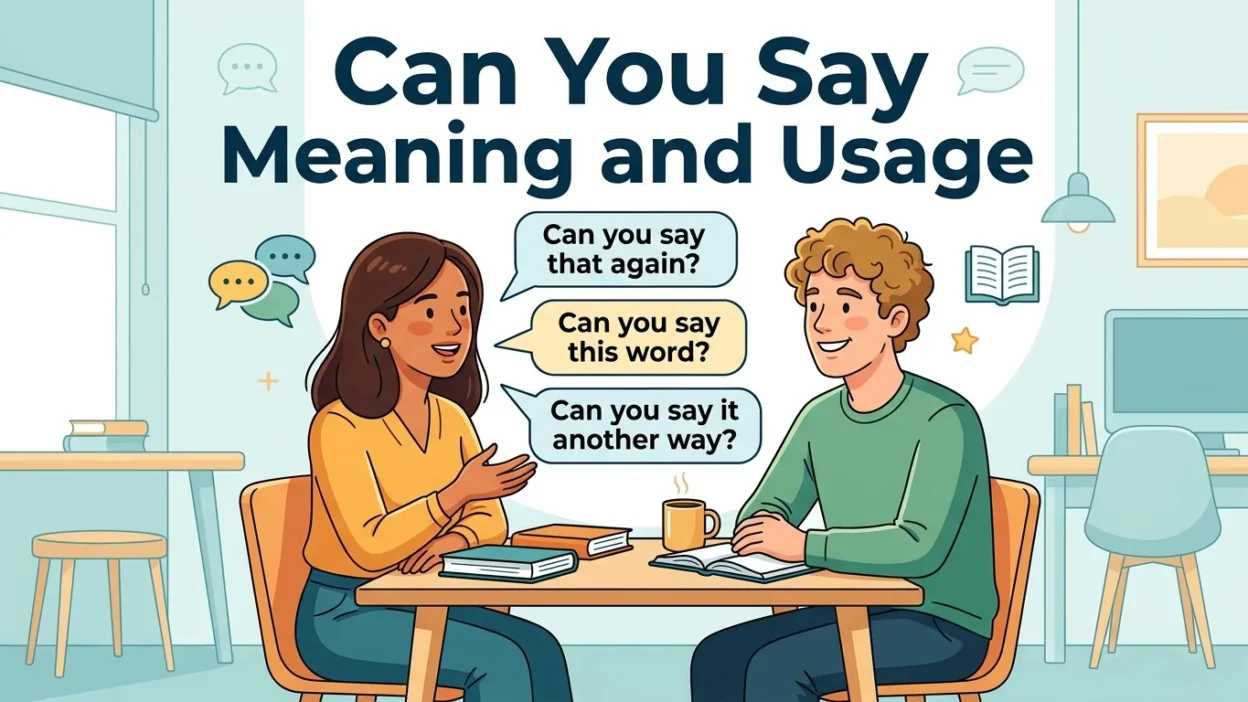
The phrase “can you say” is commonly used in English to ask if someone is able or willing to say something. It can be a simple request, as in “Can you say that again?”, or it can introduce a word, phrase, or idea that someone wants another person to pronounce or explain. The exact meaning depends on the sentence and situation.
“Can you say” is also useful when talking about pronunciation, repeating information, expressing something in different words, or asking someone to give an example. It is a very common phrase in everyday English, so learners may hear it in classrooms, conversations, interviews, and casual discussions. Understanding its different uses can help you sound more natural and confident when speaking or writing English.
Quick Answer
“Can you say” is used to ask someone whether they can or will say something. It can mean “Are you able to say this?”, “Could you repeat this?”, or “Can you express this in another way?” For example, “Can you say that again?” politely asks someone to repeat what they said.
Why Do People Confuse “Can You Say”?
People sometimes find “can you say” confusing because the phrase can have different meanings depending on the words that follow it.
For example:
Can you say your name?
This asks someone to state their name.
Can you say that again?
This asks someone to repeat something.
Can you say it in simpler words?
This asks someone to express the same idea differently.
The basic structure stays the same, but the purpose changes according to the context.
What Does “Can You Say” Mean?
“Can you say” is a question structure used to ask someone to say, repeat, pronounce, or express something.
The word can often refers to ability, but in questions it can also be used to make a request.
For example:
Can you say this word?
This can ask whether the person is able to pronounce the word.
Can you say that again?
This is a request for repetition.
Can you say what happened?
This asks someone to explain or state what happened.
So, “can you say” does not have just one fixed meaning.
Can You Say Something?
Yes. “Can you say something?” is grammatically correct.
It can mean:
Can you speak?
Can you give me a response?
Can you tell me something?
The context determines the exact meaning.
For example:
Can you say something about your experience?
Here, the speaker is asking the person to talk about their experience.
Can You Say That Again?
“Can you say that again?” is one of the most common uses of the phrase.
It means:
Please repeat what you just said.
For example:
A: The meeting starts at three.
B: Sorry, can you say that again?
This is a natural and polite way to ask someone to repeat information.
You can also say:
Could you say that again?
This sounds slightly more polite or formal.
Can You Say It?
“Can you say it?” usually means “Can you say the thing we are talking about?”
For example:
The word is difficult. Can you say it?
Here, the speaker wants the other person to pronounce the word.
It can also be used when someone is reluctant to say something.
For example:
You know what happened. Can you say it?
Here, the speaker is asking the person to state the information.
Can You Say This?
“Can you say this?” is commonly used when asking someone to pronounce or repeat particular words.
For example:
Can you say this word correctly?
Can you say this sentence aloud?
Can you say this name again?
The phrase is especially common in language learning situations.
Can You Say It in Another Way?
This expression asks someone to explain or express an idea differently.
For example:
Can you say it in another way?
This means:
Can you explain the same idea differently?
Other natural alternatives include:
Can you put that another way?
Can you explain that differently?
Could you rephrase that?
These expressions are useful when something is difficult to understand.
Can You Say vs Could You Say
Both expressions are correct.
| Expression | Meaning | Typical Use |
|---|---|---|
| Can you say that again? | Please repeat it | Everyday conversation |
| Could you say that again? | Please repeat it | More polite or slightly more formal |
| Can you say this word? | Can you pronounce it? | Learning and conversation |
| Could you say this word? | Can you pronounce it? | Polite request |
Can you is very common in everyday English.
Could you can sound a little more polite, although both are natural.
When to Use “Can You Say”
Use “can you say” when you want someone to:
• Repeat something
• Pronounce a word
• State information
• Explain something
• Express an idea differently
• Give an example
• Speak about a particular topic
For example:
Can you say that again?
Can you say your name slowly?
Can you say what happened?
Can you say it in simpler English?
12 Examples of “Can You Say”
1. Can you say that again?
This asks someone to repeat what they just said.
2. Can you say your name, please?
This asks someone to state their name.
3. Can you say this word aloud?
This asks someone to pronounce the word.
4. Can you say it more slowly?
This asks someone to speak more slowly.
5. Can you say what happened?
This asks someone to explain or describe what happened.
6. Can you say that in simpler English?
This asks someone to express the same idea using easier words.
7. Can you say the sentence one more time?
This asks someone to repeat the sentence.
8. Can you say this name correctly?
This asks about pronunciation.
9. Can you say why you chose this option?
This asks someone to explain their reason.
10. Can you say something about your family?
This asks someone to talk about their family.
11. Can you say it another way?
This asks someone to rephrase an idea.
12. Can you say what you mean?
This asks someone to explain their intended meaning more clearly.
Two Useful Comparison Tables
| Expression | Meaning | Example |
|---|---|---|
| Can you say that again? | Please repeat it | Can you say that again? |
| Can you say it slowly? | Speak more slowly | Can you say it slowly? |
| Can you say this word? | Pronounce the word | Can you say this word? |
| Can you say what happened? | Explain what happened | Can you say what happened? |
| Can you say it another way? | Rephrase the idea | Can you say it another way? |
| Can you say something about it? | Talk about it | Can you say something about it? |
Another useful comparison:
| Situation | Natural Expression |
|---|---|
| You did not hear someone | Can you say that again? |
| A word is difficult | Can you say this word? |
| Someone is speaking too quickly | Can you say it more slowly? |
| Something is difficult to understand | Can you say it in simpler words? |
| You want an explanation | Can you say why? |
| You want a different explanation | Can you say it another way? |
Common Mistakes
Mistake 1: Thinking “can” only means ability
In “Can you say that again?”, the speaker is usually making a request.
It does not simply mean:
Are you physically capable of saying it?
It naturally means:
Please repeat what you said.
Mistake 2: Using “can you say” without context
The phrase is usually followed by information about what the speaker wants.
For example:
Can you say that again?
Can you say your name?
Can you say it more clearly?
Without context, “Can you say?” may sound incomplete.
Mistake 3: Confusing “say” and “tell”
Say focuses on the words someone speaks.
Tell usually focuses on giving information to someone.
Compare:
Can you say that again?
Can you tell me what happened?
Both are useful, but they have different structures.
Mistake 4: Using “say” when “speak” is more natural
Can you say English? is usually unnatural if you mean whether someone knows how to communicate in English.
Say:
Can you speak English?
But:
Can you say this word in English?
is perfectly natural when asking for the English word or pronunciation.
Mistake 5: Assuming “can you say” always means repetition
It can also mean pronunciation, explanation, or expression.
For example:
Can you say this word?
asks about pronunciation.
Can you say it another way?
asks for a different expression.
Memory Trick
Remember:
Can you say = Can you speak these words?
Then look at what comes next.
Can you say that again?
Repeat it.
Can you say this word?
Pronounce it.
Can you say why?
Explain the reason.
Can you say it another way?
Rephrase it.
The words after “can you say” usually tell you exactly what the speaker wants.
American vs British English
“Can you say” is standard and natural in both American English and British English.
There is no important regional difference in the basic meaning or grammar.
Both American and British speakers commonly say:
Can you say that again?
Can you say your name?
Can you say it more slowly?
Can you say that in another way?
The choice between can and could is more about politeness and context than American versus British English.
Can You Say vs Can You Tell Me
These expressions are related but have different structures.
Can you say that again?
asks someone to repeat their words.
Can you tell me what happened?
asks someone to provide information.
Compare:
Can you say your name?
Can you tell me your name?
Both can be natural, but “Can you tell me your name?” is often more natural when directly asking someone for their name.
Can You Say vs Can You Speak
Say focuses on particular words or information.
Speak usually focuses on the act of talking or someone’s ability to communicate in a language.
For example:
Can you say this word?
This asks about pronouncing a particular word.
Can you speak English?
This asks whether someone can communicate in English.
Another example:
Can you say that again?
Can you speak more slowly?
The first asks for repetition.
The second asks for a change in speaking speed.
Is “Can You Say” Polite?
Yes, “Can you say” can be polite, especially in everyday conversation.
For example:
Sorry, can you say that again?
This is a very natural request.
If you want to sound more formal or especially polite, you can use:
Could you say that again, please?
Would you mind saying that again?
The level of politeness depends on the situation, tone, and words around the request.
Final Verdict
“Can you say” is a common English question used to ask someone to say, repeat, pronounce, explain, or rephrase something.
Its meaning depends on the words that follow it.
Can you say that again? means repeat it.
Can you say this word? means pronounce it.
Can you say why? means explain the reason.
Can you say it another way? means rephrase it.
The phrase is natural in both American and British English and is especially common in everyday conversation and language learning.
Frequently Asked Questions
What does “can you say” mean?
“Can you say” is used to ask whether someone can or will say something. Depending on the context, it can ask for repetition, pronunciation, explanation, or rephrasing.
What does “can you say that again” mean?
“Can you say that again?” means “Please repeat what you just said.” It is a common and polite expression in everyday English.
Is “can you say” grammatically correct?
Yes. “Can you say” is a grammatically correct question structure when followed by the appropriate information.
Is “can you say that again” polite?
Yes. It is a natural and generally polite way to ask someone to repeat something. “Could you say that again?” can sound slightly more polite or formal.
What is the difference between “can you say” and “can you tell”?
“Can you say” usually focuses on the words someone speaks, while “can you tell” usually focuses on giving information.
What is the difference between “can you say” and “can you speak”?
“Say” usually refers to particular words or information. “Speak” generally refers to talking or communicating in a language.
Can “can you say” be used for pronunciation?
Yes. For example, “Can you say this word?” can ask someone to pronounce a word.
Can “can you say” ask for a different explanation?
Yes. “Can you say it another way?” asks someone to express the same idea differently.
Remember This
Can you say = a request or question about saying something.
It can mean:
• Repeat something
• Pronounce something
• State something
• Explain something
• Rephrase something
• Talk about something
Remember these examples:
Can you say that again? = Repeat it.
Can you say this word? = Pronounce it.
Can you say why? = Explain the reason.
Can you say it another way? = Rephrase it.
The context tells you which meaning is intended.
Conclusion
The phrase “can you say” is a simple but highly useful part of everyday English. It can be used when asking someone to repeat information, pronounce a word, explain something, give an answer, or express an idea differently. Because the phrase has several uses, the words that come after it are important for understanding its exact meaning.
For English learners, some of the most useful expressions are “Can you say that again?”, “Can you say this word?”, and “Can you say it another way?” These forms are natural in both American and British English. Once you understand how the phrase works, you can use it confidently in conversations, classrooms, and everyday situations.

Adam Aaron is a language enthusiast and content writer at SimileHive, creating clear, engaging guides on similes, idioms, metaphors, and figurative language to help readers improve English confidently every day.