
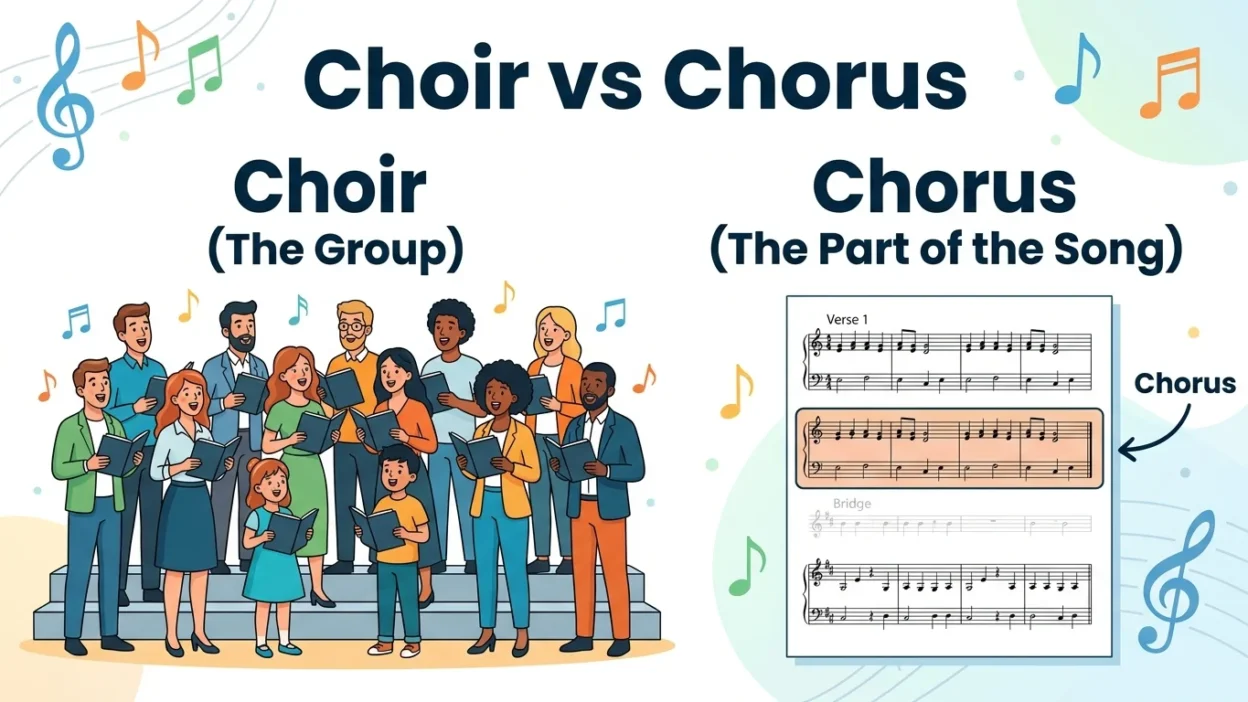
Choir and chorus are closely related words because both can refer to a group of people who sing together. However, they are not always interchangeable. A choir is generally a group of singers who perform together, often under the direction of a conductor. A chorus can also mean a group of singers, but it has several additional meanings in music, songs, theater, and poetry.
The difference becomes especially important when talking about musical performances. A choir can perform many kinds of songs, while a chorus can refer to the group of singers, a repeated section of a song, or a section of a musical or opera.
In everyday English, the two words may sometimes describe the same group of singers. The exact meaning depends on the context. Understanding these differences will help you choose the right word naturally.
Quick Answer
A choir is a group of people who sing together, usually as an organized musical group. A chorus can also mean a group of singers, but it can additionally mean a repeated part of a song or a singing group in an opera, musical, or play. The two words overlap, but they are not always interchangeable.
Why Do People Confuse “Choir” and “Chorus”?
People confuse choir and chorus because both words can describe groups of singers.
For example:
The school choir performed at the concert.
The school chorus performed at the concert.
Depending on the educational or regional context, both may be understandable.
The confusion increases because chorus has several meanings.
It can refer to:
• A group of singers
• A repeated section of a song
• A group of performers in an opera or musical
• A repeated line or phrase in poetry or drama
Choir is more specifically associated with an organized group of singers.
What Does “Choir” Mean?
A choir is a group of people who sing together.
Choirs can perform in:
• Churches
• Schools
• Universities
• Concert halls
• Community events
• Competitions
• Religious services
A choir may include different vocal parts, such as:
Soprano
Alto
Tenor
Bass
For example:
The church choir sang beautifully during the service.
Here, “choir” refers to the organized group of singers.
What Does “Chorus” Mean?
Chorus has several meanings.
The first meaning is a group of singers who perform together.
For example:
The chorus sang the final section of the opera.
A second common meaning is a repeated section of a song.
For example:
Everyone joined in during the chorus.
Here, “chorus” does not mean a group of people. It means the part of the song that is repeated.
A third meaning is a group of performers in a musical, opera, or theatrical production.
For example:
The chorus entered the stage during the final scene.
Choir vs Chorus
| Word | Main Meaning | Example |
|---|---|---|
| Choir | Organized group of singers | The choir performed beautifully. |
| Chorus | Group of singers | The chorus sang together. |
| Chorus | Repeated part of a song | Everyone sang the chorus. |
| Chorus | Group of performers in a musical or opera | The chorus entered the stage. |
The biggest difference is that choir usually refers to a singing group, while chorus has several meanings beyond a singing group.
When to Use “Choir”
Use choir when you are talking about an organized group of singers.
For example:
She joined the school choir.
The church choir practices every Wednesday.
Our choir performed at the festival.
The choir director taught us a new song.
“Choir” is especially natural when the group regularly practices and performs together.
When to Use “Chorus”
Use chorus when you mean a group of singers in a musical setting or a repeated part of a song.
For example:
The chorus sang beautifully.
This refers to a group.
But:
I love the chorus of this song.
Here, “chorus” means the repeated section of the song.
You can also say:
The chorus entered during the second act.
Here, it refers to performers in a theatrical or musical production.
12 Examples of “Choir”
1. She joined the school choir last year.
She became a member of an organized singing group.
2. The choir performed at the Christmas concert.
The organized group of singers performed publicly.
3. Our church choir practices every Thursday.
The group regularly rehearses together.
4. The choir sang three beautiful songs.
The sentence refers to the entire group of singers.
5. He has been a member of the choir for five years.
The person belongs to an organized singing group.
6. The choir director taught us a new song.
The director works with the singing group.
7. The university choir traveled to another city for a competition.
The group performed in a singing competition.
8. Everyone applauded when the choir finished singing.
The audience applauded the group.
9. My daughter loves singing in the choir.
She enjoys participating in the singing group.
10. The choir rehearsed before the concert.
The singers practiced together.
11. The school has separate choirs for different age groups.
The school has several organized singing groups.
12. The choir sounded wonderful in the large hall.
The sentence describes the sound produced by the group.
12 Examples of “Chorus”
1. Everyone sang the chorus together.
Here, “chorus” means the repeated part of the song.
2. I really like the chorus of this song.
The word refers to a repeated section of music.
3. The chorus entered the stage during the second act.
Here, “chorus” refers to a group of performers.
4. The chorus sang behind the main performers.
The group provided additional singing.
5. The audience joined in during the chorus.
The audience sang the repeated section of the song.
6. The chorus was easy to remember.
Here, “chorus” means a repeated section of a song.
7. The opera includes a large chorus.
The word refers to a group of singers in an opera.
8. The chorus returned at the end of the song.
The repeated musical section appeared again.
9. The musical featured a talented chorus.
Here, “chorus” refers to a group of performers.
10. The children learned the chorus first.
The children learned the repeated part of the song.
11. The chorus responded to the soloist.
The group of singers responded to the main singer.
12. The final chorus was the most memorable part of the performance.
Here, “chorus” refers to a musical section.
Two Useful Comparison Tables
| Situation | Better Word | Example |
|---|---|---|
| Organized singing group | Choir | She joined the choir. |
| Group of singers in an opera | Chorus | The chorus entered the stage. |
| Repeated section of a song | Chorus | I love the chorus. |
| School singing group | Choir | He sings in the school choir. |
| Church singing group | Choir | The church choir performed. |
| Musical theater singing group | Chorus | The chorus sang during the scene. |
Another useful comparison:
| Expression | Meaning |
|---|---|
| Join the choir | Become a member of an organized singing group |
| Sing in the choir | Participate in a choir |
| Sing the chorus | Sing the repeated section of a song |
| The chorus sings | A group of singers performs |
| The chorus returns | The repeated musical section appears again |
| Choir practice | Rehearsal by an organized singing group |
Common Mistakes
Mistake 1: Assuming “chorus” always means a group
Not always.
For example:
I love the chorus of this song.
Here, “chorus” means a repeated section of the song.
Mistake 2: Assuming “choir” means a part of a song
Usually, it does not.
Choir generally refers to a group of singers.
So:
She joined the choir.
is correct.
Mistake 3: Thinking choir and chorus are always interchangeable
Sometimes they overlap, but they can have different meanings.
A choir is generally an organized group of singers.
A chorus can be a group of singers or a repeated part of a song.
Mistake 4: Using “choir” for a repeated song section
Do not say:
I love the choir of this song.
when you mean the repeated part.
Say:
I love the chorus of this song.
Mistake 5: Assuming chorus only refers to popular music
“Chorus” is also used in opera, musical theater, poetry, and other forms of performance.
Memory Trick
Use this simple trick:
Choir = people
Chorus = people or part of a song
If you are talking about a regular group of singers, think:
Choir.
If you are talking about the repeated section of a song, think:
Chorus.
For example:
I joined the choir.
I love the chorus.
American vs British English
Both choir and chorus are standard words in American and British English.
There is no major spelling difference between the two varieties.
However, the exact use of the words can vary somewhat depending on the musical tradition, institution, or region.
In both American and British English:
Choir commonly means an organized group of singers.
Chorus can mean a group of singers or a repeated section of a song.
Some schools or organizations may use chorus instead of choir for their singing groups. This is a naming choice rather than a major difference in meaning.
Choir vs Chorus in School
Schools may use either word when naming a singing group.
For example:
School Choir
or:
School Chorus
Both can refer to a group of students who sing together.
However, choir is especially common for an organized vocal group that rehearses and performs together.
The exact terminology depends on the school or educational system.
Choir vs Chorus in Music
In music, the distinction can become clearer.
A choir is generally a group of singers.
A chorus can refer to:
• A group of singers
• A repeated part of a song
• A section of an opera
• A section of a musical
• A group of performers
For example:
The choir performed the song.
The group is being discussed.
The chorus was repeated three times.
The repeated musical section is being discussed.
Choir vs Chorus in Opera
The word chorus is especially common in opera.
An opera chorus is a group of singers who perform as part of the production.
For example:
The opera chorus entered during the final scene.
A choir can also perform classical music, including large vocal works, but chorus is a common term for the collective singers in an opera or similar stage production.
Is a Choir the Same as a Chorus?
Sometimes, but not always.
A choir and a chorus can both refer to a group of singers.
However, chorus has additional meanings.
For example:
The choir performed at the concert.
This refers to a singing group.
The chorus of the song was repeated twice.
This refers to a musical section.
Therefore, the words overlap when referring to groups of singers, but chorus has a broader range of meanings.
Is “Choir” Only Used for Religious Singing?
No.
Although choirs have a strong historical connection with churches and religious music, choirs can perform many types of music.
There are:
School choirs
Community choirs
University choirs
Children’s choirs
Professional choirs
Gospel choirs
Concert choirs
So “choir” does not automatically mean a religious singing group.
Final Verdict
Choir and chorus can both refer to groups of singers, but they are not always interchangeable.
Use choir when you mean an organized group of singers.
Use chorus when you mean a group of singers in certain musical or theatrical settings, or when you mean the repeated section of a song.
The easiest rule is:
Choir = singing group
Chorus = singing group or repeated song section
Frequently Asked Questions
What is the difference between choir and chorus?
A choir is generally an organized group of singers. A chorus can also mean a group of singers, but it can additionally mean the repeated section of a song or a group of performers in an opera or musical.
Is a choir the same as a chorus?
Sometimes the words can refer to the same type of singing group, but “chorus” has additional meanings that “choir” does not normally have.
Is chorus the part of a song that repeats?
Yes. In many songs, the chorus is the section that repeats and often contains the main hook or central message of the song.
Is choir only for church music?
No. Choirs can perform religious, classical, popular, traditional, and many other types of music.
Can a school have a chorus instead of a choir?
Yes. Some schools use “chorus” as the name for their student singing group.
Which is more common, choir or chorus?
It depends on the context. “Choir” is common for organized singing groups, while “chorus” is common when discussing repeated song sections, opera, musical theater, and certain singing groups.
What is an opera chorus?
An opera chorus is a group of singers who perform as part of an opera production.
What is the plural of choir?
The plural is choirs.
The plural of chorus is choruses.
Remember This
Choir = an organized group of singers.
Chorus = a group of singers or a repeated part of a song.
Remember these points:
• A choir is usually a singing group.
• A chorus can be a singing group.
• A chorus can also be a repeated song section.
• Chorus is common in opera and musical theater.
• Choirs can be religious or nonreligious.
• Both words are used in American and British English.
• The context determines the correct word.
The easiest rule is:
People singing together = choir
Repeated song section = chorus
Conclusion
The words choir and chorus are closely related because both can describe groups of singers. A choir is generally an organized group that practices and performs together. A chorus can also refer to a group of singers, especially in opera or musical theater, but the word has another very common meaning: the repeated section of a song.
When choosing between the two, think about what you are describing. If you mean a group of singers, choir is often the natural choice. If you mean a repeated section of a song, use chorus.
If you are talking about singers in an opera or musical, chorus may also be the appropriate term. Understanding the context makes the difference much easier to remember.

Lucas Luke is a passionate language writer and content creator at SimileHive, specializing in similes, idioms, metaphors, and figurative language. He enjoys making complex English expressions simple, engaging, and easy to understand for students, writers, and language enthusiasts through well-researched, practical content.