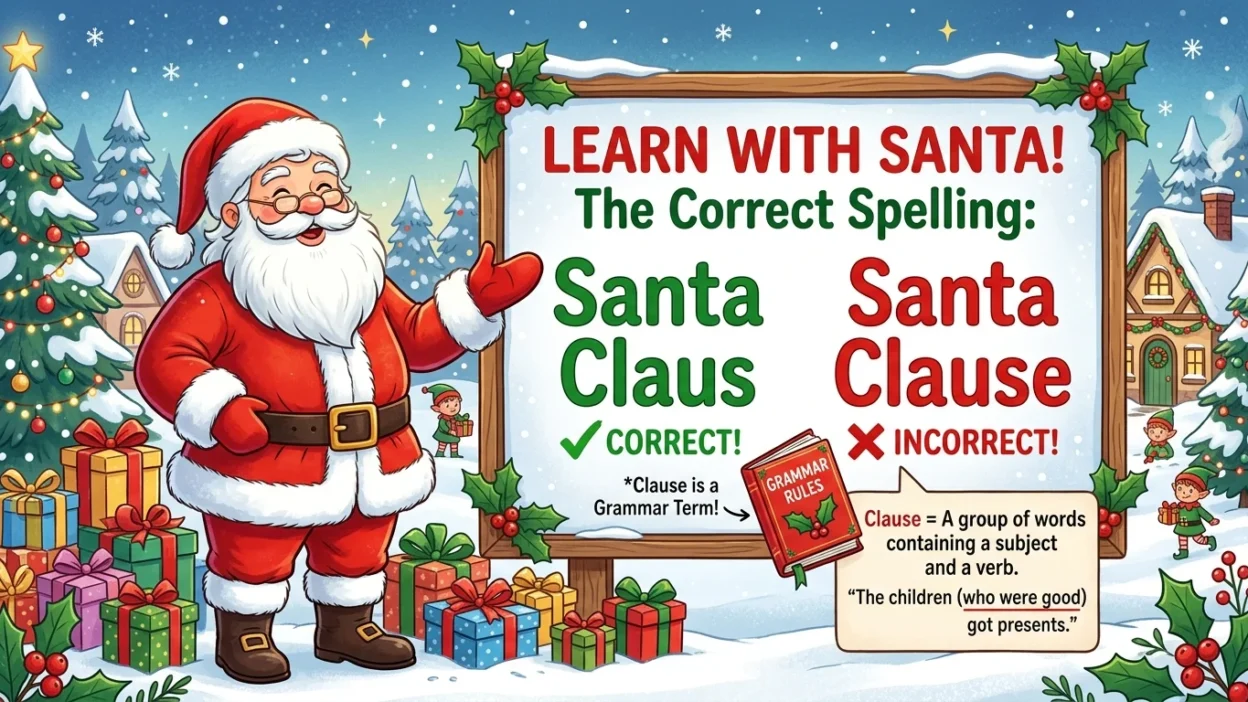
If you are wondering whether the correct expression is Santa Claus or Santa Clause, the correct spelling for the Christmas figure is Santa Claus. Santa Clause is usually a spelling mistake when someone means the man associated with Christmas, presents, reindeer, and Christmas Eve. The confusion happens because Claus and clause sound almost the same in many varieties of English.
The word Claus is part of the name Santa Claus, while clause is a completely different English word used in grammar and law. A clause is a group of words containing a subject and a verb, or a specific section of a legal document or agreement.
Although the two words look and sound similar, they have different meanings and origins. Understanding this difference will help you remember which spelling to use when talking about the Christmas character.
Quick Answer
Santa Claus is the correct spelling for the Christmas figure. Santa Clause is normally incorrect when referring to him. Claus is a name, while clause is an English word referring to a grammatical unit or a section of a legal or formal document.
Why Do People Confuse “Santa Claus” and “Santa Clause”?
People often confuse these two expressions because Claus and clause are pronounced very similarly.
The spelling difference is small:
Claus
Clause
The extra e in “clause” makes it look like it might belong in the name “Santa Claus,” but it does not.
The correct name is:
Santa Claus
The incorrect version is:
Santa Clause
This mistake is especially common when people hear the name before seeing it written.
What Does “Santa Claus” Mean?
Santa Claus is the traditional Christmas figure associated with giving presents to children.
He is commonly described as a cheerful man with a white beard who wears a red suit and travels with reindeer.
Other names for Santa Claus include:
Santa
Saint Nicholas
Saint Nick
Father Christmas
Kris Kringle
The exact traditions and names can vary between cultures and regions.
What Does “Claus” Mean?
In Santa Claus, “Claus” is part of the person’s name.
The name is historically connected with Nicholas, particularly Saint Nicholas, a Christian figure associated with generosity and gift giving.
The modern Santa Claus tradition developed from several historical and cultural traditions over time.
So when you write the name of the Christmas character, use:
Santa Claus
What Does “Clause” Mean?
Clause is a completely different word.
In grammar, a clause is a group of words that contains a subject and a verb.
For example:
She smiled
is a clause because it contains the subject she and the verb smiled.
In legal and formal writing, a clause can also mean a particular section of a contract, agreement, or document.
For example:
The contract contains a confidentiality clause.
Here, “clause” has nothing to do with Santa Claus.
Santa Claus vs Santa Clause
| Word or Expression | Meaning | Example |
|---|---|---|
| Santa Claus | The traditional Christmas figure | Santa Claus brings presents. |
| Santa | Short form of Santa Claus | The children are waiting for Santa. |
| Claus | Part of the name Santa Claus | Claus is the correct spelling here. |
| Clause | A grammatical unit or document section | The contract contains a payment clause. |
The main difference is simple:
Claus = Santa’s name
Clause = a grammar or legal term
When to Use “Santa Claus”
Use Santa Claus when talking about the Christmas figure.
For example:
Santa Claus is coming tonight.
The children wrote letters to Santa Claus.
Santa Claus is often shown wearing a red suit.
We watched a movie about Santa Claus.
Use Santa Claus in stories, articles, conversations, Christmas cards, school assignments, and other situations involving the Christmas tradition.
When to Use “Clause”
Use clause when talking about grammar, contracts, agreements, or specific sections of documents.
For example:
This sentence contains two clauses.
Read the final clause of the contract carefully.
The agreement includes a cancellation clause.
The teacher explained the difference between an independent clause and a dependent clause.
“Clause” has no connection to the Christmas character.
12 Examples of “Santa Claus”
1. The children are excited to see Santa Claus.
The sentence refers to the traditional Christmas figure.
2. We left some cookies for Santa Claus.
This refers to the common Christmas tradition of leaving food for Santa.
3. Santa Claus is coming tonight.
The sentence refers to the traditional story about Santa visiting homes on Christmas Eve.
4. The children wrote letters to Santa Claus.
Here, Santa Claus is the person receiving the letters.
5. My nephew dressed up as Santa Claus.
The child dressed as the Christmas character.
6. Santa Claus is often shown with a white beard.
This describes the traditional appearance of Santa.
7. We saw Santa Claus at the shopping center.
The sentence describes a person dressed as Santa.
8. The story begins with Santa Claus preparing his sleigh.
Santa Claus is the main character in the Christmas story.
9. Many children enjoy stories about Santa Claus.
The sentence refers to stories involving the Christmas figure.
10. Santa Claus is traditionally associated with Christmas Eve.
This describes a common Christmas tradition.
11. The children asked whether Santa Claus was real.
The sentence refers to the traditional Christmas character.
12. We put the presents under the tree and waited for Santa Claus.
The sentence uses the correct spelling of the name.
Two Useful Comparison Tables
| Situation | Correct Word | Example |
|---|---|---|
| Christmas character | Claus | Santa Claus |
| Grammar | Clause | The sentence has two clauses. |
| Legal document | Clause | The contract contains a payment clause. |
| Contract condition | Clause | Check the cancellation clause. |
| Christmas story | Claus | The story features Santa Claus. |
Another useful comparison:
| Incorrect or Correct | Explanation |
|---|---|
| Santa Claus | Correct name |
| Santa Clause | Usually incorrect when referring to Santa |
| Christmas clause | Can be correct if referring to a grammatical or legal clause related to Christmas |
| Santa’s clause | Could be grammatically possible in a special context, but does not mean Santa Claus |
| Santa’s Claus | Incorrect for the Christmas character |
Common Mistakes
Mistake 1: Writing “Santa Clause”
A common spelling mistake is:
Santa Clause
When referring to the Christmas figure, write:
Santa Claus
Mistake 2: Thinking “clause” is part of Santa’s name
“Clause” is an ordinary English word.
It is not the correct spelling of the name.
Remember:
Santa Claus
not:
Santa Clause
Mistake 3: Confusing “clause” with “Claus”
The words look and sound similar, but they have completely different meanings.
Claus is part of Santa Claus’s name.
Clause is a grammatical or legal term.
Mistake 4: Using lowercase “claus”
When writing the name of the Christmas figure, use a capital letter:
Santa Claus
“Claus” is part of a proper name.
Mistake 5: Assuming the extra “e” is harmless
The difference may look small, but spelling matters.
Claus and clause are different words.
Memory Trick
Use this simple trick:
Santa Claus has no E.
Remember:
Santa Claus 🎅
Clause = grammar or contract
You can also remember:
Claus = Christmas
Clause = language or law
If you are talking about the man who delivers Christmas presents, choose Claus.
American vs British English
The spelling Santa Claus is standard in both American and British English.
However, the names used for the Christmas figure can differ by region.
In American English, Santa Claus and Santa are extremely common.
In British English, Father Christmas is also a traditional name for the Christmas figure, although Santa Claus and Santa are widely understood and used as well.
The word clause has the same basic spelling and meanings in both American and British English.
So the spelling difference is not an American versus British English issue.
Santa Claus is the correct spelling in both varieties.
Santa Claus vs Father Christmas
These expressions can refer to closely related Christmas traditions.
| Expression | Common Association |
|---|---|
| Santa Claus | Common in American English and widely understood internationally |
| Santa | Informal short form of Santa Claus |
| Father Christmas | Traditional British English expression |
| Saint Nicholas | Historical and religious figure associated with the Santa tradition |
| Saint Nick | Informal name connected with Saint Nicholas |
The exact traditions surrounding these figures vary across cultures.
Santa Claus vs Clause in Grammar
It is useful to keep the two words completely separate.
Consider these examples:
Santa Claus came to town.
Here, Claus is part of a proper name.
The sentence contains a dependent clause.
Here, clause is a grammar term.
The spelling and meaning are different.
Is “Santa Clause” Ever Correct?
It can technically appear in a sentence if clause is being used in its normal meaning and the context makes sense.
For example:
The Christmas contract contains a special clause.
Here, “clause” refers to a section of a document.
However, if you are trying to name the Christmas character, Santa Clause is not the correct spelling.
The correct name is:
Santa Claus
Final Verdict
The correct spelling of the Christmas character is Santa Claus.
Santa Clause is normally a spelling mistake when someone means Santa.
Remember the difference:
Claus = Santa’s name
Clause = a grammatical or legal term
The easiest memory trick is:
Santa Claus has no E.
Frequently Asked Questions
Is it Santa Claus or Santa Clause?
The correct spelling is Santa Claus when referring to the Christmas character.
Why is Santa called Santa Claus?
The name is connected historically with Saint Nicholas and developed through several European and American Christmas traditions.
Is “Santa Clause” wrong?
Yes, if you mean the Christmas character. The correct spelling is Santa Claus.
What does “clause” mean?
A clause can be a group of words containing a subject and a verb, or a section of a legal or formal document.
Is Claus a word?
“Claus” is primarily encountered as a name, especially in the expression Santa Claus.
Is Santa Claus used in British English?
Yes. “Santa Claus” is understood and used in British English, although Father Christmas is also a traditional British expression.
Is Santa Claus one word?
No. Santa Claus consists of two words.
What is the easiest way to remember Santa Claus?
Remember:
Santa Claus has no E.
The word with e, “clause,” is used for grammar and legal documents.
Remember This
Santa Claus = Christmas character
Clause = grammar or legal term
Remember these points:
• Santa Claus is the correct spelling.
• Santa Clause is normally incorrect when referring to Santa.
• Claus is part of a proper name.
• Clause is a separate English word.
• Both words sound very similar.
• The spelling difference is important.
• Santa Claus is used in both American and British English.
The easiest rule is:
Christmas = Claus
Grammar or contracts = clause
Conclusion
The correct spelling is Santa Claus, not Santa Clause, when you are talking about the traditional Christmas figure. The confusion is understandable because “Claus” and “clause” look and sound very similar.
However, they have completely different meanings. “Claus” is part of Santa’s name, while “clause” refers to a grammatical unit or a section of a legal or formal document.
If you are writing a Christmas story, greeting, school assignment, social media post, or article, use Santa Claus. If you are talking about sentence structure or contracts, use clause. A simple way to remember the difference is that Santa Claus has no E.

Charles Kevin is a passionate language writer and researcher at SimileHive, creating clear, engaging content about similes, idioms, metaphors, and figurative language to help readers improve English communication confidently every day.