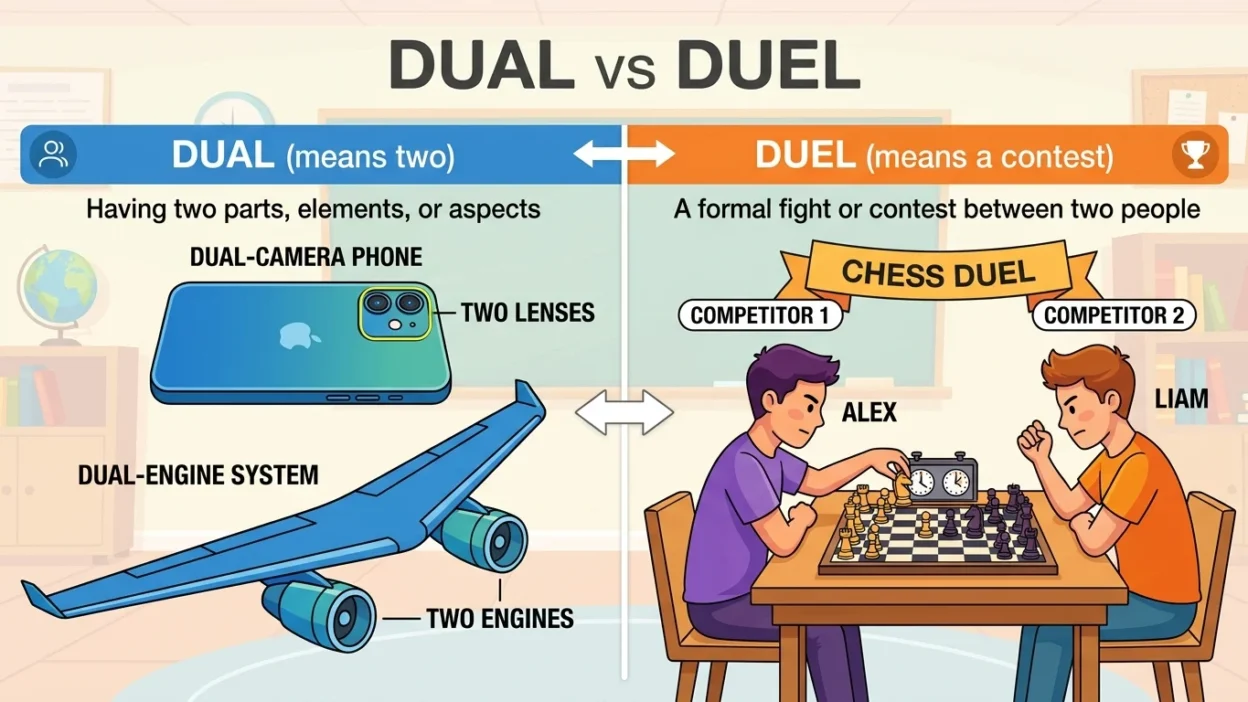
“Dual” and “duel” sound exactly the same, but they have completely different meanings. Dual is an adjective that means having two parts, two features, two purposes, or two of something.
For example, “She has dual citizenship” means she is legally a citizen of two countries. “Dual” is commonly used when talking about two roles, functions, identities, or systems.
Duel, on the other hand, is a noun or verb related to a fight or competition between two people. Traditionally, a duel was a formal fight between two people using weapons.
Today, “duel” can also be used more broadly for a direct contest between two competitors. For example, “The two players faced off in a fierce duel” means they competed directly against each other. Although the words sound the same, their meanings and uses are very different.
Quick Answer
Dual means having two parts, purposes, or features. Duel means a fight or direct contest between two people. They are homophones because they sound alike but have different spellings and meanings. Remember: dual = two, while duel = fight or contest.
Why Do People Confuse “Dual” and “Duel”?
The main reason people confuse these words is pronunciation.
Dual and duel are pronounced the same or almost the same in standard English.
However, their meanings are completely different.
Dual is connected with the idea of two.
Duel is connected with the idea of a fight or contest.
Because the words sound alike, you need to look at the context and spelling to choose the correct one.
What Does “Dual” Mean?
Dual is an adjective meaning having two of something or involving two parts.
For example:
The car has dual airbags.
This means the car has two airbags of the type being discussed.
You can use “dual” to describe:
• Two purposes
• Two functions
• Two identities
• Two roles
• Two systems
• Two citizenships
• Two options or aspects
Examples of “Dual”
She has dual citizenship.
The device has a dual purpose.
He has a dual role in the company.
The camera has a dual lens system.
What Does “Duel” Mean?
Duel is a noun or verb that refers to a fight or direct contest between two people.
Traditionally, a duel was a formal fight between two people, often using weapons.
For example:
The two soldiers fought a duel.
Today, the word can also be used figuratively for a direct competition.
For example:
The two tennis players had a thrilling duel.
Here, “duel” means a close and intense contest.
Dual vs Duel
| Word | Meaning | Part of Speech | Example |
|---|---|---|---|
| Dual | Having two parts or features | Adjective | The machine has a dual function. |
| Duel | A fight or contest between two people | Noun or verb | The two fighters agreed to duel. |
Dual and Duel Pronunciation
Both words are commonly pronounced like “doo uhl.”
This makes them homophones.
Other examples of homophones include:
flower and flour
pair and pear
right and write
sea and see
Just as these words have different meanings despite similar pronunciation, dual and duel must be distinguished by their spelling and context.
When to Use “Dual”
Use dual when you are talking about two parts, two functions, two roles, or two aspects of something.
Example 1
The phone has a dual camera.
The phone has two cameras in the system.
Example 2
She has dual citizenship.
She is a citizen of two countries.
Example 3
The building has a dual purpose.
The building serves two purposes.
Example 4
He has a dual role as a teacher and administrator.
He performs two different roles.
Example 5
The machine has dual controls.
The machine has two sets of controls.
Example 6
This software provides dual protection.
The software provides two forms of protection.
When to Use “Duel”
Use duel when talking about a fight or direct competition between two people.
Example 1
The two warriors fought a duel.
They fought each other directly.
Example 2
The movie ends with a dramatic duel.
The movie ends with a dramatic fight between two people.
Example 3
The two players entered a fierce duel.
They competed directly against each other.
Example 4
The rivals challenged each other to a duel.
They challenged each other to a formal fight or contest.
Example 5
The two champions dueled for the title.
They competed directly for the title.
Example 6
The final match became a duel between two talented players.
The match became a direct contest between two competitors.
12 Examples of Dual and Duel
1. The car has dual airbags.
“Dual” means there are two airbags.
2. The two knights fought a duel.
“Duel” means a fight between two people.
3. She has dual citizenship.
She has citizenship in two countries.
4. The movie features a dramatic duel.
The movie includes a dramatic fight or contest.
5. The machine has a dual function.
It has two functions.
6. The rivals challenged each other to a duel.
They challenged each other to a direct fight.
7. He has a dual role in the organization.
He has two roles.
8. The two competitors had a long duel.
They had a long and intense contest.
9. The camera uses a dual lens system.
The system has two lenses.
10. The story ends with a duel between the two heroes.
The heroes fight each other.
11. The device offers dual connectivity.
It provides two types of connectivity.
12. The championship became a duel between the two strongest players.
The competition became a direct contest between two competitors.
Dual vs Duel Comparison Table
| Feature | Dual | Duel |
|---|---|---|
| Pronunciation | Usually pronounced the same as duel | Usually pronounced the same as dual |
| Meaning | Having two parts or features | A fight or direct contest |
| Main idea | Two | Fighting or competing |
| Part of speech | Usually adjective | Noun or verb |
| Example | Dual citizenship | A sword duel |
| Memory clue | Two | Fight |
Common Mistakes
Mistake 1: Writing “duel citizenship”
Incorrect:
She has duel citizenship.
Correct:
She has dual citizenship.
Citizenship involves two countries, so dual is correct.
Mistake 2: Writing “dual” for a fight
Incorrect:
The knights fought a dual.
Correct:
The knights fought a duel.
A fight between two people is a duel.
Mistake 3: Confusing “dual purpose” and “duel purpose”
Correct:
The tool has a dual purpose.
This means the tool has two purposes.
Mistake 4: Confusing “dual” with “duel” in competition
If two people are directly fighting or competing, duel may be appropriate.
For example:
The two champions engaged in a duel.
Memory Trick
The easiest way to remember the difference is:
Dual = two
The word dual is related to the idea of two.
Think:
Dual = two things.
For duel, think:
Duel = two people fighting.
A simple memory sentence is:
Dual means two, duel means fight.
American vs British English
There is no major difference between American English and British English in the meanings or spellings of dual and duel.
Both varieties use:
dual for something involving two.
duel for a fight or direct contest.
For example:
She has dual nationality.
The two competitors had a duel.
The distinction is the same in both varieties of English.
Similar Words
Double
“Double” means twice as much or consisting of two.
I ordered a double portion.
Twofold
“Twofold” means having two parts or aspects.
The problem has a twofold cause.
Fight
“Fight” means to use physical force against someone or to engage in conflict.
The two men started a fight.
Contest
“Contest” means a competition.
They entered a singing contest.
Competition
“Competition” refers to a situation in which people or groups compete.
There is strong competition between the two teams.
Dual vs Double
“Dual” and “double” are related, but they are not always interchangeable.
Dual often emphasizes two separate functions, roles, systems, or aspects.
Double often means twice as much or twice the number.
Compare:
She has a dual role.
She has two different roles.
She received double pay.
She received twice the usual amount of pay.
Duel vs Fight
“Duel” is more specific than “fight.”
A traditional duel involves two people fighting each other directly, often according to some rules or convention.
“Fight” is much broader.
For example:
The two swordsmen fought a duel.
The two men got into a fight.
A duel is a type of fight, but not every fight is a duel.
Final Verdict
Dual and duel sound alike but have completely different meanings.
Use dual when you mean two parts, features, functions, roles, or aspects.
Use duel when you mean a fight or direct contest between two people.
The easiest rule to remember is:
Dual = two
Duel = fight
Frequently Asked Questions
What is the difference between dual and duel?
“Dual” means involving two parts, features, or aspects. “Duel” means a fight or direct contest between two people.
Is it dual citizenship or duel citizenship?
The correct expression is dual citizenship because the person has citizenship in two countries.
Is it a dual or a duel?
If you mean a fight or contest between two people, the correct word is duel.
Are dual and duel pronounced the same?
Yes, they are commonly pronounced the same or almost the same in standard English.
Is duel a noun or a verb?
“Duel” can be both a noun and a verb.
As a noun:
They fought a duel.
As a verb:
The two warriors dueled.
What does dual mean in simple English?
“Dual” means having two parts, purposes, functions, roles, or features.
What does duel mean in simple English?
“Duel” means a fight or direct contest between two people.
Is dual the same as double?
Not always. “Dual” emphasizes two separate parts or aspects, while “double” often means twice as much or twice the number.
Remember This
Keep this simple rule in mind:
Dual = two
Duel = fight
Examples:
Dual citizenship
Dual purpose
Dual role
But:
A sword duel
A duel between rivals
The two fighters dueled
If the meaning involves two, think dual.
If the meaning involves a fight or contest, think duel.
Conclusion
“Dual” and “duel” are easy to confuse because they sound alike, but they perform different jobs in English. Dual is an adjective used for things that involve two parts, features, purposes, roles, or aspects. You can see it in expressions such as “dual citizenship,” “dual purpose,” and “dual role.”
Duel refers to a fight or direct contest between two people and can be used as both a noun and a verb. Remember the simple connection: dual means two, while duel means fight. Once you connect each spelling with its meaning, these two homophones become much easier to use correctly.

Adam Aaron is a language enthusiast and content writer at SimileHive, creating clear, engaging guides on similes, idioms, metaphors, and figurative language to help readers improve English confidently every day.