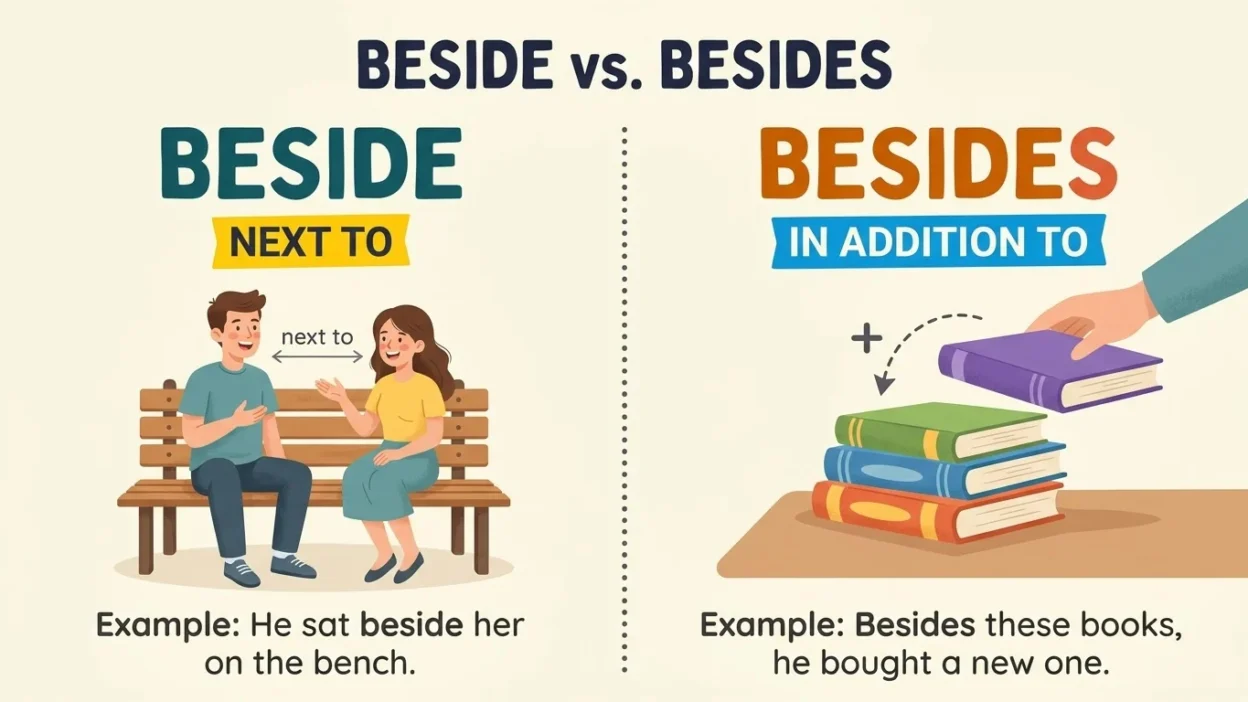
The words beside and besides look almost identical, but they have different meanings and uses. Both are correct English words, yet choosing the wrong one can change the meaning of a sentence. The main difference is that beside usually means next to or at the side of something, while besides can mean in addition to or apart from. It can also introduce an extra point in a sentence.
Understanding beside vs besides is important for students, English learners, and anyone who wants to communicate clearly. Although the difference is only one letter, these words are not interchangeable in every situation. This guide explains their meanings, grammatical roles, differences, and common uses with simple examples. By the end, you will know when to use beside and when besides is the better choice.
Quick Answer: Beside vs Besides
Beside is a preposition that means next to or at the side of someone or something. Besides can mean in addition to or apart from. It can also work as an adverb meaning moreover or furthermore. Use beside when describing physical position and besides when adding information or referring to something additional.
Why Do People Confuse Beside and Besides?
People often confuse beside and besides because they share almost the same spelling and pronunciation. The only visible difference is the letter s at the end of besides.
Both words can also appear before nouns and pronouns, which makes their grammatical use seem similar.
However, their meanings are different:
- Beside describes where someone or something is located.
- Besides adds another person, thing, reason, or piece of information.
For example:
- She sat beside her mother. (She sat next to her mother.)
- Besides her mother, her father attended the event. (Her father attended in addition to her mother.)
What Does Beside Mean?
Beside is a preposition that means next to, close to, or at the side of someone or something.
It describes the physical position of a person or object in relation to another person or object.
Examples of Beside in Sentences
- She sat beside me during the meeting.
- The school is beside the library.
- Please put your bag beside the chair.
- He stood beside his brother for the photograph.
- A small table was placed beside the bed.
- The dog rested beside its owner.
- I found my keys beside the telephone.
- There is a beautiful garden beside our house.
- The teacher stood beside the student.
- She placed her phone beside the laptop.
In each example, beside indicates a position next to someone or something.
What Are Common Expressions With Beside?
Beside also appears in a few established expressions.
Beside oneself: Extremely worried, upset, or excited.
Example: She was beside herself with joy when she heard the news.
Beside the point: Not relevant to the main subject or discussion.
Example: Your personal opinion is beside the point. We need to focus on the facts.
Beside the question: Not relevant to what is being discussed.
Example: Whether he likes the idea is beside the question.
What Does Besides Mean?
Besides has two main uses. It can function as a preposition or an adverb.
1. Besides as a Preposition
As a preposition, besides means in addition to, apart from, or other than, depending on the context.
It introduces an additional person, thing, or consideration.
Examples:
- Besides English, she speaks French and Spanish.
- Besides my parents, nobody knew about the plan.
- Besides the main course, we ordered two desserts.
- Who besides you knows the answer?
- Besides his regular job, he runs a small business.
- Besides mathematics, I enjoy studying science.
- Besides the cost, we should consider the quality.
- Nobody besides Sarah attended the meeting.
2. Besides as an Adverb
As an adverb, besides means moreover, furthermore, or in addition to what has already been mentioned.
It introduces another reason, fact, or point.
Examples:
- I do not want to go out. Besides, it is raining.
- She is an excellent teacher. Besides, she is very patient.
- We should leave early. Besides, the traffic may be heavy.
- I cannot afford that phone. Besides, I do not need a new one.
- He has plenty of experience. Besides, he knows the industry well.
In these examples, besides adds another point to support or explain the statement.
Beside vs Besides: Comparison Table
| Feature | Beside | Besides |
|---|---|---|
| Main meaning | Next to or at the side of | In addition to or apart from |
| Part of speech | Preposition | Preposition and adverb |
| Describes location | Yes | Not usually |
| Adds information | No | Yes |
| Example | Sit beside me. | Besides me, she invited John. |
| Another use | Beside the point | Besides, I disagree. |
When Should You Use Beside or Besides?
Choosing between these words becomes easier when you consider what you want to express.
When to Use Beside
Use beside when you are describing the position of a person or object.
Examples:
- The lamp is beside the sofa.
- He parked his car beside the building.
- She walked beside her grandfather.
- Keep the notebook beside your computer.
A useful question to ask yourself is: Does the sentence mean next to?
If the answer is yes, beside is usually the correct choice.
When to Use Besides
Use besides when you mean in addition to, apart from, or moreover.
Examples:
- Besides John, everyone agreed with the decision.
- Besides cooking, she enjoys gardening.
- I do not want to buy it. Besides, it is too expensive.
- Besides his salary, he receives several benefits.
A useful question to ask yourself is: Does the sentence add another person, thing, reason, or point?
If the answer is yes, besides is likely the correct choice.
Beside vs Besides: Examples in Everyday English
Here are more examples to help you understand the difference.
Examples Using Beside
- My brother is sitting beside me.
- The restaurant is beside the hotel.
- Put the flowers beside the window.
- She placed her shoes beside the door.
- A young boy stood beside his father.
- The bicycle was lying beside the road.
Examples Using Besides
- Besides coffee, we also serve tea.
- Besides being intelligent, she is hardworking.
- I have no other choice. Besides, I am already committed.
- Besides the manager, three employees attended the meeting.
- Nobody besides my best friend knows the truth.
- Besides working full time, he studies at university.
Common Mistakes to Avoid
Even experienced English speakers sometimes mix up beside and besides. Here are some mistakes to watch for.
Mistake 1: Using Besides to Describe Physical Position
Incorrect: The chair is besides the table.
Correct: The chair is beside the table.
Explanation: The sentence describes the chair’s location, so beside is correct.
Mistake 2: Using Beside to Mean In Addition To
Incorrect: Beside English, she studies German.
Correct: Besides English, she studies German.
Explanation: The sentence introduces an additional subject, so besides is needed.
Mistake 3: Confusing Besides With Beside in a Longer Sentence
Incorrect: Beside his job, he also volunteers at a local charity.
Correct: Besides his job, he also volunteers at a local charity.
Explanation: The sentence means that volunteering is something he does in addition to his job.
Mistake 4: Forgetting the Additional Meaning of Besides
Incorrect: I do not want to travel. Beside, I have no money.
Correct: I do not want to travel. Besides, I have no money.
Explanation: Besides introduces an additional reason.
Easy Memory Trick: How to Remember Beside vs Besides
Use these simple tips to remember the difference:
- Beside = Side: Both words contain the idea of a side. Think of something located at the side of another thing.
- Besides = Extra: Think of the final s as a reminder that something extra is being added.
- Beside = Location: If you can replace the word with next to, use beside.
- Besides = Addition: If you can replace the word with in addition to or moreover, use besides.
For example:
- The cat is beside the sofa. (The cat is next to the sofa.)
- Besides the cat, we have two dogs. (In addition to the cat, we have two dogs.)
Is Beside or Besides More Common in American and British English?
Both beside and besides are standard words in American English and British English.
There is no major difference in their basic meanings or grammatical uses between the two varieties.
Examples in both varieties:
- She sat beside her friend.
- Besides mathematics, he studies physics.
- Besides, we have enough time.
Therefore, you do not need to choose a different word based on whether you are writing in American or British English. Choose according to the meaning you want to express.
What Are Some Similar Words and Expressions?
Understanding related words can make the difference between beside and besides even clearer.
| Word or Expression | Meaning | Example |
|---|---|---|
| Next to | At the side of | The shop is next to the bank. |
| Alongside | Beside or together with | She worked alongside her colleagues. |
| Near | At a short distance from | The hotel is near the airport. |
| In addition to | As well as something else | In addition to English, he speaks Arabic. |
| Moreover | Used to add information | Moreover, the plan is affordable. |
| Furthermore | Used to introduce another point | Furthermore, we need more time. |
| Apart from | Except for or in addition to | Apart from John, everyone arrived early. |
Remember that these expressions are related in meaning, but they are not always interchangeable in every sentence.
Final Verdict: Beside vs Besides
The difference between beside and besides is simple once you understand their meanings.
Beside means next to or at the side of someone or something. Use it when describing physical position.
Besides means in addition to or apart from when used as a preposition. As an adverb, it means moreover or furthermore.
For example, in the sentence “She sat beside her sister,” beside describes location. In “Besides her sister, her brother attended the event,” besides introduces an additional person.
Both words are correct, but they serve different purposes. Remembering the difference will help you use them confidently in speaking and writing.
Frequently Asked Questions (FAQs)
1. What is the main difference between beside and besides?
Beside means next to or at the side of someone or something. Besides means in addition to, apart from, or moreover. The correct choice depends on the meaning of the sentence.
2. Is beside or besides correct?
Both are correct English words. However, they have different meanings. Use beside for physical position and besides when adding information or referring to something additional.
3. Can besides mean next to?
No. Besides does not normally mean next to. Use beside when describing the physical position of someone or something.
4. Can beside mean in addition to?
No. Beside generally means next to or at the side of. Use besides when you mean in addition to or apart from.
5. Is besides a preposition or an adverb?
Besides can be both a preposition and an adverb. As a preposition, it means in addition to or apart from. As an adverb, it means moreover or furthermore.
6. Is beside formal or informal?
Beside is a standard English preposition used in both formal and informal communication. It is appropriate in academic writing, professional documents, everyday conversations, and other contexts.
7. Do American and British English use beside and besides differently?
No significant difference exists in their standard meanings or uses. Both American and British English use beside for location and besides for addition or further information.
Remember This
- Beside = Next to or at the side of.
- Besides = In addition to, apart from, or moreover.
- Use beside to describe location.
- Use besides to introduce something extra.
- Both words are correct, but they are not interchangeable.
Conclusion
Beside and besides may look similar, but their meanings are different. Beside describes the position of someone or something, while besides adds another person, thing, reason, or point of information. Learning this distinction can help you avoid common grammar mistakes and make your English clearer.
The easiest way to remember the difference is to associate beside with side and besides with something extra. Whenever you are unsure, check whether the sentence refers to location or addition. This simple rule will help you choose the correct word in everyday conversations, academic writing, and professional communication.

Charles Kevin is a passionate language writer and researcher at SimileHive, creating clear, engaging content about similes, idioms, metaphors, and figurative language to help readers improve English communication confidently every day.