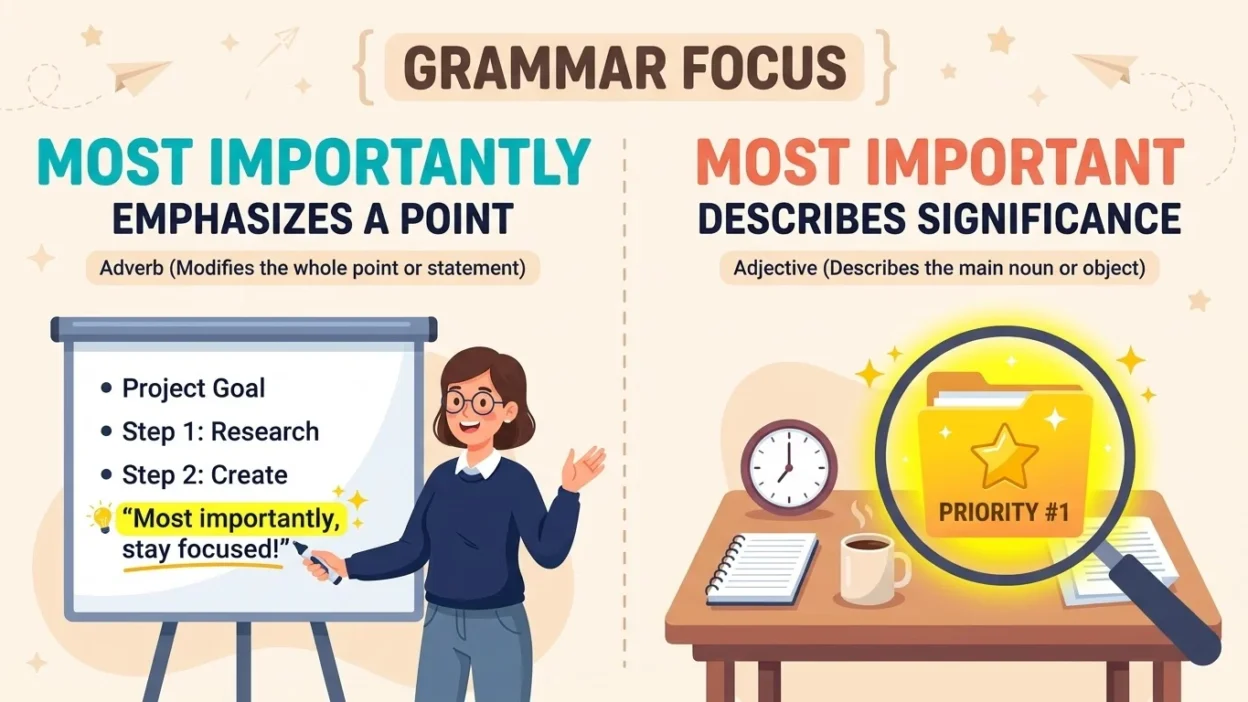
Are “most importantly” and “most important” interchangeable? Not always. Although these expressions are closely related, they have different grammatical functions. Most importantly is an adverbial expression used to introduce or emphasize the most significant point. Most important is an adjective phrase used to describe a person, thing, fact, or idea that has the greatest importance.
For example, you can say, “Most importantly, we must protect the environment,” or “Protecting the environment is the most important responsibility.” Both sentences are correct, but they use the expressions differently. Understanding the distinction will help you write more naturally, avoid common grammar mistakes, and communicate your ideas clearly. This guide explains their meanings, grammatical roles, differences, and everyday uses with simple examples.
Quick Answer: Most Importantly vs Most Important
Most importantly is an adverbial expression meaning above all or more importantly than anything else. It introduces or emphasizes a significant point. Most important is an adjective phrase meaning having the greatest importance. It describes a noun or follows a linking verb. Use “most importantly” to emphasize an action or point and “most important” to describe something that matters most.
Why Do People Confuse Most Importantly and Most Important?
People often confuse these expressions because they contain the same basic word, important, and both communicate the idea of significance.
The difference is their grammatical function.
- Most importantly emphasizes an entire statement, action, or point.
- Most important describes a noun or identifies something as having the greatest importance.
Consider these examples:
- Most importantly, we must respect other people’s opinions.
- Respecting other people’s opinions is the most important part of communication.
The first sentence uses an adverbial expression to introduce a key point. The second uses an adjective phrase to describe the importance of something.
What Does Most Importantly Mean?
Most importantly is an adverbial expression. It means above all, more importantly than anything else, or especially.
It is commonly used to introduce the most significant point in a discussion, explanation, list, or argument.
Examples of Most Importantly in Sentences
- Most importantly, we must protect our health.
- She is intelligent, hardworking, and, most importantly, honest.
- Most importantly, children need love and support.
- The plan is affordable and, most importantly, practical.
- Most importantly, remember to follow the instructions.
- He has experience, confidence, and, most importantly, patience.
- Most importantly, we should treat everyone fairly.
- The solution must be effective and, most importantly, safe.
- Most importantly, never give up on your goals.
- We need a reliable team and, most importantly, a clear strategy.
In these examples, most importantly emphasizes the significance of the information that follows.
When Should You Use Most Importantly?
Use most importantly when you want to:
- Introduce the most significant point in a discussion.
- Emphasize an essential fact or consideration.
- Add the final and most important item to a list.
- Highlight a priority or central message.
For example:
- We need to save money, manage our time, and, most importantly, stay focused.
- Most importantly, everyone must feel safe.
What Does Most Important Mean?
Most important is an adjective phrase. It describes a person, thing, idea, responsibility, or situation that has the greatest significance.
The word important is an adjective, and most makes it a superlative. Together, they express the highest degree of importance.
Examples of Most Important in Sentences
- Health is the most important thing in life.
- This is the most important decision of my career.
- Education is one of the most important parts of society.
- Her most important responsibility is caring for her family.
- Time is one of our most important resources.
- The most important question remains unanswered.
- Trust is the most important element of a strong relationship.
- Safety should be our most important concern.
- This is the most important lesson I have learned.
- Communication is an important skill, but listening is the most important one.
In these examples, most important describes a noun or follows a linking verb such as is or remains.
When Should You Use Most Important?
Use most important when you want to:
- Describe something as having the greatest significance.
- Identify the highest priority among several things.
- Modify a noun directly.
- Complete a sentence after a linking verb.
For example:
- This is the most important chapter in the book.
- Your safety is most important to us.
- The most important thing is to remain calm.
Most Importantly vs Most Important: Comparison Table
| Feature | Most Importantly | Most Important |
|---|---|---|
| Grammatical role | Adverbial expression | Adjective phrase |
| Main meaning | Above all or especially | Having the greatest significance |
| Function | Emphasizes a point or statement | Describes a person, thing, or idea |
| Common position | Often at the beginning or within a sentence | Before a noun or after a linking verb |
| Example | Most importantly, stay safe. | Safety is most important. |
When Should You Use Most Importantly or Most Important?
Choosing between these expressions becomes easier when you consider what you want to communicate.
When to Use Most Importantly
Use most importantly when introducing or emphasizing a significant point.
Examples:
- Most importantly, we must work together.
- She is talented and, most importantly, determined.
- Most importantly, everyone should understand the rules.
- The project needs funding and, most importantly, proper management.
A useful question to ask yourself is: Am I emphasizing a point or introducing something that matters above all?
If the answer is yes, most importantly is usually appropriate.
When to Use Most Important
Use most important when describing something that has the greatest significance.
Examples:
- Family is the most important part of my life.
- This is the most important meeting of the year.
- The most important issue is public safety.
- Honesty is the most important quality in a friendship.
A useful question to ask yourself is: Am I describing a person, thing, quality, or idea as having the greatest importance?
If the answer is yes, most important is generally the correct choice.
Most Importantly vs Most Important: Examples in Everyday English
The following examples show how these expressions work in different situations.
Examples Using Most Importantly
- Most importantly, you should believe in yourself.
- We need a good plan and, most importantly, enough time.
- Most importantly, do not forget your responsibilities.
- She is kind, generous, and, most importantly, dependable.
- Most importantly, we must listen to each other.
- The product should be affordable and, most importantly, reliable.
Examples Using Most Important
- Your health is the most important thing.
- This is the most important lesson of the course.
- The most important factor is experience.
- Trust is the most important foundation of a relationship.
- Our most important goal is to improve customer service.
- The most important thing is to keep learning.
Can You Say Most Important Instead of Most Importantly?
Sometimes, but the sentence structure and meaning must support it.
For example:
- Most importantly, we need to protect the children.
- Protecting the children is most important.
Both sentences are correct, but their structures are different.
The first uses most importantly to emphasize the statement. The second uses most important as an adjective phrase to describe the significance of protecting the children.
You should not automatically replace one expression with the other. Choose according to its grammatical role.
Is Most Important or Most Importantly Correct at the Beginning of a Sentence?
Both can be correct, but they are used differently.
Most importantly can naturally introduce a significant point:
- Most importantly, we need to be honest.
Most important can also begin a sentence when it introduces a noun phrase or is used in a suitable sentence structure:
- Most important is the need to protect public safety.
The second construction is grammatical, although “Most importantly, we need to protect public safety” is often more natural in everyday communication.
Common Mistakes to Avoid
English learners sometimes use most importantly and most important incorrectly. Here are some common mistakes and their corrections.
Mistake 1: Using Most Important to Introduce a Complete Statement
Incorrect: Most important, we should respect everyone.
Better: Most importantly, we should respect everyone.
Explanation: Most importantly is the natural adverbial expression for emphasizing the statement.
Mistake 2: Using Most Importantly to Describe a Noun
Incorrect: Health is most importantly thing in life.
Correct: Health is the most important thing in life.
Explanation: Important is an adjective that describes the noun thing. Importantly cannot perform this function.
Mistake 3: Confusing Adjectives and Adverbs
Incorrect: She is most importantly member of the team.
Correct: She is the most important member of the team.
Explanation: Use the adjective important to describe a member of the team.
Mistake 4: Adding an Unnecessary Word
Incorrect: Most importantly thing is your health.
Correct: The most important thing is your health.
Explanation: The adjective phrase most important describes the noun thing. The sentence also needs the article the.
Mistake 5: Using Most Importantly When Describing a Quality
Incorrect: Honesty is most importantly in a relationship.
Correct: Honesty is most important in a relationship.
Explanation: Most important describes the significance of honesty. The adverb importantly does not fit this structure.
Easy Memory Trick: How to Remember Most Important vs Most Importantly
Use these simple tips to remember the difference:
- Most importantly = Emphasis: Use it to introduce or highlight a key point.
- Most important = Description: Use it to describe something that matters most.
- Important = Adjective: It describes a noun or follows a linking verb.
- Importantly = Adverb: It emphasizes how significant a point or statement is.
Remember these examples:
- Most importantly, be honest.
- Honesty is the most important quality.
The first emphasizes advice, while the second describes a quality.
American English vs British English: Is There Any Difference?
Both most important and most importantly are standard expressions in American English and British English.
Their meanings and grammatical functions are the same in both varieties.
Examples:
- American English: Most importantly, we need to finish the project.
- British English: Most importantly, we need to finish the project.
There is no regional spelling difference between these expressions. You can use either one in American or British English, provided the sentence structure is correct.
What Are Some Similar Words and Expressions?
Understanding related words can help you use most important and most importantly more accurately.
| Expression | Meaning | Example |
|---|---|---|
| Above all | More than anything else | Above all, we must remain calm. |
| Most significantly | In the most meaningful way | Most significantly, the results improved. |
| Primarily | Mainly or chiefly | Our primary concern is safety. |
| Especially | Particularly | I especially appreciate your honesty. |
| Essential | Absolutely necessary | Trust is essential in a relationship. |
| Crucial | Extremely important | Communication is crucial to success. |
| Of greatest importance | Having the highest priority | Your health is of greatest importance. |
These expressions are related, but their grammatical structures may differ. Choose one that fits the sentence naturally.
Final Verdict: Most Importantly vs Most Important
The difference between most importantly and most important is mainly grammatical.
Most importantly is an adverbial expression used to emphasize a significant point or introduce something that matters above all.
Most important is an adjective phrase used to describe a person, thing, idea, or quality that has the greatest significance.
For example:
- Most importantly, we must protect our health.
- Our health is the most important thing.
Both expressions are correct, but they cannot always replace each other. Remember that most importantly emphasizes a point, while most important describes something’s significance. This simple distinction will help you use both expressions confidently.
Frequently Asked Questions (FAQs)
1. Is most importantly grammatically correct?
Yes. Most importantly is a correct adverbial expression. It is commonly used to introduce or emphasize the most significant point in a statement or discussion.
Example: Most importantly, we must protect our environment.
2. Is most important grammatically correct?
Yes. Most important is a correct adjective phrase. It describes something that has the greatest significance.
Example: Education is the most important investment in a person’s future.
3. Should I say most importantly or most important?
It depends on the sentence. Use most importantly to emphasize a point and most important to describe a person, thing, quality, or idea.
Examples:
- Most importantly, stay focused.
- Staying focused is the most important thing.
4. Can most important start a sentence?
Yes. Most important can begin a sentence when the sentence structure supports it.
Example: Most important is the need to protect public health.
However, most importantly is often more natural when introducing a point in everyday writing.
5. Is most importantly an adverb?
Yes. Most importantly is an adverbial expression. It is used to emphasize the significance of a statement, action, or point.
6. Can I use most importantly in formal writing?
Yes. Most importantly is appropriate in formal and informal writing. It can be used in essays, reports, presentations, articles, and professional communication when introducing an important point.
7. What is another way to say most importantly?
Depending on the context, you can use above all, most significantly, especially, or of greatest importance. However, these expressions may require different sentence structures.
Remember This
- Most importantly = An adverbial expression that emphasizes a key point.
- Most important = An adjective phrase that describes something with the greatest significance.
- Use most importantly to introduce an important statement.
- Use most important before a noun or after a linking verb.
- Both expressions are correct in American and British English.
Conclusion
Most importantly and most important are closely related expressions, but they serve different grammatical purposes. Most importantly is used to emphasize a significant point, whereas most important describes something that has the greatest value, priority, or significance.
The easiest way to remember the difference is to focus on their functions. If you are introducing or emphasizing a point, choose most importantly. If you are describing something as the most significant, choose most important. Understanding this distinction will help you write clearer sentences and use both expressions naturally in everyday English.

Adam Aaron is a language enthusiast and content writer at SimileHive, creating clear, engaging guides on similes, idioms, metaphors, and figurative language to help readers improve English confidently every day.