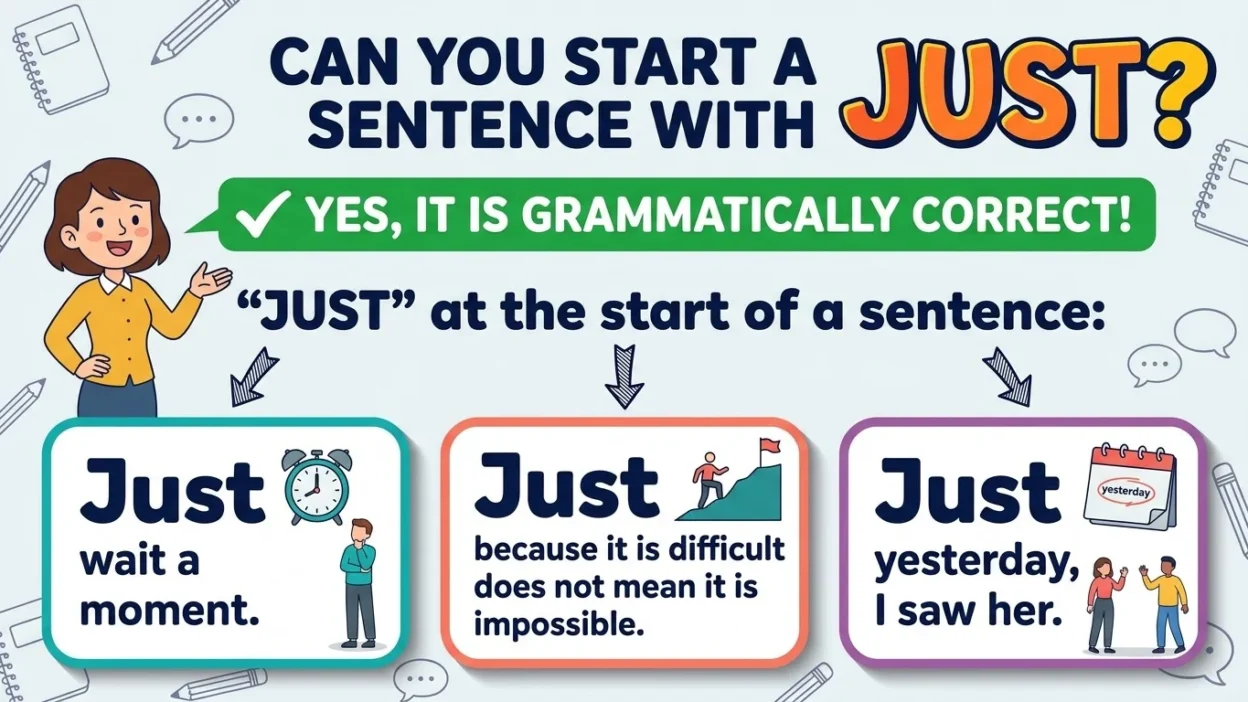
Can you start a sentence with just? Yes. Starting a sentence with just is grammatically correct, and it is common in everyday English as well as informal and formal writing. However, its meaning depends on the context. Just can mean only, simply, exactly, recently, or a short time ago. It can also be used to emphasize a request, explanation, or statement.
For example, “Just follow the instructions” is a perfectly correct sentence. Here, just means simply. Similarly, “Just yesterday, I saw him” uses just to mean very recently or only a short time ago. Although some writers avoid beginning sentences with just because they consider it informal or conversational, there is no general grammar rule that prohibits it. The important thing is to use the word naturally and make sure the sentence communicates your intended meaning.
Quick Answer: Can You Start a Sentence With Just?
Yes, you can start a sentence with just. It is grammatically acceptable to begin a sentence with this word. Depending on the context, just can mean only, simply, exactly, or recently. For example, “Just remember to call me” and “Just yesterday, we discussed this issue” are both correct. Choose the meaning that fits your sentence.
Why Do People Think You Cannot Start a Sentence With Just?
Some people believe that starting a sentence with just is incorrect because the word is often used in the middle of a sentence.
For example:
- I just need a little more time.
- She just arrived.
- He just wants to help.
However, just can also naturally appear at the beginning of a sentence.
Examples:
- Just give me a moment.
- Just because it is difficult does not mean it is impossible.
- Just yesterday, I spoke to her.
The confusion may come from writing advice that discourages unnecessary words or overly conversational expressions. However, this is a matter of style, not a grammatical prohibition.
What Does Just Mean?
Just is a versatile English word. It can function as an adverb and, in certain constructions, as part of an adjective phrase. Its meaning depends on how it is used.
Here are its most common meanings.
1. Just Means Only
Just can mean only or nothing more than something.
Examples:
- Just one person attended the meeting.
- Just tell me the truth.
- Just a little water is enough.
- Just my brother knows the answer.
- Just three students passed the examination.
2. Just Means Simply
Just can mean simply or merely. It often makes instructions and suggestions sound natural.
Examples:
- Just follow the instructions.
- Just ask if you need help.
- Just take a deep breath.
- Just open the door and come inside.
- Just think about the consequences.
3. Just Means Recently
Just can refer to something that happened a very short time ago.
Examples:
- Just yesterday, I received your message.
- Just a few minutes ago, he called me.
- Just last week, we discussed the proposal.
- Just moments before the announcement, the lights went out.
4. Just Means Exactly or Precisely
Just can emphasize that something is exactly as described or needed.
Examples:
- Just the person I wanted to see!
- Just what we needed!
- Just the right amount of sugar makes the cake taste better.
- Just where did you put my keys?
Is It Grammatically Correct to Start a Sentence With Just?
Yes. There is no general English grammar rule that prevents you from starting a sentence with just.
It can appear at the beginning of commands, statements, questions, and longer clauses.
Examples:
- Just wait here for a moment.
- Just because he is young does not mean he lacks experience.
- Just imagine living near the ocean.
- Just yesterday, I saw an old friend.
- Just what are you trying to say?
Each sentence is grammatically acceptable.
Different Ways to Start a Sentence With Just
You can use just at the beginning of several types of sentences.
1. Starting a Command With Just
Just can begin an imperative sentence, which gives an instruction, suggestion, or request.
Examples:
- Just listen carefully.
- Just give me five minutes.
- Just follow the rules.
- Just leave the documents on my desk.
- Just call me when you arrive.
Here, just often makes the command sound less forceful or more conversational.
2. Starting a Statement With Just
You can use just at the beginning of a statement to emphasize a point.
Examples:
- Just one mistake can change everything.
- Just a few people understood the explanation.
- Just yesterday, we received the final decision.
- Just another day at the office.
- Just a little patience can make a big difference.
3. Starting a Sentence With Just Because
The expression just because introduces a reason or situation that does not necessarily justify a conclusion.
Examples:
- Just because you disagree does not mean you are wrong.
- Just because something is expensive does not mean it is better.
- Just because he is quiet does not mean he is unhappy.
- Just because we failed once does not mean we should give up.
- Just because everyone is doing it does not make it right.
This construction is particularly useful when challenging an assumption.
4. Starting a Question With Just
Just can also appear at the beginning of a question, often to make it sound conversational or to emphasize a request for information.
Examples:
- Just what do you mean?
- Just where did you find this information?
- Just how much does it cost?
- Just who told you that?
- Just why are you asking?
These questions are grammatically correct, although the tone may sound more emphatic than a question without just.
5. Starting a Sentence With Just to
The expression just to can introduce a purpose or reason.
Examples:
- Just to be clear, I never agreed to the proposal.
- Just to let you know, the meeting has been postponed.
- Just to make sure, please check the address again.
- Just to avoid confusion, we should explain the rules.
- Just to clarify, I am talking about the final report.
Starting a Sentence With Just: Comparison Table
| Sentence | Meaning of Just | Usage |
|---|---|---|
| Just wait here. | Simply | Command |
| Just one person came. | Only | Statement |
| Just yesterday, I saw him. | Very recently | Time reference |
| Just because he is busy does not mean he is ignoring you. | Merely or only | Reasoning |
| Just what do you want? | Emphasis | Question |
| Just to clarify, I disagree. | For the purpose of | Explanation |
When Should You Start a Sentence With Just?
Starting a sentence with just is useful when it makes your meaning clearer or gives your sentence a natural tone.
When to Use Just at the Beginning
Use just at the beginning when you want to:
- Give a simple instruction.
- Emphasize that something is the only thing needed.
- Introduce a recent event.
- Challenge an assumption using just because.
- Clarify or explain something.
- Make a question more emphatic.
Examples:
- Just follow the instructions.
- Just one more question remains.
- Just yesterday, we received the news.
- Just because it is popular does not mean it is useful.
- Just to clarify, the deadline is Friday.
When Should You Avoid Starting With Just?
Although starting with just is grammatically correct, it is not always the best stylistic choice.
Avoid using it when:
- It adds no meaningful information.
- It makes a formal sentence sound unnecessarily conversational.
- It weakens an important statement.
- It creates ambiguity about what just modifies.
For example:
Less direct: Just I want to explain the situation.
Better: I just want to explain the situation.
The first sentence is unnatural in ordinary English because just is placed incorrectly for the intended meaning.
15 Examples of Sentences Starting With Just
Here are 15 natural examples showing different uses of just at the beginning of a sentence.
- Just give me another chance.
- Just remember that practice makes progress.
- Just one question remains unanswered.
- Just because you are tired does not mean you should quit.
- Just yesterday, we were talking about this subject.
- Just follow your instincts.
- Just a few minutes can make a difference.
- Just to be safe, save a copy of the document.
- Just imagine how beautiful the world could be.
- Just tell me what happened.
- Just because he apologized does not mean everything is resolved.
- Just another example of how important communication is.
- Just wait until you hear the full story.
- Just where did you put the file?
- Just to clarify, the decision has not been finalized.
Common Mistakes to Avoid
Although just can begin a sentence, its placement must still be appropriate.
Mistake 1: Assuming Just Cannot Begin a Sentence
Incorrect: You cannot start a sentence with just.
Correct: Just give me a moment.
Explanation: There is no general grammar rule against beginning a sentence with just.
Mistake 2: Using Just in an Awkward Position
Incorrect: Just I need some help.
Correct: I just need some help.
Also correct: Just give me some help.
Explanation: The first sentence uses an unnatural word order for the intended meaning. In the second example, just naturally modifies the verb phrase.
Mistake 3: Confusing Just Because With Because
Incorrect: Just because I am quiet. (When intended as a complete sentence.)
Correct: Just because I am quiet does not mean I have nothing to say.
Explanation: A clause beginning with just because generally needs a main clause to complete the thought.
Mistake 4: Overusing Just in Formal Writing
Less effective: Just to explain, just one issue remains, and just one more thing needs attention.
Better: One issue remains, and one additional matter needs attention.
Explanation: Repeating just unnecessarily can make writing less direct. Use it when it contributes to the meaning.
Mistake 5: Assuming Just Always Means Only
Incorrect assumption: Just has only one meaning.
Correct understanding: Just can mean only, simply, recently, exactly, or precisely, depending on the context.
Explanation: Always consider the surrounding words before deciding what just means.
Easy Memory Trick: How to Remember That Just Can Start a Sentence
Use these simple tips:
- Just = Only: Just one person arrived.
- Just = Simply: Just follow the instructions.
- Just = Recently: Just yesterday, I saw her.
- Just because = Not necessarily a reason: Just because it is difficult does not mean it is impossible.
- Just to = Purpose: Just to clarify, I disagree.
Remember that just is not restricted to the middle of a sentence. It can appear at the beginning whenever the sentence structure and intended meaning support it.
American English vs British English: Is There Any Difference?
There is no significant difference between American English and British English regarding the use of just at the beginning of a sentence.
Both varieties allow sentences such as:
- Just give me a minute.
- Just because he is busy does not mean he is ignoring you.
- Just yesterday, I received the news.
- Just to clarify, I have not made a decision.
The meanings and grammatical rules are essentially the same. You can start a sentence with just in both varieties.
What Are Some Similar Words and Expressions?
Several words and expressions can be used in ways similar to just, depending on the intended meaning.
| Word or Expression | Meaning | Example |
|---|---|---|
| Only | Nothing more than | Only one person attended. |
| Simply | In an uncomplicated way | Simply follow the instructions. |
| Merely | Nothing more than | It was merely a suggestion. |
| Exactly | Precisely | Exactly what I needed! |
| Recently | Not long ago | Recently, I visited my hometown. |
| To clarify | To make something clear | To clarify, the meeting is tomorrow. |
| Above all | More importantly than anything else | Above all, stay safe. |
These expressions are not always interchangeable with just. Choose the one that communicates your intended meaning naturally.
Final Verdict: Can You Start a Sentence With Just?
Yes, you can start a sentence with just. It is grammatically correct and widely used in everyday English and formal writing when appropriate.
Just can mean only, simply, recently, or exactly. It can introduce a command, statement, question, or clause.
For example:
- Just give me a moment.
- Just because he is successful does not mean he is happy.
- Just yesterday, I received your email.
- Just to clarify, I have not changed my mind.
The important thing is to place just where it clearly modifies the intended word or expression. Do not avoid starting a sentence with it simply because someone has told you it is incorrect. There is no general grammatical restriction against doing so.
Frequently Asked Questions (FAQs)
1. Can you start a sentence with just?
Yes. Starting a sentence with just is grammatically correct. It can introduce a command, statement, question, or clause.
Example: Just give me a few minutes.
2. Is it bad grammar to start a sentence with just?
No. It is not bad grammar to begin a sentence with just. The word can naturally appear at the beginning when it is placed correctly and communicates the intended meaning.
3. Can you start a formal sentence with just?
Yes. You can begin a formal sentence with just, provided it suits the tone and context. For example, “Just to clarify, the report covers the period ending in December” is grammatically correct, although a more formal alternative might be “To clarify, the report covers the period ending in December.”
4. What does just mean at the beginning of a sentence?
Its meaning depends on the context. It can mean only, simply, recently, or exactly.
Examples:
- Just one person came. (Only one person.)
- Just follow the instructions. (Simply follow them.)
- Just yesterday, I saw him. (Very recently.)
5. Can a sentence start with just because?
Yes. A sentence can begin with just because. The expression often introduces a reason or situation that does not necessarily support a conclusion.
Example: Just because something is difficult does not mean it is impossible.
6. Can you start a question with just?
Yes. Just can introduce an emphatic or conversational question.
Examples:
- Just what are you saying?
- Just where did you find it?
- Just how much does it cost?
7. Should I avoid using just in academic writing?
Not necessarily. Just is acceptable in academic writing when it has a clear purpose. However, avoid unnecessary repetition or conversational wording when a more precise expression would make your argument stronger.
Remember This
- You can start a sentence with just.
- There is no general grammar rule prohibiting it.
- Just can mean only, simply, recently, or exactly.
- It can introduce commands, statements, questions, and clauses.
- Use it naturally and avoid unnecessary repetition.
- Correct placement matters more than sentence position.
Conclusion
Starting a sentence with just is perfectly acceptable in English. The word can introduce instructions, emphasize an important point, refer to a recent event, or help explain an idea. Its position at the beginning of a sentence does not make the sentence grammatically incorrect.
The key is to understand what just means in the particular context and place it naturally. Whether you are writing an email, an essay, an article, or an everyday message, you can confidently begin a sentence with just when it helps express your meaning clearly.

Lucas Luke is a passionate language writer and content creator at SimileHive, specializing in similes, idioms, metaphors, and figurative language. He enjoys making complex English expressions simple, engaging, and easy to understand for students, writers, and language enthusiasts through well-researched, practical content.