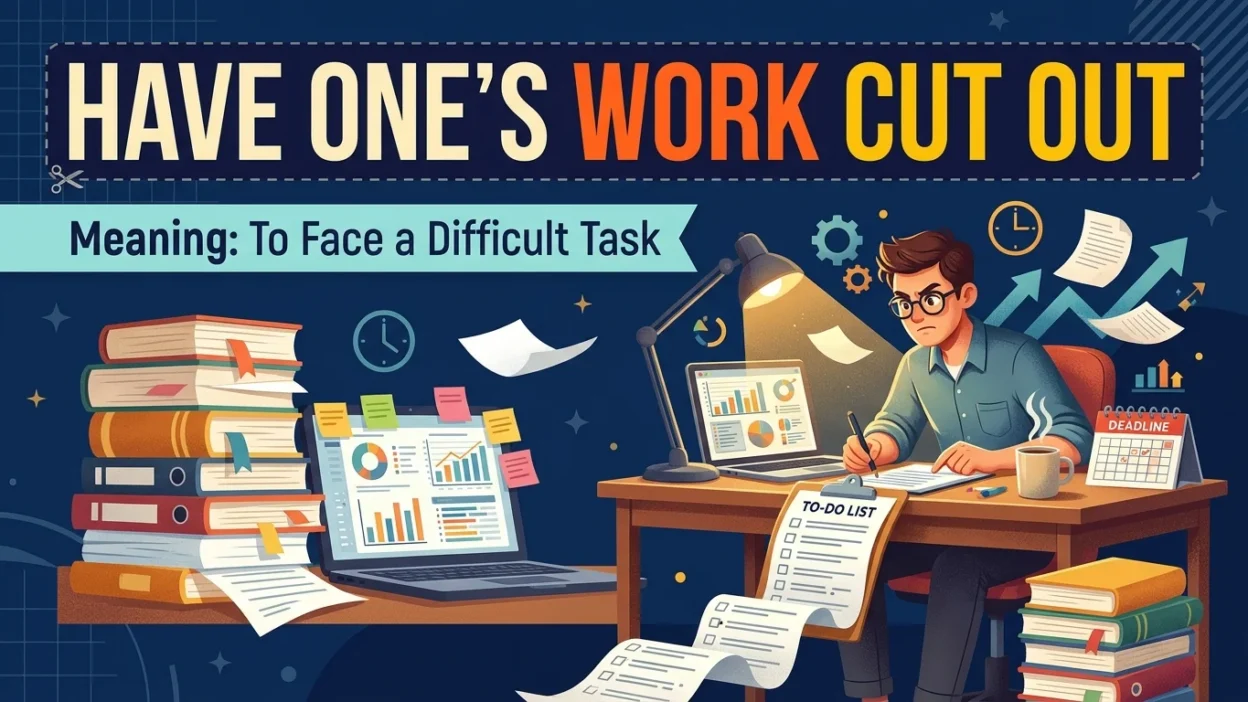
The expression have one’s work cut out is a common English idiom used when someone faces a difficult, demanding, or challenging task. It suggests that a person has a considerable amount of work to do or will need to make a serious effort to achieve a particular goal. For example, if someone says, “You have your work cut out for you,” they mean that the task ahead will not be easy.
This idiom is frequently used in everyday conversations, workplace discussions, sports, education, and other situations involving challenges or demanding responsibilities. It does not literally mean that someone’s work has been cut into pieces. Instead, it describes a situation in which considerable effort, skill, determination, or time will be required. Understanding this expression will help you recognize it in conversations and use it naturally when describing difficult tasks or demanding situations.
Quick Answer: What Does Have One’s Work Cut Out Mean?
Have one’s work cut out means to face a difficult, challenging, or demanding task that requires considerable effort. The expression is commonly used as “have one’s work cut out for someone.” For example, “The new manager has her work cut out for her” means that the manager faces a challenging job and will need to work hard to succeed.
Why Do People Confuse Have One’s Work Cut Out?
People sometimes misunderstand this idiom because its literal wording does not clearly communicate its figurative meaning.
The expression contains three familiar words: have, work, and cut out. However, when combined, they form an idiom with a meaning that cannot be understood simply by examining each word separately.
There are several reasons for the confusion:
- Literal interpretation: Some people assume that cut out refers to physically cutting something.
- Unfamiliar expression: English learners may not recognize that the phrase describes a difficult task.
- The word for: The complete expression often includes “for you,” which can make its grammatical structure confusing.
- Different situations: The idiom can describe challenges at work, school, home, or in competitive situations.
The important thing to remember is that the expression refers to a demanding task, not physically cutting or preparing something.
Meaning of Have One’s Work Cut Out
Have one’s work cut out means to have a difficult job or task ahead that requires considerable effort.
It is generally used when someone faces a challenge that may be complicated, time consuming, or demanding.
For example:
“With three major projects to complete this week, I have my work cut out for me.”
This means that the speaker has a lot of challenging work to complete.
Another example:
“The team has its work cut out for it in the final match.”
This means that the team will face a difficult challenge in the final match.
What Does Have Your Work Cut Out for You Mean?
“Have your work cut out for you” means that you are facing a difficult task or situation that will require considerable effort.
Examples:
- You have your work cut out for you if you want to finish this project by Friday.
- The new teacher has her work cut out for her.
- They have their work cut out for them in the championship.
The expression often suggests that success is possible, but achieving it will not be easy.
Origin of Have One’s Work Cut Out
The expression have one’s work cut out is generally associated with the older practice of preparing and cutting materials, particularly fabric, before sewing.
In traditional tailoring, cloth was measured and cut into the shapes required for a particular garment. Once the pieces had been cut, the tailor still had considerable work to do to assemble and finish the garment.
The expression eventually developed a figurative meaning associated with having a demanding task ahead.
Today, it is used much more broadly and is not limited to sewing, tailoring, or physical work.
How to Use Have One’s Work Cut Out in a Sentence
The idiom can be used in different situations to describe demanding responsibilities or challenging goals.
1. At Work
Use the expression when someone has a difficult professional responsibility.
Examples:
- The new director has her work cut out for her.
- We have our work cut out for us before the annual meeting.
- The company has its work cut out for it after losing several major clients.
2. In Education
Use it when students or teachers face challenging academic responsibilities.
Examples:
- You have your work cut out for you if you want to pass all your examinations.
- The students have their work cut out for them this semester.
- Our teacher has his work cut out for him preparing everyone for the final examination.
3. In Sports
Use it when a team or player faces a difficult opponent or competition.
Examples:
- The defending champions have their work cut out for them this season.
- Our team has its work cut out for it against the league leaders.
- The young player has his work cut out for him in the final round.
4. In Everyday Life
Use it when someone faces a difficult personal responsibility or challenge.
Examples:
- I have my work cut out for me organizing the entire event.
- She has her work cut out for her renovating the old house.
- They have their work cut out for them moving into a new home.
12 Examples of Have One’s Work Cut Out in Sentences
Here are 12 practical examples that demonstrate how to use this idiom naturally.
- The new manager has her work cut out for her because the company is facing serious financial difficulties.
- You have your work cut out for you if you want to learn a new language in three months.
- Our football team has its work cut out for it against the defending champions.
- I have my work cut out for me preparing for five examinations in one week.
- The construction workers have their work cut out for them completing the project before winter.
- She has her work cut out for her managing a large team with different responsibilities.
- The government has its work cut out for it addressing the country’s economic challenges.
- The teacher has his work cut out for him helping students who are struggling with mathematics.
- They have their work cut out for them restoring the historic building.
- The young entrepreneur has her work cut out for her competing with established businesses.
- We have our work cut out for us if we want to organize such a large event successfully.
- The rescue team has its work cut out for it searching the difficult terrain.
Common Mistakes When Using Have One’s Work Cut Out
Although this idiom is relatively easy to understand once you know its meaning, some common mistakes can affect its usage.
Mistake 1: Taking the Expression Literally
Incorrect understanding: Someone has physically cut their work into pieces.
Correct understanding: Someone has a difficult or demanding task ahead.
Example:
“The new employee has his work cut out for him.”
This means that the employee faces a challenging job.
Mistake 2: Omitting For When Referring to Someone’s Challenge
The expression is commonly used in the structure “have one’s work cut out for someone.”
Natural examples:
- I have my work cut out for me.
- She has her work cut out for her.
- They have their work cut out for them.
The preposition for helps identify the person who must handle the challenge.
Mistake 3: Using the Wrong Possessive Form
The possessive expression should agree with the person or group being discussed.
| Subject | Correct Expression |
|---|---|
| I | I have my work cut out for me. |
| You | You have your work cut out for you. |
| He | He has his work cut out for him. |
| She | She has her work cut out for her. |
| It | It has its work cut out for it. |
| We | We have our work cut out for us. |
| They | They have their work cut out for them. |
Mistake 4: Assuming the Idiom Always Means Failure
Having your work cut out for you does not mean that you will fail.
It simply means that the task is difficult and will require considerable effort.
For example:
“The team has its work cut out for it, but the players are determined to win.”
The team faces a difficult challenge, but success is still possible.
Memory Trick: How to Remember Have One’s Work Cut Out
Here is an easy way to remember this idiom:
Work Cut Out = Difficult Work Ahead
Imagine someone facing a large project with several challenging tasks to complete.
They have their work cut out for them because they must put in considerable effort to finish everything successfully.
Remember these examples:
- I have my work cut out for me.
- She has her work cut out for her.
- They have their work cut out for them.
Think of the expression whenever someone faces a challenging responsibility or demanding goal.
Have One’s Work Cut Out in American and British English
The idiom have one’s work cut out is used in both American and British English.
Its meaning is essentially the same in both varieties. It describes a difficult task or challenge that requires considerable effort.
| Feature | American English | British English |
|---|---|---|
| Expression | Have one’s work cut out | Have one’s work cut out |
| Meaning | Face a difficult task | Face a difficult task |
| Everyday usage | Common | Common |
| Workplace usage | Common | Common |
| Formal writing | Acceptable | Acceptable |
Examples:
American English: “The new coach has his work cut out for him.”
British English: “The new coach has his work cut out for him.”
There is no significant difference in the expression’s meaning or standard usage between the two varieties.
Similar Idioms and Expressions
Several English idioms communicate meanings similar to have one’s work cut out. However, each has a slightly different emphasis.
| Idiom or Expression | Meaning | Example |
|---|---|---|
| Have a tough job ahead | Face a difficult task | We have a tough job ahead. |
| Have one’s hands full | Have many responsibilities | She has her hands full with the new project. |
| Be up against it | Face difficult circumstances | The team is really up against it. |
| Have a mountain to climb | Face a very difficult challenge | We have a mountain to climb before the deadline. |
| Be in for a challenge | Be about to face something difficult | You are in for a challenge. |
| Be an uphill battle | Require continuous effort to succeed | Winning the competition will be an uphill battle. |
| Have one’s work cut out | Have a demanding task ahead | They have their work cut out for them. |
These expressions are useful alternatives when describing challenges, responsibilities, and demanding situations.
Final Verdict: Have One’s Work Cut Out
Have one’s work cut out is a common English idiom meaning to face a difficult or demanding task that requires considerable effort.
It is frequently used in professional situations, academic discussions, sports, and everyday conversations.
For example, “The new manager has her work cut out for her” means that the manager faces a challenging responsibility and will need to work hard to handle it successfully.
Remember that the expression does not mean someone has physically cut their work into pieces. It describes a challenging situation or a demanding task ahead.
Frequently Asked Questions
1. What does have one’s work cut out mean?
Have one’s work cut out means to face a difficult, demanding, or challenging task that requires considerable effort.
Example: “I have my work cut out for me preparing for the examination.”
2. What does have your work cut out for you mean?
It means that you are facing a difficult task or responsibility that will require a lot of effort.
Example: “You have your work cut out for you if you want to finish this project by Monday.”
3. Is have one’s work cut out an idiom?
Yes. It is an English idiom because its figurative meaning is different from the literal meanings of its individual words. It describes facing a challenging task rather than physically cutting work.
4. Is have one’s work cut out positive or negative?
The expression is generally neutral, although it often suggests difficulty or pressure. It does not necessarily indicate a negative outcome because the person may still succeed.
5. What is the origin of have one’s work cut out?
The expression is generally linked to tailoring and the preparation of fabric pieces for sewing. Its figurative meaning developed to describe someone facing a demanding amount of work.
6. Can I say I have my work cut out for me?
Yes. “I have my work cut out for me” is a grammatically correct and common expression. It means that you have a difficult task or considerable work ahead.
7. What is another way to say have one’s work cut out?
You can use expressions such as “have a tough job ahead,” “have one’s hands full,” “face an uphill battle,” or “have a mountain to climb.” The best alternative depends on the context.
Remember This
- Have one’s work cut out means to face a difficult or demanding task.
- It is an idiom, not a literal expression.
- It commonly appears as “have one’s work cut out for someone.”
- It can describe challenges at work, school, home, or in sports.
- It does not necessarily mean that someone will fail.
- It is used in both American and British English.
Conclusion
The idiom have one’s work cut out is a useful expression for describing situations in which someone faces a difficult task or demanding responsibility. It communicates that considerable effort, time, or determination will be needed to achieve a particular goal. Whether someone is preparing for examinations, managing a business, completing a project, or competing in a sports event, this expression can describe the challenge naturally and effectively.
The easiest way to remember its meaning is to associate it with having difficult work ahead. When you say, “I have my work cut out for me,” you are telling someone that you have a challenging task to handle. Use this idiom whenever you want to describe a demanding responsibility or a situation that will require serious effort.

Lucas Luke is a passionate language writer and content creator at SimileHive, specializing in similes, idioms, metaphors, and figurative language. He enjoys making complex English expressions simple, engaging, and easy to understand for students, writers, and language enthusiasts through well-researched, practical content.