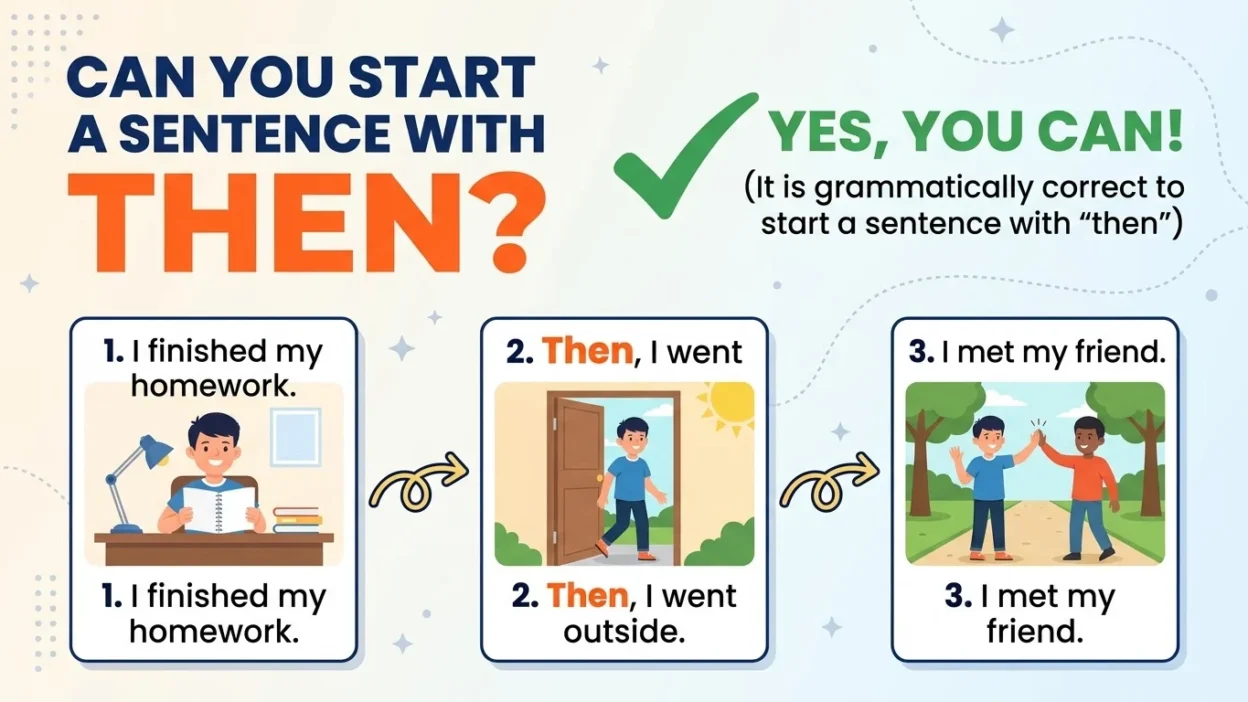
Can you start a sentence with then? Yes, absolutely! Starting a sentence with then is grammatically correct in English. The word then is commonly used at the beginning of a sentence to show the next step in a sequence, indicate what happened afterward, introduce a result, or refer to a particular time. It helps connect ideas and makes writing easier to follow.
For example, consider the sentence, “I finished my homework. Then, I went outside to play.” Here, then shows that going outside happened after finishing the homework. You can also use then to introduce a consequence, as in “If you are ready, then we can begin.” Although some people believe that starting a sentence with then is incorrect, there is no grammatical rule that prohibits it. The important thing is to use the word appropriately and make sure the sentence communicates your intended meaning clearly.
Quick Answer: Can You Start a Sentence With Then?
Yes, you can start a sentence with then. It is grammatically correct and widely used in everyday conversations, storytelling, academic writing, and professional communication. Then can introduce the next event, show a sequence, indicate a result, or refer to a particular time. A comma often follows introductory then when it functions as a transitional word, although the comma is not always necessary.
Why Do People Think Starting a Sentence With Then Is Incorrect?
Some people believe that starting a sentence with then is grammatically incorrect because they were taught to avoid beginning sentences with certain connecting words.
However, this belief is not supported by standard English grammar.
The confusion may arise because then is frequently used as an adverb or transitional word within a sentence.
For example:
- We finished dinner and then watched a movie.
- We finished dinner. Then, we watched a movie.
Both constructions are correct.
The second example simply uses then to begin a new sentence rather than placing it in the middle of the previous one.
There is no grammatical requirement that then must appear after another clause.
What Does Then Mean?
Then is an adverb that can express time, sequence, consequence, or a particular point in the past or future.
Its meaning depends on the context.
Common meanings include:
- After that: Something happens following another event.
- Next: It introduces the next step in a process.
- At that time: It refers to a particular period.
- In that case: It introduces a consequence or conclusion.
- At that point: It describes what happens at a particular stage.
Understanding these meanings makes it easier to use then naturally at the beginning of a sentence.
When Can You Start a Sentence With Then?
There are several situations in which beginning a sentence with then is appropriate.
1. To Show the Next Event in a Sequence
Use then to explain what happened after another event.
Examples:
- I woke up early. Then, I prepared breakfast.
- She finished her assignment. Then, she submitted it.
- We visited the museum. Then, we went to a nearby restaurant.
- He opened the door. Then, he walked inside.
In these examples, then connects two events in chronological order.
2. To Introduce the Next Step in Instructions
Then is useful when explaining a process or giving directions.
Examples:
- First, wash the vegetables. Then, cut them into small pieces.
- Open the application. Then, enter your password.
- Mix the ingredients thoroughly. Then, place the mixture in the oven.
- Read the instructions carefully. Then, complete the exercise.
Here, then helps readers understand the order in which actions should be performed.
3. To Show a Result or Consequence
Then can introduce a consequence, particularly in conditional sentences.
Examples:
- If you have finished your work, then you can leave.
- If it starts raining, then we will stay indoors.
- If you need help, then ask your teacher.
- If the price is reasonable, then I will buy it.
In these examples, then means something similar to “in that case.”
4. To Refer to a Particular Time
Then can introduce information about a past or future period.
Examples:
- Then, I was living in London.
- Then, nobody knew what would happen next.
- Then, the city was much smaller than it is today.
- Then, we will discuss the remaining questions.
The word refers to a particular time or stage in these sentences.
5. To Continue a Story
Writers often begin sentences with then to make storytelling smoother and more engaging.
Examples:
- Then, a strange noise came from the basement.
- Then, the lights suddenly went out.
- Then, she noticed someone standing near the window.
- Then, everything changed.
Starting a sentence with then helps readers follow the progression of events.
Then at the Beginning vs Then in the Middle of a Sentence
Then can appear at the beginning, middle, or end of a sentence, depending on its purpose.
| Position | Example | Purpose |
|---|---|---|
| Beginning | Then, we went home. | Introduces the next event |
| Middle | We then went home. | Shows sequence |
| After a conjunction | And then we went home. | Continues a sequence |
| End | We can discuss it then. | Refers to a particular time |
All these constructions are grammatically acceptable.
The choice depends on sentence structure, emphasis, and writing style.
15 Examples of Sentences Starting With Then
Here are 15 practical examples demonstrating how to begin sentences with then.
- Then, we decided to take a different route.
- Then, she realized that she had forgotten her keys.
- Then, the teacher explained the lesson again.
- Then, everyone started laughing.
- Then, I understood what he was trying to say.
- Then, we moved to another city.
- Then, the situation became more complicated.
- Then, he called his parents to share the news.
- Then, I will tell you everything.
- Then, the children went outside to play.
- Then, we discovered the reason behind the problem.
- Then, the manager announced the final decision.
- Then, I remembered where I had left my phone.
- Then, the journey finally came to an end.
- Then, they began preparing for the next competition.
Each sentence begins with then to introduce a subsequent event, action, or stage.
Common Mistakes When Starting a Sentence With Then
Although beginning a sentence with then is correct, certain mistakes can make your writing less clear.
Mistake 1: Assuming Then Is Always Incorrect at the Beginning
Incorrect assumption: A sentence should never begin with then.
Correct understanding: Then can naturally introduce a new sentence, especially when showing sequence or consequence.
Example:
“Then, we went home.”
This is grammatically correct.
Mistake 2: Using Then When Than Is Needed
Then and than are different words.
- Then refers to time, sequence, or consequence.
- Than is used to make comparisons.
Examples:
- Then, we went to school.
- She is taller than her brother.
Using these words interchangeably is a spelling and grammar mistake.
Mistake 3: Using Then Without a Clear Connection
A sentence beginning with then should make sense in relation to the surrounding context.
Unclear: “Then, the answer is blue.”
Clearer: “We discussed all the available options. Then, we agreed that blue was the best choice.”
The second example provides a logical connection.
Mistake 4: Overusing Then
Using then at the beginning of every sentence can make writing repetitive.
Repetitive:
“Then, we arrived at the station. Then, we bought tickets. Then, we boarded the train.”
Improved:
“We arrived at the station. Next, we bought tickets before boarding the train.”
Use alternatives such as next, afterward, subsequently, and later when appropriate.
Mistake 5: Adding a Comma Automatically
A comma after introductory then is often helpful, but it is not compulsory in every sentence.
For example:
- Then, we went home.
- Then we went home.
Both are acceptable.
A comma is particularly useful when then acts as a transitional introductory word and a pause improves readability.
Should You Put a Comma After Then at the Beginning of a Sentence?
A comma after then is optional in many ordinary sentences. The decision depends on the sentence structure, intended emphasis, and writing style.
Consider these examples:
With a comma:
“Then, we started preparing dinner.”
The comma creates a slight pause and emphasizes the transition.
Without a comma:
“Then we started preparing dinner.”
This version is also correct and sounds natural.
However, when then introduces a conditional result, punctuation depends on the sentence structure.
Example:
“If you finish your work, then you can go outside.”
Here, the comma separates the introductory conditional clause from the main clause, not simply the word then.
Is Starting a Sentence With Then Formal or Informal?
Starting a sentence with then is acceptable in both formal and informal English.
However, its suitability depends on the type of writing.
In informal writing:
Then is common in everyday conversations, personal messages, and storytelling.
Example: “Then, what happened?”
In academic writing:
Then can be used to explain sequences, processes, and logical consequences.
Example: “The samples were collected. Then, they were examined under a microscope.”
In professional writing:
Then can introduce the next step in instructions, reports, and explanations.
Example: “Then, the department will review the submitted documents.”
There is no need to avoid then simply because you are writing formally.
Starting a Sentence With Then in American and British English
Starting a sentence with then is grammatically correct in both American and British English.
There is no significant difference in its basic usage between the two varieties.
| Feature | American English | British English |
|---|---|---|
| Starting with then | Correct | Correct |
| Meaning | Sequence, time, or consequence | Sequence, time, or consequence |
| Comma after then | Optional in many contexts | Optional in many contexts |
| Formal usage | Accepted | Accepted |
| Informal usage | Common | Common |
Both varieties allow sentences such as:
- Then, we went home.
- Then we went home.
The choice of comma may vary according to editorial preferences and sentence rhythm.
Similar Words and Alternatives to Then
Several words can replace then, depending on the intended meaning.
| Word | Meaning | Example |
|---|---|---|
| Next | Following something | Next, we visited the library. |
| Afterwards | At a later time | Afterwards, we went shopping. |
| Subsequently | Following an event | Subsequently, the company changed its policy. |
| Later | At a future or subsequent time | Later, I called my friend. |
| Thereafter | From that time onward | Thereafter, the rules remained unchanged. |
| Finally | At the end of a sequence | Finally, we reached our destination. |
| Therefore | For that reason | Therefore, we decided to cancel the trip. |
These words are not perfect substitutes for then in every situation. Choose an alternative that accurately expresses the relationship between your ideas.
Final Verdict: Can You Start a Sentence With Then?
Yes, starting a sentence with then is completely grammatically correct. It is a useful way to introduce the next event, explain a sequence, describe a particular time, or present a consequence.
For example:
“First, read the instructions carefully. Then, answer all the questions.”
There is nothing wrong with this construction. You can use then at the beginning of sentences in everyday conversations, stories, professional documents, and academic writing.
The only important consideration is clarity. Make sure then has a logical connection to the information that comes before it. Also, remember that a comma after then is often optional.
Frequently Asked Questions
1. Is it grammatically correct to start a sentence with then?
Yes. Starting a sentence with then is grammatically correct. It is commonly used to introduce the next event, explain a sequence, or indicate a consequence.
Example: “Then, we decided to leave.”
2. Should there be a comma after then at the beginning of a sentence?
A comma is often optional after introductory then. Both “Then, we went home” and “Then we went home” are grammatically correct. Use a comma when it improves clarity or creates a natural pause.
3. Can I start a formal sentence with then?
Yes. Then is acceptable in formal writing, including academic papers, business reports, and instructions. It is particularly useful when explaining a sequence of events or steps in a process.
4. What does then mean at the beginning of a sentence?
At the beginning of a sentence, then commonly means next, afterward, or at that point. It can also introduce a consequence, depending on the context.
5. What is the difference between then and than?
Then relates to time, sequence, or consequence, whereas than is used to make comparisons.
Examples:
- Then, we went home.
- She is younger than her brother.
6. Can you start a sentence with and then?
Yes. Starting a sentence with “and then” is grammatically acceptable, particularly in informal writing and storytelling.
Example: “And then, something unexpected happened.”
7. What are some alternatives to starting a sentence with then?
Depending on the context, you can use next, afterwards, later, subsequently, thereafter, or finally. Each alternative has a slightly different meaning, so choose the one that best fits your sentence.
Remember This
- Starting a sentence with then is grammatically correct.
- Then can introduce the next event or step in a sequence.
- It can also indicate a particular time or consequence.
- A comma after introductory then is often optional.
- Then is acceptable in formal and informal writing.
- Do not confuse then with than.
- Avoid overusing then when other transitional words would improve your writing.
Conclusion
Starting a sentence with then is perfectly acceptable in standard English. Despite the common misconception that certain words should never appear at the beginning of a sentence, then can be used naturally to connect ideas, organize events, and make explanations easier to understand. Its usefulness extends to conversations, storytelling, academic writing, and professional communication.
The key is to use then when it establishes a clear relationship between ideas. Whether you write “Then, we continued our journey” or “Then we continued our journey,” both constructions are correct. Do not avoid beginning a sentence with then simply because someone told you it was grammatically wrong.

Charles Kevin is a passionate language writer and researcher at SimileHive, creating clear, engaging content about similes, idioms, metaphors, and figurative language to help readers improve English communication confidently every day.