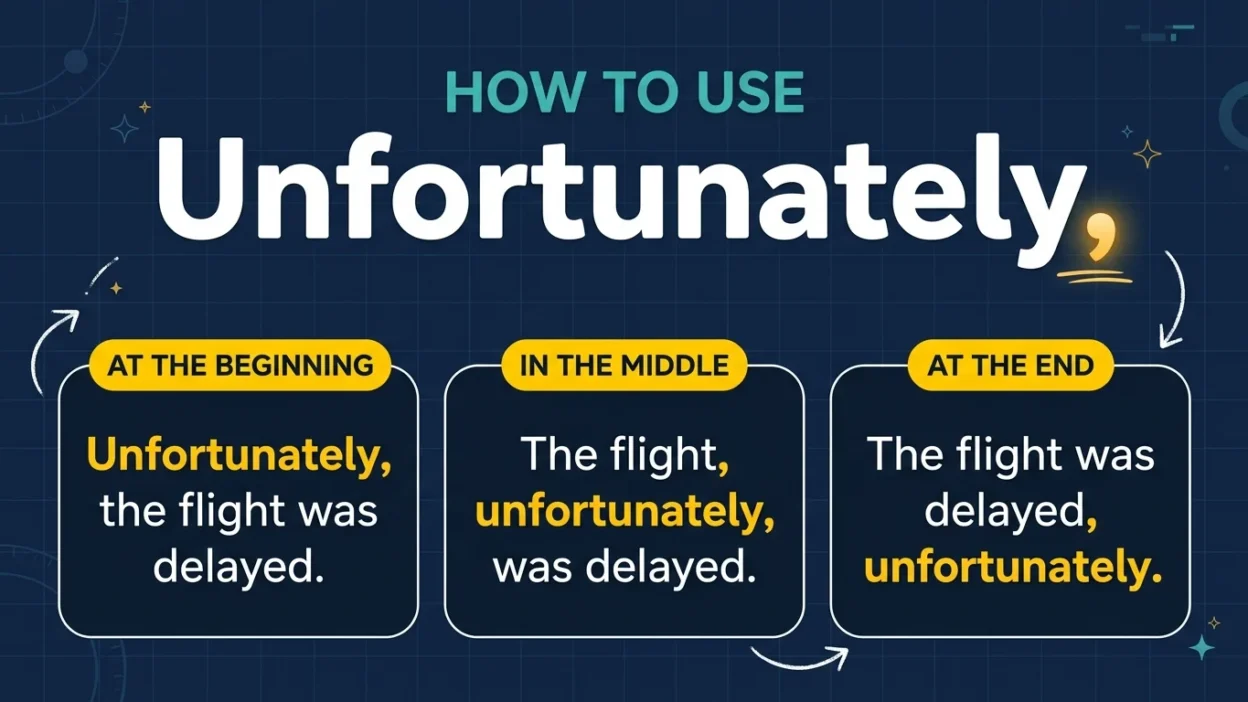
The word “unfortunately” expresses regret, disappointment, or an unpleasant fact. Knowing if to use a comma before or after “unfortunately” depends on where the word appears in a sentence and how it functions. In many cases, you need a comma after “unfortunately” when it begins a sentence. When it appears in the middle of a sentence as an interrupting comment, commas usually go on both sides. However, a comma before “unfortunately” is not always necessary, especially when the word is closely connected to the preceding clause.
Understanding these comma rules can make your writing clearer and more natural. If you are writing an email, an academic assignment, a professional message, or an everyday sentence, the right punctuation helps readers understand your meaning. This guide explains when to place a comma before or after “unfortunately,” with clear examples, common mistakes, and easy memory tips.
Quick Answer: Is There a Comma Before or After Unfortunately?
Use a comma after “unfortunately” when it begins a sentence: “Unfortunately, we missed the train.” Use commas before and after “unfortunately” when it interrupts a sentence: “The train, unfortunately, was delayed.” When “unfortunately” appears at the end, a comma before it may be appropriate depending on the sentence structure and intended emphasis.
Why Do People Confuse Commas With Unfortunately?
People often confuse this punctuation because “unfortunately” can appear at the beginning, middle, or end of a sentence. Its position affects where commas belong.
The word often acts as a sentence adverb, showing the writer’s attitude toward the entire statement. In this role, it is commonly separated from the rest of the sentence by a comma or a pair of commas.
1. When Do You Put a Comma After Unfortunately?
Use a comma after “unfortunately” when it introduces a sentence or an independent clause.
Examples:
- Unfortunately, I cannot attend the meeting.
- Unfortunately, the store is closed today.
- Unfortunately, we missed our flight.
- Unfortunately, she did not pass the exam.
- Unfortunately, the weather ruined our picnic.
In each example, “unfortunately” introduces the statement and is followed by a comma.
Rule to remember: When “unfortunately” begins a sentence as a comment on the whole statement, put a comma after it.
2. When Do You Put a Comma Before Unfortunately?
A comma before “unfortunately” is often used when the word appears at the end of a clause or sentence as an added comment.
Examples:
- We missed the train, unfortunately.
- The event was canceled, unfortunately.
- I cannot join you, unfortunately.
- The package arrived late, unfortunately.
This punctuation presents “unfortunately” as an afterthought. In some contexts, a writer may use a different sentence structure to make the meaning flow more naturally.
Compare:
- We missed the train, unfortunately. This is acceptable, with “unfortunately” added at the end.
- Unfortunately, we missed the train. This is also correct and often sounds more direct.
3. When Do You Put Commas Before and After Unfortunately?
When “unfortunately” appears in the middle of a sentence as an interrupting comment, use a comma on each side.
Examples:
- The project, unfortunately, was delayed.
- She is, unfortunately, unable to help us.
- Our team has, unfortunately, lost the final.
- The restaurant was, unfortunately, fully booked.
- The decision, unfortunately, cannot be changed.
The two commas mark “unfortunately” as an interruption that expresses the writer’s attitude.
However, punctuation can depend on the sentence’s structure and emphasis. If “unfortunately” is integrated more closely into the sentence, the punctuation may differ.
Comparison Table: Comma Before or After Unfortunately
| Position | Correct example | Punctuation rule |
|---|---|---|
| Beginning | Unfortunately, I am busy. | Comma after |
| Middle | The plan, unfortunately, failed. | Commas on both sides |
| End | I am busy, unfortunately. | Comma before |
| After a conjunction | But unfortunately, we lost. | Usually comma after “unfortunately” |
| After a semicolon | It was raining; unfortunately, we had no umbrella. | Comma after |
| Before a new independent clause | We wanted to go, but unfortunately, it was too late. | Comma before “but” and after “unfortunately” |
4. When Should You Use Each Punctuation Pattern?
Use a comma after “unfortunately”
Choose this pattern when you want to introduce disappointing news.
- Unfortunately, the deadline has passed.
- Unfortunately, no tickets are available.
Use commas around “unfortunately”
Choose this pattern when you insert the word into the middle of a sentence.
- The results, unfortunately, were disappointing.
- He has, unfortunately, decided to leave.
Use a comma before “unfortunately”
Choose this pattern when you place the word at the end as a comment.
- We cannot offer a refund, unfortunately.
- The meeting has been postponed, unfortunately.
5. More Examples of Unfortunately With Commas
Here are 12 examples showing how to punctuate “unfortunately” in different positions.
- Unfortunately, I forgot my keys.
- Unfortunately, the flight was delayed.
- Unfortunately, he was not selected.
- The application, unfortunately, was rejected.
- Our plans have, unfortunately, changed.
- The road was, unfortunately, blocked.
- I will be unable to attend, unfortunately.
- The tickets are sold out, unfortunately.
- Unfortunately, we cannot accept your request.
- The team, unfortunately, lost the match.
- She has, unfortunately, resigned from her position.
- We arrived too late, unfortunately.
Each example uses punctuation to separate “unfortunately” from the main statement when it functions as a comment.
6. Common Mistakes With Unfortunately
Mistake 1: Forgetting the comma at the beginning
Incorrect: Unfortunately we cannot help you.
Better: Unfortunately, we cannot help you.
Mistake 2: Using only one comma around a middle interruption
Incorrect: The results, unfortunately were poor.
Correct: The results, unfortunately, were poor.
Mistake 3: Adding a comma where the word is not an interruption
Incorrect: The news was unfortunately, disappointing.
Better: The news was unfortunately disappointing.
The better version can be written without commas when “unfortunately” is closely integrated into the sentence. If you want to present it as an interrupting comment, write: “The news was, unfortunately, disappointing.”
Mistake 4: Thinking the comma must always come before the word
The comma’s position depends on where “unfortunately” appears. If it begins a sentence, the comma normally follows it.
7. An Easy Memory Trick
Remember these three patterns:
- Beginning: Unfortunately, …
- Middle: …, unfortunately, …
- End: …, unfortunately.
Think of “unfortunately” as a brief comment from the writer. When it starts the sentence, place the comma after it. When it interrupts the sentence, use two commas. When it comes at the end as an afterthought, a comma usually comes before it.
8. American vs. British English
American and British English generally follow the same comma conventions for “unfortunately.” The choice of comma placement depends on sentence structure and the writer’s intended emphasis, not on a major difference between the two varieties.
For example, both styles commonly use:
- American English: Unfortunately, the event was canceled.
- British English: Unfortunately, the event was cancelled.
The spelling of “canceled” and “cancelled” differs, but the comma rule remains the same.
9. Similar Words That Follow the Same Comma Rules
Other sentence adverbs and introductory comments often use similar punctuation.
| Word | Beginning | Middle |
|---|---|---|
| Fortunately | Fortunately, we arrived early. | We, fortunately, arrived early. |
| Sadly | Sadly, he had to leave. | He, sadly, had to leave. |
| Apparently | Apparently, the store is closed. | The store, apparently, is closed. |
| Surprisingly | Surprisingly, nobody complained. | Nobody, surprisingly, complained. |
| Thankfully | Thankfully, everyone was safe. | Everyone, thankfully, was safe. |
These words can also appear at the end of a sentence, often with a comma before them when they function as an afterthought.
10. Frequently Asked Questions
Is there always a comma after unfortunately?
No, but a comma is normally used after “unfortunately” when it begins a sentence as an introductory comment. In other positions, punctuation depends on how the word functions in the sentence.
Should I put a comma before unfortunately?
Use a comma before “unfortunately” when it appears at the end as an added comment or when the sentence structure calls for it. For example: “We cannot attend, unfortunately.”
Do I need commas around unfortunately in the middle of a sentence?
Usually, yes, when “unfortunately” interrupts the sentence as a comment. For example: “The plan, unfortunately, failed.”
Is “Unfortunately I cannot come” grammatically correct?
It is understandable, but standard punctuation normally calls for a comma after the introductory word: “Unfortunately, I cannot come.”
Can unfortunately come at the end of a sentence?
Yes. For example: “The tickets are sold out, unfortunately.” The comma helps separate the final comment from the main statement.
Should there be a comma before unfortunately after “but”?
Usually, no comma is needed directly before “unfortunately” if the word follows “but” within the same clause. For example: “But unfortunately, we ran out of time.” If “but” joins two independent clauses, a comma normally comes before “but”: “We wanted to stay, but unfortunately, we had to leave.”
Is a comma before unfortunately optional?
In some sentence structures, punctuation can vary according to emphasis and how the word is integrated into the sentence. However, when “unfortunately” begins a sentence, the comma after it is the standard choice.
Remember This
The easiest way to punctuate “unfortunately” is to look at its position:
- At the beginning: Unfortunately, …
- In the middle as an interruption: …, unfortunately, …
- At the end as an afterthought: …, unfortunately.
Conclusion
The correct comma placement for “unfortunately” depends on its position and function in a sentence. Use a comma after it when it begins a sentence, commas on both sides when it interrupts the middle, and usually a comma before it when it appears at the end as an afterthought.
Once you recognize these three common patterns, punctuating “unfortunately” becomes much easier. When in doubt, read the sentence aloud and decide whether the word is introducing the statement, interrupting it, or adding a final comment.

Lucas Luke is a passionate language writer and content creator at SimileHive, specializing in similes, idioms, metaphors, and figurative language. He enjoys making complex English expressions simple, engaging, and easy to understand for students, writers, and language enthusiasts through well-researched, practical content.