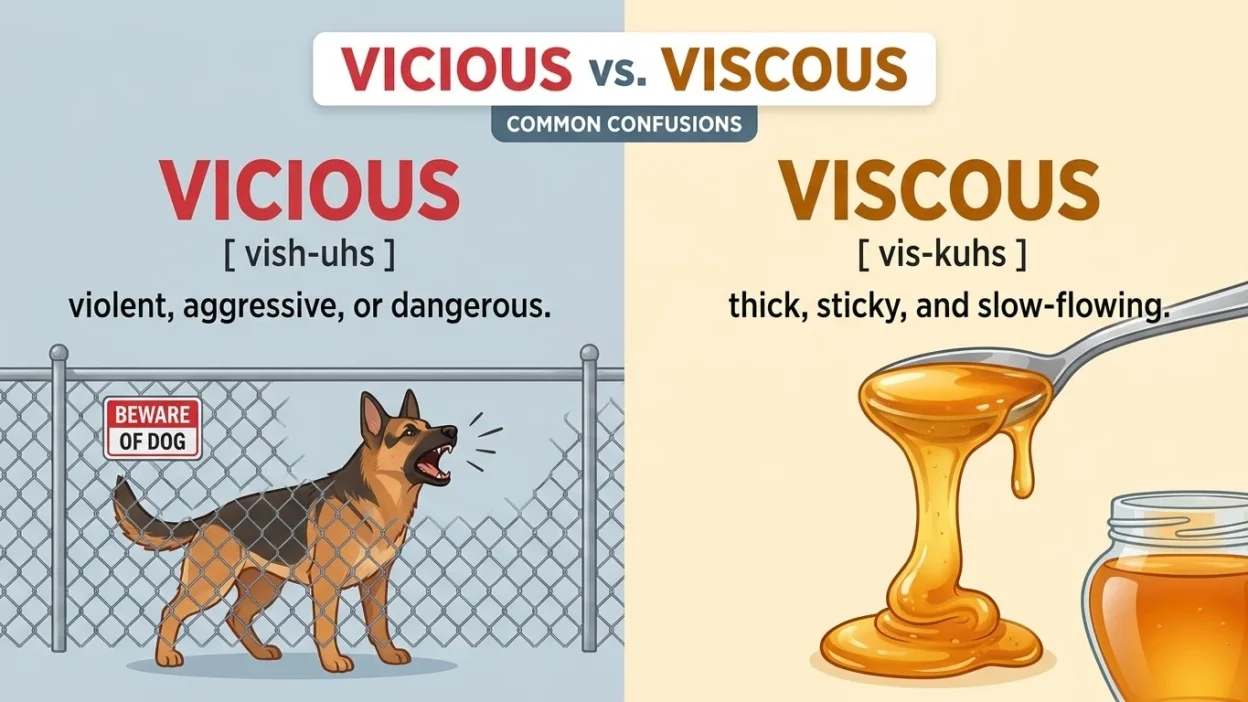
The words vicious and viscous look and sound similar, but they have very different meanings. Vicious describes someone or something cruel, violent, or deliberately harmful. Viscous describes a thick, sticky liquid that flows slowly, such as honey, syrup, or motor oil. Choosing the correct word matters because confusing them can change the meaning of a sentence completely.
For example, a vicious dog may attack someone, while a viscous liquid may cling to a spoon. Both words can describe something unpleasant in certain situations, but they are not interchangeable. Understanding their definitions, pronunciation, and common uses will help you avoid mistakes in writing and everyday conversation.
If you are learning English, improving your vocabulary, or checking which word fits a particular sentence, this guide explains the difference between vicious and viscous with simple definitions, practical examples, and easy memory tricks.
Quick Answer: What Is the Difference Between Vicious and Viscous?
Vicious means cruel, aggressive, violent, or harmful. Viscous means thick and resistant to flowing easily. A vicious animal may attack someone, while a viscous liquid, such as honey, moves slowly because of its thickness. Remember that vicious describes harmful behavior or effects, whereas viscous usually describes the physical properties of a fluid.
Why Do People Confuse Vicious and Viscous?
People often confuse vicious and viscous because the words have similar spellings and share several sounds. Both begin with “vi” and contain the letters “c” and “s.” However, their meanings belong to different categories.
- Vicious is associated with cruelty, aggression, hostility, and harm.
- Viscous is associated with thickness, stickiness, and resistance to flow.
Their pronunciations are also slightly different. Vicious is commonly pronounced VISH-us, while viscous is commonly pronounced VIS-kus.
1. What Does Vicious Mean?
Vicious is an adjective that describes someone or something cruel, violent, aggressive, or intended to cause harm. It can refer to people, animals, attacks, criticism, rumors, and cycles of harmful behavior.
Examples of vicious in a sentence
- The vicious dog chased the cyclist down the street.
- She received a vicious message from an angry stranger.
- The politician faced vicious criticism after the announcement.
- A vicious storm damaged several buildings.
- The two rivals exchanged vicious insults.
- The article contained a vicious personal attack.
- The animal became vicious when it felt threatened.
- They were trapped in a vicious cycle of debt and stress.
Common expressions with vicious
Vicious attack: An extremely aggressive or cruel attack.
Example: The journalist received a vicious attack online.
Vicious rumor: A harmful rumor intended to damage someone’s reputation.
Example: A vicious rumor spread throughout the school.
Vicious cycle: A repeating pattern in which one problem causes another, making the original problem worse.
Example: Lack of sleep can create a vicious cycle of fatigue and poor concentration.
Vicious circle: Another common expression for a vicious cycle.
2. What Does Viscous Mean?
Viscous is an adjective used mainly in science and everyday descriptions of liquids. It describes a fluid that resists flowing because of its viscosity. In simple terms, a viscous liquid is relatively thick and often flows slowly.
Honey, syrup, and some oils are common examples of viscous liquids. Water has much lower viscosity than honey, so it generally flows more easily.
Examples of viscous in a sentence
- Honey is more viscous than water.
- The viscous syrup slowly dripped from the spoon.
- The machine requires oil with the correct viscosity.
- The thick, viscous liquid coated the inside of the container.
- The sauce became more viscous as it cooled.
- Scientists measured how viscous the fluid was.
- The viscous substance took several minutes to drain.
- Some industrial processes require highly viscous materials.
Common expressions with viscous
Viscous liquid: A liquid that resists flowing easily.
Example: The laboratory technician poured the viscous liquid carefully.
Viscous fluid: A fluid with viscosity, a property that measures resistance to flow.
Example: The engineer studied how the viscous fluid moved through the pipe.
Highly viscous: Very resistant to flow.
Example: The highly viscous paste was difficult to spread.
Vicious vs. Viscous: Comparison Table
| Feature | Vicious | Viscous |
|---|---|---|
| Part of speech | Adjective | Adjective |
| Main meaning | Cruel, violent, or harmful | Thick and resistant to flow |
| Common context | Behavior, attacks, criticism, harmful patterns | Liquids, fluids, oils, syrups |
| Pronunciation | VISH-us | VIS-kus |
| Example | The vicious dog barked aggressively. | The viscous honey flowed slowly. |
| Related noun | Viciousness | Viscosity |
When Should You Use Vicious or Viscous?
Use vicious when you describe cruelty, aggression, hostility, or something harmful.
- A vicious attack
- A vicious argument
- Vicious criticism
- A vicious animal
- A vicious cycle
Use viscous when you describe the flow properties of a liquid or fluid.
- Viscous honey
- Viscous oil
- A viscous solution
- A viscous fluid
- A highly viscous substance
A simple test can help: if you are describing cruelty or harm, choose vicious. If you are describing a liquid’s thickness or resistance to flow, choose viscous.
12 Examples of Vicious vs. Viscous in Sentences
- Vicious: The vicious dog frightened everyone in the park.
- Viscous: The viscous honey slowly slid down the jar.
- Vicious: He made a vicious comment about his colleague.
- Viscous: The viscous oil was difficult to pour in cold weather.
- Vicious: The online discussion turned into a vicious argument.
- Viscous: The chef added water to thin the viscous sauce.
- Vicious: The newspaper published a vicious personal attack.
- Viscous: The scientist examined the viscous liquid under controlled conditions.
- Vicious: The company faced a vicious campaign of false rumors.
- Viscous: The viscous gel spread slowly across the surface.
- Vicious: The two competitors engaged in a vicious rivalry.
- Viscous: The industrial pump was designed to handle viscous fluids.
Common Mistakes With Vicious and Viscous
Mistake 1: Using vicious to describe a thick liquid
Incorrect: The vicious honey stuck to the spoon.
Correct: The viscous honey stuck to the spoon.
Why? The sentence describes the honey’s thickness and flow, not cruelty.
Mistake 2: Using viscous to describe cruel behavior
Incorrect: He made a viscous remark about her appearance.
Correct: He made a vicious remark about her appearance.
Why? The remark is cruel or hurtful, so vicious is the correct word.
Mistake 3: Confusing viscosity with viciousness
Viscosity refers to a fluid’s resistance to flow. Viciousness refers to cruelty, aggression, or harmful behavior.
Example: The liquid’s viscosity made it flow slowly, while the man’s viciousness made him feared by others.
Mistake 4: Assuming the words are interchangeable
Although vicious and viscous look similar, they cannot normally replace each other. Always choose the word that matches the intended meaning.
An Easy Memory Trick
Use these simple associations to remember the difference:
Vicious = violence.
Both words begin with a “v” sound, and vicious can describe violent or cruel behavior.
Viscous = viscosity.
Viscosity is the scientific term for a fluid’s resistance to flow. A viscous liquid, such as honey, flows more slowly than water under comparable conditions.
Remember: a vicious person may hurt someone, while a viscous liquid may stick to a spoon.
American vs. British English
There is no meaningful difference in the spelling or core meaning of vicious and viscous between American and British English. Both varieties use vicious for cruelty or aggression and viscous for fluids that resist flowing easily.
Examples in both varieties include:
- The vicious attack shocked the public.
- Honey is a viscous liquid.
The words are spelled the same in both varieties, so the distinction is about meaning rather than regional spelling.
Similar Words to Know
| Word | Meaning | Example |
|---|---|---|
| Cruel | Causing pain or suffering without concern | His cruel words upset her. |
| Aggressive | Ready to attack or confront | The aggressive dog growled. |
| Hostile | Unfriendly or antagonistic | They received a hostile response. |
| Thick | Not thin or watery | The soup is thick. |
| Sticky | Tending to adhere to surfaces | The sticky syrup covered the table. |
| Viscosity | A fluid’s resistance to flow | Temperature can affect viscosity. |
These words may be related to vicious or viscous, but they do not all mean the same thing. For example, a liquid can be thick or sticky without every context requiring the technical word viscous.
Frequently Asked Questions
Is it vicious or viscous liquid?
Use viscous liquid. The word viscous describes a liquid that resists flowing easily, such as honey or thick oil.
Does vicious mean thick?
No. Vicious generally means cruel, aggressive, violent, or harmful. Viscous is the word that describes a fluid’s resistance to flow.
What is the meaning of viscous in simple English?
Viscous means thick and slow-flowing. Honey is a familiar example of a viscous liquid because it flows more slowly than water.
What is the meaning of vicious in simple English?
Vicious means cruel, violent, or deliberately hurtful. For example, a vicious attack is an extremely aggressive or harmful attack.
How do you pronounce vicious and viscous?
Vicious is commonly pronounced VISH-us. Viscous is commonly pronounced VIS-kus. The middle sounds help distinguish the two words.
Is honey vicious or viscous?
Honey is viscous because it is relatively thick and flows slowly. It is not described as vicious unless the word is being used in an unusual figurative context.
What is the noun form of viscous?
The noun form is viscosity, which describes a fluid’s resistance to flow. For example, honey has a higher viscosity than water under comparable conditions.
Can vicious describe a cycle?
Yes. A vicious cycle is a repeating pattern in which problems reinforce one another and make the situation worse.
Remember This
- Vicious describes cruelty, violence, aggression, or harmful behavior.
- Viscous describes a liquid or fluid that resists flowing easily.
- A vicious attack is harmful.
- Viscous honey is thick and slow-flowing.
- Viscosity is the property that explains how readily a fluid flows.
Conclusion
Vicious and viscous are easy to confuse because their spellings are similar, but their meanings are quite different. Vicious describes cruel, aggressive, or harmful behavior, while viscous describes the thickness and flow properties of a fluid. Learning the distinction will help you choose the correct word in everyday writing, professional communication, and scientific contexts.
The easiest way to remember the difference is to connect vicious with violence and viscous with viscosity. If you are describing an attack, a cruel comment, or a harmful cycle, use vicious. If you are describing honey, oil, syrup, or another slow-flowing liquid, use viscous.

Charles Kevin is a passionate language writer and researcher at SimileHive, creating clear, engaging content about similes, idioms, metaphors, and figurative language to help readers improve English communication confidently every day.